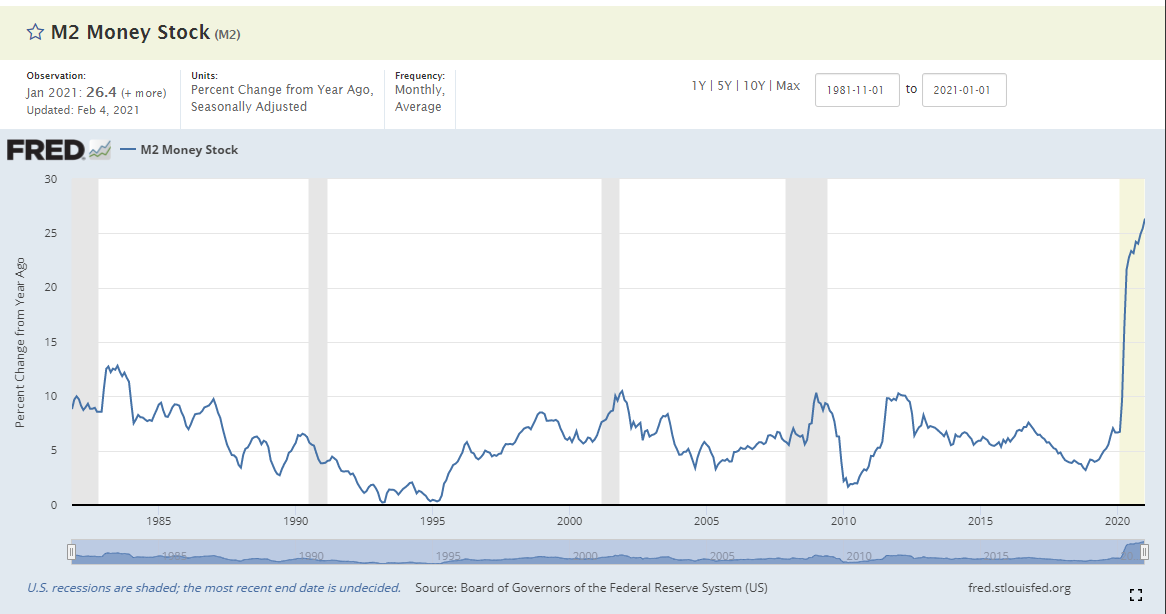
Love this kid and his refreshing dose of common sense in a world of panic buying and creation of “fake scarcity” with too much money driving asset prices, and now prices of goods and services. Maybe he, like I, is just not woke enough to the miracles of Modern Monetary Theory.
Inflation Path
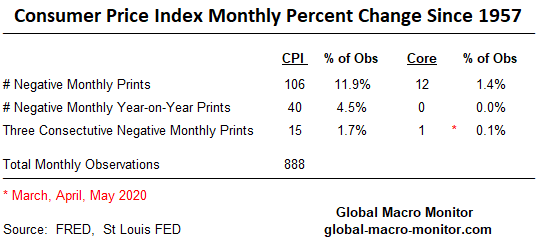
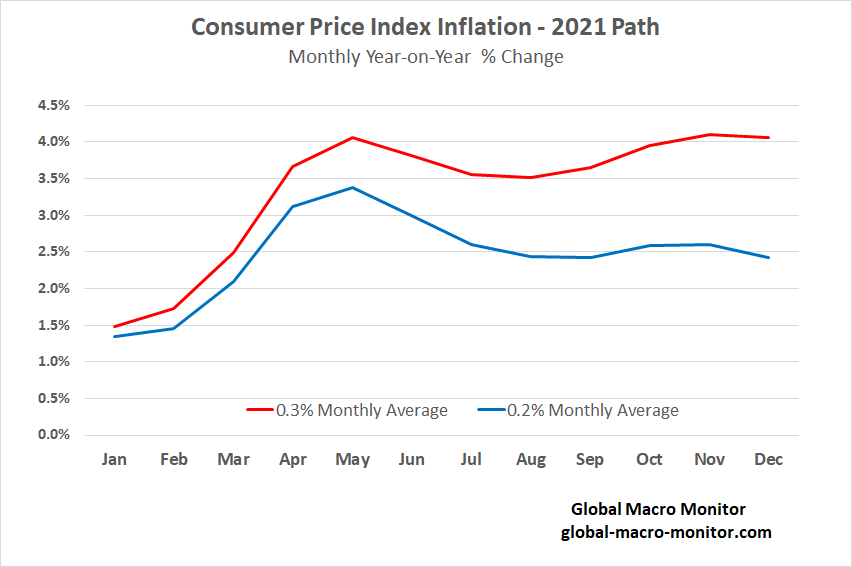
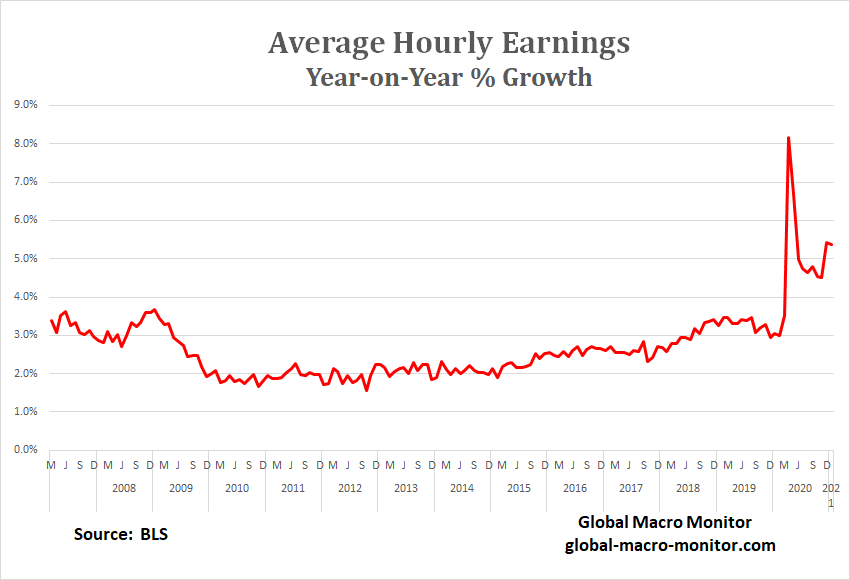
I am fairly confident, 80 percent probability, year-on-year CPI prints above 4 percent in May, and believe there is a much higher probability than markets are pricing that a 5 percent CPI prints sometime this year.

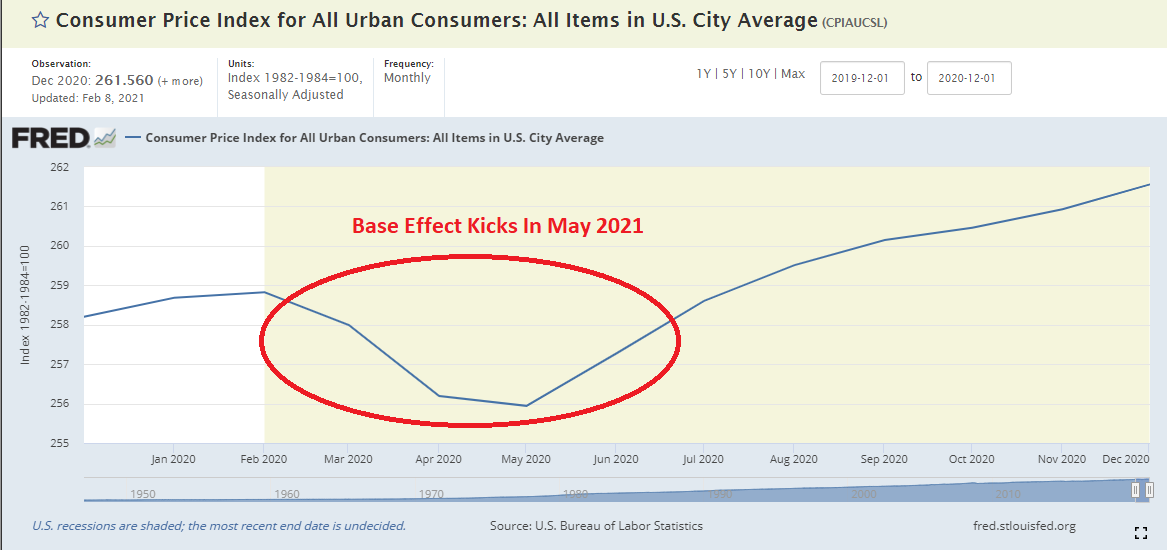
Base effect? Yes, partially, for the next few months. Transitory? Only if money supply growth falls dramatically but can it without asset markets collapsing?
At the market close on Friday, we estimate the U.S. stock market cap hit 200 percent of GDP, which is 40 percent higher than the dot.com peak. That is a 40 percent higher valuation folks, not levels.
Creating Fake Scarcity In A Land Of Plenty
Recall our post last July, The Ultimate Scarcity Asset,
GaveKal reminds us why assets typically have value.
- They can be rare—gold bars, diamonds, houses on Victoria Peak, bottles of 1982 Pétrus, Van Gogh paintings, or
- They can generate cash flows over time
We have been writing for years how the supply-side (relative shortages) has been increasingly driving financial asset values.
Also, run, don’t walk to our donut shop analogy. – GMM, July 2020
Market Anarchy
Markets have become what hedge fund manager, David Einhorn, calls quasi-anarchic, and on the verge of “breaking completely.” We just call it what it is, unhinged and morphing into a complete farce.
Someone pointed us to Hometown International (HWIN), which owns a single deli in rural New Jersey. The deli had $21,772 in sales in 2019 and only $13,976 in 2020, as it was closed due to COVID from March to September. HWIN reached a market cap of $113 million on February 8.
The largest shareholder is also the CEO/CFO/Treasurer and a Director, who also happens to be the wrestling coach of the high school next door to the deli. The pastrami must be amazing. Small investors who get sucked into these situations are likely to be harmed eventually, yet the regulators – who are supposed to be protecting investors – appear to be neither present nor curious. From a traditional perspective, the market is fractured and possibly in the process of breaking completely. – Greenlight Capital Letter To Investors
Ya’ know that one deli in Jersey is scarce, they are not making another one.
My Boston Buddy’s Kid
My buddy, a fund manager from Boston conveyed to me today his teenage kid believes he is a genius Dogecoin trader using his Robin Hood account. He wanted to borrow money from his parents to buy more. He’s made $800 on a $500 investment.
To wit, I sing,
How much is that Dogecoin in the window worth?
The one chasing Elon’s tail
How much is that Dogecoin in the window worth?
We do hope that Dogecoin will sail [to the moon]

What could ever go wrong? As an old trader, I get the trade but I have seen this movie many times. It doesn’t end well.
Sorry for the rant, CK, I do love you mostest.