
This a must view video, folks, if you really want to understand what ails and divides America politically, and why Trump’s base sticks with him.
I had a great discussion today with Carol K., GMM’s crack stock picker about what is it that really divides America. Not only is she financially astute but a pretty damn good political scientist.
Much what she said sounded exactly like the Harvard professor I heard early in the day in an interview with CNN’s Michael Smerconish.
Harvard professor Michael Sandel discusses his theory that credentialism is the last acceptable form of prejudice in today’s society, and how that relates to President Trump’s political rise. – CNN
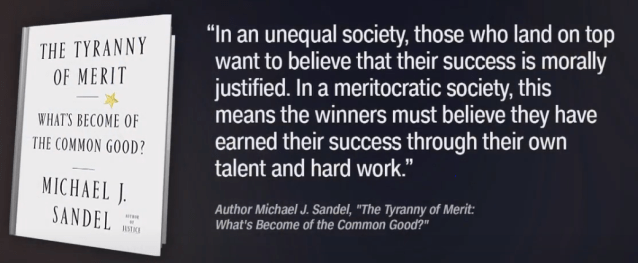
Working-Class Resentment And Meritocratic Hubris
In a nutshell, it is resentment by many of America’s working-class that the “elites” are looking down on them, and that elites have a “meritocratic hubris” that their success is their own doing, and by implication, those who have fallen behind must deserve their fate as well. Carol also nailed why many of the elites, who believe they deserve and have earned what they have, resent, say minorities or women, who are encroaching on their space or their income through taxation, for example.
We have talked a lot about the “Lucky Sperm Club”(LSC) at GMM over the years.
LSC
If not for our membership in the Lucky Sperm Club (LSC), that could be you or I out on the street. The LSC does not mean just belonging to a billionaire family, but being born into a decent family with decent parents with the means of providing us with a decent education. We could just as easy been born a crack baby in Harlem, folks. Being born in America makes you part of the LSC.
Thank goodness we are the right side of randomness. Fat tails, indeed. – GMM, Nov ’18
If you are reading this post, you are part of the LSC, by the way.
Only until we understand a life of Grace – unmerited favor –can we really begin to heal this great country, which is in the midst of a slow-motion catastrophic train wreck, threatening its very existence.
Listen to the whole interview before firing off the snarky emails about hard work and making your own destiny…yada yada yada.
Money Quotes From The Interview
QOTD: Quote of the Day
This quote is always in the back of my mind, especially when volatility kicks up in an overvalued and what has been a one-way market as the “newbie geniuses” begin to mock investing legends, such as Warren Buffet as “dinosaurs.”
The newbies are almost always the last to the party and a contrarian signal of a market top. As we say, “know they marginal buyer.” The only thing we find interesting for the back book is stocks, with growing and sustainable dividends.
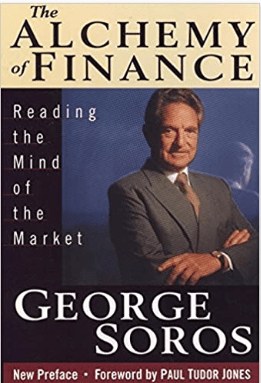
Short term volatility is greatest at turning points and diminishes as a trend becomes established. By the time all the participants have adjusted, the rules of the game will change again. – George Soros
When Art Cashin speaks, we listen. He is the best in the business and such a great man. If you are going to listen to any of the market pundits, Art is your guy. So great to see him back.
Here’s a little taste of “fine Art” from earlier today as he opines on the current state of the momentum market.
These charts are hard to take. Have you ever seen such dead money investments?
Here’s to hoping that if Jamie Dimon becomes Secretary of Treasury in a Biden Administration — a huge stretch given the rising power of the Democratic left — he never allows negative interest rate policy NIRP (yes, we get it, it’s theoretically the Fed’s job).
Look what NIRP has wrought, or should we say rot in Europe.

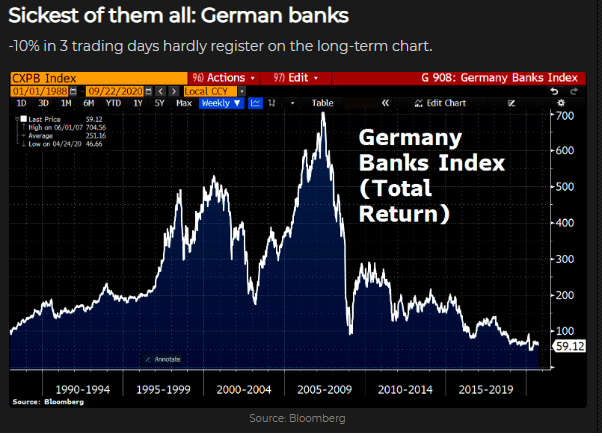
Source: The Market Ear
Summary
Interesting data on which industrial sectors are winning during the Great Lockdown. The data are from last week’s Industrial Production release from the Federal Reserve Board.
Clearly, there has been a strong bounce from the March and April collapse, which has slowed markedly last month, and thus rules out a V-shaped recovery. The next 5-10 percent to get back to even will be much harder.


Source: Custer Consulting Group
“…there is always inequity in life. Some men are killed in a war and some men are wounded, and some men never leave the country, and some men are stationed in the Antarctic and some are stationed in San Francisco. It’s very hard in the military or personal life to assure complete equality. Life is unfair.” –“President’s News Conference of March 21, 1962 (107),” Public Papers of the Presidents: John F. Kennedy, 1962.
We originally posted the following in October 2018 after President Trump threw Montenegro, then the newest member of NATO under the bus a few months earlier.
We suspected POTUS’ loose lips would someday sink ships, at least metaphorically, if not literally.

The flapping of his jaws back in July 2018, we believe, triggered the geopolitical dynamics, sending a signal to Moscow and Beijing that the U.S. was not committed to its allies and we now find ourselves on the verge of a geopolitical hurricane.
As if the market didn’t have enough on its plate dealing with its extreme overvaluation and the current American political shit show.
Posted on October 21, 2018 by macromon
We posted the following in July after President Trump threw Montenegro under the bus.
Taiwan may be about to get hot, hot, hot in the next year after last night’s Commander in Chief’s ambiguous message on defense treaties. – GMM
One of GMM‘s most excellent followers, who we very much like and respect, responded with this:
This whole article is a science-fiction of oh, this could happen, and oh that could happen…. And we could be hit with an asteroid tomorrow. Just sit back and watch the hands that are dealt and how they are played. This article is either Sci-fi or false news. Your choice!
Montenegro
By the way, in case your wondering about Montenegro? It didn’t take a Ph.D. in international relations to figure out Trump’s interview with Fox would lather up Putin and wasn’t difficult to anticipate the outcome.
In an interview with Fox’s Tucker Carlson last night, President Trump seemed to question the raison d’être of NATO and foreign alliances in general.
Tucker Carlson: So membership in NATO obligates the members to defend any member that is attacked. So let’s say Montenegro, who joined last year, is attacked, why should my son go to Montenegro to defend it from attack?
President Trump: I understand what you are saying. I have asked the same question. You know Montenegro is a tiny country with very strong people… They may get aggressive, and congratulations you are in World War III…But that is the way it was set up, don’t forget I just got here. – The Day “Strategic Ambiguity” Died. GMM July ’18
Are you then surprised at the following?
A recent parliamentary election in Montenegro may have attracted little notice outside the country, but it will have outsized repercussions for the international order. Strongman President Milo Djukanovic has been in power for nearly 30 years at the helm of his pro-Western Democratic Party of Socialists, which lost its bid for reelection in the Aug. 30 vote, although Djukanovic will stay president until 2023. Taking the Democratic Party of Socialists’ place is a pro-Russian and pro-Serbian-led alliance, which has given Moscow an ally not just within NATO, but potentially within the European Union. It’s high time the EU wakes up and does something to stem Russian President Vladimir Putin’s creeping influence in the Balkans.
The newly formed coalition of opposition parties set to lead the small Balkan state have notionally agreed to continue Djukanovic’s pro-Western tilt, but that is unlikely to stop the festivities in the Kremlin. After all, the new coalition’s first goal, according to one of its leaders, is to lift the country’s sanctions on Russia. And although much of the Montenegrin public may be cheering the end of Djukanovic’s autocratic rule, the happiness is likely to be short-lived. Their small nation is just the latest Balkan domino to fall toward Moscow. – Foreign Policy, Sept 17th
Context From Trump’s Former National Security Advisor
Here is some excellent context from General H.R. McMaster in tonight’s 60 Minutes interview as to what is driving the increasing global geopolitical instability. McMaster is now teaching at Stanford. It’s well worth your time.

Click here to view the video
Wonder what our dear reader is thinking now?

 Global Macro Monitor