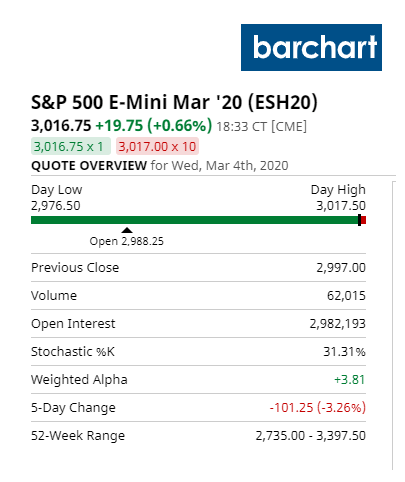
The contract has moved in almost a 100 point range or 3.5 percent in the 90 minutes it has been trading.
The market is very oversold and a bounce is natural. We believe the S&P500 moves lower over the next few months, however, until we get a better handle on the coronavirus crisis.
We seriously doubt it and the Fed is going to have to step-up big time with QE, non-QE, or let’s just call it for what it is, monetization.
These yields are distorted and not true market rates, and now have become Airbnb rentals driven by haven flows, the MoMo crowd and ‘bots, and a proxy for stock shorts.
Long-term investors? Think rent control distortions. We will be closely monitoring the monthly auctions for real demand.
One branch of the federal government tells us to buy the dip as the coronavirus is contained and is a hoax hyped by the Democrats while another branch is considering measures to protect itself, including shutting down. Not exactly a positive to turn market sentiment.
BREAKING from me & @AlexNBCNews : Members of Congress are becoming increasingly anxious about coronavirus and there is growing pressure on leadership to take steps to protect lawmakers — even potentially recessing for a period of weeks, according to two Democratic sources
Everybody panic! It’s just like the Titanic but its full of bears! – Jackie Moon
The global markets are having their first real Jackie Moon moment of this downturn. We suspect many more to come.
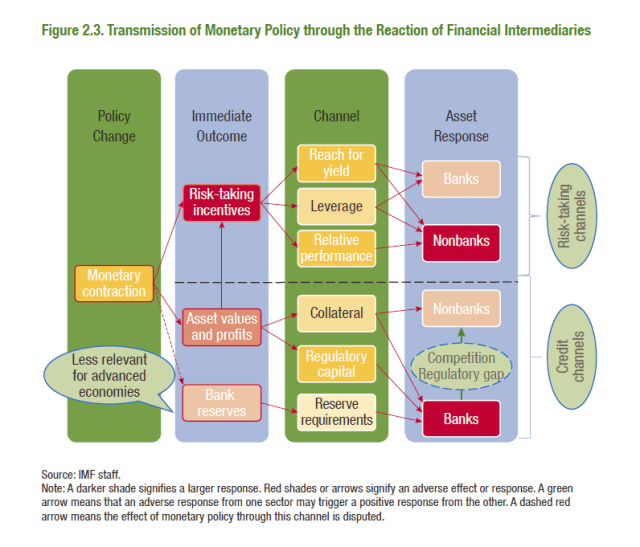
What happens when they realize that the monetary policy transmission mechanism to stocks has mainly been a placebo effect? Monetary policy is much more of a black box than the market geniuses realize, in our opinion.
Will the Fed follow the Bank of Japan and start making outright purchases of stocks to prop up the market?
Analysts and investors in Tokyo have begun to question whether the programme, started in 2010 as a way to prop up the market in the wake of the financial crisis, still serves much purpose. The central bank now owns 80 percent of the domestic exchange-traded fund market, fanning fears that its grip over prices has become too strong. – FT, Nov ’19
Here are a few clues and a potential roadmap,
“We should allow the central bank to purchase a broader range of securities or assets,” Rosengren [FRB Boston president] said in a speech Friday in New York. “Such a policy, however, would require a change in the Federal Reserve Act.”
U.S. law currently limits Fed purchases to “any obligation which is a direct obligation of, or fully guaranteed as to principal and interest by, any agency of the United States.” That translates to buying U.S. government and agency debt and mortgages issued by federal housing agencies.
The Fed has traditionally maintained a strong internal resistance to expanding its purchases beyond Treasury securities because such activities are essentially credit allocation and leave the central bank vulnerable to criticism of favoritism if it’s investing in the bonds or stocks of specific companies.
“New deal progressives are not going to tolerate this unless the unemployment rate has risen sharply,” said Mark Spindel, a co-author of a book about Congress and the Fed. — Bloomberg, March 6th
Top 10 percent Own 88 percent of Corporate Equities
Good luck changing the Federal Reserve Act in the current populist moment that we find ourselves. Remember, folks, 88.1 percent of all corporate equities and mutual funds are held by just the Top 10 percent of households.
Nikkei’s Gruesome 30-year Bear Market
By the way, even with the Bank of Japan’s direct intervention in the stock market, 20 years of zero interest rates, massive fiscal stimulus, and quantitative easing, the Nikkei is still 50 percent below its December 29, 1989 high.
I went on to explain, yes, he was partially right, COVID-19 is a type of the flu, but a new or novel flu, which probably originated from animals and the human body has yet to build up immunities to help fight it off, unlike the seasonal flu. Still many unknowns about this corona beast now infecting the world.
Exponential Growth
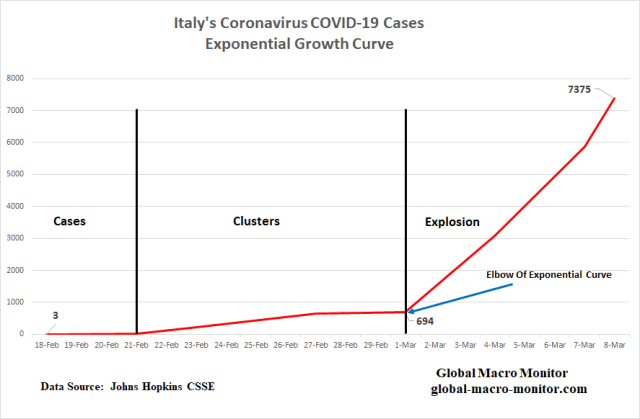
What struck me most was that he, like many of us have difficulty grasping the concept of exponential growth in a real-world context beyond finance. I shared with him what is happening in Italy, which had only 3 reported cases less than three weeks ago to now 7,335 cases as of March 8th. Of course, it is difficult to unpack the true growth of transmission and distinguish it from the ramping up of testing and counting.
We suspect the numbers will look much higher as governments begin and ramp up testing, which almost surely is and will be the case in the United States.
Elbow Of The Curve
COVID-19 starts with a few cases, morphs into clusters before moving beyond the elbow of the curve to an explosion of cases. We both agreed there is so much we don’t know, such as how many people in our area are currently infected, and that we will survive and get through this crisis.
By the way, he is first-generation Italian.
Dow futures are down 900 points and April crude oil is down over 20 percent and printed at $30 bbl., stunning.
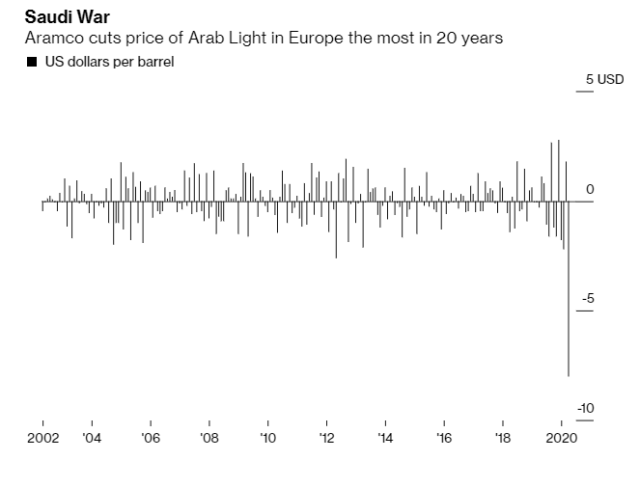
The Saudi-Russian Oil War is going to set the deflationistas hair on fire. What is wrong with the relative price of oil collapsing?
A big flop in the price of a headline commodity almost always brings out a deflation panic. We have yet to see any sustained general deflation in our lifetime, however.
Yes, the price of big-screen televisions is tanking but rents and health care are screaming higher. Furthermore, we have a strong conviction that the price inflation is under measured. Please, folks, don’t mix relative price moves with deflation, where the general level of prices is falling over a sustained period.
It does seem the Fed, and, for sure, the market geniuses define deflation as falling stock prices, which is one of the very reasons they find themselves in the current unpleasant situation. The central bank can’t even attempt to close the oven door due to fears the Japanese soufflé pancake will collapse.
Politics Of Falling Crude Prices
The fall in the price of oil is a very similar dynamic of the trade-off between the winners and losers of international trade. More than 225 million American automobile drivers will benefit from the drop in price but the roughnecks and real estate speculators in, say, Midland, Texas are going to get hurt bad.
Should the U.S. government then implement policies to prop up oil prices to protect oil and gas mining jobs, which total only around 157K? By now, I think you know our view.
Nevertheless, it depends on the political strength of domestic oil producers.
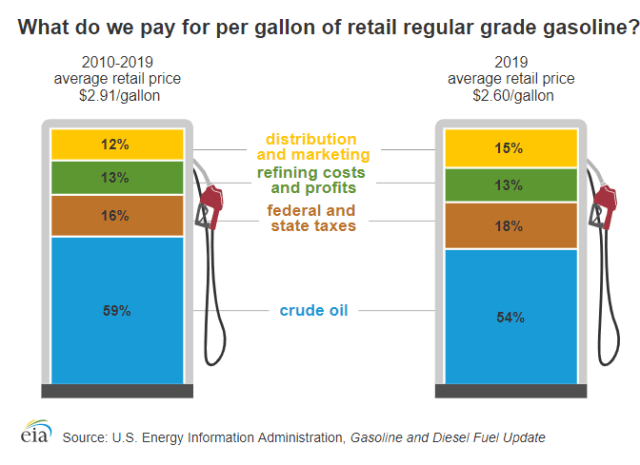
In 2019, about 142.23 billion gallons (or about 3.39 billion barrels1) of finished motor gasoline were consumed in the United States, an average of about 389.68 million gallons (or about 9.28 million barrels) per day. – EIA
For every $.25 drop in the price of gas as a result of the crude price flop, domestic consumers are set to save about $100 million per day. A nice tax cut, indeed.
Saudi Arabia plans to increase oil output next month, going well above 10 million barrels a day, as the kingdom responds aggressively to the collapse of its OPEC+ alliance with Russia.
…“This is going to get nasty,” said Doug King, a hedge fund investor who co-founded the Merchant Commodity Fund. “OPEC+ is going to pump more, and the world is facing a demand shock. $30 oil is possible.”
Oil traders are looking to historical charts for an indication of how low prices could go. One potential target is $27.10 a barrel, reached in 2016 during the last price war. But some believe the market could go even lower.
“We’re likely to see the lowest oil prices of the last 20 years in the next quarter,” said Roger Diwan, an oil analyst at consultant IHS Markit Ltd. and a veteran OPEC watcher, implying that the price could fall below $20 a barrel. — Bloomberg
It just ain’t so, Joe, as our M.O. is to try and panic before everyone else.
What will be the big negative shock that shakes the tree loose? Your guess is as good as ours but it shall come. – GMM, Nov 25, 2019
The stock market was a bubble in search of a pin. The coronavirus was that pin.
Moreover, GMM was out with one of the first analyses of the impact of coronavirus on the global economy in late January when most still thought it was a yuppie beer from Mexico.
There is a supply shock to global manufacturing as many factories in the world’s supply chain will be shuttered for longer, which shifts the global supply curve left, increasing-price and production pressures. Ergo component shortages, higher prices, and lower production.
The 2 percent decline in the U.S. stock market and collapse in bond yields are signaling a potential global aggregate demand shock that offsets inflationary pressures of the supply shock. – GMM, Jan 31st
Do The Math
We suggest those in denial and still can’t grasp exponential growth read the following thread — 8 million cases in the U.S. by the end of May? Double yikes!
Where do you think the S&P will be if that happens, which could move us from the current state of denial to peak fear?
I think most people aren’t aware of the risk of systemic healthcare failure due to #COVID19 because they simply haven’t run the numbers yet. Let’s talk math. 1/n
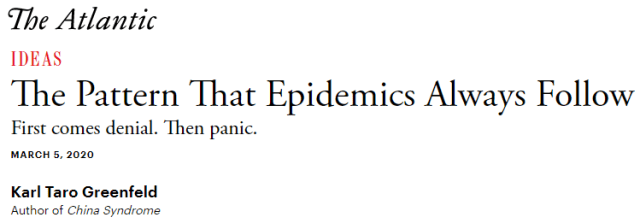
We also suggest you have a quick read of the following Atlantic article, which keeps the current crisis in perspective. We have pulled out the money quotes for you.
Whenever a new microbial killer emerges, we go through each of these stages, starting with denial as government officials insist that there is no outbreak. When smallpox appeared in the Roman Empire in a.d. 189, one local prefect attributed the upsurge in deaths to a displeased Jupiter, while another assigned blame to a poisoned barrel of wine.
…denial led to panic. Denial always leads to panic.
…With an outbreak like COVID-19, everything from the source, to the means of transmission, to recovery rates remains essentially unknown. So each new piece of information—even data that should be reassuring, like the downward revision of mortality rates—elicits more panic.
...“A pestilence isn’t a thing made to man’s measure,” Albert Camus observed in The Plague. “Therefore we tell ourselves that pestilence is a mere bogey of the mind, a bad dream that will pass away.” Panic is exhausting. Only so many witches can be tossed into wells or rolls of toilet paper hoarded before knee-jerk anxiety progresses to a steady state of fear.
...Fear dissipates eventually, replaced by a more realistic sense of the risks. An epidemic, even one of a disease as seemingly easy to transmit as COVID-19, while burdening public-health systems and potentially deadly for the elderly and those with compromised immune systems, is eminently survivable by the majority of the population.
…Which brings us to the last stage of epidemic grief: rational response. After denial, panic, and fear, we can finally get down to the business of basic sanitary measures and infection protocols.
...If you want to panic, go right ahead. It’s what we do. It’s what your ancestors did. Then be afraid. Eventually, however, roll up your sleeves and get to work, scrubbing this bug back to whatever its host species happens to be. We’ll get there. Humanity has so far survived every microbe that has jumped the species barrier, and we will survive this one. – Atlantic
Finally, Chris Martenson has been all over and right about the coronavirus since Day One. We can learn from anybody and don’t engage in the ad hominem attacks to discredit his work just because many accuse him of being a doomster and prepper. Those who were mocking him last week are probably out shopping and hoarding toilet paper as we write.
Even his latest video from a few days prior is outdated. That is what exponential growth does, folks. The data moves at a lightning-fast speed.
“The United States is going to have a lot of self-inflicted wounds. – Chris Martenson”
As the Atlantic piece concludes, we — well most of us — will survive this. Not before some very dark days and much lower stock prices, in our opinion.
It feels like the country is right at the tipping point of full blown panic.
Closer to home,
Keysight Technologies, the county’s third-largest employer with about 1,500 workers, Thursday said it was closing indefinitely its Santa Rosa campus over worries one of its employees may have been exposed to coronavirus. – Press Democrat
And this,
Sutter Santa Rosa Regional Hospital issued quarantine orders to at least 30 of its hospital workers who came in contact with a patient with coronavirus, according to the union representing most front-line hospital staff. – Press Democrat
Yet we get this, the mentality and antics of a third grader as many Americans are forced to contemplate life with mass school closures,
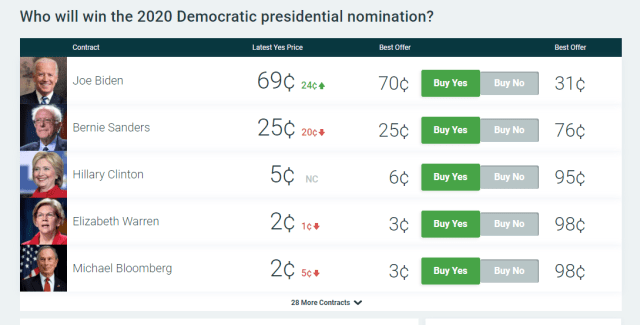
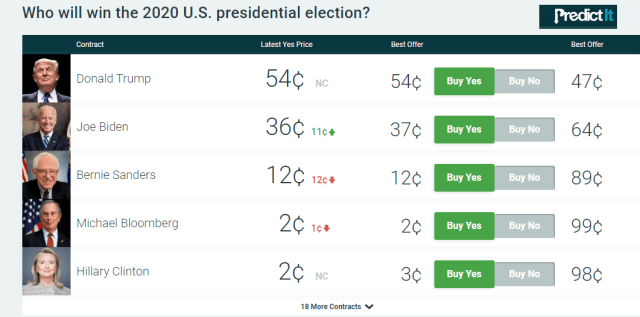
Stunning moves in the prediction market on who will be at the top of the Ticket in November. Joe Biden, who was running behind Bernie at the time of our post last night has rocketed ahead to a 70 percent probability. Amazing.
Politics, like the current markets, is all about momentum. The S&P futures are showing some pep after opening down almost 1 percent in overnight trading. It may be the result of the political polls and it may not.
Still, no move in President Trump’s probability of being reelected, however, which remains slightly above 50 percent




 Global Macro Monitor