If Facts Mattered…….

The just-released phone logs in the House Intel report would be a nuclear bombshell and could potentially take down a government.   Unless, of course, Rudy is working on a balanced budget amendment with the OMB.

Phone Records

Democracy cannot survive if facts don’t matter.  The pols may start repeating propaganda and conspiracies propagated by America’s foreign adversaries.  Wait….

Poltical Spectrum

Posted in Uncategorized | Leave a comment

American Democracy In A Bear Market

Democracy.png

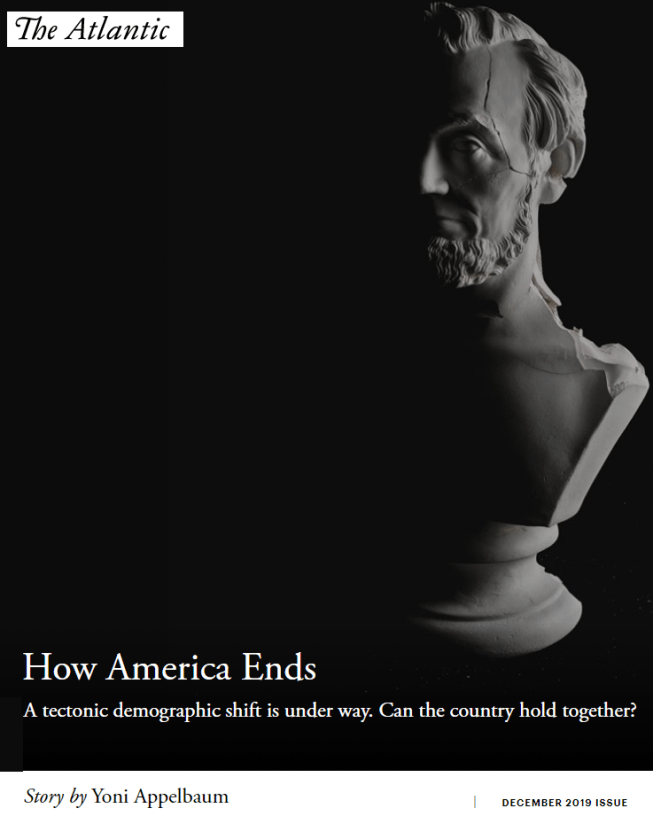
…As partisans have drifted apart geographically and ideologically, they’ve become more hostile toward each other. In 1960, less than 5 percent of Democrats and Republicans said they’d be unhappy if their children married someone from the other party; today, 35 percent of Republicans and 45 percent of Democrats would be, according to a recent Public Religion Research Institute/Atlantic poll—far higher than the percentages that object to marriages crossing the boundaries of race and religion. As hostility rises, Americans’ trust in political institutions, and in one another, is declining. A study released by the Pew Research Center in July found that only about half of respondents believed their fellow citizens would accept election results no matter who won. At the fringes, distrust has become centrifugal: Right-wing activists in Texas and left-wing activists in California have revived talk of secession…

What has caused such rancor? 

But the biggest driver might be demographic change. The United States is undergoing a transition perhaps no rich and stable democracy has ever experienced: Its historically dominant group is on its way to becoming a political minority—and its minority groups are asserting their co-equal rights and interests. If there are precedents for such a transition, they lie here in the United States, where white Englishmen initially predominated, and the boundaries of the dominant group have been under negotiation ever since. Yet those precedents are hardly comforting. Many of these renegotiations sparked political conflict or open violence, and few were as profound as the one now under way.  — The Atlantic

The above is a must-read, folks (click on the link to the Atlantic).

Rather than just momentum and central bank haruspicy — the reading of the Fed’s entrails, for example –  there are much bigger forces at work which will determine the future path of asset prices in the long-term.  Politics and demographics are a couple of the biggies.

Posted in Fed, Politics, Uncategorized | Tagged , , , | Leave a comment

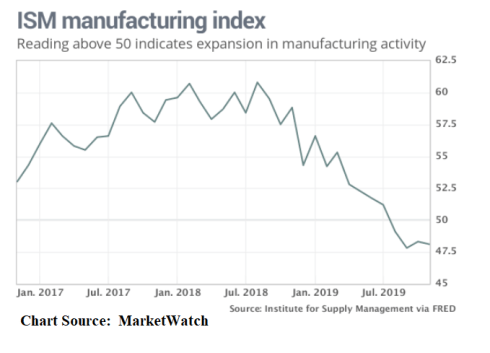
Manufacturing Sector Contraction Continues, Led By New Orders – ISM

ISM_3

Of the 18 manufacturing industries, five reported growth in November: Apparel, Leather & Allied Products; Food, Beverage & Tobacco Products; Paper Products; Miscellaneous Manufacturing; and Computer & Electronic Products.

(Tempe, Arizona) — Economic activity in the manufacturing sector contracted in November, and the overall economy grew for the 127th consecutive month, say the nation’s supply executives in the latest Manufacturing ISM® Report On Business®.

The report was issued today by Timothy R. Fiore, CPSM, C.P.M., Chair of the Institute for Supply Management® (ISM®) Manufacturing Business Survey Committee: “The November PMI® registered 48.1 percent, a decrease of 0.2 percentage point from the October reading of 48.3 percent. The New Orders Index registered 47.2 percent, a decrease of 1.9 percentage points from the October reading of 49.1 percent. The Production Index registered 49.1 percent, up 2.9 percentage points compared to the October reading of 46.2 percent. The Backlog of Orders Index registered 43 percent, down 1.1 percentage points compared to the October reading of 44.1 percent. The Employment Index registered 46.6 percent, a 1.1-percentage point decrease from the October reading of 47.7 percent. The Supplier Deliveries Index registered 52 percent, a 2.5-percentage point increase from the October reading of 49.5 percent. The Inventories Index registered 45.5 percent, a decrease of 3.4 percentage points from the October reading of 48.9 percent. The Prices Index registered 46.7 percent, a 1.2-percentage point increase from the October reading of 45.5 percent. The New Export Orders Index registered 47.9 percent, a 2.5-percentage point decrease from the October reading of 50.4 percent. The Imports Index registered 48.3 percent, a 3-percentage point increase from the October reading of 45.3 percent.  –Institute of Supply Management

ISM_1

ISM_2

Posted in Economics, Uncategorized | Tagged , , | Leave a comment

S&P’s Great Run…What Next?

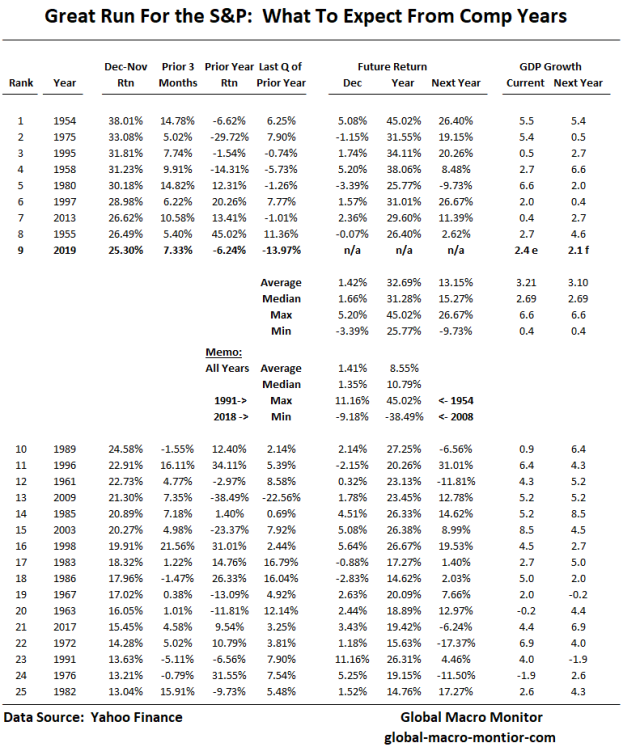
The S&P500 price index is up 25.30 percent going into December, the 9th best performance for the index from January to November since 1950.   What makes this year’s rally unique to the prior big years is that it launched from the nastiest Q4 and December, in particular,  in the preceding year.   So in some sense, much of the rally has been a reflexive bounce back from the crash in Q4 2018 and has also been goosed by the Fed reversal to easing and big repo operations in the money markets.

What to expect in December and next year after such a great run?

We don’t know but do look too similar markets from the past for some guidance.  We crunched the data and though past is not always prologue,  we do know that the algos look to history for patterns in their predictive analytics and to set trading and market perimeters.

The data show that the S&P return for December in the years with such momentum in the first eleven months average a 1.42 percent, which is almost exactly what the average return is for all the Decembers in the data set (1950-2018).

Next year?  The average return for S&P for the proceeding year in the eight years of 26 percent-plus returns from January to November is 13.15 percent,  which is about 500 bps above the average return for the S&P for all years.

Valuations

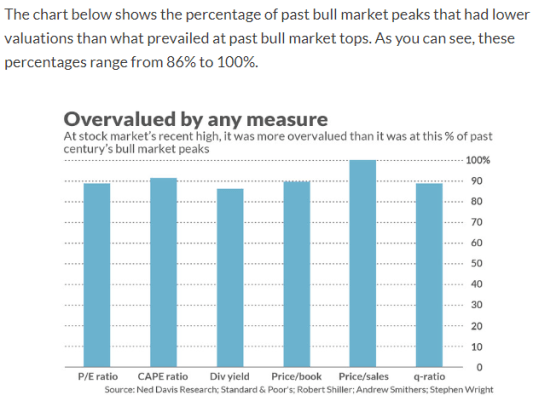
Given that valuations are at, or close to record highs, we suspect the prospective returns that history suggests are a bit too bullish.

S&P_November_2

Source:  Mark Hulbert, MarketWatch

Maybe the inertia and the increasingly positive narrative that “things are turning up” pushes the S&P a bit higher into the New Year, which of course will also be determined by I f the Chinese get their rollback on some tariffs and President Trump does not impose the new round of tariffs scheduled for December 15th.

We are waiting for a better set up to sell this market after getting stopped out at 3125.


S&P_November

Posted in Algos, S&P500, Uncategorized | Tagged | Leave a comment

Ten Facts About Inequality In Advanced Economies (AE) — PIIE

Very good discussion on the inequality landscape in the AEs.  We know it ain’t no Tik-Tok video but it’s a good investment of your time to learn something more about what is important and going to drive the political economy in the next several years.

(Full session) Lucas Chancel, codirector of the World Inequality Lab and of the World Inequality Database (WID) at the Paris School of Economics, explains that economic inequality is on the rise after a historic decline. Inequality, he says, is now greater within advanced economies than between the world’s rich and poor countries. In a presentation at the conference on “Combating Inequality” at the Peterson Institute for International Economics on Oct. 17-18, 2019, Chancel outlined why racial and gender inequality remains high, how trade and technological advances cannot totally be blamed, and why progressive taxation offers a solution to curbing extreme inequality. He is joined by discussant Peter Diamond (MIT Department of Economics) and chair Adam Posen.

For more details on the event, visit https://www.piie.com/events/combating….

Posted in Inequality, Uncategorized | Tagged , , | Leave a comment

The Parable Of The Good Salvadoran

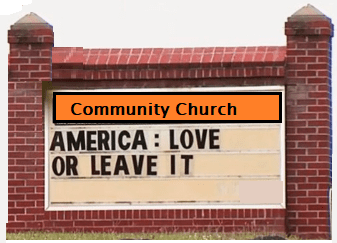
It was just past midnight on a Saturday night when the pastor of a popular urban city megachurch, Reverend Jerry Graham Jr., had just finished the bulletin on the billboard sign located on the lawn outside the large modern church structure.  He was in a bit of a hurry to get home and grab some sleep before his first sermon, which was to be delivered at the 8:00 am service the next morning.
Church_Board.png

He took a last look at the sign before leaving for the two-block walk to the church parking garage: “America, love it or leave it.”

Perfect, and very relevant he thought, as the next morning’s  politically charged sermon was titled, “Is the President the Chosen One?”

The Road Down From Jerusalem Down To Jericho

A late-night walk from the church building down to the parking garage was always uncomfortable for the pastor as the church was located in a low-income area often riddled with violent crime.  So much so, that many of his parishioners named the journey to the parking lot “the road down from Jerusalem to Jericho,”  which was one of the most treacherous and dangerous roads in the Holy Land during the days of Jesus of Nazareth.

After about a block, the pastor encountered a group of armed robbers, who, first threw acid in his face to blind him, then stole his wallet, watch, and Gucci sport coat.  They finished their crime by severely beating the pastor leaving him for dead.  The acid burns on the pastor’s face were so bad it made him unrecognizable.

The pastor remained unconscious throughout the night and was still lying motionless on the sidewalk as the members of his church began to arrive the next morning for the 8 o’clock service.  The head elder of the church was the first to arrive and upon seeing the unrecognizable and mutilated body on the sidewalk, he crossed to the other side of the road.

He had much work to do to prepare the church for the five Sunday services and thought the unfortunate soul lying on the sidewalk was just another victim of the violent and criminal immigrants he feared were invading and taking over the country.

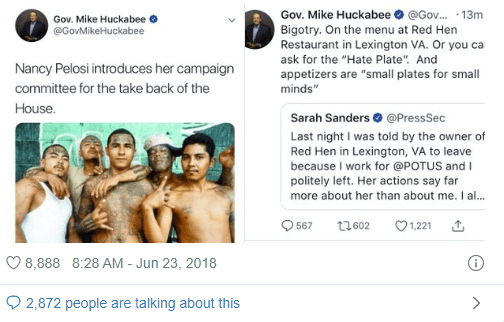
https://twitter.com/GovMikeHuckabee/status/1010497564435730434?s=20

The original racist Tweet was deleted from Mike Huckabee’s account but we found the following copy.
The next to arrive was one of the church deacons.  She, too, also crossed to the other side to avoid the body lying by the side of the road.

The Good Salvadoran

Suddenly, Óscar Ramírez, a brown-skinned man emerged from the dumpster just about two hundred yards from where the pastor was robbed and almost beaten to death.  Mr. Ramírez was hiding in the trash can from the immigration authorities as he had arrived in the United States from El Salvador illegally just one week earlier.

He had come to the country in panic after receiving a frantic phone call from his wife, who had traveled north about a month earlier to seek political asylum in a “safer” America, that she and their 3-year old daughter had been separated by U.S. border authorities.  After arriving Óscar Ramírez searched desperately for his wife while living in great fear of ICE, the former U.S. Customs and Immigration and Naturalization Service, which he knew would deport him before he could reunite with his wife and daughter.

As he spotted the body of the man lying beside the road it brought back horrible memories of the violent crime he and his family had suffered in El Salvador, which his wife and daughter were trying to escape in their dangerous trip to the north.

Without hesitation,  Mr. Ramírez ran to help the man and had compassion on him.

He gave the hurting pastor water, tried to comfort him and attempted to wash the acid from his face.  The Salvadoran knew there was a hospital just a few blocks away but was gripped with fear that he would be arrested and deported by ICE if he even came close to a hospital.  The stories of ICE immigration raids on hospital emergency rooms were ubiquitous in the immigrant community.

Knowing exactly what he had to do, even if it risked that he would never see his family again, Óscar Ramírez, the Good Salvadoran, gently lifted the pastor from his pool of blood on the sidewalk and carried him the two blocks to the Good Samaritan Hospital emergency room.

Good Samaritan.png

Risking everything, the Good Salvadoran checked the pastor into the ER and stayed with him until he regained full consciousness and the authorities at the hospital were able to contact the pastor’s family and congregation.

Which of these three do you think was a neighbor to the man who fell into the hands of robbers?”

The expert in the law [religion] replied, “The one who had mercy on him.”

Jesus told him, “Go and do likewise.”   — The Gospel of Luke

Lessons

We retell the parable of the Good Samaritan in a relevant and modern-day context not as a political narrative, though it does take place in the context of our politically charged and divisive culture, which many of our leaders attempt to exploit for their own political gain.

It is not a story to warn about walking on dangerous roads.  It is not a story about open borders nor about unjust or lax immigration laws.  It is not a story about medicare for all or universal health care.

It is not a story just about compassion and helping people in need, though that gets us warmer and closer but just a small part of the real truth in the parable.

Evils Of Racism

It is a story about the evils of racism and the hypocrisy of religious acquiescence or direct participation in the toxic mix of racism and destructive stereotyping.

To understand this, one must understand the times of first-century Judea, where Jesus and his followers lived. In order to do this, one must understand the relationship between Jews and Samaritans.  This is sometimes hinted at when the parable is told today but it is rarely fully grasped.

Samaritans

Who were the Samaritans?  They were not just the outcasts of Judea but were the despised enemies of the Jews.  “Half-breeds,” half Jewish and half Gentile, who worshipped false gods and were considered traitors.  They were hated more than the Roman conquerors.

The Jews of the day would not even walk in Samaria because they believed the people to be unclean.   They would go far out of their way rather than set foot in Samaria, even if it were a much longer trip.

It doesn’t take much imagination to hear the chants in Jerusalem back in that day to “Send them back! Send them back!”

This is exactly why Jesus used a Samaritan in his parable as they would have been perceived as the least likely to help a fellow Jew.  The listeners when Jesus told the story would have expected a Jew to be the hero of the parable but were likely very shocked and offended to hear in the end that it was……wait for it…….a Samaritan!

Only by understanding this reality,  does the power and true message of the parable convey the main lesson it was meant to when originally told 2,000 years ago and is so very relevant in today’s slouch toward tribalism.

The Parable of the Good Samaritan 

On one occasion an expert in the law stood up to test Jesus. “Teacher,” he asked, “what must I do to inherit eternal life?”

“What is written in the Law?” he replied. “How do you read it?”

He answered, “‘Love the Lord your God with all your heart and with all your soul and with all your strength and with all your mind’; and, ‘Love your neighbor as yourself.”

“You have answered correctly,” Jesus replied. “Do this and you will live.”

But he wanted to justify himself, so he asked Jesus, “And who is my neighbor?”

In reply Jesus said: “A man was going down from Jerusalem to Jericho, when he was attacked by robbers. They stripped him of his clothes, beat him and went away, leaving him half dead.  A priest happened to be going down the same road, and when he saw the man, he passed by on the other side.  So too, a Levite, when he came to the place and saw him, passed by on the other side. But a Samaritan, as he traveled, came where the man was; and when he saw him, he took pity on him.  He went to him and bandaged his wounds, pouring on oil and wine. Then he put the man on his own donkey, brought him to an inn and took care of him.  The next day he took out two denarii and gave them to the innkeeper. ‘Look after him,’ he said, ‘and when I return, I will reimburse you for any extra expense you may have.’

“Which of these three do you think was a neighbor to the man who fell into the hands of robbers?”

The expert in the law replied, “The one who had mercy on him.”

Jesus told him, “Go and do likewise.”   –  The Gospel of Luke

Let us all “go and do likewise” and make it a better holiday season,” folks.

Posted in Uncategorized | Tagged , | 1 Comment

Discipline Trumps Conviction

Today’s close above 3125 takes us out of our short position, which we started scaling into at 3025.  We are still fairly confident that this market can be bought at much lower prices at some point in the next 18 months.   We hate getting squeezed out up here, which is probably a sign of the top and it won’t be the first time.

We’re going to the beach and patiently waiting with our long-term money and we will be on alert to the downside when the fever and market breaks.   Maybe the MoMo takes the S&P up another 1-2 percent but we don’t know, nor does anyone else, and we have limited pain tolerance.

S&P500 Returns

The S&P500 closed today, up exactly 25 percent on the year.   An up year after the ugly Q4 2018 crash and a subsequent strong first-quarter bounce is no surprise, folks.

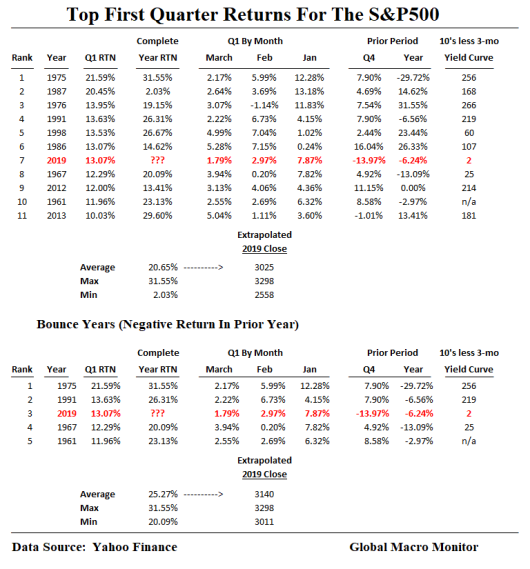
There has not been one year since 1950, not one, where the S&P has increased by more than 10 percent in Q1, after experiencing a negative prior year, which didn’t close the year up less than 20 percent.  It’s Newton’s Q1 Law of S&P Momentum.   – GMM,  April  1, 2019

S&P_Q1

By the way,  the data in the above table illustrate how we calculated 3025 as the beginning of the selling zone.  It was our extrapolation of the average return for years with similar short-term histories.   Our trade worked out twice this year before the latest ramp.

The above data also show that this year’s strength is a mirror image of the extreme weakness in Q4 2018 but look at the yield curve at the end of Q1 versus the other years.

If the market closes here for the year, it would be the 13th best annual price move for the S&P since 1950.  Another 60 S&P points higher by year-end would move it into 6th or 7th place.

Really?   Does the economy and earnings justify these gains?

Yield Curve

The yield curve is almost meaningless in a world where central banks own half of the U.S. Treasury coupon curve though their positions in bills are very light historically.  At the end of 2007, for example, before the Fed moved from an OMO to a QE monetary policy, the U.S. and foreign central banks held 44.05 percent of outstanding T-bills versus just 12.64 percent at the end of September.  This, of course, distinguishes between repos and asset purchases on the Fed’s balance sheet.

We suspect this is a major reason for the cash crunch in the money markets.   More in later post.

Why Is The Market Rising?

It is for silly reasons that the market is rising or, should we say, the prevailing narrative of why it is moving higher.

Expectations of some sort of faux-China trade deal, which we get — any cessation of economic hostilities between the two world superpowers is a good thing but the market has rallied quite a bit already.   There will be no resolution to the economic competition and long-term conflict between Chimerica, which has been the main driver of corporate earnings and global growth for the past 25 years.  The world economy will be much weaker than when the trade war began with no resolution in sight, and we don’t think a “Phase 1” deal is going to move the real economic needle much.

Furthermore,  the Fed’s massive repo intervention (SOMA portfolio has not grown much) to stabilize the money markets is not exactly positive in our book.  It is a signal the monetary distortions and huge debt issuance over the past decade are beginning to come home to roost.

Nevertheless, the markets can remain irrational longer than we can remain solvent.

The market strength has been more of a technical matter, in our opinion.  Lack of supply as corporates have taken out massive stock with buybacks, the move to passive investing, and the greed & fear of FOMO.

Sustainable Levels   

This market needs some very accelerated global economic growth to sustain these levels. Growth is difficult in such a highly indebted world, however, as interest rates can’t move higher to their equilibrium levels.  The large stock of debt is going to act as a governor on growth as a break out in market rates will break the market and break the economy.   And that, folks, is why the central banks are in their current feeding frenzy.

What will be the big negative shock that shakes the tree loose?   Your guess is as good as ours but it shall come.

Cut Quick And Keep Losses Small

Our total loss in the short position is a little over 2.3 percent.  Keeping losses small allows you to fight another day.  We know it’s pretty tight stop but that’s the downside of playing with leverage.

Moreover, we are more comfortable to be flattish and missing another, say, one or two percent but will continue to move our target sale prices higher and wait for the market to break.

As my first trading boss on Wall Street used to preach to me almost daily, ” I don’t like being long when the fundamentals are not supportive.  The bottom can drop out of the market.”

Hear ya’, boss.

On to the next trade and, now, it over the woods and through the snow and to Grandmother’s house, we go.

Have a great Thanksgiving, folks.

S&P500

Posted in Economics, S&P500, Uncategorized | Tagged | 5 Comments

China Trade Talks And Presidential Stengelese

All right everyone, line up alphabetically according to your height. – Casey Stengel 

Posted in Trade War | Tagged , | Leave a comment

Party Like It’s 1999

Geez…all roads seem to lead to skewed distributions, be it: 1) household wealth ;  2) excess reserves held by a few large SIFI banks, and, 3) stock market returns (narrow breadth).   Not healthy.


Posted in Uncategorized | Leave a comment

Is Real Populism On The Way?

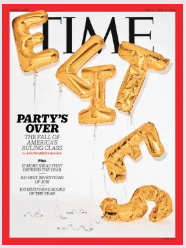
The new cover of Time thinks so.

Time

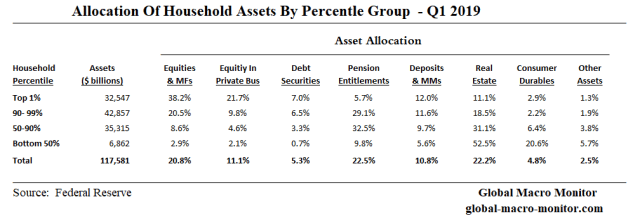
Real populism is usually rooted in left-wing economic policies of soaking the rich, import-substitution trade policies and zero concern of protecting the wealth of the elites, which is mostly held in the financial genre of public and private equity (around 60 percent).

Asset_Allocation_By_Percentile Group

In 2016, the Democratic Socialists of America (DSA) had 5,000 members; since then, its dues-paying membership has multiplied more than tenfold. This new energy on the left terrifies chief executives and billionaires, and yet many of them have been voicing similar alarms about a crisis of capitalism. Ray Dalio, the billionaire co-chairman of the investment firm Bridgewater Associates, warned in April that America faced a “national emergency” in capitalism’s failure to benefit more people, and he pronounced the American Dream lost. The anti-capitalist impulse has some purchase on the right too. Before he pushed a tax cut that lined the capitalists’ pockets, Donald Trump ran, most improbably, as a Republican skeptical of the financial elite’s loyalty to Americans. On Fox News, Tucker Carlson has entertained a surprising skepticism of capitalist doctrines and said positive things about Warren. – Time

Trump’s populism is one that cuts taxes for the rich, make cosmetic tweaks to trade deals as not to upset the markets, and leans heavily on the Fed to lower interest rates to keep the stock market inflated.   In other words, a Trojan Horse for the 1 percenters but he puts on one helluva great circus to entertain the base.

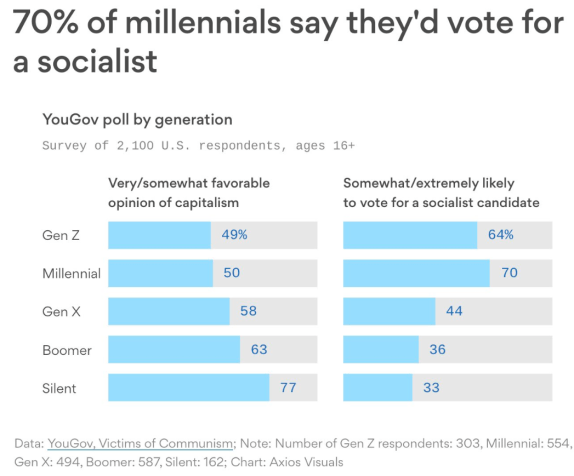
Not absolutely sure if it’s going to be 2020 — the predictions markets have cut Elizabeth Warren’s chances of winning the nomination in half in the last month — but maybe a pop lighter version until the demographics are stronger, but it is coming, folks.  You can bank on a People’s QE.


YouGov.png


Long pitchforks.  Long inflation.

Posted in Populism, Uncategorized | Tagged , , | Leave a comment