The Magical Monetary Policy Mystery Tour

Wow!  Just heard a so-called “banking expert” say that the Fed was reducing reserves on their balance sheet during quantitative tightening (QT), which has led to the current chaos in the overnight repo market.   Not entirely true.

Asymmetric Libalibity Balance Sheet Accounting

During QE the Fed purchased assets in the secondary markets, primarily Treasury notes and bonds, and mortgage-backed securities (MBS), by increasing their liabilities in the form of bank reserves.    During QT, on a monthly basis, the Fed did not reinvest some or all of the maturing securities purchased during QE up to a certain monthly cap.  The U.S. Treasury, for example, would have to pay down the debt by reducing their cash balance at the Fed.

Rather than reducing reserves on the liability side, the Fed would reduce their liabilities by the reduction of the Treasury cash balance equivalent to the maturing securities.   We are not certain, but suspect, when MBS rolled off, reserves were reduced.   The Fed is a bit less transparent when it comes to their MBS portfolio, at least that is our perspective and could be due to the complications of prepayment risk.

Nevertheless, we believe QT worked more through a high powered fiscal channel as the maturing Treasuries sucked liquidity out of the market through maturing debt and not a direct reduction in bank reserves on the Fed balance sheet.  As a consequence, the Treasury had to issue more securities in the market to replenish their cash balances, an effective checking account, at the Fed.  Crowding out on steroids.

Still, at the end of the day,  excess reserves in the monetary system have tracked the reduction in Federal Reserve assets fairly closely but certainly not a rho =1,  perfect correlation.  There is the rub.

Monetary Policy Is Complex And Complicated

As an undergraduate political science student (double major in econ),  I read somewhere that President Kennedy had much trouble understanding the difference between monetary and fiscal policy.  In fact, to prevent from conflating the two in public, he wrote cheat notes with a pen on each fist before his press conferences.  I am still searching for the source of that factoid.

Even former Chairman Alan Greenspan admitted monetary policy is a black box,

There is, regrettably, no simple model of the American economy that can effectively explain the levels of output, employment, and inflation. In principle, there may be some unbelievably complex set of equations that does that. But we have not been able to find them, and do not believe anyone else has either. 

Consequently, we are led, of necessity, to employ ad hoc partial models and intensive informative analysis to aid in evaluating economic developments and implementing policy. There is no alternative to this, though we continuously seek to enhance our knowledge to match the ever-growing complexity of the world economy.   – Alan Greenspan, Decemeber 1996

The Pragmatic Capitalism blog has the best perspective on the complexity of today’s monetary system, in our opinion,

The monetary system is too complex and too dynamic for you to understand it all. So it’s better to understand enough that you can be competent, but not so much that you become a danger to yourself.  – Cullen Roche

So, nobody knows with absolute certainty what the hell is going on in the repo and money markets.

Are bank reserves too low?  Are markets starting too convulse because debt is too high?  Is there a temporary mismatch in cash flows of different financial entities?   Is the problem a temporary blip or more systemic?  All of the above?  None of the above?

Wish we could say, but we don’t know.

Nevertheless, as  Goethe once stated, 

By seeking and blundering, we learn.

Look At Deficit Financing

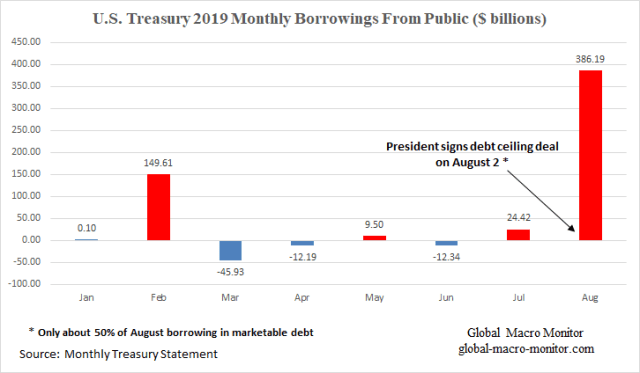
We do have our suspicions that the money market turmoil has something to do with what is happening with the huge increase in the budget deficit, which in the first 11 months of fiscal (Oct-Sep) 2019 is close to $1.1 trillion dollars.  That’s larger than the combined GDPs of Austria,  Ireland, and the Czech Republic.   In addition, how the deficit has been financed during the budget ceiling negotiations we believe is also impacting market liquidity.

It’s tantamount to holding a beach ball underwater and then released when the President signed the debt ceiling deal at the beginning of August.
 

Repo_Montly Borrowings

Add to that our distorted monetary system where interest rates are repressed and prices can’t clear the market but quantities will.  Think, rent control.

A decade of extraordinary monetary policy experiments has left the system badly distorted. Thus the Fed is now like a pilot flying a plane with an engine that has been stealthily remodelled. Neither the passengers nor the pilot knows how the engine’s shifting cogs might affect the controls during a wave of turbulence, because there is little historical precedent.  —  FT,  Sep 19th

Le Chatelier’s Principle (LCP)

It’s a classic case of Le Chatelier’s principle (LCP) in action.  If one economic variable is repressed in a dynamic equilibrium system, such as prices or interest rates and not allowed to adjust to clear the market, another variable in the system will have to move to offset.  The great economist, Paul Samuelson, did his Ph.D. dissertation on LCP.

Maybe that variable is cash liquidity?

It is clear to us, there is too much debt in the system to allow interest rates to move to their equilibrium levels in a steady-state normal world.  We saw what happened in Q4 2018 to the stock market when the 10-year Treasury yield broke out higher, one year ago to almost this very day.

Because rates can’t move higher to a technical equilibrium level as the supply of debt increases, the larger budget deficits will have to be financed by either haven flows as other markets (stocks, e.g.)  sell off,  foreign inflows (stronger dollar), more indirect monetization in the form of some kind of QE or a derivative of POMO, OMO,  a combination of all of the above, or whatever you want to call it.

It doesn’t seem there is much appetite to allow markets to fall to generate the haven flows nor for a stronger dollar.  Ergo, the Fed will be forced to do the heavy lifting.  If you been reading GMM over the years, you know which variable will offset the Fed activity.  That is the end game.

Coming Soon 

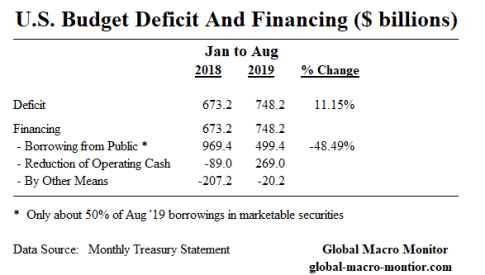
We are still working on the analysis but here is a sneak peek at some of the data.
Repo_Montly Borrowings_2

Again, looking at the data in the table, we believe the Treasury is going to be issuing a lot more debt in the next few months to make up the months of nonborrowing from the public due to this year’s debt ceiling constraints,  Similar to the first 8 months of last year (see table), which was a catch-up from the 2017 debt ceiling debacle.

As usual, we reserve the right to be wrong.    Stay tuned.

Posted in Fiscal Policy, Uncategorized | Tagged , , | 2 Comments

Impeachment Market Update

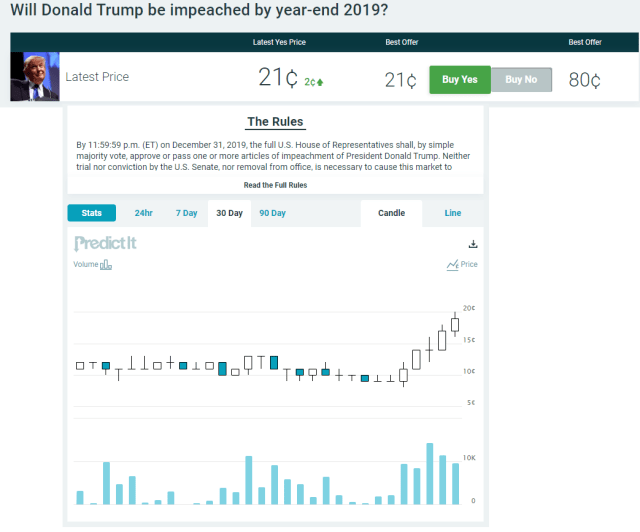
Since our post on the impeachment market about nine hours ago, the 2019 contract is up 81 percent, from 21 to 38, and 322 percent in the past week.   Annualize that return!

Mr. Market is not priced for the coming political instability the prediction markets are now starting to price.  Almost even money now for the  first term impeachment contract.

Seat Belts_Mar24


Posted in Politics, Uncategorized | Tagged | Leave a comment

Impeachment Prediction Market Flying

Check out the prediction market on impeachment over at PredictIt.

Odds Have Moved From 11:1 To 4.8:1 Trump Will Now Impeached By Year-End

The contract that Trump will be impeached by the end of 2019 is up 133 percent in the last week,  moving the odds from 11:1 to 4.8:1.

The contract for impeachment by the end of Trump’s first term is up 71.4 percent, moving odds from 4.8:1 to 2.8:1.

Of course, impeachment doesn’t mean removal but Leon Cooperman said on CNBC last week,

“Right now, the market is assuming Donald Trump is reelected.”
2.05 minutes in

Cooperman

Click here to view video 


Please, no hate mail accusing us of partisanship.   We are just conveying information that many of our readers are probably not aware of.

Put your money where your politics are and place your bets, folks.  Mr. Market certainly isn’t pricing it.   Maybe there is an arb here?


Impeachment Market.png

Posted in Politics, Uncategorized | Tagged | 2 Comments

If It’s On The Internet, It’s True. Right?

Posted in Uncategorized | Leave a comment

President Trump grants exemptions on 400 tariffs

Probably not the roll back China was looking for?

Posted in China, Trade War, Uncategorized | Tagged , | Leave a comment

What’s Hot In Women’s Fashion

Capitalism at its best or worst?

We have a few questions:  1)  Does the Tariff Man get a royalty for the sale of each dress sold, and will that violate the Emoluments Clause of the U.S. Constitution, and 2) Are the dresses Made in China?

Just askin’.

Fashsion Trend

Hat Tip:  @scottlincicome

Posted in Trade War, Uncategorized | Tagged , , | 6 Comments

Beware Mocking Bubbles & Bears

Once again, seeing lots of articles and talking heads mocking bubbles and the bears, which is usually a sign a big bubble is going to burst.  The last time we saw this kind of taunting of the bears was three days before the bear market, which we think is on, began in January 2018.

Here’s what we wrote,

Finally, you also see the investing public openly mocking the bears during the later stages of a bull market. We see a lot of that these days. Just check your twitter feed.  –  GMM, January 23, 2018

Stress In Money Markets

Nobody really knows for certain what is causing the stress in the money markets, but our calculated guess is it is:  1)  somehow related to the massive new issuance of Treasuries, which is sucking liquidity out of the markets, as prices are repressed and not allowed to clear –>  think,  a) rent control, where the excesses have to be cleared through quantities,  and  b) Le Chatelier’s principle, where, in a dynamic equilibrium, pressure on one variable has to be offset by movement in other variables;   2) primary dealers stuffed with Treasuries having to fund themselves, and 3) though there are still $1.4 trillion of excess reserves in the banking system, it is possible only a few banks hold the bulk and are hoarders.  In other words, another top-heavy distribution problem, along with wealth and income, where the few own the much.

Primary dealers


Whatever the case, the markets are so distorted now and becoming more so, especially by the false belief that central banks can even now fine-tune a Stradivarius violin.  Haha!

We believe quantitative easing and the massive expansion of central bank balance sheets are the financial equivalent to excessive carbon emissions resulting in kind of a of global warming in the markets. Thus, traders and investors should expect more extreme weather  market conditions.

Didn’t you see this coming?

FP

To be fair to Adam,  we took the headline a bit out of context to make our point.  Please read his article here.

Discount The Street

During my days on Wall Street, it was stunning to watch how many would sell their souls and anything else to help them make their year-end bonus.  I specifically remember a sales pitch by some bozo about how the Mexican Peso was going to become the next dollar, less than 12 months before it fricking blew!   We laughed him out of the office.

This is one reason why Mr. Market is so cold-blooded,  doesn’t correctly discount risk, and tends to have a one in every 10,000-year event (high sigma crash) almost every 10 years.

So, folks, when listening to the Street, bubble vision, the market talking heads, and even central bankers and policymakers,  take heed the words of the great American author,  Upton Sinclair.

Quote_BB.png

Posted in Equities, Uncategorized | Tagged , , | 15 Comments

QOTD: Pick Your Poison, Or Not

QOTD = Quote of the Day

Both propositions are equally uncomfortable in today’s market.   Also, partially explains why the default investment strategy is now passive.

When the music stops, in terms of liquidity, things will be complicated. But as long as the music is playing, you’ve got to get up and dance. We’re still dancing, – Chuck Prince,  Former CEO of Citigroup, July 2007


Quote_BB

Posted in Uncategorized | Leave a comment

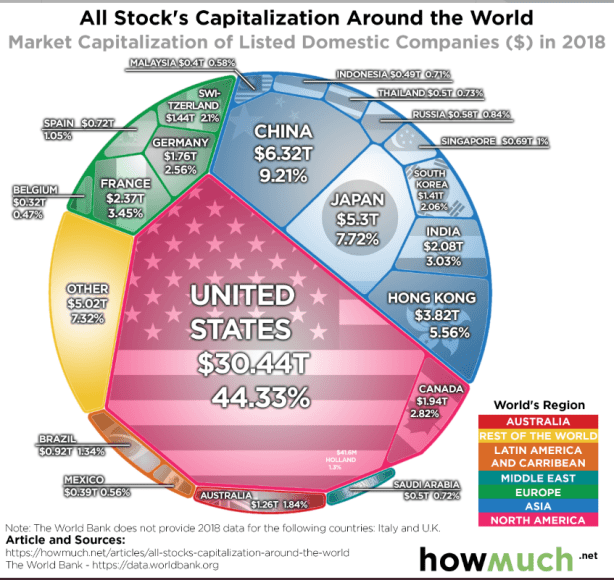
Major Global Stock Market Caps

Global Market Capts.png

Hat Tip: @jessefelder

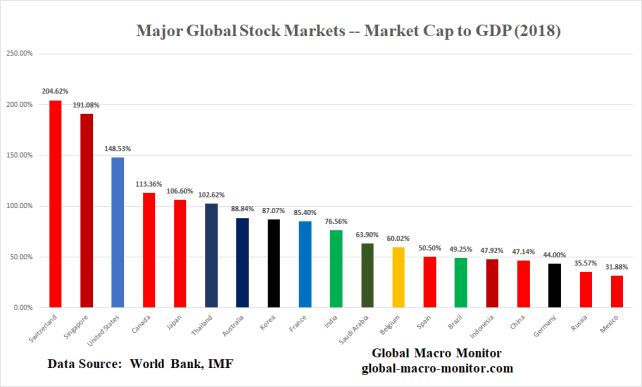
Our Favorite Valuation Metric

We had to post our favorite macro stock valuation measure.   Some caveats come with the comps, including exchange rate translation.

Global Market Capt_2
Posted in Equity, Uncategorized | Tagged , , | Leave a comment

The ‘Bots Are Coming For The Priests

Good, God!

  • A mechanical ‘priest’ has recently begun conducting Buddhist prayers in Japan. It is not the first attempt to deliver religious teachings and advice through the use of a programmed machine.
  • And Catholic Christians may soon find spiritual advice from a tiny 40-cm robot SanTO, developed by Gabriele Trovato, a roboticist and assistant professor at Japan’s Waseda University, after Trovato finishes perfecting his device in Peru.
  • In Germany, there is a BlessU-2 robot that looks like a hybrid between an ATM terminal and US comic Jeff Dunham’s puppet of Ahmed the Dead Terrorist. The robot is reportedly designed to engage in philosophical debates about the future of religion and the potential of artificial intelligence.  – Sputnik International

Just think of the coming spike in moral dilemmata.

Here’s one, for example.

  1. Does confessing sins of adultery with a sex robot to a robotic priest absolve you of sin?
  2. Is the affair with the robot adultery?

.

Posted in Technology, Uncategorized | Tagged | 19 Comments