
Interesting interview. Worth your time.
Interesting interview. Worth your time.
Wait…Were’t we promised the cost of auto insurance would be cut in half? CPI came in hot this morning.

This year’s Super Bowl commercials were about as interesting as the game, IMHO.
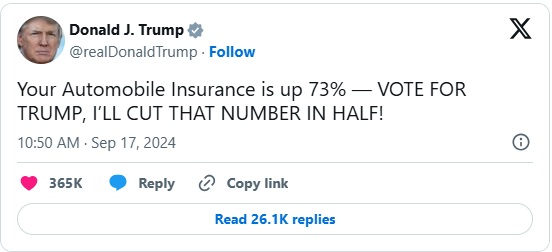
The real price of motor vehicle insurance is up 63 percent since 2010 with the nominal price up 138 percent. We wait.

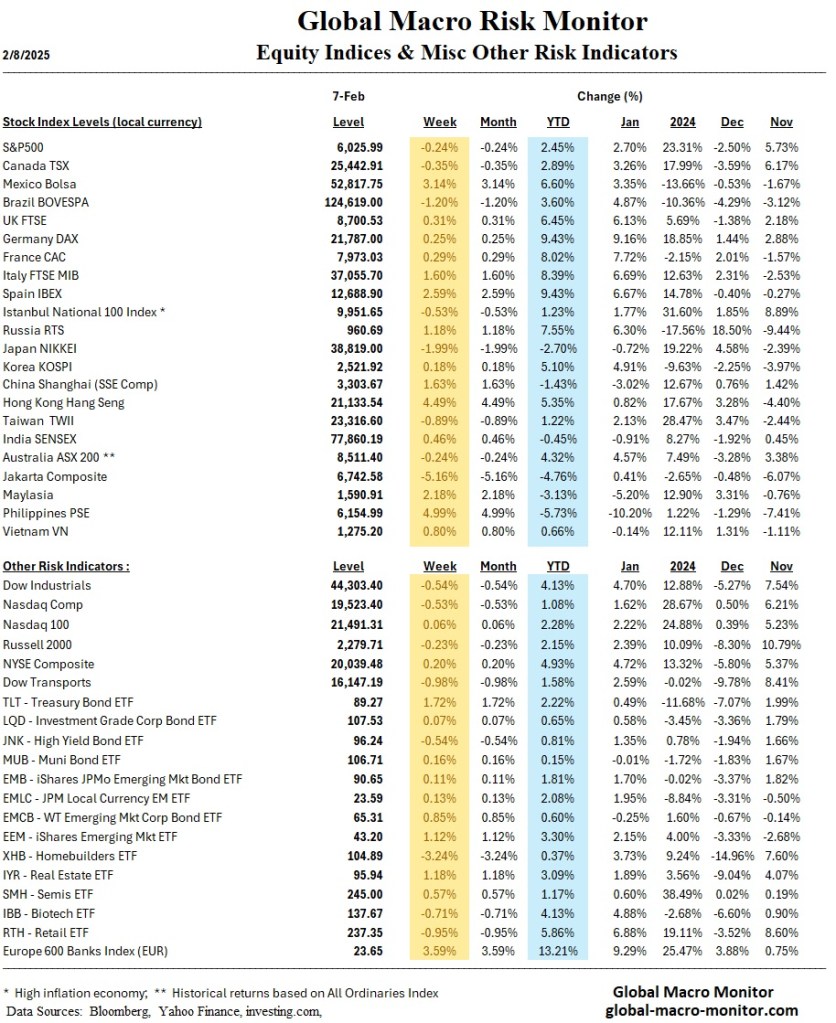
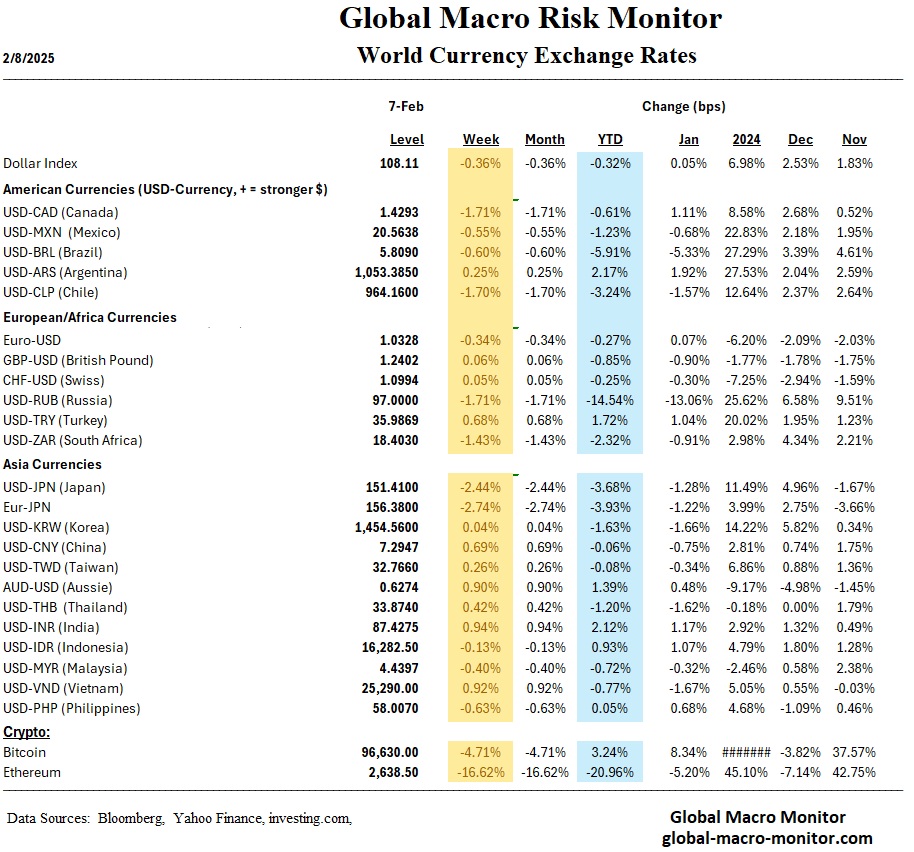
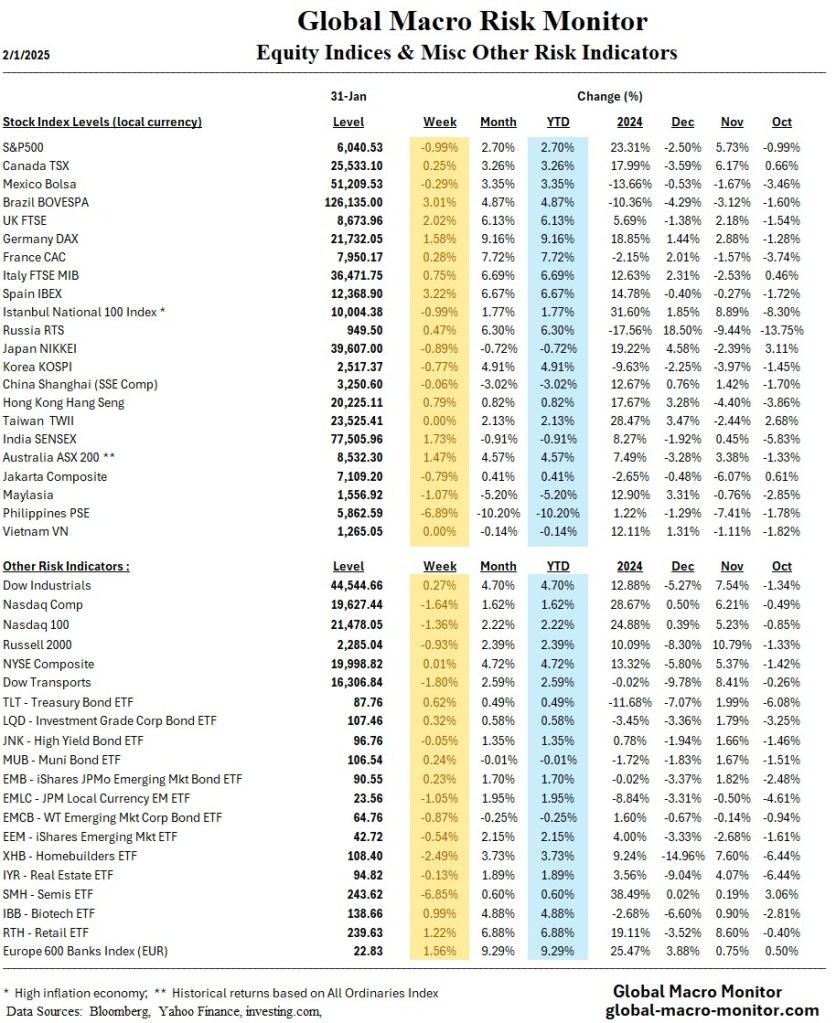
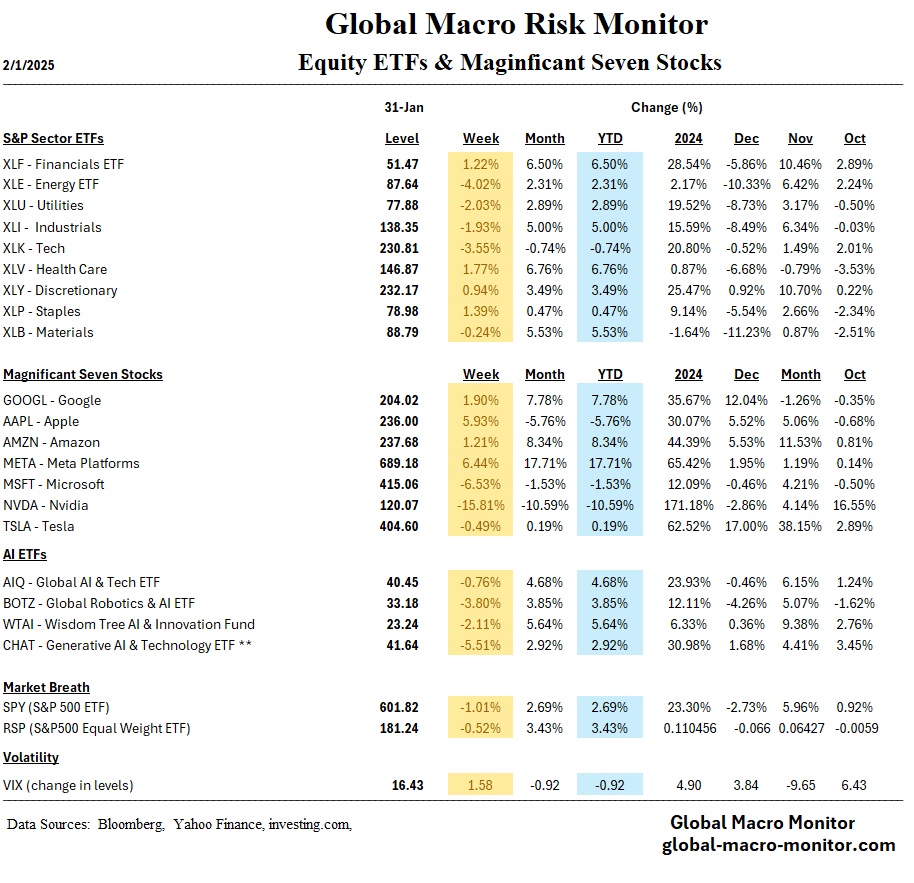
Markets experienced a volatile week as investors reacted to trade policy developments, economic data, and earnings reports. U.S. equities opened lower following the White House’s announcement of sweeping tariffs on imports from Mexico, Canada, and China. However, stocks rebounded after President Trump postponed tariffs on North American trade partners, easing fears of an imminent trade war. The S&P 500 declined 0.24%, while the Dow Jones Industrial Average and Nasdaq Composite also finished in negative territory. Strong corporate earnings helped limit losses, with 77% of S&P 500 companies surpassing expectations.
Globally, European stocks posted gains, with Italy’s FTSE MIB rising 1.6% and Germany’s DAX up 0.25%. Japan’s Nikkei 225 fell 2%, pressured by a stronger yen as the Bank of Japan (BoJ) shifted to a more hawkish stance. China’s Shanghai rose 1.63% in a shortened trading week, bolstered by robust Lunar New Year spending despite weak PMI data.
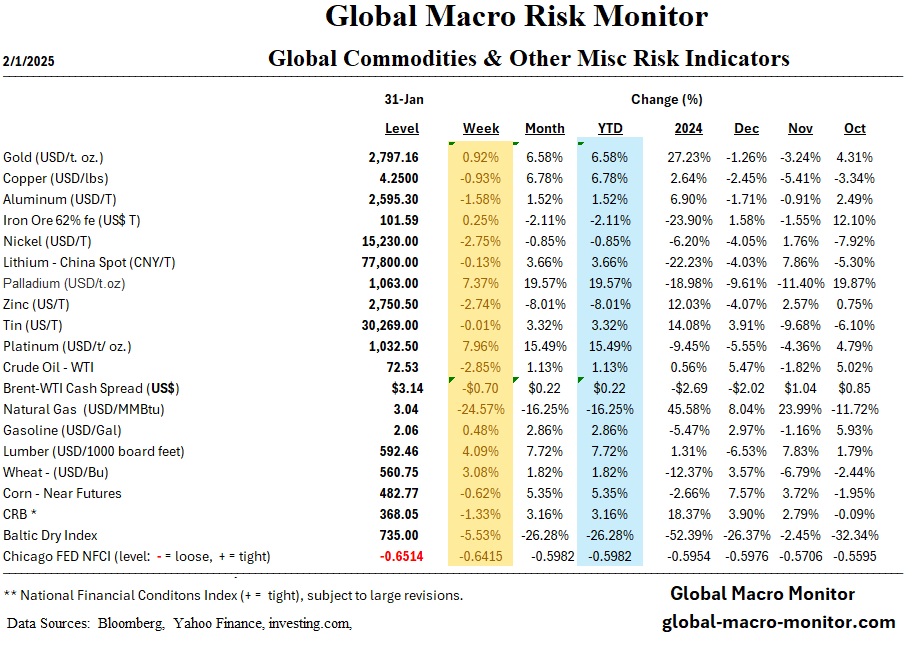
U.S. Treasuries rallied as weaker-than-expected jobs data reinforced expectations of a dovish Federal Reserve. The 10-year Treasury yield fell to 4.50%, reflecting concerns over slowing growth. Municipal bonds and investment-grade corporate debt saw strong demand, with high-yield issuance remaining active. In Europe, the Bank of England cut rates by 25 basis points, while the Czech National Bank also eased policy but signaled caution moving forward.
The U.S. labor market showed signs of gradual cooling, with 143,000 jobs added in January, well below December’s revised 307,000. However, the unemployment rate fell to 4.0%, suggesting underlying resilience. Job openings declined to a three-month low, reinforcing the view that hiring is stabilizing. Wage growth accelerated, with average hourly earnings rising 0.5%, which could complicate inflation control. Meanwhile, manufacturing PMI expanded for the first time in over two years, but business sentiment remained fragile amid ongoing trade policy uncertainty.
Europe’s economy presented a mixed picture. Eurozone inflation remained elevated at 2.5%, delaying expectations for European Central Bank (ECB) rate cuts. Germany’s factory orders surged 6.9%, but industrial production declined, highlighting economic imbalances. The Bank of England cut interest rates for the third time since August, citing slowing growth and persistent inflation risks.
In Asia, Japan’s BoJ signaled a more hawkish stance, strengthening the yen and pressuring exporters. China’s economy showed resilience in consumption, with Lunar New Year retail spending up 7% and travel demand hitting record levels. However, manufacturing PMI indicated slowing production growth, raising concerns over longer-term economic momentum.
Looking ahead, tariff negotiations remain a key market driver, with potential trade developments between the U.S., China, Mexico, and Canada likely to impact sentiment. Investors will also watch inflation data, with the Consumer Price Index (CPI) and Producer Price Index (PPI) due next week. The Federal Reserve’s policy stance will continue to be a focus, particularly as market expectations for a 2025 rate cut cycle evolve. Meanwhile, corporate earnings season continues, with major reports from firms in the technology, consumer, and industrial sectors.
Global attention will also be on central bank decisions in emerging markets, particularly Turkiye, Poland, and Czechia, as policymakers navigate inflationary pressures. In Latin America, Ecuador’s elections will be watched for potential policy shifts amid regional political uncertainty. With markets navigating geopolitical risks, economic data, and corporate earnings, volatility is likely to persist in the near term.




Across the globe, in the United States and Uruguay, in Italy and India, families are getting smaller. To some, this may seem like good news. In an era of human-induced climate change, it’s hard for many liberal, environmentally minded people to rally around having more children — harder still for many young Americans of all political stripes to imagine raising and supporting three children when rent can eat nearly a third of their paycheck.
But economists, demographers and government leaders are increasingly alarmed about the downward trend. According to the latest United Nations projections, the world’s population will peak in 60 years. After that, experts say, humanity will face an unprecedented decline — and, along with it, profound social and geopolitical consequences.
The average fertility rate in the United States has not been above the 2.1 replacement rate since 2007, according to World Bank data. Currently, no country in the developed world, barring Israel, has a fertility rate above replacement level, and, based on U.N. projections, by the end of the century, almost every country will have a shrinking population.
A McKinsey report exploring falling fertility rates says that the trend is “propelling major economies toward population collapse in this century,” pushing society into “uncharted waters.” Think empty schools and crowded retirement homes; dwindling Social Security; and a voting public that skews far older than generations past. Further down the line, shrinking populations could spur mass migration and new global conflict. – Washington Post
Today is Groundhog Day, and it feels like it, with the Trump Administration starting another trade war. This war will end when the countries appear to make some minimal concession so the president can declare victory. Or maybe this is the big kahuna.
Recall during his first administration NAFTA was tinkered with to allow the president to declare:
The USMCA is the largest, most significant, modern, and balanced trade agreement in history. All of our countries will benefit greatly. – Donald J. Trump
The IMF analysis of that deal was essentially, “big hat, no cattle.”
We’ve dusted off an old post for your review.
Originally posted on October 10, 2019
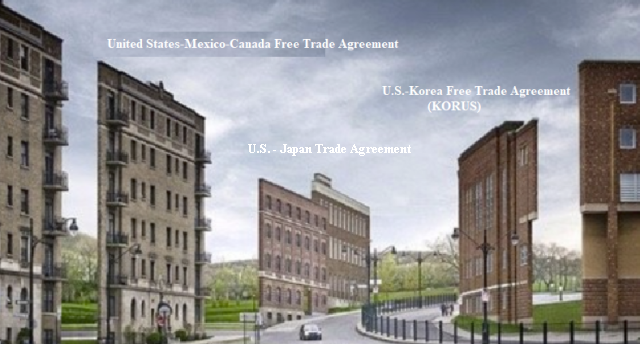
Chalk up another meaningless, photo-op trade agreement with the recent U.S.-Japan Trade Agreement. The country and, especially, American farmers would have been much better off staying in the Trans Pacific Partnership (TPP).
The Japan deal is just another Potemkin trade agreement that will not move the needle one centimeter in bringing jobs back to the United States as was promised.
The dominant loop in the algo to predict President Trump’s behavior with respect to just about everything is to reject all things Obama even if it damages the country. It’s really not rocket science, folks.
Here’s Forbes on the Japan trade deal,
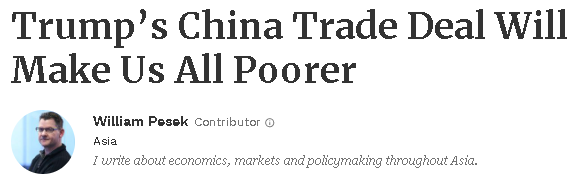
If you’re looking for evidence that a U.S.-China trade agreement is a pointless exercise in economic futility, consider Donald Trump’s non-deal with Japan.
…Late last month, he [Abe] gave Trump a “deal.” That, Trump figured, would enable him to claim a much-needed win on the global stage and get his impeachment troubles out of the headlines. Knowing this, Abe’s team skillfully watered down the deal—essentially to TPP levels. All it means is that U.S. farmers missed out on nearly three years of increased access to Japan, Australia, Singapore, Malaysia, Chile and elsewhere.
Yes, the man famed for the ghostwritten bestseller Art of the Deal got played by Japan’s negotiators. And soon, Xi Jinping’s trade team will be able to make the same boast. Any U.S.-China deal will be a cosmetic affair that gives Trump a “win” and President Xi clearance to make China’s rise great again.
Trump is desperate for a face-saving way to end the trade war. Fallout on U.S. farmers and consumers paying higher import prices is imperiling Trump’s reelection odds for 2020. Yet backing down to Beijing would create its own problems with Trump’s base. Xi’s men are well aware of this, just like Abe’s. – Forbes, Oct 8th
We have been very critical of the Administration’s trade policy simply because there is none.
The financial markets are poised for heightened volatility following President Donald Trump’s decision to impose broad tariffs on Mexico, Canada, and China. The move, which includes a 25% tariff on imports from Mexico and Canada and a 10% tariff on energy imports from Canada and goods from China, has injected uncertainty into global trade relations. Investors now face two key risks: potential retaliation from U.S. trading partners and the impact on inflation, corporate earnings, and economic growth.
Markets typically react swiftly to major geopolitical and policy shifts before evaluating the long-term consequences. While some may view the tariffs as an aggressive opening stance in negotiations, markets tend to “shoot first and ask questions later.” The latest measures come at a time when global growth is already fragile—China’s economic data showed contraction across multiple sectors, and the eurozone reported stagnation in Q4 GDP.
The immediate concern is whether this tariff escalation will lead to retaliatory measures from Canada, Mexico, or China. If so, supply chain disruptions and inflationary pressures could prompt renewed Fed scrutiny. Investors should brace for increased volatility in equity and fixed income markets as the implications of Trump’s tariff strategy unfold.



 Global Macro Monitor