Power suits, robotaxis, Leonardo da Vinci mania—just a few of the things to look out for in 2019. But what else will make our top ten stories for the year ahead?
Click here to subscribe to The Economist on YouTube: https://econ.st/2xvTKdy
Here’s a nifty tune to start 2019. St. Bono looks like a baby…
Although it is one of U2’s most well-known tunes, many fans don’t realize that the song’s lyrics are actually about the Polish Solidarity movement. – IrishCentral

Bolso’s FinMin, Paulo Guedes and his team of “Chicago Boys” are very market-friendly and potentially transformative for the Brazilan economy. The question is does Bolsonaro have the political skills to see the reforms through?
The animal spirits of a new market-friendly government should boost the BOVESPA during the administration’s honeymoon. Brazil is our favorite stock market to start the year.
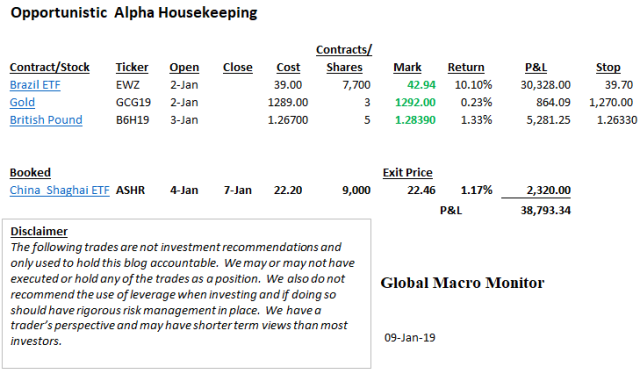
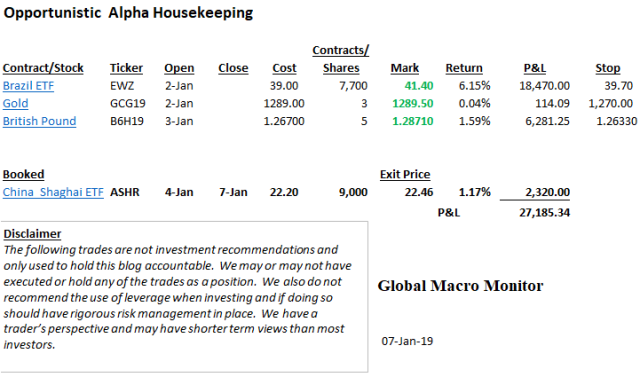
Probably the best way to play it is with the Country ETF, EWZ, with the buy trigger at break above the 50-day at $38.99, in our opinion. First upside target is $47.77. After the purchase, put in the first trailing stop at $36.20.
EWZ has been correcting after the almost 40 percent six-week runup into the election. The ETF could see a measured move to $47.77-$53.38 in a timeframe dependent on how global markets fare in January. Good risk reward with a potential 20-35 percent upside. Not a bad day at the office.
Caveat emptor: the medium-term political risk is elevated. Pension reform is a real political bitch, in all countries, and allegations of corruption continue to haunt even the Bolsonaro government. Moreover, Jair seems to have tied his future to President Trump, who is, at best, certain to have a rocky 2019.


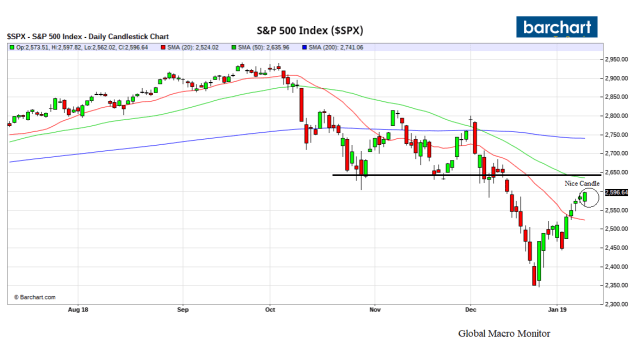
The S&P500 starts the New Year in a global bear market, which began at the end of last January, and sitting just a few points below a key Fibonacci retracement level at 2508.94. Interestingly, the New Year’s Eve rally could not hold that level.
Major technical damage to the S&P was done while we were out during the past few weeks. The close below the 2404.22 last week even puts the secular trend from the Mark of the Beast 666 generational low in play.
To the upside, we first need a close above the 2508.94, and then to take out the 20-day at 2476.95. Very doable.
Levels to watch on the downside are Friday’s low at 2472.89, a close below Friday’s close at 2485.74, Thursday’s low of 2397.94, the .50 Fibo at 2375.50, the 20 percent correction level at 2352.73, and the recent low of 2346.58.
Gun to head? Possible 2-5 percent more in the bounce for a trade, especially if China trade deal noise is turned up, but wouldn’t put medium-term money to work here. Capital preservation mode with a short trade bias and will reconsider if S&P recaptures its 50-day moving average at 2660.
Good luck in 2019, folks.


Dec.18 — Billionaire investor Stanley Druckenmiller discusses the outlook for the U.S. economy, his investment strategy for stocks and bonds, President Donald Trump’s attempts to sway Federal Reserve policy and the prospects for a solution to the U.S.-China trade dispute. He talks with Bloomberg’s Erik Schatzker.
Summary
Commentary: What’s up in 2019? More volatility. We expect a huge Rumble In The Jungle, especially after the attempted January rally fails. Stay tuned for the trades we think will work.
Note how wrong the market was on expectations on a Fed hike and a pause.


This will make for some nice New Year’s cocktail conversation.
Upshot? One gallon of gasoline = the energy equivalent of 54.7K Big Macs.
BFTP = Blast From The Past
OK, time for a little fun. You can try this and let us know if it works.
Almost everything today comes down to energy, right?
The rise in food prices is really nothing more than an energy problem. After all, food consumption is about the digestion of calories — one metric of energy measurement – to fuel the human machine.
Scientists have learned to “crack” the energy of foodstuffs, mainly corn and sugar, and convert these into transportation fuel. It gives new meaning to “cracking corn.”
If we could do the reverse and crack highly efficient refined fuels into foodstuffs, for example, we believe we have found the greatest arbitrage of all time.
The Energy Conversion Table below shows that one British Thermal Unit (BTU) is equivalent to 252 calories and one gallon of gasoline is equivalent to 125K BTUs. Therefore, one gallon of gasoline is the energy equivalent of 31.5M calories.
The energy component of a Big Mac without cheese, for example, is 576 calories, so one gallon of gasoline is the energy equivalent of 54,688 Big Macs. Still with us?
We’ve included the following table/matrix to show that if you drove 50 miles today in a car that gets 20 miles per gallon, you consumed the energy equivalent of 137K Big Macs. Yuck!
The last table, The Greatest Arbitrage Ever, shows the dollar price of a Big Mac in various countries (no wonder the Brazilians are now aligning with U.S. against China ‘s FX policy) and the Big Mac energy equivalent price of a gallon of gas. That is, one gallon of gas is the energy equivalent to 54,688 Big Macs and with the price of a Big Mac in Brazil at $5.26, the Big Mac energy equivalent price of a gallon of gas in, say Sao Paulo, is $287,656.25.
What an arb, no? Buying a gallon of wholesale gasoline in Rio for $2.45, “cracking” it into 54,688 Big Macs, and selling them at $5.26 for $287,656.25 sounds like a “splendid arbitrage” to us!
Fun exercise and we can’t wait for the e-mails from the economists on this one. Before you waste your time, remember, we’re not serious!
Forget about the noise of the last week. December and Q4 were an ugly finish to an ugly year. A lot going on underneath the hood. Stay tuned.