The Coming Political Earthquake(s)

Nation [ethnic groups] will rise against nation [ethnic groups], and kingdom against kingdom. There will be great earthquakes, famines and pestilences in various places, and fearful events and great signs from heaven.  – Jesus of Nazareth

OK,  folks, we will lay it on the anvil.

We are not afraid of being wrong, which is often the case, as we have internalized the key to longevity is to cut your losses quickly.   That is the essence of being a trader.  Nobody knows the future but you need to act as if you do in order to have the confidence to pull the trigger.

Furthermore,  we don’t suffer the recency bias from being wrong in the November 2016 election and therefore not afraid and don’t have to hedge our analysis.   If we are wrong, we move on.  Punto!

If women and the young turn out in November,  we won’t be, however.

Our conclusions are not influenced by our partisanship (though always impossible to exclude all bias) and not wishful thinking  but positive analysis based on the data, recent trends, and probabilities, sprinkled with some political intuition.

BREXIT ain’ gonna happen.  The political extremes on both ends have “woke” the sleepy and complacent middle, women, and the young.

We believe you will see the results in the upcoming “November to Remember” midterms.

I fear all we have done is to awaken a sleeping giant and fill him with a terrible resolve. — Japanese Admiral Isoroku Yamamoto (quote never confirmed)


Brext_1.png


A second vote on BREXIT is an uphill battle, but if the Trump administration gets “bitch slapped” in the November midterms the momentum and pressure for a new BREXIT vote will build, in our opinion.

Theresa May’s government has ruled out a second referendum on membership, saying it would be an undemocratic denial of the result of the June 2016 Brexit referendum, which voted 52-48 in favour of leaving. The main opposition Labour party also officially remains opposed, although Keir Starmer, shadow Brexit secretary, last month said the party had not ruled out supporting a new vote.   – FT

Young Voters The Key In The U.S. November Midterms

It’s all up to young voters turning out in November.  If they would have voted in the first BREXIT referendum, we wouldn’t be having half of  this conversation.

It has been estimated that only 36 per cent of people in the 18 – 24 year old category voted in the EU referendum. 64 per cent of young people did not bother to take themselves down to the polling station and place their vote  – Independent 

Gen Z

It does look like the youth are finally getting fired up, at least, in the States.

So far, the data point to a surge in political engagement, intention to vote and outreach between friends to encourage voting. Gen Zers may be voting for the first time, but they are certainly not new to politics.  – The Conversation

Millennials

The jury is still out on whether their older brothers and sisters, the millennials, will get off their arse and get to the polls.

In the 60+ age demographic, almost 90 per cent of eligible voters cast their ballots, but, at the other end of the scale, only 25 per cent of millennials took the time to vote.  – Global News

Bad freaking citizenship, millennials.  Do they enjoy being slaves to their senior political taskmasters and enjoy laying down in the Clash of Generations?   Just askin’.

Indeed, if there is one sentiment that unites the crises in Europe and America it is a powerful sense of “baby boomers behaving badly” — a powerful sense that the generation that came of age in the last 50 years, my generation, will be remembered most for the incredible bounty and freedom it received from its parents and the incredible debt burden and constraints it left on its kids. – Thomas Friedman, NY Times

Brext_4


Moreover,  millennials have no right to complain the leadership of the Democratic Party is dominated by septuagenarians, octogenarians, and soon to be, nonagenarians.   Shut up and vote!


Brext_3


The Lavender Wave

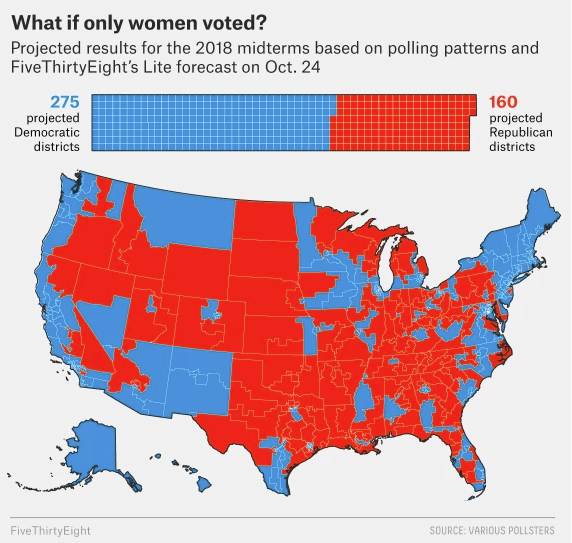
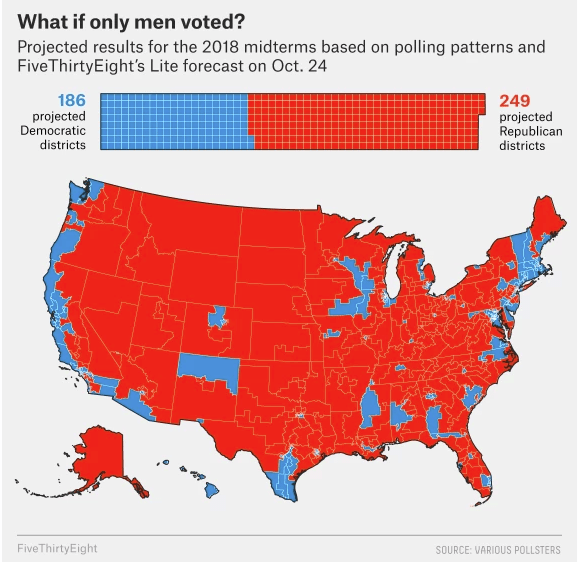
We are expecting a Lavender Wave (pink plus blue) in the November midterm.  The die is cast with the women’s  vote,  now let’s see if the young show up.

The political arithmetic seems pretty simple to us.   Women and the young will Trump old white men, that is if they show up.

  • Women vote in higher numbers than men and have done so in every election since 1964. In 2016, 9.9 million more women than men voted. Women have voted at higher rates than men since 1980. In 2016, 63.3% of eligible female adults went to the polls, compared to 59.3% of eligible male adults. Even in midterm elections, when voter turnout is lower among men and women, women vote in higher numbers and at higher rates than men.
  • More women than men register to vote. Some 83.8 million women were registered to vote in 2016, compared to 73.8 million men.   –  Footnotes


Blue Wave_2


The Young And The Left

Socialism_Feb19


Simple math.  Where are we wrong?

After the November to RememberEXIT the BREXIT will take center stage.

The political tectonics are about to shift, folks, and you heard it here first.

No Sugar Coating It

Our recommendation to the one percenters and the comfortably numb retired baby boomers, who have bequeathed to and saddled the younger generations with massive pension and public sector debt liabilities?

You better Wake The F&*k Up!  – Global Macro Monitor,  Feb. 20, 2018

By the way,  not priced.

Posted in Politics, Uncategorized | Tagged , , | 6 Comments

Sector ETF Performance – October 19

Sector_ETF_Day

Sector_ETF_W

Sector_ETF_M

Sector_ETF_YTD

Posted in Sector ETF Peformance, Uncategorized | Tagged , | Leave a comment

Global Risk Monitor – October 19

RiskMon_1


RiskMon_2

Posted in Daily Risk Monitor, Uncategorized | Tagged , , , , , | Leave a comment

On This Day In History: The Fed Put Is Born

Or, at least, went into labor.

Stock Market Crash_5


Stock Market Crash


Wow,  three decades and one year today, I was a young economist at the World Bank.  My friend and I, now the chief economist at the FDIC, were graduate students and walked by the White House on our way to lunch.  The stock market was down somewhere between 5-10 percent in the morning.  I looked through the gates on Pennsylvania Avenue and thought to myself, “I wonder if President Reagan is up to the challenge.”

My Boss In The Oval

The president was 76 years old, and rumors were floating around he was already losing it.  Little did I know, I would be working for the man who was briefing the POTUS in the Oval about the crash on that morning just a few years later at a major money center bank.

He was the Deputy Secretary of the Treasury, who was acting Secretary on Black Monday as James Baker was in Europe beating up on the Germans over exchange rate policy.

Over lunch in 1989 or 1990, my boss shared with me the play-by-play in the Oval on October 19, 1987.  He said President Reagan was sharp, impressive, calm, and proactive, jumping up from his desk, “What do we need to do to calm the markets?”    How America misses that kind of leadership even if you agreed with the president’s policies and politics, or not.

Money & Banking Class

I was also a young adjunct professor at George Mason University teaching money and banking courses.   I had been warning my students that a major crash, as in 25 percent, was highly probable.

I think my classes were on Tuesday and Thursday.  I walked in the next day after Black Monday  and they were impressed.  Interest rates were spiking for almost a year, and coupled with the increased volatility, which began in August after a two-year stock run, almost straight up, were clear warning signals.

The stock market was in a speed wobble and free fall even before it crashed.  Ditto for 1929.

I also can’t remember any of my students’ names but one was a big blonde dude, very bright, and another a young woman who said she worked at the C.I.A..  I can’t remember the exact details of the path of how I walked to class that day,  or any of my students name, but I am 100 percent certain it took place, Senator.

One In A Zillion? 

WTF?  Wasn’t the volatility spike on October 19, 1987 like a one in 11 billion probability, or something like that?

I later worked with options traders who were short calls on the OEX that day and lost money, so they said.   The vega (volatility derivative) swamped the delta causing the price of the call option to increase in price even as the price of the underlying fell over 20 percent.  That is frickin’ hard to believe.

The Morning After

The next morning, Terrible Tuesday,  the market was still in free fall.  Volume had already exceeded the prior day.  No bid.  The market makers were abandoning ship, some were thought to be insolvent.

Many Wall Street firms put pressure on the NYSE to close the market but President Reagan, under pressure from the Fed, would not allow them claiming executive privilege.

…the president of the United States would very much prefer if the New York Stock Exchange could see its way clear to remain open.”  – Howard Baker, Chief of Staff

All of a sudden, I believe after lunch, a phantom buyer came into Chicago and bought the Major Market Index (MMI), which stabilized prices and the market hasn’t looked back since.   Market psychology is a real bitch sometimes.

Thank you, Alan Greenspan.   Can’t say for sure it was him and them but it is widely believed to be the birth of the Fed put, and later the Plunge Protection Team (PPT).

Recall, the Dow didn’t recover its September 1929 high until 1954.

Now The Addiction

The problem now is we are addicted to and expect the Fed crack or Xanax with every little market hiccup.  The economy, and, now, especially, monetary policy are determined, in large part,  by asset prices.

It’s stunning to see the POTUS and pundits, such as Jim Cramer,  whining the Fed is “too crazy tight” when the real effective funds rate is still negative.

REEFR_2

Crazy stupid.

Posted in Black Swan Watch, Equities, Uncategorized | Tagged | 35 Comments

Fighting Back 2.0

Cruel scene, but love the fight back.

Trophy this, D-bags!  You go, Dumbo!


Posted in Uncategorized | Leave a comment

Chinese Stocks Have Been Shanghaied

Shanghai – term describing a type of kidnapping.  Back in the 17th and 18th century in back alleys behind orphanages and bars there were trap doors that were watched and opened on drunken people or wandering children, then the children or drunks were beaten up until unconscious and brought aboard a ship to do slave labor out at sea until they died.

“we need one more crew member, let’s shanghai some drunk fuck.”   – Urban Dictionary 

What a warped world.

Shanghai ugly.  Trap door in the definition above is spot on.

The index is now down 30 percent from the January high.

China is not an asset dependent economy as is the U.S., therefore the stock market has less an impact on growth.  You can see from the monthly chart, the Chinese have seen this picture before.   Huge speculative spikes, gravity finally takes over, then the proverbial dead cat bounce.   Wash, rinse, repeat.

Monthly chart looks like the Shanghai Composite is headed for the 2,000 support level, another 20 percent lower.

China is still a command economy, folks.  Remember that.


Shanghai_1

Shanghai_2

Posted in China, Equities, Uncategorized | Tagged , | 2 Comments

Free Ride Is Over: China & Japan Bailing On Treasuries

We had a request to look at the annual change in foreign holdings of U.S. Treasury securities as an addendum to our post from last night.

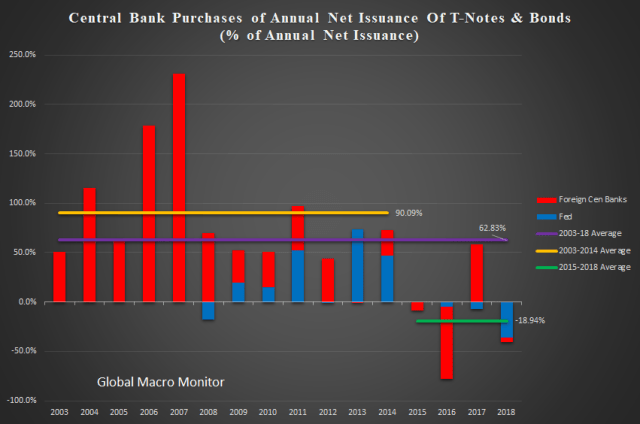
It’s clear the two largest foreign creditors to the United States government are pulling the plug.  Not so much dumping their trillion dollar plus stock of holdings but engaging in slow sales and definitely no more net buying.

Not good at a time when the U.S. budget deficit is exploding and set to run a trillion hole as far as the eye can see.   At least, until the market has other ideas.

Also, interesting is the sharp decline in flows from the Cayman, which are the hedge funds domiciled offshore.

Expect the hole from China and Japan, and especially the central banks, to be plugged by capital flows diverted from the marginal emerging markets, and we suspect lower credit quality corporate bonds.

The U.S. government will be funded but will have to pay more — maybe much more  as the price-insensitive central banks are no longer the alargest buyers but now sellers —  and at the expense of the other borrowers.  The classic crowding out issue.

Central banks and foreigners have accumulated almost 75 percent of the  stock of marketable notes and bonds.  That liquidity is/has  dried up,  folks.   America First soon to be America Thirst?

The budget mess is also starting to get loopy.  That is higher interest rates = higher interest payments = higher deficits = higher borrowing requirements = higher interest rates…  Wash, rinse, repeat.    Yes, Mr. Vice President, deficits do matter when they have to be financed by normal means.

The free ride is over, Edgar, and winter is coming.

TIC_12


TIC_10


TIC_6

Posted in Bonds, Capital Flows, China, Japan, Uncategorized | Tagged , , , | Leave a comment

“The Reign Of The Middle-Aged White Men Is Over”

Yikes!  Sounds like a House Of Cards,  Claire…   Just, maybe, it is.

It’s dark but so is the real thing currently.   House of Cards is one reason why  NFLX is up in a down tape today — superb original content.  However,  Netflix’s library of old movies suck, in our opinion.

The question is will Reed redeem the Underwood Washington in the final season?


House_of_Cards.png


Posted in Politics, Uncategorized | Tagged , | Leave a comment

China and Japan Continue To Reduce Treasury Holdings

The U.S. Treasury just released the August TIC (Treasury International Capital) data at the market close.

The key takeaways:

  • China and Japan, the U.S. government’s two largest foreign creditors, continue to reduce their Treasury holdings, both down $6 billion in August
  • Chinese and Japanese flows into Treasury securities have reversed over $200 billion from the same period in 2017
  • Foreign central banks, who hold almost 33 percent of marketable notes & bonds, holdings are down $4 billion from Jan-Aug ’18 versus a positive $238 billion in same period last year
  • Foreign central banks did increase their holdings of Treasuries by $24 billion in August, however
  • Brazil led net increases with an $18 billion increase in Treasury holdings in August
  • Ireland was second, with $16 billion, which leads us to believe that U.S. corps continue to stash capital offshore
  • More than 50 percent of the stock of U.S. Treasury notes and bonds are still held by price-insensitive central banks, though that profile is changing
  • Central banks and foreigners own almost 75 percent of marketable Treasury notes and bonds

Upshot

Markets are way too complacent, and the Trump administration is too cavalier about the economy’s increasing vulnerability caused by its dependence on foreign financing of the government’s exploding budget deficits.

Check out the trends in the data and then do the math.

With the budget deficit exploding, coupled with the Treasury having to raise an additional $300 billion plus/or minus per year to pay back the Federal Reserve as it rolls off its balance sheet, the supply of marketable Treasury securities hitting the market over the next few years will be unprecedented.

At the same, time the “free financing” of deficits provided by the central banks, including the Fed and foreign central banks, is over.   Not to mention the other factors which have kept rates low are fading.

Stay tuned!


TIC_7


TIC_1


TIC_6

Posted in Interest Rates, Uncategorized | Tagged , | 1 Comment

Social Security In Deficit = More Public Treasury Borrowing

Summary

  • Largely ignored by the markets,  Social Security moved into structural deficit this year
  • Social Security has been running primary deficits since the GFC; that is financing itself by the interest earned on Treasury securities
  • The government will no longer be able to borrow from the Social Security Trust Fund ( Old-Age Survivors Insurance (OASI) Trust Fund) to fund its on-budget deficits
  • The Social Security Trust Fund financed more than half the U.S. budget deficit during the mid-2000’s
  • The result will be more market supply of Treasury securities and upward pressure on interest rates
  • This post is an excerpt of our Sep 23rd post, The Gathering Storm In The Treasury Market 2.0

We suspect our Sep 23rd beast of a post,  The Gathering Storm In The Treasury Market 2.0,  was TLDR – Too Long, Didn’t Read.  One famous blogger said of it, “This post is so big, you can see it from space.”   We feel it was an important read for any market watcher as the 10-year T-Note yield is the most important price in the world.

In that post we which laid out why several factors which have kept U.S. long-term interest rates low and repressed term premium suppressed are fading,

Impatience and ADD equals missed opportunities,  as we wrote in the summary bullet points,

  • The yield curve is flat for technical reasons, and we believe term premia will increase
  • We expect a measured move in the 10-year Treasury yield to 4.25 to 4.40 percent, much sooner than the Street anticipates  – GMM, Sept 23rd

That was just before the 10-year yield broke out.

We are going to slice and dice the that post for an easier read for those of us use to 140 280 characters.

We named four significant factors that were changing and set to move long-term interest rates higher and increase the term premium.   This post extracts and focuses on the little noticed fact that Social Security has moved from surplus to deficit this year and the impact it will have on the Treasury market.

More than 70 million baby boomers are in the process of retiring and Social Security and Medicare are projected to run an  $82 trillion cash deficit over the next 30 years

Posted on September 24rd

Social Security Now In Deficit 

Another significant structural change in 2018 is that Social Security (SS) has moved into structural deficit.  In fact, SS began running a primary deficit (noninterest income less payouts) just after the GFC.

Treasury_SocSec_Projections

Source:  Social Security Administration 

Our chart below shows the U.S. government ’s off-budget balance, which only includes social security and postal service, the federal entities protected from the normal budget process, and excluded from budget caps, sequestration, and pay-as-you-go requirements.  The postal service is a tiny fraction of the balance.

Treasury_Off_Budget

The important takeaway is that the social security surpluses were used to build asset or reserves in their two trust funds:

1) Old-Age Survivors Insurance (OASI) Trust Fund, which pays retirement and survivors benefits, and 2) Disability Insurance (DI) Trust Fund, which pays disability benefits.

If one looks past the cash flow transactions to the impact on actual payments to and from the public, it becomes clear that an increase in trust fund reserves will be associated with a decrease in publicly held Treasury securities. That decrease in turn reduces the Treasury’s current cash needs for interest payments to the public and its need to borrow to make those cash payments.
– Social Security Administration

The large surpluses before the GFC (see above charts) provided a sizeable portion of the financing of the government’s on-budget deficit.   For example, the off-budget surpluses from 2002-2008 averaged $173.5 billion per year, which financed, on average, 40 percent of the on-budget deficits.

In other words, social security provided the U.S. government with a significant free-ride of deficit financing, and took substantial pressure off the markets, keeping interest rates low.

The next chart illustrates how the Treasury is becoming increasingly dependent on market financing as the social security surpluses faded and are now in deficit.  Marketable debt currently makes up 71 percent of the over $21 trillion total public debt versus  49 percent in 2007.


Treasury_%_Marketable_GAS

The upshot?  More relative issuance of Treasuries into the market and pressure on interest rates to increase and to crowd out other borrowers.

Posted in Fiscal Policy, Interest Rates, Uncategorized | Tagged , , , | 3 Comments