




At least, not yet.
President Trump did the right thing by canceling the SecState’s visit. He signals that the U.S. can’t be played, and he won’t be duped into diminishing the U.S. role in the region while the Chinese grow stronger. Don’t get us wrong, we would love to see a good deal with Korea.
Our Base Case Playing Out
We took much grief for our skepticism on a quick de-nuke deal with North Korea.
In fact, it looks like our base case scenario is playing out. From our post, Trump Says Unified Korea Could Happen,
Do you think President Trump has consulted with President Xi about a unified Korea?
It is highly doubtful China will allow a unified Korea, one under Western influence.
Different Scenarios
Our best case scenario is the South and North move closer together, but also closer to China. China’s influence and power in the region is on the rise while the U.S. is in decline.
Our base case is no “complete denuclearization”, lots of happy talk, some arms control and integration, including cross-border labor and travel between the North and South, and a slow positive trend moving away from the status quo.
Our low case (which has a much higher probability than the best case, in our opinion) see here and scroll down to Segue To Korea. The upshot is the Trump-Kim summit ends in a complete debacle.
Why is Kim at the table? Because he now has the nukes and delivery system.
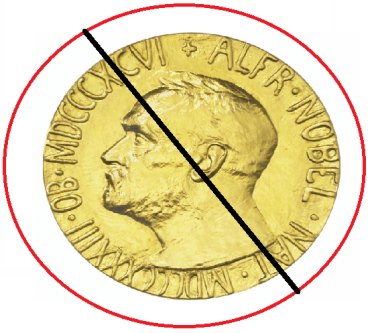
Time to curb your enthusiasm for a Trump Nobel Peace Prize. – GMM, April 28th
Some of our other comments on North Korea,
Trump Plays Checkers, Xi And Kim Play 3-D Chess
President Trump may have finally had an epiphany that China’s President Xi and Kim Jong Un are engaged in three-dimensional diplomacy and may be playing him. After today’s press conference it sure sounds like it.
We have been pounding the table about this in several posts over the past few months. See here, here, here, and here.
President Trump is learning by doing, Lord Palmerston’s dictum, “in international relations, there are no permanent friends or permanent enemies, only permanent interests.” – GMM, May 22nd
“Déjà vu All Over Again” In Korea
Curb Your Enthusiasm
George W. doesn’t have a Nobel Peace Prize that we know of.
We also hope it is not an all or nothing negotiation with Trump and Kim. The environment seems ripe to make the world safer and the lives better for the Koreans even if it just incremental and without achieving total victory as the administration sees it. – GMM, April 29th
QOTD: North Korea Deal Or China Deal?
Kim Jong-un was in Beijing Tuesday talking strategy with Xi; there frankly won’t be a deal between North Korea and the U.S. without the Chinese leader’s blessing. So what does Trump want more: a “deal” with Kim Jong-un, or a fight with China? – GMM, June 19th
China In Charge
Let’ face it, folks. China is pulling the strings behind the curtain.
No coincidence, at least in our minds, that Pompeo’s visit is canceled the day after the lower level trade talks with China ended with no progress and Xi’s retaliation tariffs kicked in.
We get it.
Jeff Gundlach (we are some of his biggest fans) is a trader at heart, as are we, and is very cognizant of short-term market technicals.
He recently tweeted,
However, it was only June he stated
So it’s eye-catching, then, that Gundlach reiterated in a webcast on Tuesday his call that the 10-year Treasury yield would rise to 6 percent by 2020 or 2021. “We’re right on track” for that, he said. As a reminder, that would be the highest yield since 2000.
His reasoning is fairly straightforward. The combination of rising U.S. interest rates and fiscal deficits is like a “suicide mission,” he said in the webcast, escalating the intensity from last month when he referred to the trend as a “pretty dangerous cocktail.” Ultimately, the debt burden will rise to such a level that borrowing costs will surge, in his estimation. That hasn’t happened yet because ultra-low German yields are capping how much Treasuries can sell off. – Bloomberg
Wow, 6 frickin’ percent!
Two Views Are Consistent
We are with Jeff.
In the near term, the bond shorts may be scorched (or may not) with their record off-side position but given time long-term interest rates are going much higher than the markets believe. Deteriorating flow technicals will bring term premia back with a vengeance.
European Bond Bubble
The trigger will most likely be the bursting of the European bond bubble.
The Portuguese 10-year trading at 100 bps through the 10-year U.S. Treasury? Come on, man, Are you serious?
When Super Mario takes his foot off the pedal, turn out the lights on those holding the Spanish 2-year at -0.327 percent, or the 10-year bund at 0.34 percent.
Dr. Ed recently wrote,
The Bond Vigilante Model suggests that the 10-year Treasury bond yield tends to trade around the growth rate in nominal GDP on a y/y basis (Fig. 1). It has been trading consistently below nominal GDP growth since mid-2010. The current spread is among the widest since then, with nominal GDP growing 5.4% while the bond yield is around 3.00% (Fig. 2). – Ed Yardeni
German nominal GDP is also running around 5 percent, and the 10-year bund is trading at 34 bps. Totally absurd. Kafkaesque.
But, hey, that is the market we are dealt, no?
QE Distortions To Work Off Slowly
The markets are so distorted by QE it is going to take some time to normalize interest rates and asset prices. The consequence may be some inflation headaches for the central banks over the next few years.
We are holding off on our piece on interest rates until everyone returns from the beach. Don’t want to waste our fastballs.
Stay tuned.
Ah, the good ol’ daze. This is hilarious.
President Clinton and President Yeltsin on the steps of Franklin Roosevelt’s home in Hyde Park. Go visit if you haven’t been there.
Like President Trump, they both seemed peeved at the press, but had a little more respect and didn’t weaponize their resentment.
Take the few minutes to watch. Yeltsin’s comments will crack you up as it did President Clinton.
It’s about to get interesting, folks.
We have been warning of the rising political risk.
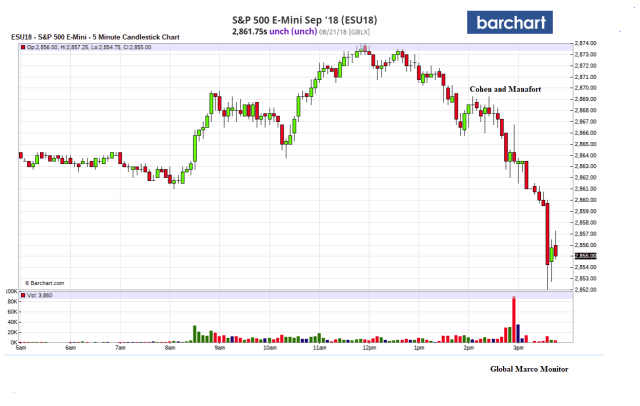
Cohen had struck a deal with U.S. attorneys in Manhattan’s southern district after months of court proceedings related to a raft of materials seized in raids on his office and hotel room in April.
Trump’s name was not used in the lower Manhattan courtroom, but Cohen made references to an unidentified “candidate,” at whose direction Cohen said he paid two women for the purpose of influencing the presidential election. – CNBC
Will Trump now begin to burn down Rome?
The market has been in hyperbolic discount mode of any political risks going forward, including the Dems retaking the House, all for just 50 S&P points of upside and a new nominal intraday high. Piss poor risk-reward, in our opinion.
This new chapter that began late today will last for some time, and who knows where it takes the country. Hoping for the best. Seat belts.
Stay tuned.
Videographic on the European Central Bank. After years of austerity, Greece emerged on Monday from its third and last bailout. The European Union, ECB and the International Monetary Fund loaned the country a total of 289 billion euros ($330 billion) in three successive programmes in 2010, 2012 and 2015.VIDEOGRAPHIC – AFP News Agency
Fowl Play? The Twisted Linguistics of Turkey
American turkeys and African guinea fowl, victims of Portuguese vagary, became inextricably mixed. Today the geographically garbled turkey is known as dinde (from poule d’Inde or chicken of India) in France, kalkoen (from Calicut hen) in the Netherlands, and indjushka (Indian bird) in Russia. The Turks, who knew it didn’t come from Turkey, called it hindi (from India). In Levantine Arabic, it’s known as dik habash (Ethiopian bird); in Malaya, ayam belanda (Dutch chicken); and in Cambodia, moan barang (French chicken). The Albanians, who hedged their bets, call it gjel deti (sea rooster).
– National Geographic
Fascinating to watch the younger market pundits declare the worst is over for the emerging markets.
The worst? NFW!
Temporarily oversold? We fully agree.
https://twitter.com/AnthonyBSanders/status/1030611873165725698
U.S. Monetary Policy
The dollar monetary tightening is the receding tide exposing those emerging market economies who have been swimming naked. Thus far, Turkey and Argentina have been caught in their birthday suits.

More Tightening Coming
It’s about to get worse, not better, folks.
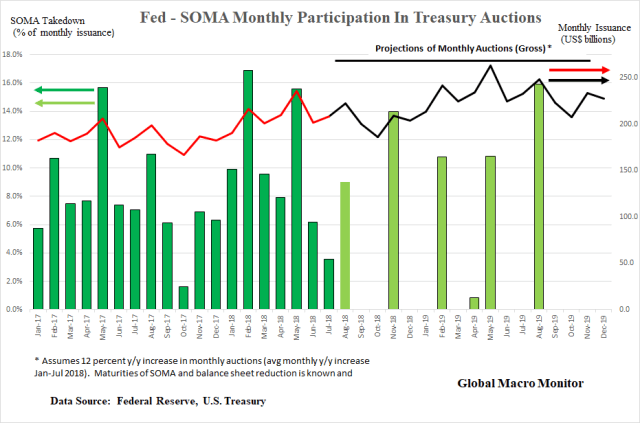
The rollover of the Fed’s maturing Treasury portfolio into the monthly 2,3,5,7, 10, 30-year notes and bond, 2-year FRNs, and 5-10-30 TIP auctions begins to drop-off significantly starting in September. That is very little Fed participation in Treasury auctions going forward. The Fed SOMA portfolio recently took down 11.85 percent of the 10 and 30-year auctions just last week.
The diminishing participation of SOMA as the funding needs of the U.S. government increase due to the explosion of the budget deficit, ceteris paribus, should put significant upward pressure on long-term interest rates.
Of course, safe haven inflows into the Treasury market in the event of a macro shock could upend our interest rate expectations. Moreover, the net short position in Treasury futures is at record levels and vulnerable to a short squeeze.
But that has been the case for quite awhile. Short squeezes are technical and by definition short-term in nature, and the crowd is sometimes right.
Thus, while economists and investors obsess daily over the flattening yield curve, we are are looking for it to begin steepening as it has been artificially flat and distorted by QE, both at home and abroad.
On The QT
Moreover, the Fed’s quantitative tightening cap steps up from $40 billion per month ($24 billion = Treasuries and $16 billion = MBS) to $50 billion ($30 billion = Treasuries and $20 billion = MBS) in October. That is the Fed will be draining a maximum of $50 billion per month of dollar liquidity starting in Q4.
Granted most will come out of excess bank reserves, but monetary policy is a complex and complicated beast. Nobody fully understands the consequences of the Fed’s actions and can pinpoint precisely the impact and timing on capital flows. This applies as much to the monetary authorities as it does to Joe Sixpack and Mrs. Watanabe.
Black Box
In other words monetary policy has always been and always will be a black box. Now more than ever as we are in the uncharted territory of unwinding quantitative easing. Indicator species become that more important to detect changes in the financial ecosystem. Emerging markets and commodities have traditionally been the first to suffer physical deformities when the global monetary screws begin to tighten and become binding.
Thus far, the drain of liquidity from the Treasury market is relatively close to the projective cumulative cap — $132 vs $131.6 billion actual (end-July). The SOMA MBS portfolio reduction is running only about 60 percent of the cumulative QT cap, which began last October, probably due to the erratic nature of the maturities of mortgage securities with prepayment uncertainty. The MBS portfolio has shrunk by $53.6 billion (end-July) versus the projected maximum of $88 billion.
63.4 percent Cum Probability of a 50 bps Higher FED Funds Rate By December
Then there are the further interest rates hikes to come. The markets are estimating a 96 percent probability the Fed hikes another 25 bps in September and a 66 percent probability of another 25 bps in December to a Fed Funds target range of 2.25-2.50 percent by year-end.
Turkey Lookalikes
Nice interactive table from Reuters BreakingViews on EM countries with macro vulnerabilities similar to Turkey.
Resembling Turkey is a problem right now. The lira’s alarming slide has made investors wary of any emerging country that shares too many of the same economic and financial vulnerabilities. The most similar, such as South Africa and Argentina, are already hurting. But even those with a less striking resemblance are vulnerable as capital flows out of riskier markets.
Breakingviews has identified some of the economic problems afflicting Turkey and ranked other emerging markets according to how vulnerable they are on the same counts. These difficulties include big budget and current account deficits, inadequate foreign exchange reserves, and too much debt issued in foreign currency. A relatively high proportion of overall debt held by outsiders is another weakness. – Reuters BreakingViews
It pains us to see Chile ranked so poorly as we worked on the country’s structural adjustment programs in the late 1980’s, and watched it become the superstar emerging market for 25 years. We suspect this is largely the result of being caught up in the trade wars and collapse of copper prices. We need to drill down deeper at the country level.
Feels Like 1997
We hope you had a chance to read our post, Feels Like 1997. It gives a good background on the current turmoil in emerging markets in the context of the 1997 Asian Financial Crisis. We also explore the danger of weaponizing capital flows.
Is The U.S. The “Ultimate” Emerging Market
Because the U.S. so dependent on external financing, we believe the use of capital flows as a weapon and tool of achieving policy goals will certainly backfire and eventually turn on the United States.
In fact, Adam Posen writes FDI into the U.S. has fallen to zero.
Beyond the cost of President Trump’s trade war with longtime US friends and rivals, his policy of economic nationalism has taken a toll in another important sphere: Net inward investment into the United States by multinational corporations—both foreign and American—has fallen almost to zero. As I pointed out in a posting in Foreign Affairs this month, this shift of corporate investment away from the United States will decrease long-term US income growth, reduce the number of well-paid jobs available, and accelerate the shift of global commerce away from the United States. – Adam Posen, IIE
Are portfolio flows into the Treasury market next?
Turkey dropped off the U.S. government’s list of major owners of Treasury debt, following in the footsteps of Russia in reducing its portfolio.
Turkey’s holdings of bonds, bills and notes have fallen 42 percent in the first half of this year, dropping to $28.8 billion in June, according to a Treasury Department report released Wednesday. Treasury has a floor of $30 billion to be classified as a major holder. – Bloomberg
It is difficult to definitively conclude that a country selling off it Treasuries is retaliation or financial weaponization. Economies with balance of payments difficulties, who are forced to intervene in their FX markets to prevent a currency collapse, by definition, suffer a reduction in international reserves, which are usually held in Treasury securities. Ergo their holdings of U.S. Treasuries decline.
Gold
A little sidebar.
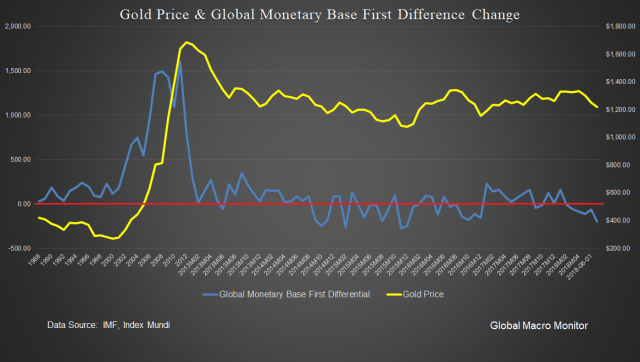
The reduction of international reserves in the emerging markets, the largest component of the global monetary base, is the major reason why we believe the gold price has been falling and continues to decline. See here to understand what many consider the surprisingly poor performance of gold in the current environment.
The Limits Of Quantitative Easing As A Bailout Mechanism
Nevertheless, the demand for a currency, even if it is the reserve currency, is not infinite nor is it permanent. American voters and policy makers need to put the country on a sustainable political and fiscal path, and do it soon. That is possible but not probable without a crisis.
Fed Bailout?
Don’t count on the Fed retreating from its tightening policy or bailing out the emerging markets just yet. Not until the glass really begins to shatter.
Raghuram Rajan, former governor of the Reserve Bank of India, in an interview with CNBC, said the Fed isn’t in a position to hold off on rate hikes.
“In 2013, when we had the last bout of volatility, the Fed stayed off raising interest rate for some time. It is not clear it can do that right now because we have inflation numbers in the U.S. gaining strength,” said Rajan, who in 2005 went to the Fed’s Jackson Hole retreat and warned that the global economy faced the risk of a meltdown from risky behavior in the financial sector.
“At this point, it seems to me the Fed is set on a path of rate hikes, and emerging markets will have to manage,” he added. – MarketWatch
Stay tuned.



