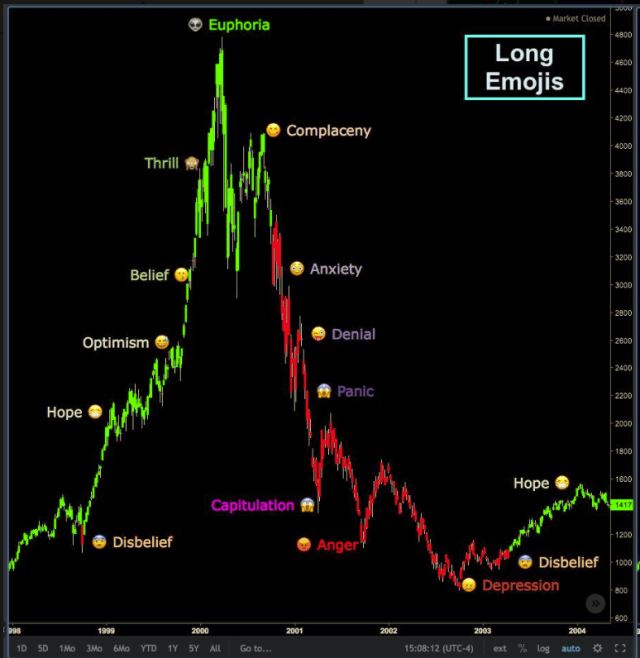
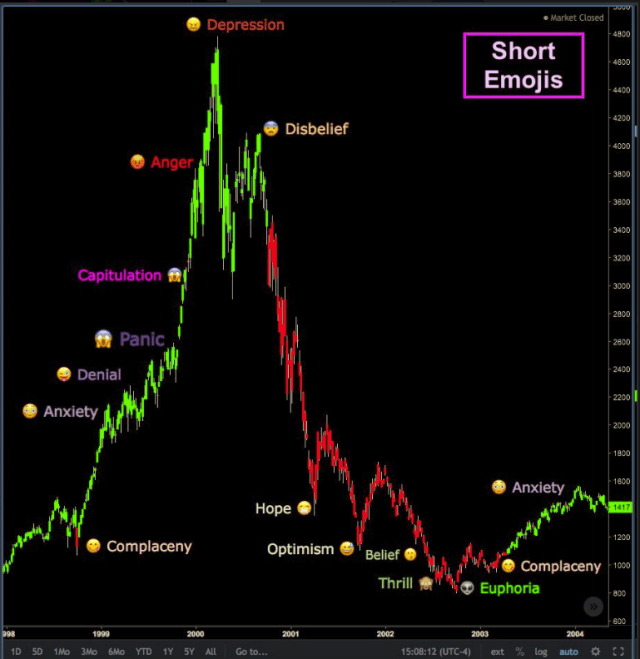
Tweet of the Day: Prophecy In The Comic Strips

Posted in Tweet of the Day, Uncategorized | Tagged , | Leave a comment

Week In Review – May 25

Summary

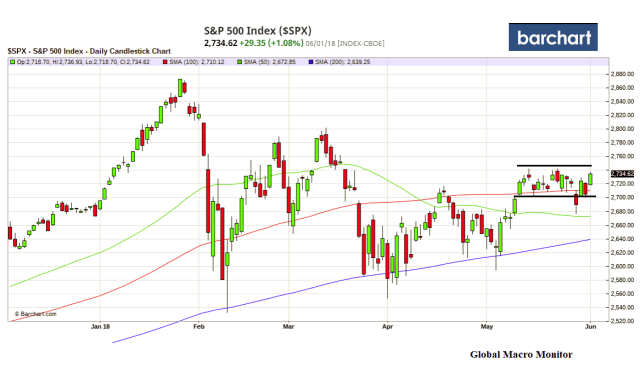
  • The S&P500 is trapped in a 2-week trading range between 2707 to 2742. Of note, 2742.92 is the 61.8 Fibo in the correction, 2702.78 the 50 percent level Fibo.  The 100-day moving average is also support at 2710.86.  Watch these levels
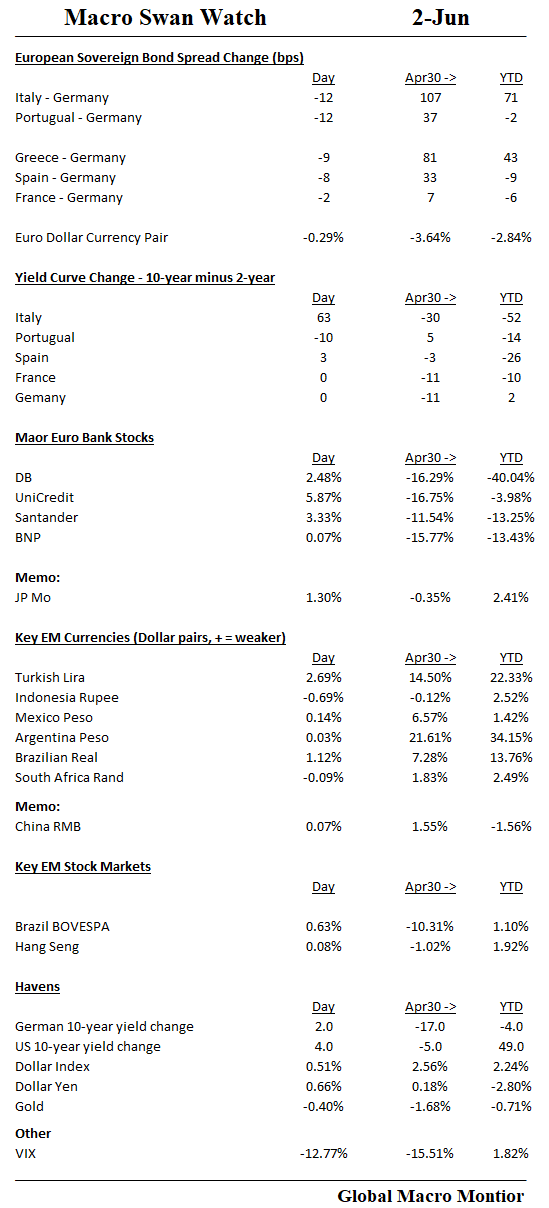
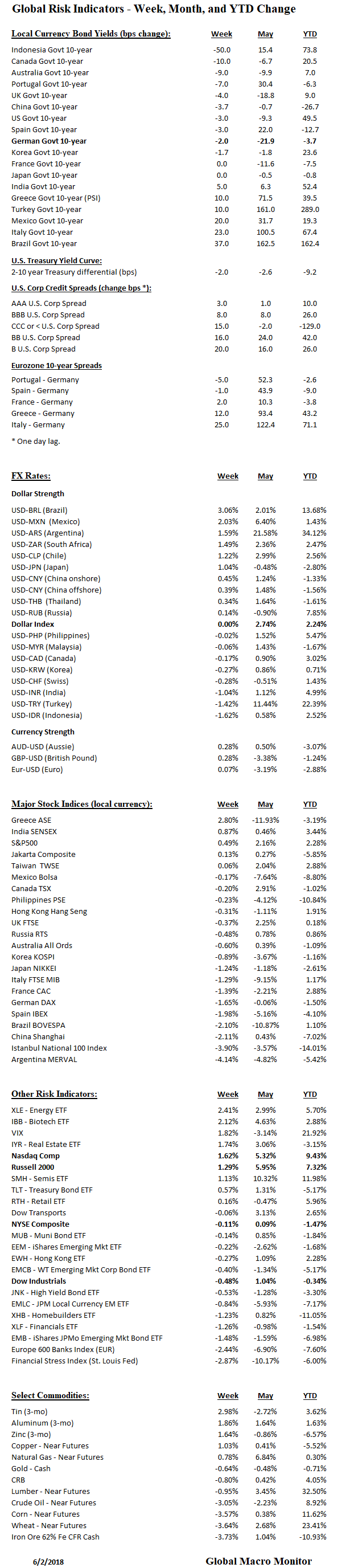
  • Big blowout in Euro periphery spreads, led by political and policy uncertainty in Italy, and Friday’s political tape-bomb in Spain. Italy sovereign spread out 40 bps on the week
  • Dollar index (60 percent euro weight) continues higher
  • Turkish lira pounded another 5 percent on the week and 24 percent YTD. Erdogan asks Turks to convert their foreign currency holdings to lira.
  • Other EM currencies stabilized, eking out small gains of around 2 percent
  • Big move down in 10-year bond yields in the majors. Flight to quality as macro swans gather
  • Bond yield spike in Brazil, Indonesia, and Italy
  • Global stocks relatively weak with big selloffs in Argentina, Brazil, and Italy
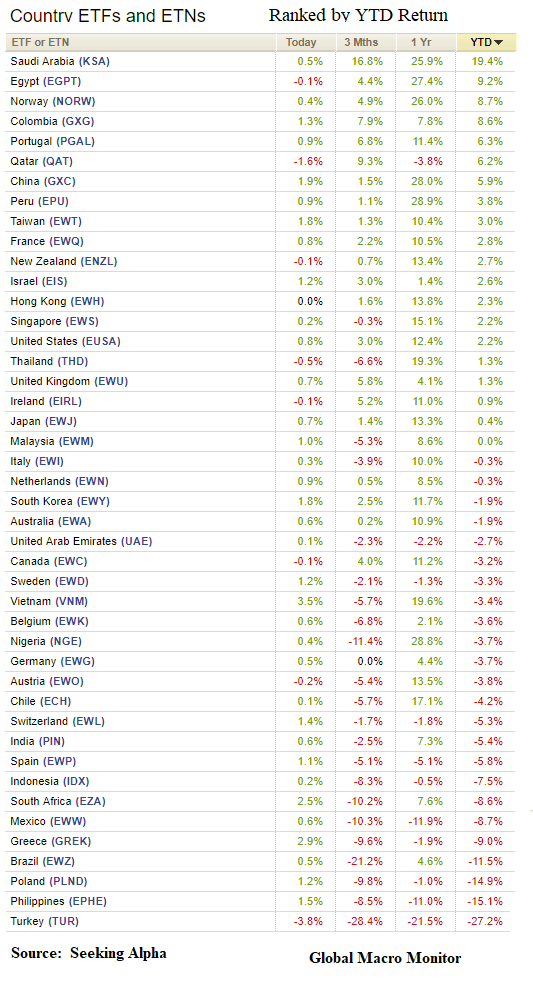
  • Saudi and Egypt country ETFs standout as only two with double-digit YTD return
  • JFK-Trump S&P500 analog had a big divergence this week. Friday marked 389 trading days since the election, and the  day of JFK’s S&P500 flash crash, taking the index down 6.7 percent on the day, and 11 percent over the five day period.  We can force fit the analog by changing start dates but will not.  Still on the shelf and will bring it out when it starts working again.  Note the Trump S&P500 has always lagged the JFK market over the history of the analog.


Weekly_Chart1


Weekly_Euro_Spreads


Weekly_Currency


Weekly_10-year_yields


Weekly_Recovery1


Weekly_Recovery2


Weekly_Bull_Bear


Weekly_2018_ETFs

Weekly_Table


Posted in Bonds, Uncategorized, Week in Review | Tagged , , , , , | Leave a comment

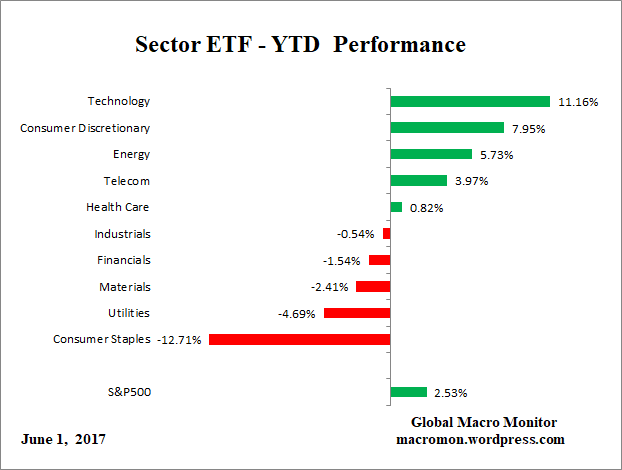
Sector ETF Performance – May 25

ETF_D

ETF_W

ETF_M

ETF_Q

ETF_YTD


Posted in Sector ETF Peformance, Uncategorized | Tagged , | Leave a comment

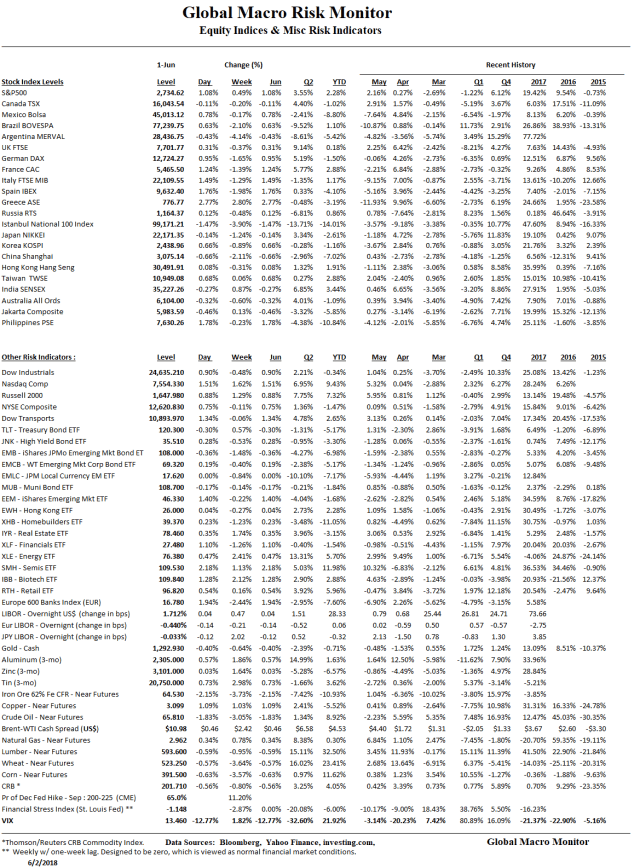
Global Risk Monitor – May 25

RiskMon_1

RiskMon_2

Posted in Daily Risk Monitor, Uncategorized | Tagged , , , , , , | 3 Comments

Get up and fight, sucker!

53 years ago today, one of the most iconic photos in sport: Ali vs Liston II, captured by the brilliant Neil Leifer – @MeredithFrost

May25_Ali


The ending of the second Ali-Liston fight remains one of the most controversial in boxing history. Midway through the first round, Liston threw a left jab and Ali went over it with a fast right, knocking the former champion down. Liston went down on his back. He rolled over, got to his right knee and then fell on his back again. Many in attendance did not see Ali deliver the punch. The fight quickly descended into chaos. Referee Jersey Joe Walcott, a former World Heavyweight Champion himself, had a hard time getting Ali to go to a neutral corner. Ali initially stood over his fallen opponent, gesturing and yelling at him, “Get up and fight, sucker!”  – BoxRec

Posted in Sports, Uncategorized | Tagged , , , | 1 Comment

When The U.S. Government Defaulted

One of the most pervasive myths about the United States is that the federal government has never defaulted on its debts. There’s just one problem: it’s not true, and while few people remember the “gold clause cases” of the 1930s, that episode holds valuable lessons for leaders today. – Sebastian Edwards, Project Syndicate,  May 21, 2018

My friend, UCLA professor,  Sebastian Edwards, is out with a must-read summer book, American Default: The Untold Story of FDR, the Supreme Court, and the Battle over Gold.


May24_Edwards


Sebastian has also published an excellent synopsis of the the book, Learning from America’s Forgotten Default, on the Project Syndicate (PS) website.   It is an excellent introduction to the subject material but only scratches the surface and should not be a substitute or excuse for not purchasing the book.

Money quotes from the Project Syndicate  piece:  

  • There was a time, decades ago, when the US behaved more like a “banana republic” than an advanced economy, restructuring debts unilaterally and retroactively
  • In April 1933, in an effort to help the US escape the Great Depression, President Franklin Roosevelt announced plans to take the US off the gold standard and devalue the dollar. 
  • …this would not be as easy as FDR calculated. Most debt contracts at the time included a “gold clause,” which stated that the debtor must pay in “gold coin” or “gold equivalent.” 
  • These clauses were introduced during the Civil War as a way to protect investors against a possible inflationary surge.
  • …the gold clause was an obstacle to devaluation. If the currency were devalued without addressing the contractual issue, the dollar value of debts would automatically increase to offset the weaker exchange rate, resulting in massive bankruptcies and huge increases in public debt.
  • Congress passed a joint resolution on June 5, 1933, annulling all gold clauses in past and future contracts.
  • Republicans were dismayed that the country’s reputation was being put at risk, while the Roosevelt administration argued that the resolution didn’t amount to “a repudiation of contracts.”
  • On January 30, 1934, the dollar was officially devalued. The price of gold went from $20.67 an ounce – a price in effect since 1834 – to $35 an ounce.
  • …those holding securities protected by the gold clause claimed that the abrogation was unconstitutional. 
  • Lawsuits were filed, and four of them eventually reached the Supreme Court; in January 1935, justices heard two cases that referred to private debts, and two concerning government obligations.
  • On February 18, 1935, the Supreme Court announced its decisions. In each case, justices ruled 5-4 in favor of the government – and against investors seeking compensation. 
  • Justice James Clark McReynolds… wrote the dissenting opinion – one for all four cases… He ended his presentation with strong words: “Shame and humiliation are upon us now. Moral and financial chaos may be confidently expected.”
  • …the 1935 ruling is invoked [today] when attorneys are defending countries in default (like Venezuela). And, as more governments face down new debt-related dangers – such as unfunded liabilities associated with pension and health-care obligations – we may see the argument surface even more frequently.
  • …the US government’s unfunded liabilities are a staggering 260% of GDP – and that does not include conventional federal debt and unfunded state and local government liabilities.
  • A key question, then, is whether governments seeking to adjust contracts retroactively may once again invoke the legal argument of “necessity.”
  • The US Supreme Court agreed with the “necessity” argument once before. It is not far-fetched to think that it may happen again.  – Sebastian Edwards

A Roadmap? 

There you have it, folks.

The good professor lays it all out, which may or may not be the roadmap for how the U.S. and other highly indebted governments resolve their ,massive and almost impossible to fulfill contractual obligations to both creditors and its citizens.   The Supremes have already ruled in favor of the government under the “necessity” argument.

Modern Monetary Theory (MMT)

Sebastian’s material gives us much ammunition in arguing with the Modern Monetary Theory crowd, who believe a sovereign government cannot and will never default on its local currency obligations if it has an independent central bank.    Of course, they will argue that FDR and the U.S. didn’t have an independent monetary policy because of its link to the gold standard.

Russia 1998

When we bring up Russia’s 1998 default on local currency GKO debt (David Tepper’s worst trade, BTW) the MMTs argue “special case.”

It seems to us the MMT crowd believe that because a government has an independent central bank and can always print money to payoff debt, they will never, ever experience rollover risk.  Complete nonsense.

Can you say Venezuela?

When a government experiences financing problems through a sudden stop in funding, the leaders must make a political decision on whom to inflict the pain.

Either default, which hurts their creditors, and who be predominantly consists of foreigners, as was the case in Russia in 1998; and is the case with the U.S. federal government marketable debt in 2018;  or monetizing the rollover, resulting in hyperinflation and wiping out domestic residents.

We have the first-hand experience of the latter and have written about it in many posts over the years,

We’ll also never forget being in the Bulgarian central bank in 1996 just before some very large maturities of treasury bills were coming due.  The market had lost confidence in the government and a high ranking central bank official looked us straight in the eye and said “we will not let the government default.”

We knew instantly a massive amount of liquidity was about to hit the local markets, the demand for the currency was going to collapse, and the country was headed for hyperinflation.   Rioting broke out, the government fell, and the country eventually implemented a currency board, not too dissimilar from  that of the Euro, in order to enforce fiscal discipline upon the government. – GMM, November 2011

We suspect when the day of reckoning comes for the United States to pay for its debt profligacy, it won’t be such a simple binary choice. There will be many and various types of public sector obligations in the queue to be paid, which may require differential treatment.

Sebastian’s example of the U.S. government default in the 1930’s is a combination of both.  The default on the contractual gold clause and the inflating away of much of the debt through devaluation.

This is tantamount to an emerging market government unilaterally and retroactively converting its foreign currency debt into local currency and then monetizing it, and supported by the legal system.

How would that work out for, say,  Venezuela dollar denominated bond holders?

Let’s hope our political leaders and policy makers come to their senses before that dreadful day is upon us.

Now take the few minutes to read the full article and go buy the book for some excellent beach reading. .

Posted in Bonds, Budget Deficit, Sovereign Debt, Sovereign Risk, Uncategorized | Tagged , , , , , , | 43 Comments

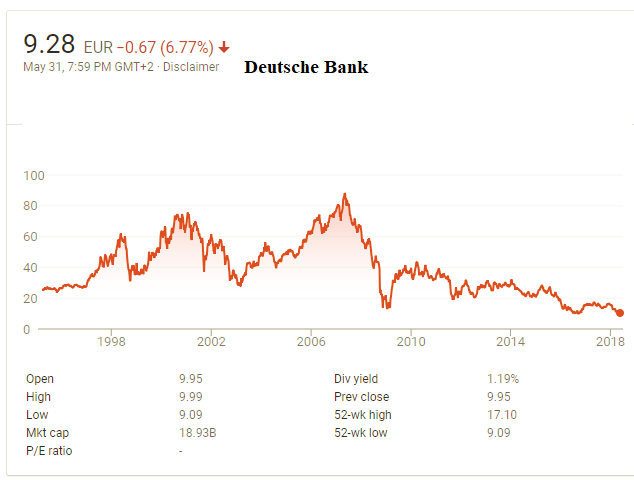
Swan Watch: Deutsche Bank Tanks

The markets are about €0.53 away from having a Jackie Moon moment when Deutsche Bank’s stock becomes a single digit midget (non-p.c., my bad).  As per September 2016, when it traded single digits for a few nanoseconds,  we are not so sure the financial authorities will allow it to get or stay there.

ZH out with a good piece today on the market dynamics when a TBTF bank — and Deutsche ranked the world’s most dangerous — stock enters the death spiral. Unpredictable nonlinear dynamics take over.

Watch this space.  Not even close to registering on the markets’ radar.

The macro swans continue to gather.


May24_DB

Posted in Banking, Black Swan Watch, Uncategorized | Tagged , | Leave a comment

Swan Watch: Italy’s New Prime Minister Faces Challenges

The macro swans continue to gather.

May24_German_Italy

Giuseppe Conte says he will be the defender of the people but faces a tough political task at home and hard negotiations with Europe

► Subscribe to FT.com here: http://bit.ly/2GakujT

Posted in Eurozone Sovereign Spreads, Italian Yields, Uncategorized | Tagged , , | Leave a comment

The New Supply-Side Of Housing & Landlord Nation

David Stockman tweeted the following Zero Hedge chart this morning.

May23_Home Sales

Clearly, a shift in the supply curve for new homes to the left.

OK  – and some buying at irrational prices fueled by artificially low-interest rates and excess money.  The irrational panic buying will take care of itself as interest rates rise and the Fed reduces its balance sheet making money tighter.

This is not the highly leveraged housing market of 2006-07, where even our range boy at the local golf club owned mortgaged three homes, quit his job, and bought an Escalade financed by a home equity loan (true story).   This market is driven primarily by restricted supply and will be more difficult to pop.  The price adjustment will also take place over a much longer period.

The New Supply-Side Economics Is Not Good

We have written how private equity has taken a yuuuge supply of existing homes off the market through their mega 2012-14 bankruptcy purchases, and now rent out the homes to the same people they foreclosed on.  Existing housing is a perfect substitute for new homes.

Rising Costs

The rising costs of building, primarily labor shortages in the construction sector, and restrictive zoning laws are constraining building and the supply of new homes.

The lack of enough skilled workers and a narrow talent pipeline has added extra hurdles, time, and costs to many current projects, according to builders, hindering the current boom time in the industry.

“The number one issue is the cost and availability of labor,” says Randy Strauss, owner of Strauss Construction in Amherst, Ohio, roughly 40 miles east of Cleveland.

The issue is a nationwide one. Contractors in areas such as Houston, which were battered by Hurricane Harvey last year, have struggled to staff up, and the National Association of Home Builders recently found that 82 percent of its members believe the cost and availability of labor are their biggest issues. In 2011, only 13 percent named labor costs as their biggest worry.  — Curbed

The immigration crackdown has played a significant role in the labor shortage in the construction sector.

One study from the National Bureau of Economic Research found that over 1.1 million undocumented immigrants, many of them skilled in essential trades such as framing, work in the construction industry.  –  CITYLAB

Lumber Prices

The parabolic rise in lumber prices isn’t helping either.  Lumber prices are down over 12 percent from last week’s high, however, with several days of limit down in the futures markets.  Look no further than the long-term lumber price chart to understand what tariffs do to prices and input costs, which ultimately hurt the majority.

Last April, the Trump administration placed a 20.83 percent tariff on Canadian lumber, to the benefit of politically valuable voters in Maine. Within the construction industry, these imports commonly turn into framing lumber, which is used to build single-family homes and small multifamily buildings.
– CITILAB

Bad timing by the administration unless you belong to the small minority of those who make their living in the framing lumber business.

May23_Lumber_Prices

Policy Relief Needed

Shortages are breaking out and are now ubiquitous throughout the economy.

The housing market is one of the hardest hit sectors.  Shortages of new and existing homes; shortages of buildable land, shortages of skilled construction workers.  Inflation is running rampant in the sector.  Yet it hardly registers in the inflation indices because of the way the government measures housing costs.

The new supply-side of housing (shifting the curve left)  is not working for most Americans.  Taking existing homes off the market for rentals or the restriction of new supply through rising input costs, labor shortages, and zoning restrictions are severely reducing affordability and turning the country into a  Landlord Nation.

Since most of the problems are policy-induced, they can be fixed by better and a more comprehensive housing policy.   That is getting back to the old supply-side economics of the Reagan era where the supply curve shifts to the right, illustrated in the simple graph below.  Lower prices with more supply of homes (P 2, Q 2).

Higher prices and lower supply may work for some, but it is certainly not good economics and only adds to an already toxic political environment.

It is time for disruption in housing.


May23_New Supply Side

Posted in Housing, Uncategorized | Tagged , , , , , | 22 Comments

Nonlinear Thinking: Robotic Sailboats

Wow, it’s been almost eight years since our first nonlinear thinking post.  How time flies.

Intelligent, indestructible and with no humans on board, these sailboats are plotting their own course through the waters of San Francisco Bay.  If Richard Jenkins gets his way, soon there’ll be hundreds of them – trawling the oceans for data.

Video by Victoria Blackburne-Daniell, David Nicholson – Bloomberg

Posted in Nonlinear Thinking, Uncategorized | Tagged , | Leave a comment