Who Is Financing The U.S. Budget Deficit?

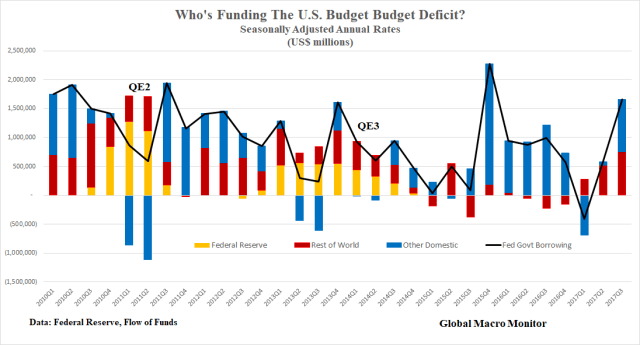
In case you missed it in our last post, here’s an interesting chart illustrating how the U.S. budget deficit has been funded since 2010 on a quarterly basis.  The data are annualized.

During QE2 and QE3, from Q4 2010 to Q4 2014,  the Federal Reserve indirectly financed 60 percent of the deficit on an average quarterly basis.  Add to that foreign financing,  mainly central banks, and the budget deficit was indirectly overfunded,  freeing up capital for other risk assets, and for bond prices to move higher.

We just calculated foreign purchases of Treasury securities from the TIC data in Q4 2017 at a negative $12.7 billion.   The market is waking up, though not yet internalized,  to the fact the easy money to finance growing U.S. budget deficits has gone away.   Also, the Fed and foreign central banks were not price sensitive and motivated in their purchases of Treasury securities by policy concerns.

Recall Greenspan’s bond market conundrum, where the Fed lost control of the yield curve during the housing and credit bubble as foreign central banks were recycling excess dollars back into the U.S. bond market.    Greenspan lays the blame for the genesis of the housing and credit crisis on this very fact and not ultra-loose monetary policy.

The U.S. government will now have to scramble to finance trillion dollar deficits as far as the eye can see with price-sensitive capital.  Unless foreign central banks start showing up again,  the U.S. financial markets will have a trillion dollar hole to fill each year, unprecedented in this new century.

Prepare for the resurrection of the old term,  “crowding out.”  Already showing up in the housing data.

Real interest rates have only one direction to travel.  North.


Budget_Feb26

Fed Funding The Deficit_Feb24


Posted in Bonds, Uncategorized | Tagged , | 8 Comments

Major Stock Index Recovery Percentages

Recovery_Feb26

Posted in Equities, Uncategorized | Tagged , | Leave a comment

Stocks And Bonds Now Joined At The Hip

Market Recovery

The U.S. stock market rallied Friday on the six bps decline in the 10-year Treasury yield.  The S&P500 has now recovered 63.09 percent of its peak-to-low loss.  We are looking for 2,805 on the S&P500 for a green light and believe this level can only be obtained and sustained with a decent bond market rally.  Unlikely, however, in our opinion.


Levels_Feb24


Stock And Bond Comovements

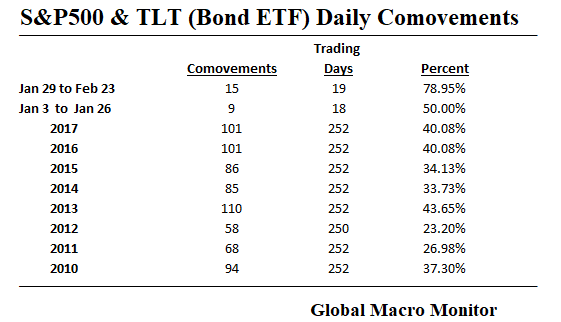
Since the correction began on January 29th, the S&P500 has moved the same direction with the bond ETF (TLT) 15 of 19 days or almost 80 percent of the daily moves.  The two had tracked each other this closely only three other times since 2002 when TLT was created (see chart).

The table below also illustrates their daily comovements over various periods.    The normal range is around 40 percent.  That is the S&P500 moves in the same direction of the TLT about 40 percent of the time on average.  In other words, long-term interest rates and the S&P500 have moved together about 60 percent of the time since 2010 before this recent correction.
Covmovements_Feb24


Comovements_Feb25


Regime Shift? 

Over the past three weeks, the relationship has reversed dramatically.  Rising interest rates are now an anathema to the stock market.     We believe this is due to market concerns about three major structural factors that are unlikely to fade anytime in the near future.

Debt Levels Are High

First,  the stock of global debt has increased as a percent of GDP over the past ten years in all sectors with exception of the financials.  The big increase has been in government debt though some has been offset by the G4 central bank debt purchases through their respective quantitative easing programs.

The corporate sector is also vulnerable to rising interest rates as their debt relative to the economy has largely gone to finance stock buybacks in the U.S. and dubious investments in China.

Debt_Feb25

Now that the debt fears are squarely on the radar of the stock traders,  the relationship between stocks and bonds has reversed and is likely to be sustained.   Rising interest rates will be now be a stiff headwind to stocks prices.   This wouldn’t be the case and the cheerleaders would be right that rising rates won’t hurt stocks, IF debt and valuation levels were not so high.  But that, of course, is not the case.

Funding Of The U.S. Budget Deficit

Second, fiscal promiscuity in Washington is likely to drive up U.S. budget deficits to over one trillion dollars per year as far as the eye can see.  Trillion dollar deficits are nontrivial especially in an expanding economy where money becomes more dear.

Moreover, the size of the annual U.S. deficits will exceed all but 12 of the 190 country  GDPs monitored by the IMF.   Foreigners have been a large buyer of U.S. Treasuries over the past 20 years.  Let’s hope they continue to show up at the auctions.


Who is funding the deficit_Feb25

Data Source:  FRB, Flow of Funds

The End Of QE

Finally,  the Federal Reserve has stopped its indirect monetization of the U.S. budget deficit.  The table below shows that during the period of QE2 and QE3, from Q4 2010 to Q4 2014,  the Fed financed on average over 60 percent of the U.S. budget deficit.  Add foreign financing (mainly foreign central banks) and the deficit was over financed during the period, repressing and distorting interest rates across the yield curve and freeing up capital to flow into stocks and other risk assets.


Fed Funding The Deficit_Feb24

Though the Federal Reserve still holds around 30 percent of the stock of outstanding Treasury securities,  their flow has turned negative as they are now running off their balance sheet.

Higher Rates

Growing deficits coupled with declining flows from financiers who have been insensitive to market rates will certainly put a strain on interest rates in the U.S., and it unlikely to dissipate anytime soon.

No doubt, there will be periods of short covering bond rallies and bouts of flight to quality, which will drive stocks temporarily higher, but make no mistake,  “We are not in Kansas anymore.”

The U.S. government is going to have to work a bit harder and pay more to attract capital to finance itself.   “Crowding out” will increasingly become an issue.  Nevertheless, the  U.S. government will get funded and crumbs will be left for other markets.

Foreign Buyers

We sense foreign buyers of Treasuries also sense this and have become a bit more tepid in their purchases and have on the margin been sellers of the dollar as the U.S. current account deteriorates    This is a change from prior periods where central banks would intervene in their foreign exchange markets and recycle almost all the excess dollars back into the U.S. bond market.  It could be they are also diversifying their stock of FX reserves.

European Bond Market

It is also important to keep and eye on interest rates in the eurozone.  The monetary hawks are circling Mario Draghi.  

It is baffling the German economy, which is probably growing at 4-5 percent in nominal terms, has a 10-year bond yield of .65 percent.  Granted the ‘zone is a two-speed economy with the North and South, but the rule of thumb is that long-term yields should be close to nominal GDP growth.

That puts the bund yield about 300-400 bps below its equilibrium value.  The European bond market is a disaster waiting to happen, in our opinion, and will certainly have a spillover effect in the U.S. bond and equity market.

Conclusion

The global economy is a complex adaptive system which nobody fully understands. We have laid out our analysis and there you have it, folks, our best guess without the cheerleading that every little sell-off is a BTFD opportunity.

Sometimes market hurricanes do occur and, though it’s not the end of the world, it is best to tread carefully and take shelter.  We take the recent volatility shock as a warning shot across the bow.

One Big Caveat

Even if all our facts are correct,  our conclusions may be completely wrong.

To illustrate this, we like to use the story that Abraham Lincoln used to tell to try and persuade juries when he was an Illinois circuit court lawyer.

The story goes that Lawyer Lincoln was worried he had not convinced the jury during the closing argument of a civil case against a railroad.   The jurors had gone to lunch to deliberate.  Lincoln followed them and interrupted their dessert with a story about a farmer’s son gripped by panic,

“Pa, Pa, the hired man and sis are in the hay mow and she’s lifting up her skirt and he’s letting down his pants and they’re afixin’ to pee on the hay.” “Son, you got your facts absolutely right, but you’re drawing the wrong conclusion.”

The jury ruled in Lincoln’s favor.

Posted in Bonds, Equities, Sovereign Debt, Uncategorized | Tagged , , , | Leave a comment

Week In Review – February 23

Bonds Are The Dog Wagging The Equity Tail

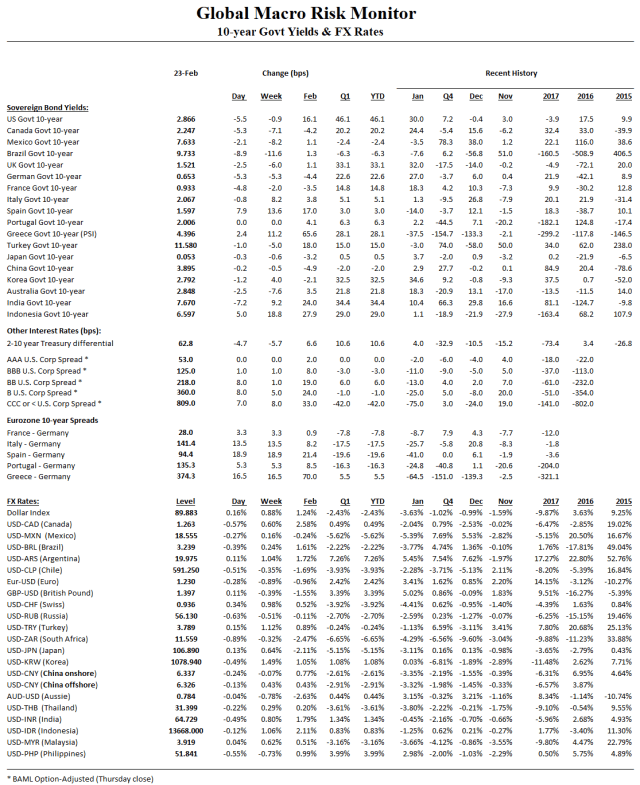
A relatively quiet week on a close-to-close basis as not much movement because of no move in the bond.  The bond-stock correlation is extremely high.   The bond and S&P500 have moved in the same direction in 15 of the 19 trading days during this correction, that is about 80 percent versus 53 percent for the current year before the crash and around 40 percent for the prior two calendar years.

The stock rally on Friday was clear evidence the bonds are the dog that wave and stocks tail.  The 10-year yield fell 5.5 bps Friday, and the S&P500 rallied 1.60 percent.

The S&P500 managed to close above the key 61.8 percent Fibonacci level.

Credit has not come back, and sovereign spreads in Euro periphery are starting to blow out probably due to worries over the March 4th Italian election.

Lumber prices continue to grow to the sky


JFK_Trump_Feb24

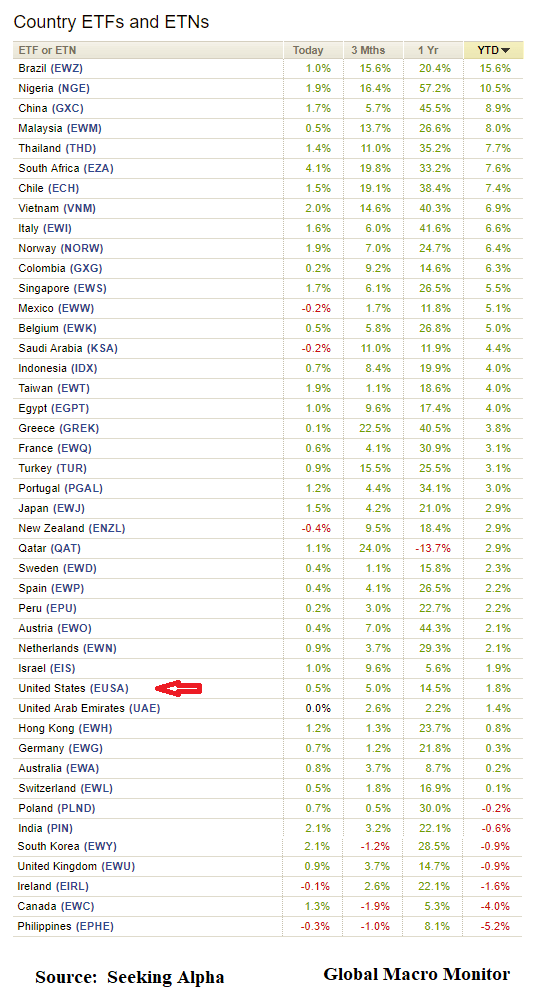
Week_2017_ETFs


Weekly_Table


Posted in Uncategorized, Week in Review | Tagged , , , , , | Leave a comment

Why Arming Teachers Is A Really Dumb Idea (In Pictures)

Sometimes you need a crayon to illustrate a simple point.  We will use pictures.

Where is your market?

AR15_Feb24.png

And one reason why we have this:

Police_Feb24

Looks like the useful idiots in Washington are still taking their dumb-dumb pills.

Pills_Feb24


Dum Dum_Feb24

Queen Victoria

Posted in Politics, Uncategorized | Tagged , , , | Leave a comment

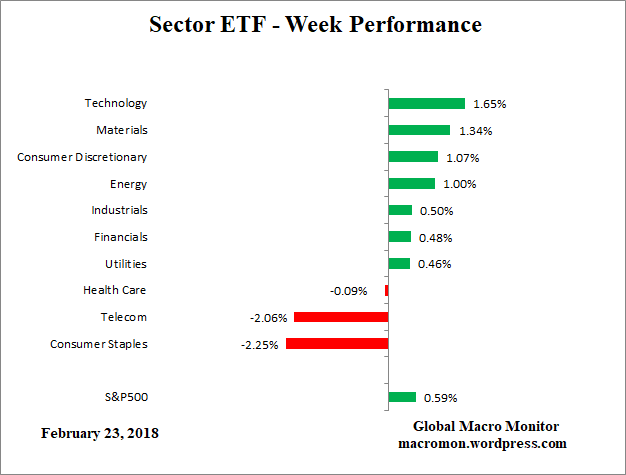
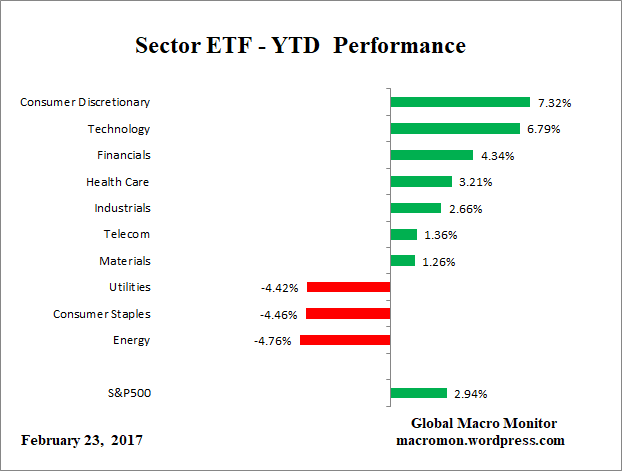
Sector ETF Performance – February 23

ETF_D

ETF_WETF_M

ETF_YTD

Posted in Sector ETF Peformance, Uncategorized | Tagged , | Leave a comment

Global Risk Monitor – February 23

RiskMon_1

RiskMon_2

Posted in Daily Risk Monitor, Uncategorized | Tagged , , , , , | Leave a comment

Jumping On The Comeback Karl Train

Wow!  Seeing more of Karl since our post:  Karl, The Comeback Kid?

Bloomberg just retweeted this:


Posted in Politics, Uncategorized | Tagged | 2 Comments

Manhatten Rush Hour Before Uber

Rush Hour_Feb22

Posted in Picture of the Day, Uncategorized | Tagged | Leave a comment

The Coming “Socialist Wave” – NRA

You heard it here first, comrades!

On Tuesday night we posted, Karl, The Comeback Kid?

We intended to point out  what may be coming over the next decade as job-destroying automation through artificial intelligence and robotics accelerates and drives the younger generation to the unemployment line and further political left.

While everyone is looking right at the rise of populist nationalism, they’re about to be hit with a 2×4 in the face from the left.   Called for the them to Wake The F.  Up.

Our recommendation to the one percenters and the comfortably numb retired baby boomers, who have bequeathed to and saddled the younger generations with massive pension and public sector debt liabilities?

You better Wake The F&*k Up!  – Global Macro Monitor

We do not mean the hard left socialism of Cuba and Venezuela but the softer gentler Nordic kind, as in Denmark, Norway, and Sweden.   That is capitalism with a vast and wide social safety with higher taxes.  Think Bernie Sanders.  

The swing left, in our opinion, will be the culmination of the Clash of Generations, when millennials wake up and realize they have been screwed.

No political statement, no agenda, just an observation and inference from the data.

Today’s NRA Rant

Now, others are jumping on the Comeback Karl train but with an agenda, however.


NRA_Feb22


The head of the NRA, Wayne LaPierre, unleashed a tirade today at the Conservative Political Action Conference (CPAC) warning of a “socialist wave” that is coming as a result of the Florida high school shooting.

NRA Leader Warns Conservatives Of ‘Socialist Wave’ In Wake Of Shooting

Just over a week after 17 people were killed at Parkland, Fla., high school, National Rifle Association executive vice president and CEO Wayne LaPierre gave a fiery, defiant speech at the annual Conservative Political Action Conference, or CPAC, on Thursday at the National Harbor in Maryland. LaPierre defended Second Amendment rights and warned of a “socialist agenda” intended to strip firearms away from law-abiding citizens.  – NPR

We call red-baiting.  We call utter bullshit.

Red-baiting, also reductio ad Stalinum, is an informal logical fallacy that intends to discredit the validity of an opponent’s logical argument by accusing, denouncing, attacking, or persecuting an individual or group as  communist, socialist, marxist  or anarchist, or sympathetic toward communism, socialism, marxism or anarchism. In the United States, the term “red-baiting” dates from at least 1927. In 1928, black-listing by the Daughters of the American Revolution was characterized as a “red-baiting relic”. It is a term commonly used in the United States, and in United States history, red-baiting is most often associated with McCarthyism, which originated in the two historic Red Scare periods of the 1920s (First Red Scare) and 1950s (Second Red Scare).  In the 21st century, red-baiting does not have quite the same effect it previously did due to the fall of Soviet-style Communism,  but some pundits have argued that notable events in current American politics indicate a resurgence of red-baiting consistent with the 1950s. – Wikipedia

Dog whistling to conflate Stalinist communism with the lefty leanings of the younger generation to scare and manipulate the body politic or to “shore up the base” is such nonsense and wouldn’t matter if it didn’t.

What else would you expect in our new age of McCarthyism?  Where gaslighting,  from both the right and the left, is the new tool of political persuasion.

Welcome back, Karl.  It has been awhile.

Posted in Politics, Uncategorized | Tagged , , | 4 Comments