Stratfor: Russia’s Massive Demographic Shift

Stratfor explains how Russia’s diversifying population coupled with a proportional increase in the post-Soviet era population will pose the greatest challenge to the government.

For more analysis, visit: http://www.Stratfor.com

(click here if video is not observable)

Posted in BRICs, Demographics, Geopolitical | Tagged , | Leave a comment

Cliff Diving – Day 17

Image_Cliff DiveNot much happening x/ markets remain weakish.

The big moves came in gold, down over 1 percent, and the VIX continues to move higher.  No panic yet as the Russell continues to outperform.  Concern?  Yes.  Panic?  Not yet.

Apple couldn’t break through its 200-day moving average and is looking weak.  Watch $572.26, last Wednesday’s low.

Dec4_FCM_SPY

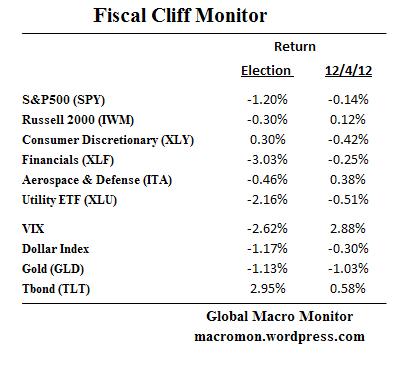
What would a real fiscal cliff panic look like?

Stocks down hard;  Russell 2000 down harder;  consumer discretionary down hard;  gold up;  dollar down;  VIX spiking;  and defense stocks in the tank.

Bonds?   Tough to extract a clear signal with the Fed’s financial repression, but, initially,  the cowboys would most likely be in buying on recession fears and increased worries about going over the cliff.

Dec4_FCM

(click here if video, chart, and table are not observable)

Posted in Fiscal Cliff Monitor | Tagged , , | Leave a comment

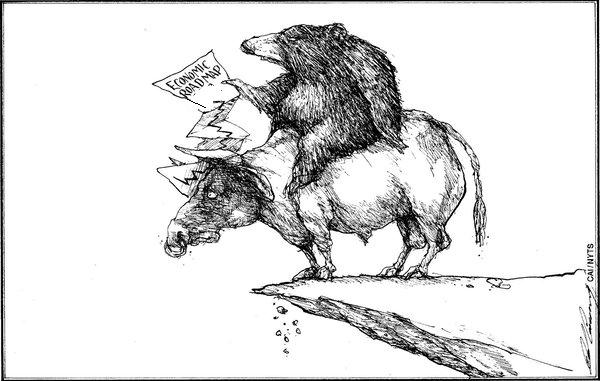
‘Toon of the Day

Nov26_Bull&Bear_Toon

(click here if cartoon is not observable)

Posted in Cartoon of the Day | Tagged , , | 2 Comments

Cliff Diving – Day 16

Image_Cliff DiveDecember, the overall best month for stock performance, isn’t supposed to start like this!

The S&P500 opened almost at its high of the day, traded through the 50-day moving average, got spanked  and commenced to sell off the rest of the day.  The market did respond positively after Speaker Boehner’s fiscal cliff counter but couldn’t hold the bid.  The President took to twitter to drum up support for his negotiating position.

The Administration and House are still far apart.  The ISM also came in very ugly.

The price action in all the indicators listed in the table confirm cliff fears are starting to grow.  Whether it’s not coming to an agreement, or the realization that austerity is just beginning,  today’s price action was concerning.

The S&P500 (SPY) was down 0.5 percent; consumer discretionary down 0.53 percent; and defense off over 1 percent.   The VIX moved above its 50-day moving average, the dollar was down, bonds, down and gold up a smidgen.

Some ugly reversals in MoMo land, especially the Facebook.

We still think the equity market, as reflected in the S&P500, is in a range between its 50-day and 200-day moving average.  That is, 1420 (50-day) and 1385 (200-day).   The index was clearly rejected at upper bound today.    Stay flexible and stay tuned.

Dec_Obama

What would a real fiscal cliff panic look like?

Stocks down hard;  Russell 2000 down harder;  consumer discretionary down hard;  gold up;  dollar down;  VIX spiking;  and defense stocks in the tank.

Bonds?   Tough to extract a clear signal with the Fed’s financial repression, but, initially,  the cowboys would most likely be in buying on recession fears and increased worries about going over the cliff.

Dec3_FCM

(click here if picture and table are not observable)

Posted in Fiscal Cliff Monitor, Uncategorized | Tagged , , , , | 1 Comment

Seasonal Greetings

It’s the most wonderful time of the year!

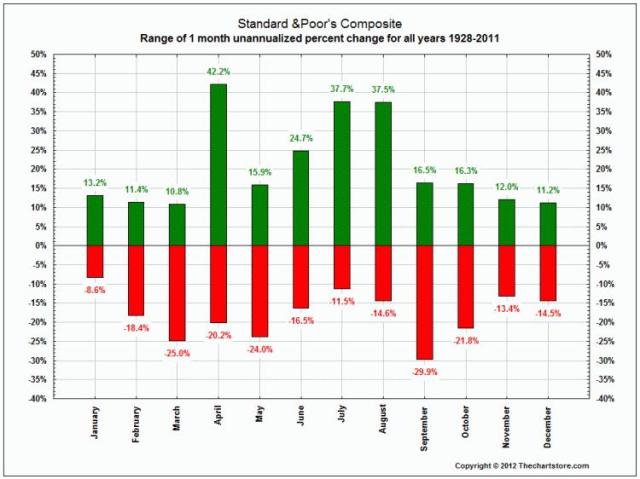
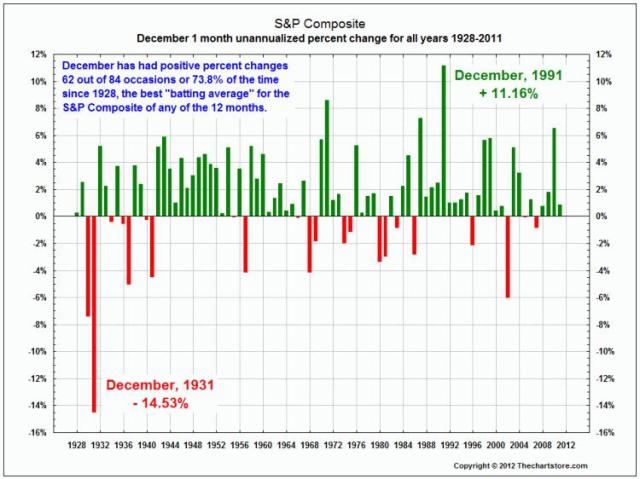
That’s if past is prologue for equity traders and investors.   Since 1950,  the S&P500 has averaged a 1.61 percent return in December, three times the overall monthly average return.   Furthermore,  the S&P500 has generated a positive return in December almost 75 percent of years since 1928.

We put together the first chart and our friends over at The Chart Store constructed the other four.  They have a longer times series and do some incredible work.

Dec3_Seasonal GreetingsDec3_Seasonal Greetings_2Dec3_Seasonal Greetings_3Dec3_Seasonal Greetings_4Dec3_Seasonal Greetings_5(click here if charts are not observable)

Posted in Technical Analysis | Tagged , , | 1 Comment

Stratfor: Increasing European Fragmentation

Stratfor Europe analyst Adriano Bosoni discusses the growing geographic, political and economic divisions within Europe.

For more analysis, visit: http://www.Stratfor.com

(click here if video is not observable)

Posted in Euro, Geopolitical | Tagged , | 2 Comments

2012: The Year of Stock Market Symmetry

We were playing around with the charts on Friday night (‘cuz that’s what nerds do with their Friday nights)  and discovered something very interesting about the 2012 stock market.  The results are illustrated in the table and chart below.

The S&P500 made two major moves to new post crash highs during year.  The first was a continuation of the rally that began on December 19th of last year,  totaled 216.6 S&P points, or 18.02 percent, and lasted 72 trading days.   It was followed by a 152.3 point correction, or 10.73 percent,  which lasted 42 trading days.

After bottoming on June 4th, the second rally took the S&P500 to a high of 1,474.51 on September 14th,  a move of 207.8 points, or 16.4o percent, which also lasted 72 trading days – the exact same number as the first rally.   It doesn’t stop there.

The rally to new highs was followed by a decent sell off of 131.16 points, or 8.90 percent, lasting 43 trading days.  Just one more trading day than the April-June correction!

Both corrections ended with nasty bear traps where the S&P500 fell through its 200-day moving average and key .618 Fibonacci retracement levels.   The first rally gave up 70.3 percent of its gains during the correction and the second retraced 63.1 percent before reversing.

The the second rally peaked at 125.6 percent of the first rally and 136.4 percent of the retracement,  not exactly the 1.272 or 1.382 Fibonacci extensions, but close enough for government work.

Dec2_S&P500

Why the symmetry in the 2012 rallies and corrections?   We can only speculate it’s a combination of the constant of human emotion and agorithmic trading.

Can we conclude the current 72.8 point rally, which began on November 16th is going to continue a similar total of 72 tradings days and take the S&P500 up 16-18 percent, or another 10-12 percent from?   Wish it were that easy,  but wouldn’t rule it out, however, especially if Washington can come to a fiscal agreement.

The upshot of this post?  Perspective and that technicals and time do matter!

Dec1_S&P_Symmetry(click here if table and chart are not observable)

Posted in Technical Analysis, Uncategorized | Tagged , , , , , | 6 Comments

Guest Post: Edupreneurs and Investing in Education Startups

Global Macro Monitor’s recent post about fast and slow-growing economies looked at national numbers, but did not spend much time focusing on actual industries within localized markets. In the article that follows, contributor Emma Collins takes a deep dive into the online education sector, which is touted by many as something of a “next big thing.” Emma’s recent work includes a description of 2012’s best online MBA programs, and her insights should be of real interest to anyone looking either to invest or take part in Internet-based learning in the years ahead.

The Birth of Edupreneurs and Investing in Education Startups

In recent years, austerity measures at state governments throughout the US have lead to cutbacks in university funding and surging tuition rates. Many students, educators and school officials have expressed concern that overpopulated classes, fewer resources and professors are leading to a significant decline in the quality of education at many schools. As traditional schools suffer, though, a number of technology entrepreneurs see an opportunity to revitalize higher education.

Venture capitalists have poured millions of dollars into education-technology startups in the past few years. Investments in online education startups having tripled in the last decade, from $146 million in 2002 to $429 million in 2011. “The investing community believes that the internet is hitting education,” says Jose Ferreira, founder of interactive-learning company Knewton, which secured a $33 million investment in 2011. At stake is both a burgeoning industry and, for millions of potential students around the globe, an opportunity for a world-class education unlike any before.

In the last two years alone, venture investments in education technology have more than doubled, from $82 million in the first quarter of 2010 to $189 million in the second quarter of 2012. While education startup investing has undoubtedly experienced a boom in the past two years, there is reason to believe the return on investment is only beginning to accrue. While Knewton has a number of different business models, including charging for access to test prep materials for standardized exams like the Law School Admission Test, most companies are still exploring methods of generating consistent revenue. Startups like Coursera, which allows users to access Ivy League lectures and coursework for free, and Udacity, which offers free courses and charges a nominal fee for testing and certification, will likely be focusing on revenue generation in the coming years as their services gain traction around the globe.

“These new technologies can really accelerate the learnings of students from preschool all the way to college graduate education,” says venture capital investor and board member of Coursera John Doerr. “So it’s important, it’s big, and entrepreneurs can make a high impact in this large market.”

Of course, as more education-technology startups enter the marketplace, those offering the largest returns on investment will be those with sound business models that can outperform their competition One of the organizations best positioned for long-term success is EdX, a joint creation of MIT and Harvard University. The partnership of two of the most prestigious names in academia have helped EdX to gain a great deal of exposure since its inception. In July, the service received a $1 million grant from the Bill & Melinda Gates Foundation, illustrating the perceived potential of the company in becoming a leader in online education. Around this same time, EdX added course offerings from a third university, the University of California at Berkeley.

Like Coursera, the partnership strives to democratize online learning by allowing people around the globe to access courses and real-time lectures at top universities for free, and has already acquired hundreds of thousands of students around the globe. However, one of the chief concerns for students is how to ensure their work is recognized and valued in the workplace. In September, EdX worked out a deal that would address these concerns by allowing students to formally test in supervised centers run by Pearson VUE for a nominal fee. To date, there are 450 of these centers in 110 countries throughout the globe. EdX founders and students hope that soon, their testing records will be recognized as equal to those of degrees received at traditional universities.

Udemy, another education startup, has garnered attention by offering an even more democratic method of education. Udemy allows anyone to take or build an online course, instead of only adapting those offered at colleges and universities. Udemy is essentially crowdsourcing education. Instructors can implement PowerPoint, audio files, video lectures and PDFs to create courses and share them around the globe. Since its launch in May of 2010, the San Francisco based startup has come to offer over 6,000 courses on subjects ranging from language developing and programming to computer applications. While about 90% of courses are Udemy are free, some instructors choose to charge. In these cases, Udemy pays the instructor 70% of the class revenue, resulting in many instructors making $5,000 to $10,000 per month on the site. By 2012, Udemy had already raised over $4 million from investors, which, along with their funding through paid courses, suggest Udemy’s long term prospects are strong.

With university costs continuing to rise and millions of individuals around the world now connected online, the potential growth for technology-education startups is staggering. In the US and around the globe, the growing relationship between education and technology could revolutionize education and economics while offering opportunities to many who would have otherwise never had a chance to take advantage of higher education. As top schools begin to embrace online education and effective business models are discovered and cemented, world-class education may soon be available to nearly anyone with the intelligence and ambition to pursue it.

Posted in Uncategorized | 4 Comments

Global Trend Indicators

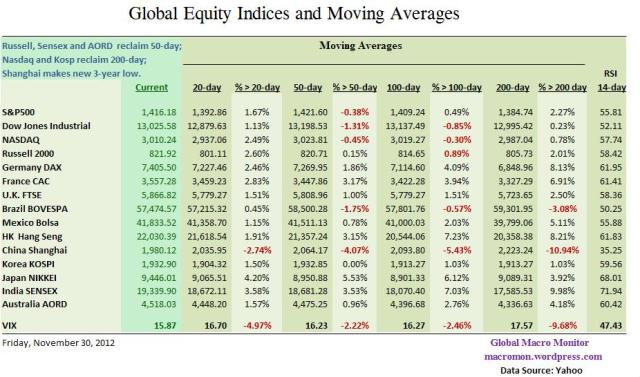
WIR_Global TrendWIR_Equity_MA(click here if tables are not observable)

Posted in Global Trend Indicators | Tagged , , , , , , , , | 3 Comments

Week in Review

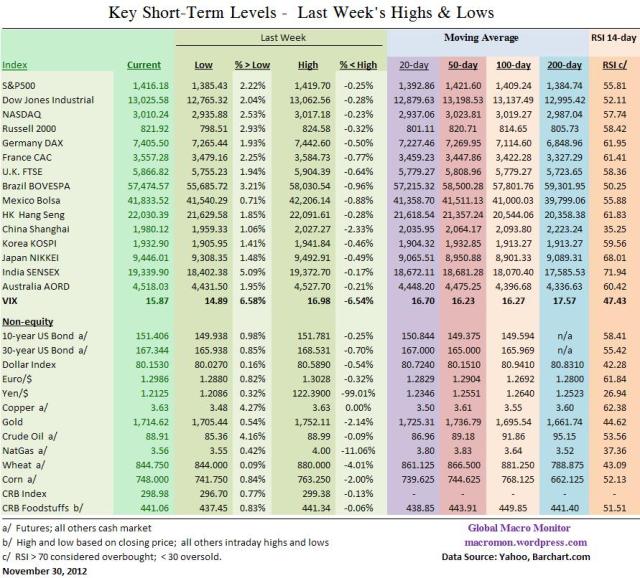
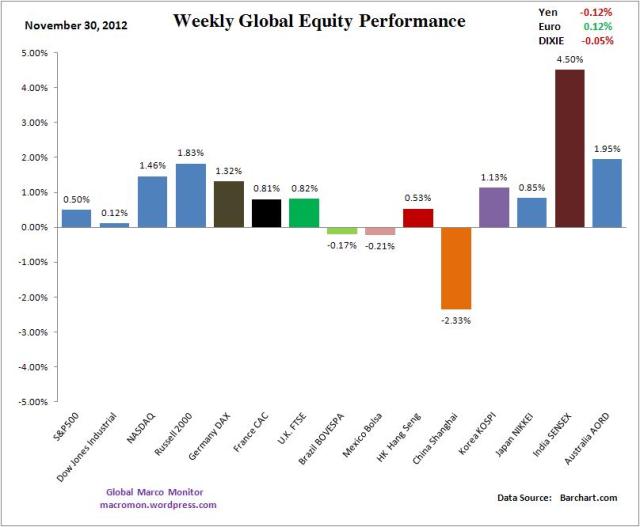
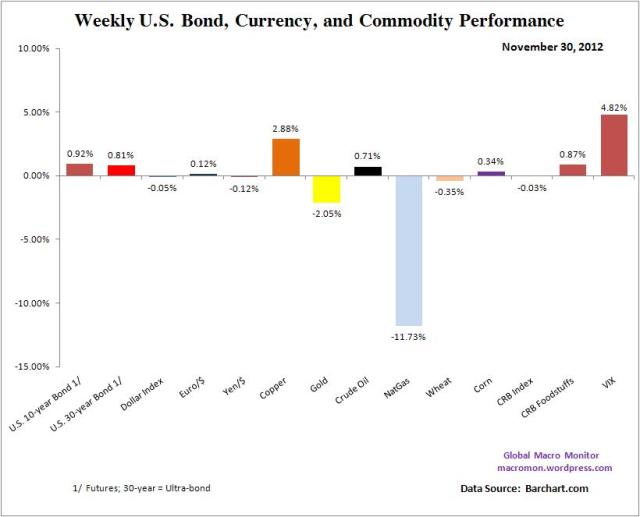
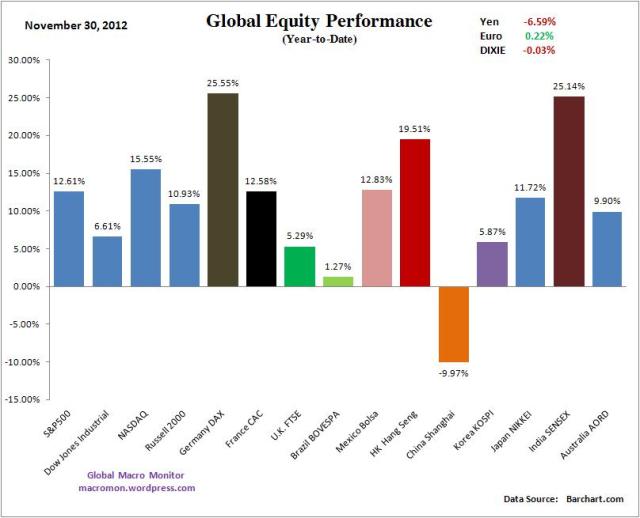
WIR_Key LevelsWIR_Equity_WeekWIR_Bond_WeekWIR_Equity_YTDWIR_Bond_YTD(click here if charts are not observable)

Posted in Week in Review | Tagged , , , , , , | 2 Comments