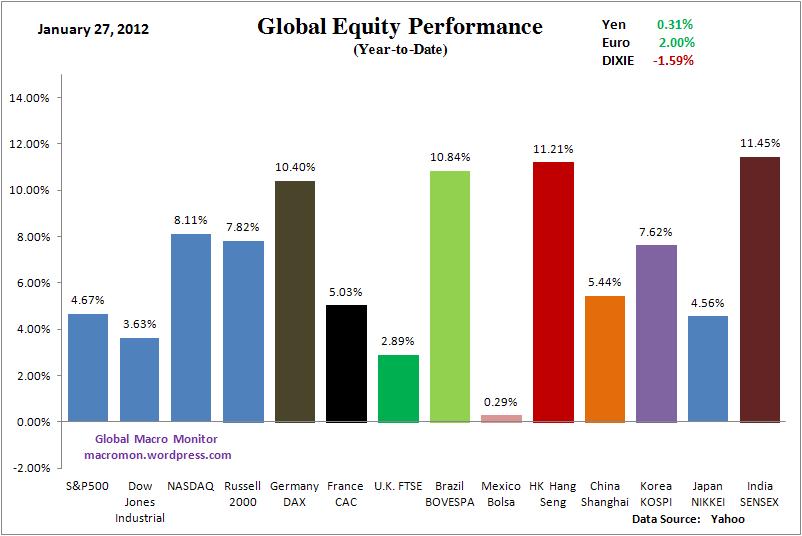
Capitano Crunch: Europe’s Collapsing Monetary Aggregates

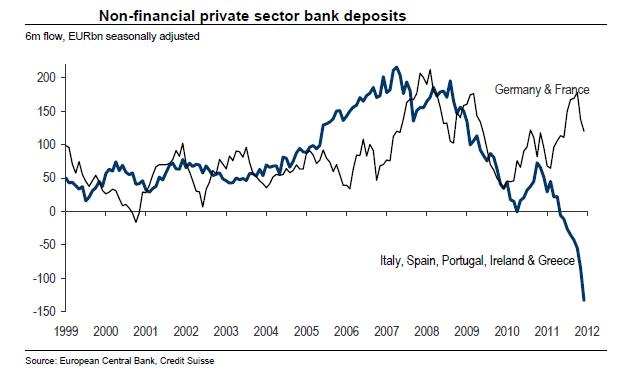
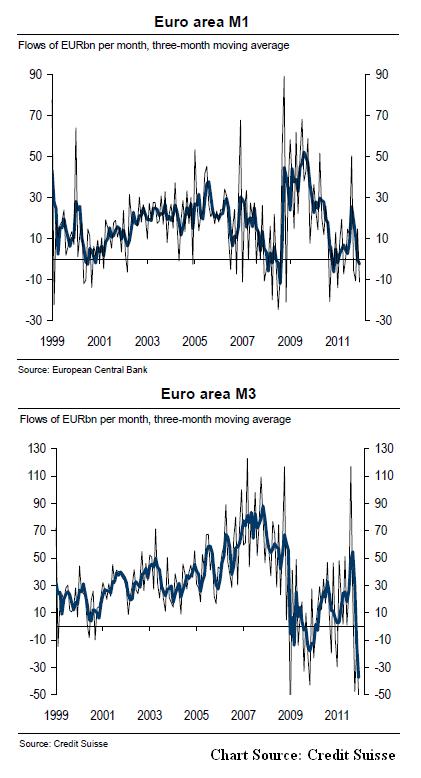
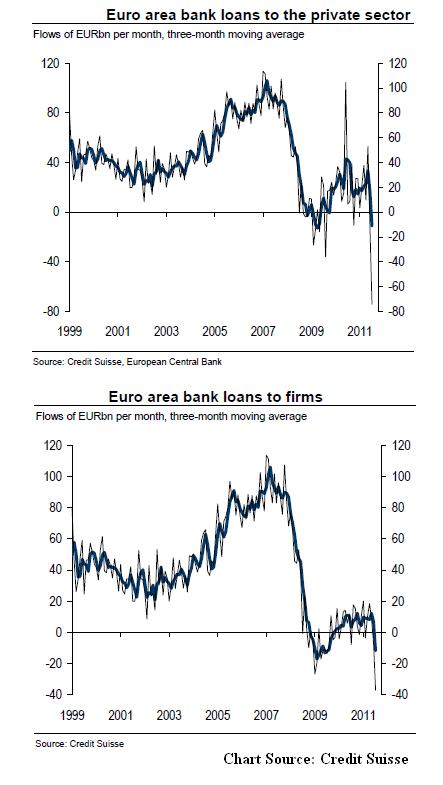
Here are some great pictures from Credit Suisse illustrating what’s happening in the European monetary sector.  The monetary aggregates have been collapsing at a greater pace than 2008/09  as banks have been cutting credit and shrinking their balance sheets to meet capital ratios.   The European bank run, which really accelerated in the core in  the second half of last year was a major contributor to the monetary contraction and loss of confidence by the banks.

The last chart is very interesting to us in that it shows the flows of deposit and capital flight from the periphery, German, and French banks.   For most of 2011,  capital flight from the periphery was flowing to the core, with German and French banks receiving much of it, for example.   This partially explains why the Euro was relatively strong for much of last year.

The crisis became acute and systemic in Q3 2011 as deposits fled Germany and France causing the steep sell-off in the Euro.  The ECB, the Fed, and other global central banks, did a good job preventing the collapse of Europe’s, and, ultimately, the global financial system, by fulfilling their role as lender of last resort to Europe’s banking system.

It’s unlikely, at least to us,  the European credit spigot turns back on anytime soon, providing more room for ECB balance sheet growth and rate cuts.   We’ve noticed this the modus operandi or reaction function of most central banks,  post crisis.

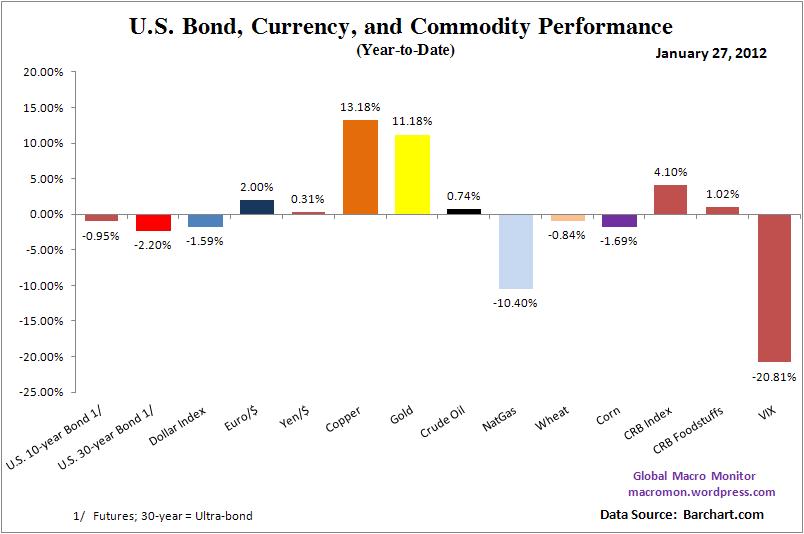
And this folks, is another reason why we like gold as the central banks kick it into even higher gear to offset the deflationary headwinds of the global (possibly x/U.S.) credit crunch coming out of Europe.

Stay tuned as we will have a post in the next few days on the contraction of external bank credit that is currently taking place in the emerging markets.
(click here if charts are not observable)

Posted in Black Swan Watch, Credit, Euro, Monetary Policy, Policy, Sovereign Risk, State and Local Government | Tagged , , , | 4 Comments

Germany’s fiscal solidarity plan for EU approved

Domestic political blowback to follow.  Stay tuned.

(click here if video is not observable)

Posted in Black Swan Watch, Euro, Eurozone Sovereign Spreads, PIIGS, Sovereign Debt, Sovereign Risk | Tagged , | 2 Comments

Where Are the Labor Unions? The Public Sector….

Excellent chart from the BLS on the union affiliation of U.S. wage and salary workers.

We’ve noted the differences between public vs. private sector unions in prior posts.   Here is the WSJ cited in one of those posts,

…unlike in the private economy, a public union has a natural monopoly over government services. An industrial union will fight for a greater share of corporate profits, but it also knows that a business must make profits or it will move or shut down. The union chief for teachers, transit workers or firemen knows that the city is not going to close the schools, buses or firehouses.

This monopoly power, in turn, gives public unions inordinate sway over elected officials. The money they collect from member dues helps to elect politicians who are then supposed to represent the taxpayers during the next round of collective bargaining. In effect union representatives sit on both sides of the bargaining table, with no one sitting in for taxpayers.

You can draw your own conclusions,  hopefully based on positive versus normative analysis.   We believe Steve Jobs did.   Strong political leadership needed.

(click here if charts are not observable)
Posted in Apple, Demographics, Employment | Tagged , | Leave a comment

Global Markets: One Large Complex Adaptive System

We once read somewhere that there are 10 to the 180th power possible paths to checkmate in a game of chess.   Similarly,  the global markets are one large complex adaptive system and almost impossible to project their short-term macro path.

Nothing drives this home better than today’s market action.   To the surprise of many, China’s Shanghai Composite reopened after a week of holiday celebrating  the Year of the Dragon to close down 1.5 percent.  S&P futures immediately drop 7 points on the China down opening.  Many are caught leaning the wrong way, including yours truly.

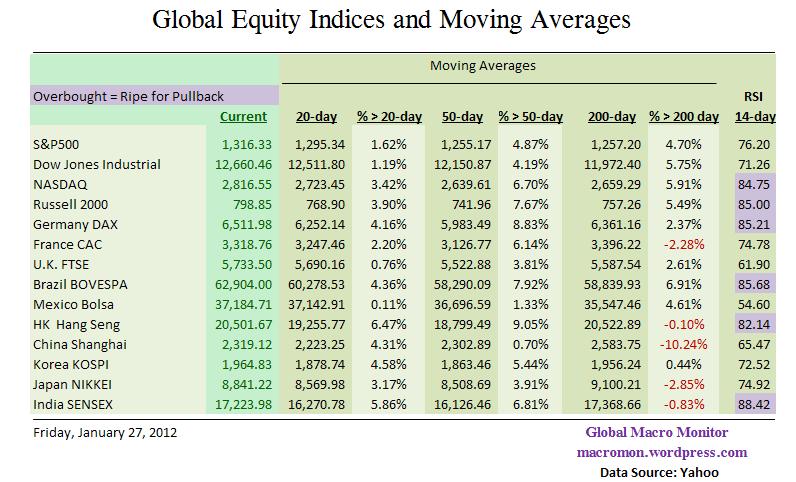
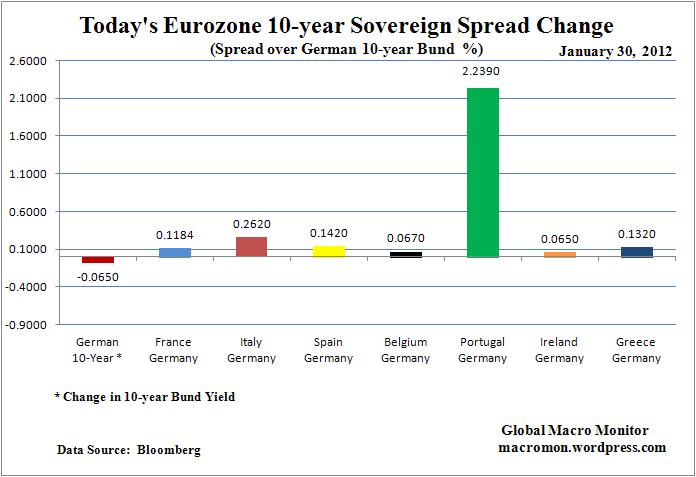
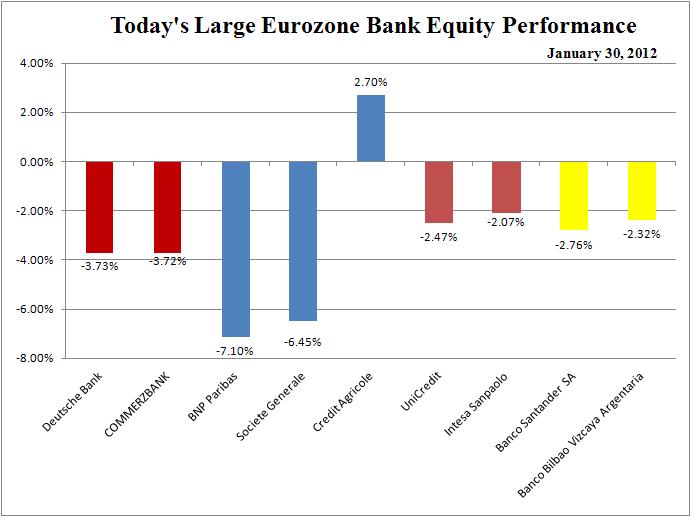
The foul mood spills into Europe.  The Portugal-Germany 10-year bond spread blows out over 200 bps;  investors/traders use Sarkozy’s transaction tax announcement and Portugal to spank the French banks hard;  the media noise kicks up several decibels as a Greek PSI deal has yet to be announced.   All this with a backdrop of extreme overbought markets where some 14-day RSIs are north of 80!

Now’s it the U.S. markets’ move.  Apple reverses a lower open and trades up over $7; the  S&P500 holds 1300 and begins to climb back.   How it closes will determine how the Asian markets react overnight.

Checkmate?  Who said this business was easy.

(click here if charts are not observable)
Posted in Black Swan Watch, Dollar, Euro, Eurozone Sovereign Spreads, German Bund, Global Stock Performance | Tagged , , , , | 2 Comments

Sovereign Debt Hygienics

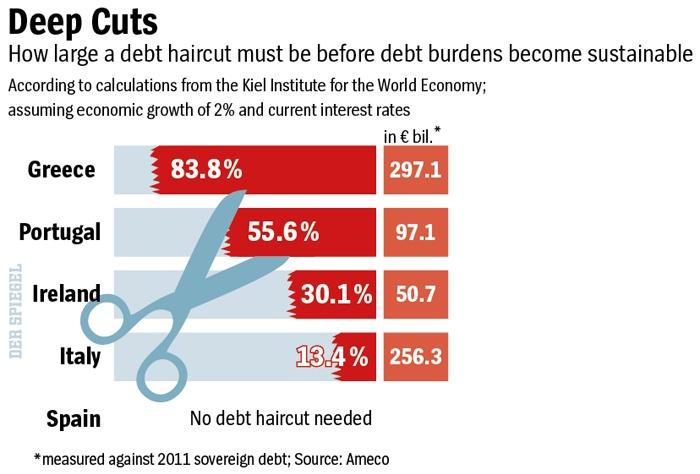
Interesting calculations posted by Spiegel from the Kiel Institute on the sovereign haircuts which would make the debt of the listed countries sustainable.   We would love to see the calculations for the U.S., U.K., and Japan.

(click here if charts are not observable)
Posted in Black Swan Watch, Euro, Italian Yields, PIIGS, Sovereign Risk | Tagged , , , , , | 3 Comments

Week in Review: Still Overbought & Nattie’s Big Bounce

(click here if charts are not observable)
Posted in Week in Review | Tagged , , , , | 1 Comment

Clash of Generations: A Discussion in Davos

We’ve posted several pieces on the coming war between the generations and even how the Occupy Wall Street and Arab Spring are more about intergenerational equity than anything else.   Here’s an interesting discussion from Davos for those who have the time and interest.  The need for intergenerational burden sharing is going to be a huge political issue going forward and will take strong leadership.

(click here if video is not observable)

Posted in Black Swan Watch, Demographics, Employment | Tagged , , | 3 Comments

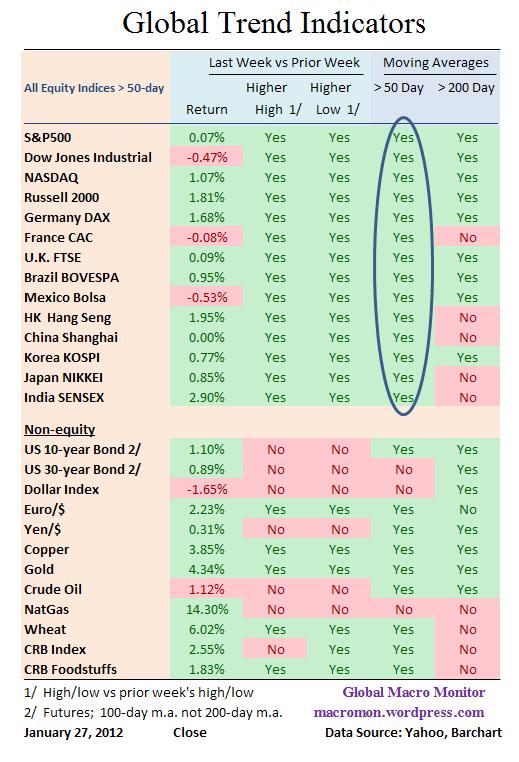
Global Trend Indicators

(click here if tables are not observable)

Posted in Global Trend Indicators | Tagged , , , , , | 1 Comment

Euro Fracture: Europe’s Biggest Risk…

Now that a financial systemic collapse has been taken off the table with LTRO, it’s reform backlash/fatigue and political risk.   The AP writes this morning,

Instead of a beacon for a better future, many Europeans are starting to see the EU as a death knell, one that is suffocating them with austerity instead of supporting them with job-boosting measures.

Expect more growth agenda rhetoric and use of monetary policy measures.  Monitor carefully.

(click here if video is not observable)

Posted in Black Swan Watch, Euro, PIIGS, Sovereign Debt, Sovereign Risk | Tagged , , , | Leave a comment

The Golden Bid

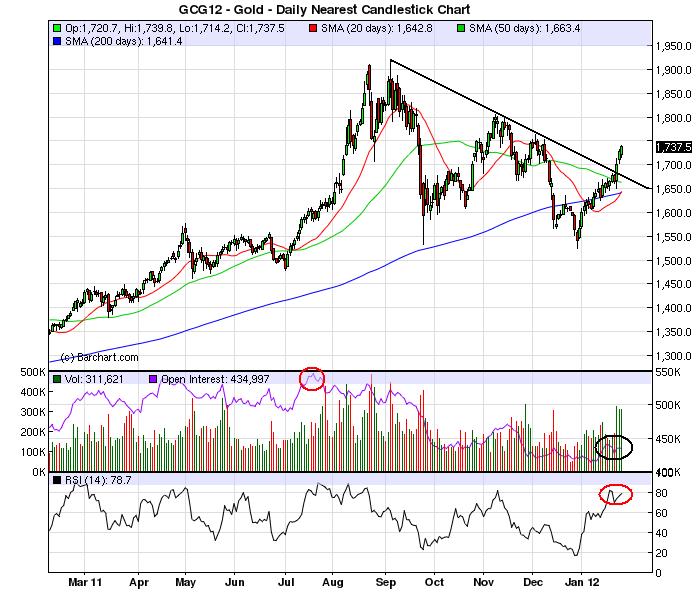
Nice breakout in gold on strong volume after the Fed’s announcement they’ll continue to flog savers, possibly into 2014.  Technically it looks good x/the 78.7 RSI overbought condition.   Open interest is way down and you can feel that in the way it trades.

You can also see from last year’s July 1 to August 23 move of 30 percent the yellow metal can really giddy on up  when it wants to.  It feels like it wants to and we wouldn’t be surprised to see an $1,800 handle relatively soon.  Always can be wrong and never without a stop.

(click here if charts are not observable)

Posted in Gold | Tagged , , | 2 Comments