What’s Up With Micron (MU)?

The price and volume, that’s what’s up, and not insignificantly.   We are in and out of this stock and it really caught our eye on Friday as the market was down big,  MU was up almost 2 percent with volume almost 50 percent above its 10-day moving average.

Up and away again today to close just above its 50-day moving average on relatively heavy volume — up 5.5 percent on volume 25 percent above the 10-day moving average.

Smells like Kentucky Fried Takeout to us.  Yes, we’re talking our book, but for good reason.  Nevertheless,  keeping both hands on the  ripcord.

By the way,  the macro tape bomb du jour was the FT report  Italy is in talks the China sovereign wealth fund, China Investment Corp,  hoping they will buy “significant” amounts of their sovereign debt.  The FT writes,

Italy’s centre-right government is turning to cash-rich China in the hope that Beijing will help rescue it from financial crisis by making “significant” purchases of Italian bonds and investments in strategic companies.

The Euros engineer another short squeeze catching traders leaning the wrong way and now reaching for the you know what.  Welcome to the volatility zone.

(click here if chart is not observable)

Posted in Charts, China, Equities, PIIGS | Tagged , , | Leave a comment

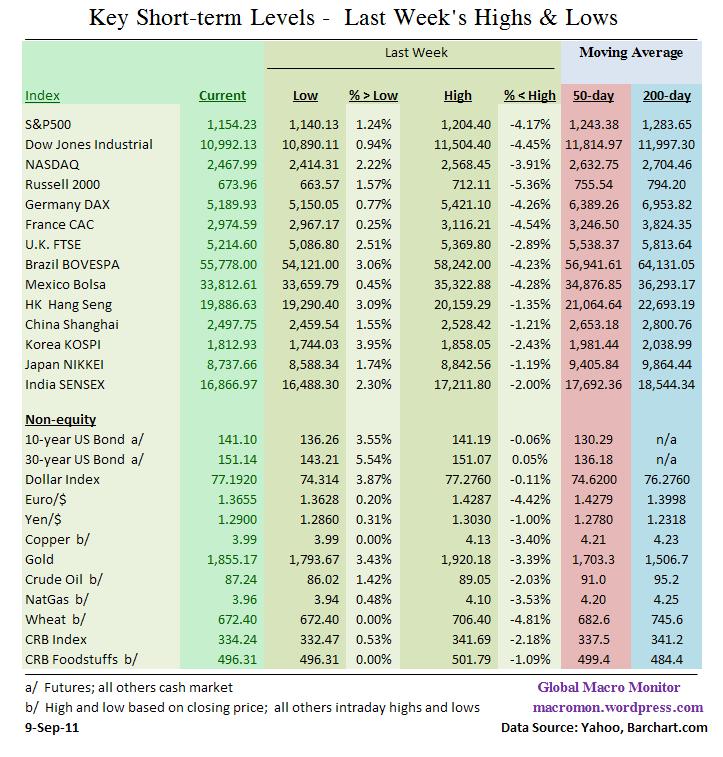
Key Support Levels

The stock index charts in the Eurozone, especially the DAX and CAC, look extremely ugly.  A little better in the U.S., but the way markets are trading overnight these levels look they’ll be pierced like a hot knife through butter.

(click here if table is not observable)

Posted in Black Swan Watch, Equities, Global Stock Performance | Tagged , , , , | Leave a comment

Week in Review

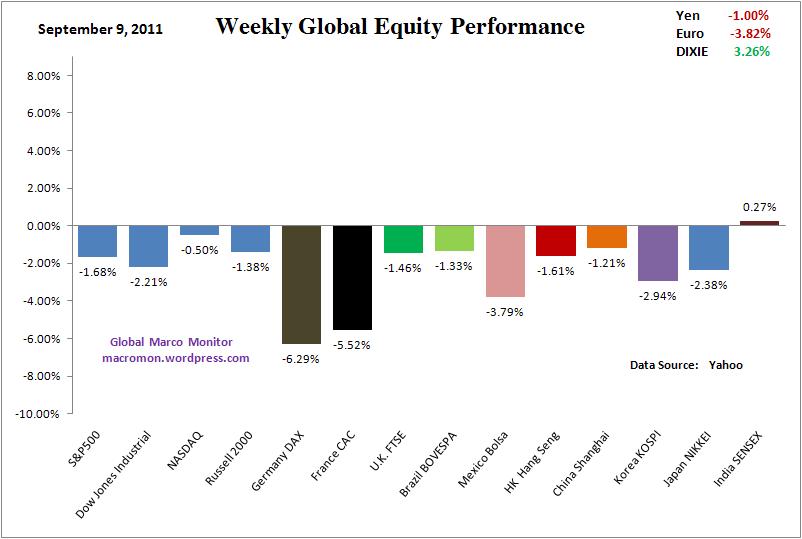
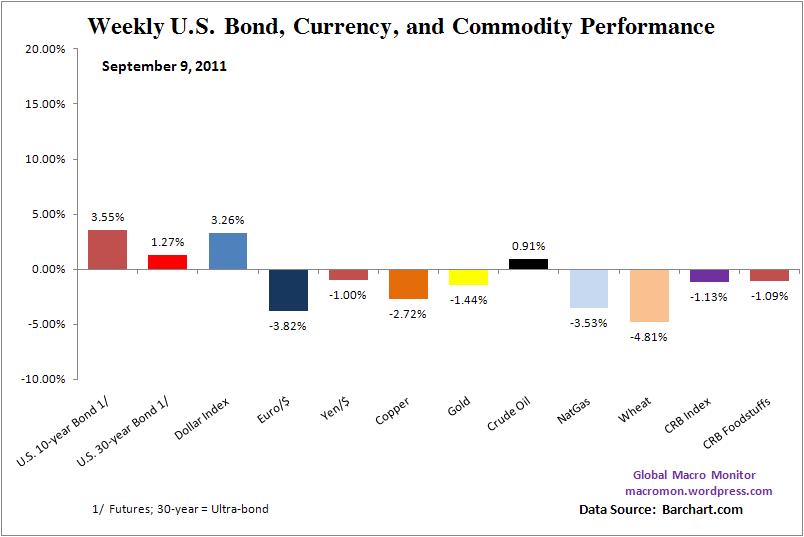
Markets will once again be on euro watch this week.  After the dollar’s strongest weekly performance of the year and the euro/dollar’s weakest, and a big drop in the DAX and CAC,  all eyes will be watching to see if Greece’s announcement of additional fiscal measures can turn global risk aversion.

We doubt it, unless the shorts and nervous under weights really panic and scramble to square up positions.   The melanoma has spread from a skin sore in Southern Europe into the vital organs of the core’s financial system. Too much uncertainty, lack of leadership, potential big tail risks, funding problems in the European financial sector are enough of a toxic brew to keep global markets on edge and likely to probe recent lows, in our opinion.   Time to tighten the seat belts.

  (click here if charts are not observable)

Posted in Week in Review | Tagged , , , , , | 1 Comment

German Finance Minister Prepares for Possible Greek Bankruptcy – Spiegel

These are the headlines at Spiegel Online, which should hit the markets like a ton of bricks offers on Monday.   Looks like Spiegel  posted the teaser to the full story to be released on Monday.    Not a great way to restore market confidence, in our opinion.   Here’s how the post ends:  Read the full story on Monday on SPIEGEL ONLINE International.

And here’s how it begins,

With doubts growing about Greece’s ability to implement important savings measures and reforms, there are concerns that insolvency may be inevitable. In Germany, officials in Wolfgang Schäuble’s Finance Ministry are exploring what Athens’ financial collapse would mean for the euro zone

German Finance Minister Wolfgang Schäuble, who is reportedly doubtful that the country can be saved from bankruptcy, is preparing for the possibility of Greek insolvency. Officials in his ministry are currently reviewing scenarios for handling such a situation, exploring what it might mean for the rest of the euro zone. Under the first scenario for a Greek bankruptcy, the country would remain in the euro zone. Under the other, Athens would abandon the common currency and reintroduce the drachma.

And this,

One of these key instruments would be credit lines provided to countries like Spain or Italy if investors stop lending them money after a Greek bankruptcy. If banks were forced to write off the billions in Greek government bonds on their books, they could become reliant on billions in rescue fund aid in numerous euro-zone countries. Both developments are to be expected in a Greek insolvency, regardless of whether the country exits the euro or not.

Volker Bouffier, the governor of the state of Hesse, which is home to Germany’s financial capital Frankfurt, is a member of Chancellor Angela Merkel’s conservative Christian Democratic Union (CDU) party, as is Schäuble. Bouffier is now urging that the possibility for countries to leave the euro zone be created quickly. Current European Union treaties provide no provisions for a country to abandon the currency.

Call us paranoid but we were perplexed reading this in the G7 comminque,

Central Banks stand ready to provide liquidity to banks as required. We will take all necessary actions to ensure the resilience of banking systems and financial markets.

Do or are the banks, and which ones, for that matter, going to need to CenBank liquidity? Certainly not U.S. banks who are sitting on a mountain of excess reserves.   Is the G7  anticipating or seeing a liquidity crunch in Europe?  Maybe that is why gold is flopping around like a fish out of water.

Is Greece so far out of compliance with its IMF program that there’s no hope?  Or is this just hardball negotiating tactics to give them one last chance before Germany pulls the plug?   We have no freaking idea and just trying to make decisions with imperfect information.  We’re getting whipped around by the tape bombs coming out of Euroland just as much as anyone else.

Nevertheless,  Zero Hedge cites this Dow Jones story,  IMF Likely To Re-Activate $580B Resource Pool Amid Europe Crisis-Sources,  which states,

The International Monetary Fund will likely re-activate a $580 billion resource pool in coming weeks to ensure it has funds to help cover Europe’s worsening sovereign-debt crisis, according to several people close to the matter.

The IMF activated the so-called New Arrangements to Borrow in April of this year for a six-month period. The IMF’s board, which met informally on the issue late Friday afternoon, would have to approve re-activation of the resource pool if the fund wants to tap it beyond September.

“A large majority of the board members are in favor of re-activating the NAB,” as a precautionary measure, one of the people said. The board is scheduled to formally approve activation next Friday, the person said.

David Lipton, first deputy managing director at the IMF, said recently in a private meeting that keeping the NAB available may be necessary in coming months given Europe’s debt meltdown, people familiar with the matter said. The crisis is entering a dangerous new phase as the risk of Greece defaulting rises and Italy and Spain’s sovereign debt has come under attack.

And we note this from Reuters quoting French FinMin Alain Juppe,

Greece has made some mistakes. They have to correct these mistakes. They also have to honor the commitments that they have made.

Enough to make you think something big is about to break as it appears the powers that be are assembling a huge armada of liquidity.   Or maybe we’re just paranoid.  Stay tuned.

Posted in Black Swan Watch, Euro, Fiscal Policy, PIIGS, Sovereign Debt, Sovereign Risk | Tagged , , , | 2 Comments

Global Trend Indicators

(click here if tables are not observable)

Posted in Global Stock Performance, Global Trend Indicators | Tagged , , , , , , , | Leave a comment

‘Euro no good for Greece but zero chance of exit soon’

(click here if video is not observable)

Posted in Euro, PIIGS, Sovereign Debt, Sovereign Risk | Tagged , | Leave a comment

This Time is Different

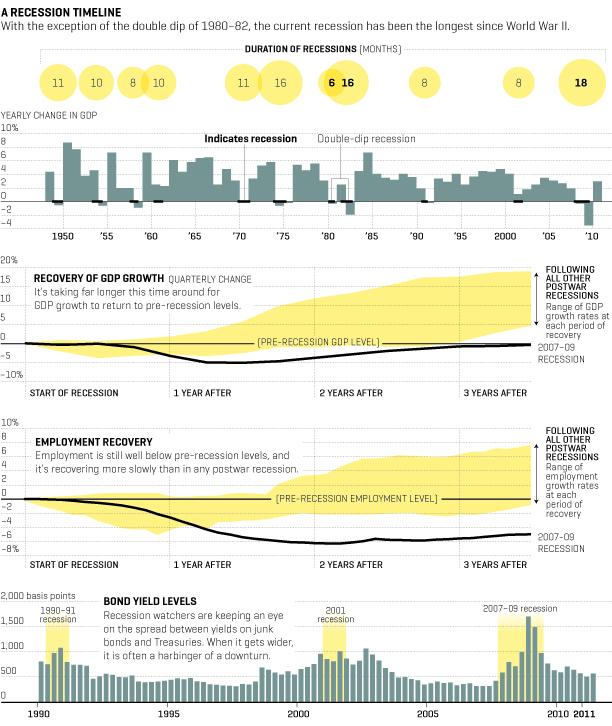
Those dreaded words you never want to hear as an investor.  But check out the Fortune Magazine graphic of this recession relative to others since the WWII.   Yes it’s a balance sheet problem and the economy needs more time to heal and delever.

We also maintain, however,  at least some, if not much of the weakness, especially in the labor market, is structural and not cyclical.  Take the U.S. Postal Service (USPS) as the poster child of the current problems plaguing the U.S. labor market.   The USPS  has 571,566 full-time workers making it the country’s second-largest civilian employer after Wal-Mart.  It has eliminated 110,000 jobs in the past four years and according to the FT,

During the next five years, the service plans to cut 220,000 staff – about 120,000 through lay-offs – and close up to 300 processing centres on top of plans to shutter up to 3,700 post offices released last month.

Now why is this?  Not enough stimulus?  Monetary policy too tight?  Insufficient quantitative easing?   To paraphrase James Carville,  “It’s technology, stupid!”   The rise of the internet, e-mail, and Twitter coupled with some piss poor management, which failed to adapt to the changing times,  and the result is one of the nation’s largest employers facing bankruptcy and mass layoffs.

Borders Books Inc. is also in the process of liquidating the last of its stores, which will result in a final mass layoff of close to 11,000 employees.   True, they failed because of  “lack of demand” for their goods and services.  But not because of cyclical forces that could be offset by fiscal and monetary expansion.   The rise of the e-book, Kindle, and iPad shut them down.

The Shumpeterian  “creative destruction” of one sector is not being equally and instantaneously offset by job creation in the sectors benefiting from technology.  This takes time, retraining, political vision and strong leadership.  Companies can’t hire enough software engineers in these fields because the current labor pool lacks the education, training and skills.

Policymakers must recognize the global economy is sitting at the elbow of an exponential curve in technological advances that is and will uproot everything from manufacturing to how we read our mail and books to how medical services will be delivered.

We’ve posted several pieces on the Global Macro Monitor blog about the role of  transformative tech, including medical apps where smart phones can be transformed into EKG monitors and cataract detecting devices.  How do you think this revolution will impact the traditional health care workforce?

We haven’t even touched on the mobile payments revolution, which will reduce the demand for retail salespersons and cashiers.  Not a near-term positive for employment as the the BLS points out,

Retail salespersons and cashiers were the occupations with the highest employment in 2010. These two occupations combined made up nearly 6 percent of total U.S. employment.

The painkillers of fiscal and monetary stimulus,  including negative real interest rates and quantitative easing, has no doubt cushioned the blow of the great crash of 2007-08.   We’re the first to thank Paulson, Bernanke, Geithner and Co. that we are not all farmers living under the freeway.  They all deserve the Presidential Medal of Freedom in our book for saving and stabilizing the global financial system.

But the continued use of cyclical policies to deal with structural issues has created an acute addiction in the markets and economy causing more uncertainty, political angst, and volatility, in our opinion.   This is especially true in the equity markets, which was evident yesterday in its reaction to Mr. Bernanke’s speech.

The policy medicine has now become an additional disease afflicting and distorting markets and the economy, which are now hooked on the painkillers.

Policies that address structural issues, though painful,  will go a long way in healing the economy.   A long-term credible budget plan which addresses the structural deficit will instantly reduce much of the uncertainty holding back investment.  Punishing savers with negative real interest rates “for at least two more years” will not and may actually consume the rest of the decade in cleaning up the unintended consequences of the Fed’s serial distorting of the relative price of money.

There’s now talk of the Fed targeting unemployment.  How ’bout this.  As part of the next quantitative easing,  the Fed creates a $1,000 checking deposit for every citizen who agrees to write ten letters to friends, especially in rural parts of the country.  This stimulates demand for postal services and thus eliminates, for a time, the need for mass layoffs at the USPS.

In no way do we intend to be insensitive to the workers at risk of losing their jobs.   But is this really where economic policy is headed?  Where is the leadership?
(click here if chart is not observable)

Posted in Black Swan Watch, Charts, Demographics, Economics, Employment, Fiscal Policy, Policy, Politics | Tagged , , | 12 Comments

European Leaders Take the Fork in the Road

Good piece in the Economist, Europe’s debt crisis: Fudge, the final frontier, summing up the crisis in the Eurozone.   Even a little history lesson,

SEPTEMBER is a cruel month in international monetary history, when regimes that once seemed inviolate have shattered. In 1931 it was the month when Britain went off the gold standard. In September 1992 the same country was booted out of the European Exchange Rate Mechanism. This month will not see the end of the euro, but could go a long way to deciding its fate.

(click here if picture is not observable)

Posted in Black Swan Watch, Bonds, Euro, PIIGS, Sovereign Debt, Sovereign Risk | Tagged , | Leave a comment

France Approves Greece Bailout

(click here if video is not available)

Posted in Black Swan Watch, Euro, PIIGS, Sovereign Debt, Sovereign Risk | Tagged , , | Leave a comment

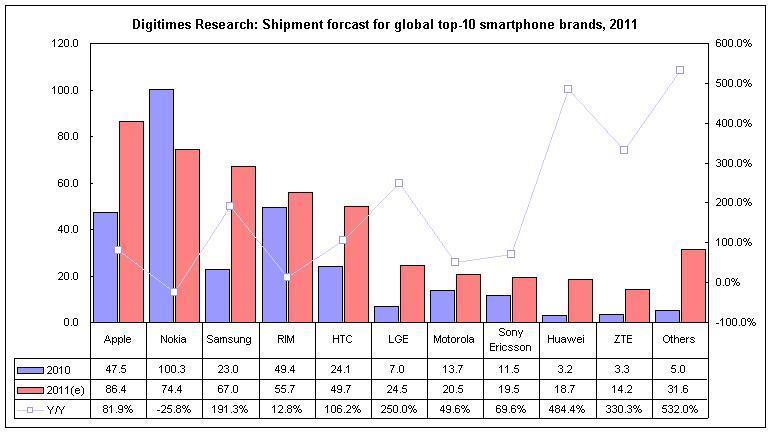
Apple to lead in 2011 smartphone shipments – Digitimes

Global smartphone shipments for 2011 will reach 462 million units, rising 60% from the 288 million shipped in 2010, according to Digitimes Research. Apple is expected to overtake Nokia as the top ranking vendor in terms of shipment volume in 2011, while Huawei Technologies will enjoy robust growth in shipments enabling the China-based company to close its gap with Sony Ericsson and Motorola.

Apple’s smartphone shipments are projected to top 86.4 million units in 2011, up 82% from 47.5 million units in 2010. In contrast, Nokia’s smartphone shipments in 2011 will decline to 74.4 million units from over 100 million in 2010, said Luke Lin, analyst for Digitimes Research.

(click here if chart is not observable)

Posted in Apple | Tagged , | Leave a comment