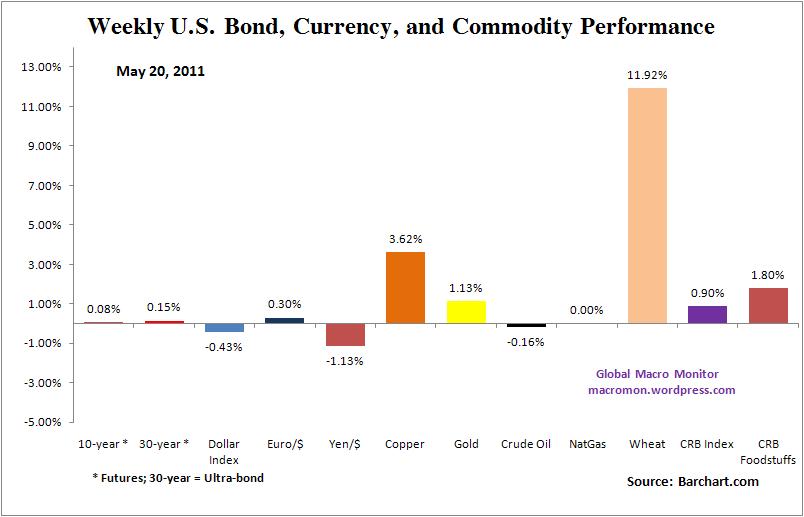
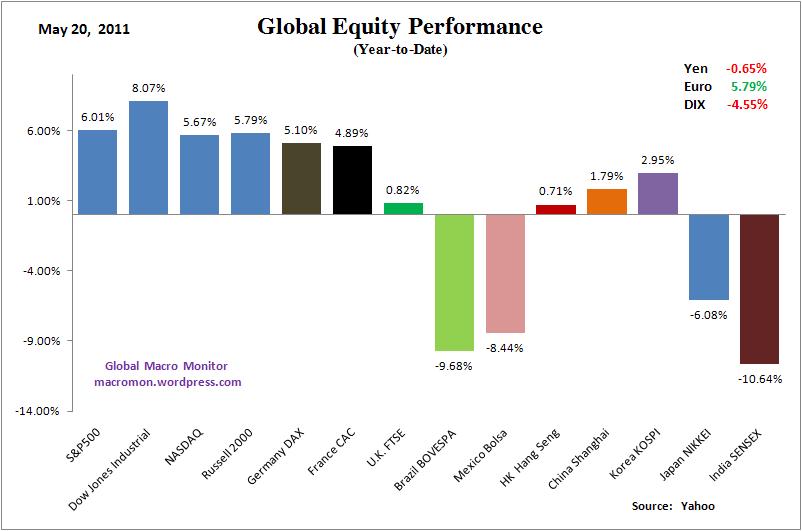
We take a look at how a couple of the global equity markets we track are trading this week.
The Good: After hitting its lowest level since last July on Monday, the Brazilian BOVESPA has staged a nice 4-day rally and is up 2.4 percent for the week. Pretty impressive given how closely linked it is to China and how poor the Shanghai has been trading.
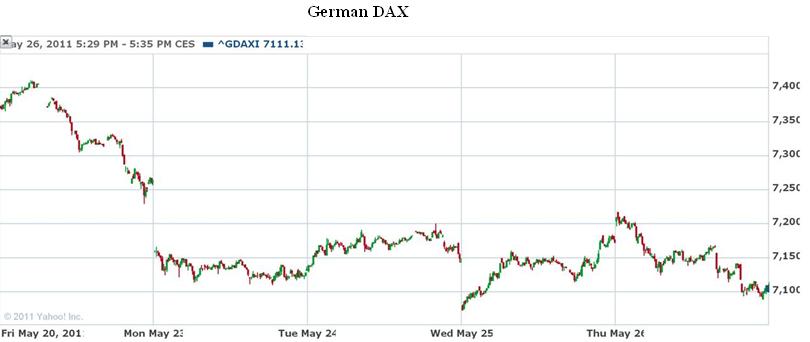
The Bad: The DAX, under pressure from the sovereign debt crisis in the periphery, is down 2.10 percent for the week.
The Ugly: China’s Shanghai Composite continues to trade very poorly closing at its lows and down 4.31 percent for the week. Keep this one on your radar. (click here if charts are not observable)
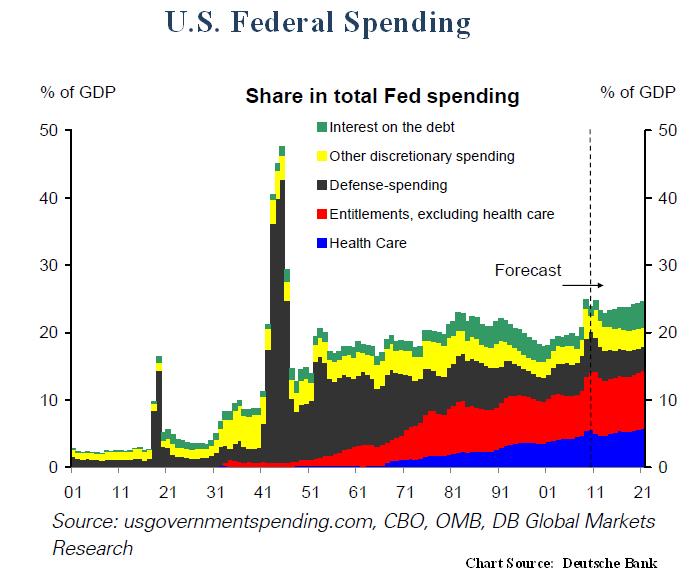
Great chart from Deutsche Bank showing a times series of U.S. Federal spending. Note the “peace dividend” and decline in defense spending during the 1990’s, which was partially responsible for the Clinton surpluses. The chart also illustrates where the reform and cuts need to come — entitlements and heath care. Third rail.
What also stands out is the interest on the debt component, which currently, as a % of GDP, is less than half of what it was in the 1990’s, even though the stock of national debt has exploded. The Power of Zero (interest rates).
The news of Mark Haines hits us square in the gut. We’ve been watching the guy almost everyday since the mid-1990’s. The old Squawk with Haines, Kernen, and Faber was something else. Remember how he would play up Kernen’s vanity, “Hair Force One”? Priceless. The chemistry between him and Simon Hobbs was fun to watch. Just like the passing of Tim Russet, we felt like we lost an Uncle in Mark Haines. R.I.P, our friend.
Jim Cramer had an “Eureka Moment” on his show last night:
When 17 million people cease paying their mortgages… and that’s if everybody does… you have 17 million people losing the biggest monthly payments they have to make, totally at the expense of a fortunately well-capitalized banking system, and congressionally-supported government-sponsored enterprises like Fannie and Freddie…They’re part of why the retail numbers are so strong. And that’s the puzzle solved.
I just keep coming back to the “housing consumer miracle”… the huge transfer of wealth that’s going on, between the defaulting consumer, and the banks… all aided by politicians who routinely side with defaulting homeowners, believing squarely that it’s not their fault. It’s a modern day Robin Hood story. Or maybe it’s closer to The Merchant of Venice. The bankers can take the house, but they can’t evict the former owners.
We wrote back in November of the Kafka-esque moment we’re living in where the average number of days since the average borrower in foreclosure last made a mortgage payment was 492 days.
For some underwater homeowners living in California McMansions, including taxes and insurance, this equates to $80,000 of purchasing power. That’s a lot of iPads! How long will it be before economists begin referring to the restart of payments on “reprofiled” mortgages or monthly rent payments as a tax on consumers? In effect, if Cramer is right, that’s exactly what it is, no?
The whole mortgage mess is a tragic story and shouldn’t be taken lightly. But, we would like to see Cramer’s “Robin Hood” story quantified and measured against the efficacy of government’s stimulus. No doubt the stuff of future Ph.D. dissertations. (click here if chart is not observable)
Related Stories
‘Squatter Rent’ May Boost Spending as Mortgage Holders Bail – Bloomberg
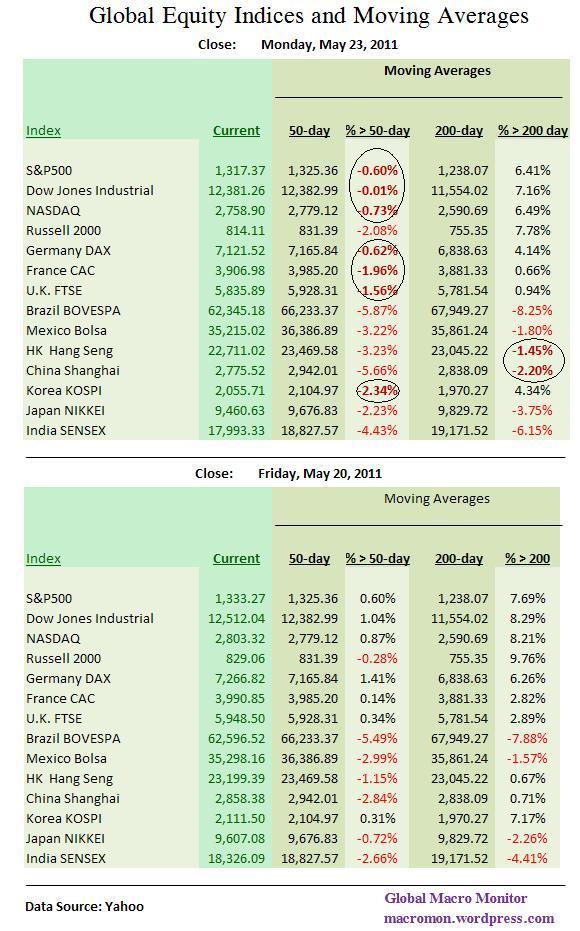
What a difference a trading day makes. As of Friday’s close only seven of the fourteen major global indices that we track were below their 50-day moving averages. As of today, they all are. The S&P500, Dow (just barely), Nasdaq, all three European, and the Korean Kospi broke their 50-days. The Hang Seng and Shanghai fell sharply to close below their 200-day moving averages.
Some positives were the VIX, after opening at 19.55, traded lower almost all day. The S&P500 filled the April 19-20 opening gap at 1312.70-ish and held. The BOVESPA and Mexican Bolsa were able to muster impressive bounces off their opening lows. And, finally, Apple, after probing the key support level of $327.50, closed up $5 off its low of $329.42. Given the attack of the Macro Swans and lack of upside catalysts, tough to see how we bounce big here, other than some nutcracking short covering. Let’s see what Turnaround Tuesday brings us. (click here if table is not observable)
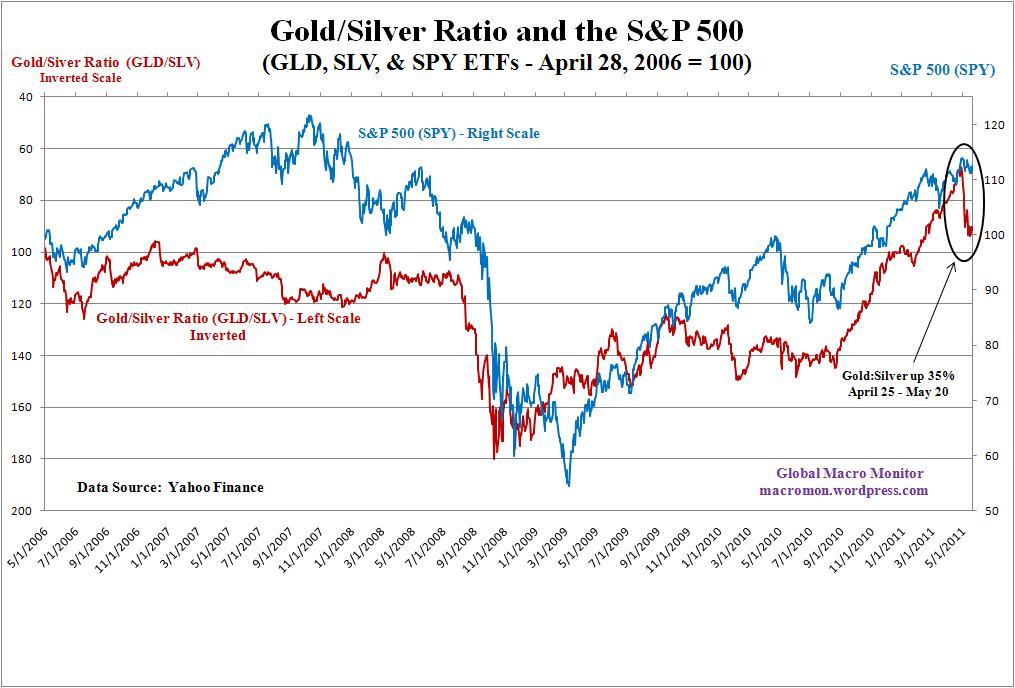
Many have written about the gold/silver ratio as a leading indicator of risk and equity appetite (see here and here) so we won’t take your time explaining the relationship. We do point out in our chart the speculative blow off and subsequent massive correction in silver without a corresponding move in gold has increased the gold/silver ratio by 35 percent in the 19 trading days since April 25th. This is the largest percentage move in the ratio since the silver ETF (SLV) began trading in 2006.
Though the move, in part, may be just correcting the froth in the silver rally it may also be signaling global risk aversion and flight to quality. Note the big move in the ratio which began at the end of July 2008 several weeks before the financial crisis and collapse of Lehman Brothers. The chart also shows the S&P500 continued to rally before turning down at the end of August.
Cross market indicators are often unstable, rarely unambiguous, and must be interpreted within in a larger context. However, the spike in the gold/silver ratio coupled with confirmation from other risk indicators, such as Treasury yields, the Hang Seng, and the convergence of several macro swans increases the odds, in our opinion, of a fairly sharp correction in the risk markets.
Note the data used in chart are from the corresponding ETFs and the ratio is inverted in order to more easily track the S&P500. (click here if the chart is not observable)
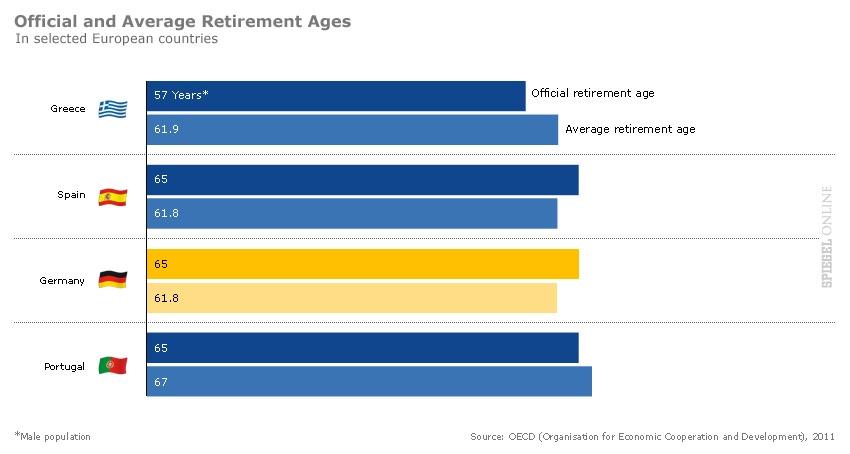
Lots of push back to Angela Merkel’s “lazy Southern Europe” speech. Here are a few interesting charts refuting the German chancellor’s notions which we found posted on Der Spiegel’s website. (click here if charts are not observable)
After a week where several major equity indices bounced off key moving averages only to close weak on fears of the Euro/sovereign debt McSwan, next week will be a another big test for the markets. Last week’s lows are very important for U.S. equity indices. The S&P 500 closed 1.12 percent above its 1318.15 low on Tuesday as is now sitting 0.60 percent above the key 50-day moving average of 1325.40. The Russell 2000 did close Friday below its 50-day for the first time since March 18th. The ugly action in Apple at the close on Friday shows the bears are in control of this market, in our opinion.
The Hang Seng, our indicator species for global risk, bounced and closed the week above its 200-day moving average. The Shanghai composite is also flirting with the 200-day moving average and should be kept at the center of the trading radar. The Brazilian BOVESPA continued to make new lows for the year and is approaching last summer’s key support level of 60,865.
Gold closed the week bid on Euro debt fears. Copper was able to bounce a bit and wheat had a big week.
We expect continued chop with a bearish bias as the deflationary Macro Swans are lining up against the equity markets and the “risk trade” (o, how we hate that term!). Given what we perceive as a lack of participation of long-term money, the chop of traders flipping back and forth to each other based on macro news should dominate short-term price action. The power of zero interest rates and no current viable investment alternative is keeping the panic of the global slowdown, the coming fiscal and monetary contraction, the increasingly negative news out of Europe, and the ugly action in emerging equities from resulting in a full blown market rout.
Remember, if you’re going to panic, make sure you do it before everyone else! Good luck next week. (click here if charts are not observable)
Five months ago, a government change in Spain’s Catalonia region revealed a budget deficit more than twice as big as previously reported. Now, a growing chorus of economists, local politicians and business leaders say that new governments are likely to discover, as Catalonia did, piles of “hidden debt” owed to health clinics and other suppliers. – Wall Street Journal
Bonds
California Governor Brown’s GO Revise Stretches Market – Bond Buyer
China
Retail in China – Economist
Mining fuels Mongolia’s ‘wolf economy’ – CNN
Mizuho Bank receives approval to invest in China’s interbank bond market – BBR
Commodities
Bespoke’s Commodity Snapshot – Bespoke
Commodities: Possible U-turn over price controls – FT
Has George Soros signaled the end of Gold & Silver’s bull market? – Gold Seek
Fed’s Dudley Hopes Commodity-Price Retreat Endures – WSJ
Rare Earths: Has the Thesis Changed? – Seeking Alpha
Currencies
IMF chief’s departure is another nail in the euro’s coffin – Telegraph
Economics
A Flight Plan for the American Economy – Fareed Zakaria
Britain’s inflation nightmare becomes worse – Martin Wolf
Data Signal Global Industrial Slowdown – IBD
Emerging Markets
Emerging Markets Face Key Test – Forbes
Equities
Barnes & Noble may get freer hand under Liberty – MarketWatch
Gap suffers biggest drop in decade on cost warning – MarketWatch
Fortune Brands agrees $1.2bn Titlest golf deal with Fila – FT
LinkedIn shares double on debut – Sydney Morning Herald
Salesforce.com shares top new high on results – MarketWatch Two die in explosion at Foxconn iPad plant – CNET
Europe
ECB’s political tensions flare over Greece – FT
Eurozone design and management failures – Vox
Greece hit by Fitch debt downgrade – FT
Lagarde Warns on Greece’s Public Finances – WSJ
Spain Vote Threatens to Uncover Debt – WSJ
Why Markets Are Underplaying Greek Drama – WSJ
General
Capitalists Who Fear Free Markets – NY Times Once bullish, contrarian Jim Grant likes cash now – AP
The IMF after Strauss-Kahn – Economist
Geopolitical
Libya: The colonel feels the squeeze – Economist
March to Arab democracy ‘unstoppable’ – Economist
Japan
Japan Banks Ignore Lessons of Costly Tuition – WSJ
Japan’s post-quake economy: Casting about for a future – Economist
Tepco Credit-Default Swaps Surge – People Forum
Markets Indian stockmarkets: Barbarian near the Gate: Economist
Monetary/Fiscal Policy
Budget surplus to deficit: How we got here – Politico
Fed’s Evans says no need to alter easy money policy yet – Chicago Tribune
Fiscal rules that sometimes bind – Economist
Will The US Have A “Debt Crisis”? – Simon Johnson
Politics Red Professors, Blue Professors – Roll Call
Science/Technology
Pier 38 in San Francisco is a hub for young internet startups – Economist
Dr Van Winkle and the Large Hadron Collider – Economist


 (click here if charts are not observable)