Question of the Day: British Parliament

I am listening to the live debate in the House of Commons about the vote, which just took place voting down a “no-deal Brexit,”  321-278, close enough to make us a little nervous.  Some MPs are up in arms that the vote is “indicative” and not policy.

Does the will of the House trump the will of the people? – MP of British House of Commons

We ask you again, are you surprised that in our post-Truth world we live that all things are indicative, nothing matters, nothing is binding, alternative facts, fake news, and now fake athletes?

You can now redefine your child, for a $400K bribe, as a football placekicker, and get him into Stanford.  Man, I smell pitchforks on this one!  AOC will be on the warpath.

Article 50 Extension Vote Tomorrow

The House of Commons votes tomorrow on extending the Article 50 March 29th deadline to leave the EU.

You know where we stand.

Big buyers of cable (pound/dollar) all year,  as we believe the MPs will eventually have to take this debate to the people, which the remainers should win overwhelmingly.    Cable up almost 2 percent today and closing in on its 6-month high.   The pound is trading like an EM currency, now up almost 5 percent for the year, which is causing the export-heavy FSTE to significantly lag DM stock markets year-to-date.

Pound

Coming “Summer Political Discontent?”

There will be some political instability into a second referendum vote as the Brexiteers take to the street.  Depending on how things shape up with President Trump’s legal troubles,  we may be moving into a transatlantic  “summer of discontent,” where the U.K. and U.S. experience a bout of political and social instability.

Hey, we are always nervous and on the lookout for off-the-radar tail events.

Buy the French British dip in cable, and keep the above on your radar.

Posted in Brexit, Politics, Uncategorized | Tagged , , | 2 Comments

Thank You, Mr. Gundlach

In our Monday post, we stated,

Absolutely stunning to see such large budget deficits as far as the eye can see with the actual and projected unemployment rate under 5 percent. What kind of budget deficit beast will we run if we have a recession?  Will demand for Treasury securities be there to finance, say, a $2 trillion deficit? – GMM

Jeff Gundlach illustrates our concern in a chart from his presentation today, Highway To Hell 


Gundlach

What Does Ray Dalio Think?

Wow,  more than $2.5 trillion-plus in new Treasury issuance hitting the market during the next recession.  No wonder Fed Chair Jay Powell looked a little pale during his 60 Minutes on Sunday night.

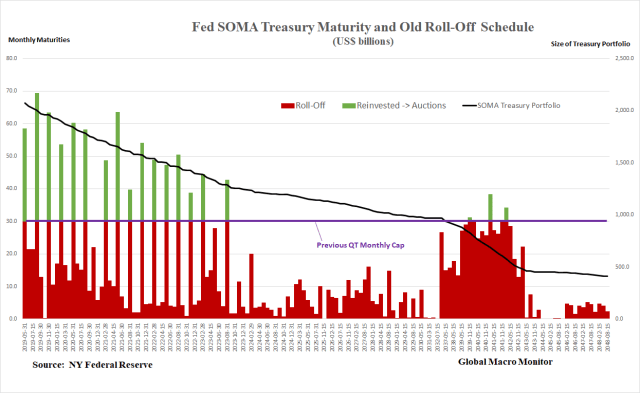
Given the structural changes taking place in the Treasury market, we are not so sure the markets can absorb such a large supply shock, which would overwhelm even the massive increase in haven inflows into Treasuries during a recession.  The Fed would be forced to finance a yuuge portion just as they did indirectly during the first few rounds of QE.

The question is how will a new round of the effective monetization of potentially $2.5-3.0 trillion annual deficits impact confidence in/and the demand for the dollar? Especially after it is evident the Fed can’t normalize its balance sheet without a major market disruption even with a 3.8 percent unemployment rate.  Beijing and Tokyo, we have a problem.

This is how emerging markets get into trouble, folks.  Money demand collapses when  the citizenry and its foreign creditors lose confidence in their currency and central bank.  And ”confidence is a very fragile thing.”

Hedge fund great Ray Dalio also has some thoughts on the topic,

Billionaire hedge fund manager Ray Dalio predicted the U.S. economy is about two years from a downturn, which will see the dollar plunge as the government prints money to fund a swelling deficit…

“We have to sell a lot of Treasury bonds, and we as Americans will not be able to buy all those treasury bonds,” he said. “The Federal Reserve will have to print more money to make up for the deficit, will have to monetize more, and that’ll cause a depreciation in the value of the dollar.” 

…The currency may “easily” weaken by as much as 30 percent, creating a “dollar crisis,” he said, though the economic contraction won’t be as sharp or severe as it was after the 2008 financial crisis.  – Ray Dalio, Bloomberg, Sept 2018

That is just about Game Over, folks.   No one cares, anymore.

That is why we all should worry even more.

Posted in Economics, Food Prices, Uncategorized | Tagged , , , , | Leave a comment

On This Day In History – March 13

Birthdays

  • 1913 William J. Casey, American head of the CIA during the Iran-contra scandal (1981-87), born in NYC, New York (d. 1987)
  • 1946 Yonatan Netanyahu, Israeli soldier who died leading rescue operation Entebbe in Uganda, born in NYC, New York (d. 1976

TIH_YoniNet_Mar13

  • 1950 Charles Krauthammer, American conservative political commentator and psychiatrist (The Washington Post), born in NYC, New York (d. 2018)
  • 1956 Jamie Dimon, American business executive and CEO of JPMorgan Chase, born in NYC, New York

TIH_JaimieD_Mar13

  • 1960 Adam Clayton, English-Irish musician and rock bassist (U2-I Will Follow), born in Chinnor, England

Events

  • 1639 Cambridge College, Massachusetts, renamed Harvard for clergyman John Harvard

TIH_Harvard_Mar13

  • 1677 Massachusetts gains title to Maine for $6,000
  • 1852 Uncle Sam cartoon figure made its debut in the New York Lantern weekly

TIH_Mar13_UncleSam

  • 1868 Senate begins US President Andrew Johnson‘s impeachment trial
  • 1881 Alexander II of Russia is assassinated by members of far-left terror group ‘People’s Will’ who throw a bomb at him in the city of St. Petersburg
  • 1900 In France the length of the working day for women and children is limited by law to 11 hours.
  • 1918 Trotsky gains control of the Red Army
  • 1925 Tennessee makes it unlawful to teach evolution
  • 1933 Joseph Goebbels becomes Nazi Germany’s Minister of Information and Propaganda
  • 1943 Failed assassin attempt on Adolf Hitler during Smolensk-Rastenburg flight
  • 1954 Braves’ Bobby Thomson breaks his ankle, he is replaced by Hank Aaron

TIH_Mar13_Hammer

  • 1957 Bloody battles after anti-Batista demonstration in Havana Cuba
  • 1986 Microsoft has its Initial public offering.

TIH_Mar13_Microsoft

  • 2005 Bob Iger is named CEO of Walt Disney International, succeeding Michael Eisner
  • 2008 Gold prices on the New York Mercantile Exchange hit $1,000.00 an ounce for the first time
  • 2013 North Korea shreds the Korean Armistice agreement
Posted in This Day In Financial History, Uncategorized | Tagged , , , | Leave a comment

Life In The “New Farm” Belt

We know the farm belt is in crisis,

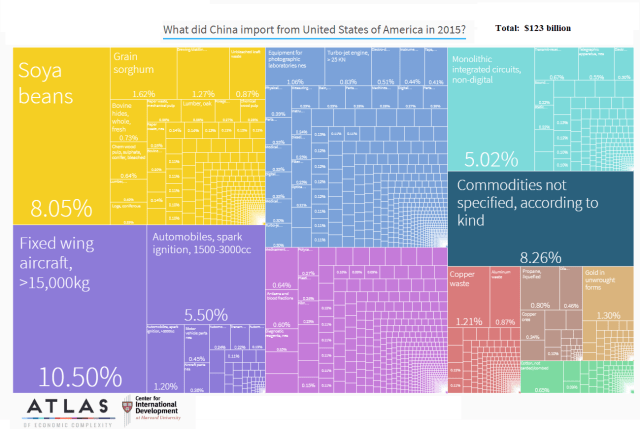
President Donald Trump’s trade war is magnifying some of the toughest farm conditions since the crisis that bankrupted thousands of farmers in the 1980s — and threatening a constituency crucial to his reelection hopes. – Politico

Here’s a look at some of the new farms rising up over the past few years.


Posted in Agriculture, Technology, Trade War, Uncategorized | Tagged , | Leave a comment

Corbyn calls for no deal to be taken off the table

Parliament not there yet on a second refi but the path is becoming clearer.  The House of Commons votes down a “no deal Brexit” tomorrow (highly likely) and then votes to extend Article 50 on Thursday (highly likely).   Then what?

TINA – There is no alternative.   The MPs will have to take it to the people.

A buyer of cable on dips.

Posted in Brexit, Uncategorized | Tagged , | 2 Comments

On This Day In History – March 12

Birthdays

  • 1685 George Berkeley, Irish philosopher/bishop of Cloyne

TIH_Berkeley_Mar12

  • 1922 Jack Kerouac, American Beat writer (On the Road, Mexico Blues), born in Lowell, Massachusetts (d. 1969)

TIH_Mar12_Kerouac

  • 1932 Andrew Young, US ambassador to UN (1977-79)/(Mayor-D-Atlanta)
  • 1947 Mitt Romney, 70th Republican Governor of Massachusetts and presidential candidate, born in Detroit, Michigan
  • 1948 James Taylor, vocalist/guitarist (Up on the Roof), born in Boston, Massachusetts

Events

  • 1455 First record of Johannes Gutenberg‘s Bible, letter dated this day by Enea Silvio Piccolomini refers to the bible printed a year before

TIH_Mar12_Gutenberg

  • 1642 Abel Tasman is the 1st European to sight New Zealand, viewing the north-west coast of the South Island
  • 1664 New Jersey becomes an English colony
  • 1848 2nd Republic established in France
  • 1913 Foundation stone of the Australian capital in Canberra laid
  • 1917 A German submarine sinks an unarmed US merchant ship, the ‘Algonquin’ on the same day that US President Woodrow Wilson gives executive order to arm US merchant ships
  • 1930 Mohandas Gandhi begins 200m (300km) march protesting British salt tax
  • 1933 FDR conducts his 1st “fireside chat”

TIH_Mar12_FDR

  • 1938 Nazi Germany invades Austria (Anschluss)
  • 1947 US President Harry Truman introduces Truman-doctrine to fight communism
  • 1951 Communist troops driven out of Seoul
  • 1956 Dow Jones closes above 500 for 1st time (500.24)

TIH_Mar12_Dow

  • 1999 Former Warsaw Pact members the Czech Republic, Hungary and Poland join NATO
  • 2012 China records its highest trade deficit in over a decade

TIH_Mar12_China

Posted in This Day In Financial History, Uncategorized | Tagged , , , | Leave a comment

Theranos – Silicon Valley’s Greatest Disaster

Damn, those “blood pricks” of Silicon Valley!

Posted in Technology, Uncategorized | Tagged | 1 Comment

BFTP: How to Become a Trillionaire And Other Thoughts

BTFP:  Blast From The Past

Time to repost our piece from January 2017, almost two weeks before the Trump administration took power.

We hit the big topics back then which are now making headlines today:  1)  Modern Monetary Theory;  2)  How Trump’s fiscal policy will lead to larger trade deficits, regardless of his “trade deals”;  and 3) Our call on spikey interest rates, which though gained some traction by breaking out in September 2018, which took the stock market down, but has yet to fully play out.  Give it some more time.

New Charts

Here are some up-to-date charts, which confirm some of our predictions back in January 2017.

Absolutely stunning to see such large budget deficits as far as the eye can see with the actual and projected unemployment rate under 5 percent. What kind of budget deficit beast will we run if we have a recession?  Will demand for Treasury securities be there to finance, say, a $2 trillion deficit?


Deficits and Unemployment

Source:   Forbes


Trade Deficit

Source:  Forbes

Another Macro Divergence 

The Exploding Twin Deficits Will Eventually Hit Stocks

TwinDefs_S&P500

Source:  Otavio (Tavi) Costa  @TaviCosta

Also see the recent Forbes article, Trump’s Twin Deficits Are Exploding.

Nobody cares until it they think it matters — and it will, folks.


How to Become a Trillionaire and Other Thoughts

Grab one of these:

zimbabwe_jan7

Careful what you wish for central bankers and fiscal policy makers.  Though we don’t see signs of “rollover risk” in any of the G5 or G20, it’s all about confidence and you know what Joe said about confidence:

Confidence is a very fragile thing.  – Joe Montana

.

The World Economic Forum reports this about Zimbabwe’s ghost of hyperinflation past,

Zimbabwe was once so gripped by hyperinflation that the central bank could no longer afford paper on which to print practically worthless trillion-dollar notes. 

The government reported in July 2008 that Zimbabwe was experiencing inflation of 231 million percent (231,000,000%). However, the Libertarian think tank, the Cato Institute, believes that the real inflation rate was 89.7 sextillion percent or 89,700,000,000,000,000,000,000%.

It is interesting to note that the country is now grappling with the opposite problem.

Like Britain, Japan, the US and other nations dealing with the consequences of weak demand and cheap oil, Zimbabwe is threatened more by the prospect of falling prices. But that doesn’t mean its people are ready to trust that hyperinflation won’t happen again.

This is what happens when you are not a reserve currency — i.e., there is global demand for and a financial incentive to hold your currency  — and markets have lost confidence in your central bank and central government.   That, in our opinion, is the next major systemic macro swan:  the loss of confidence in a G5 central bank and government.  Not a black swan as it is a known unknown rather than an unknowable unknown.

We still have ongoing debates with our good friends from the modern monetary theory (MMT)  about whether a major sovereign government can default if they have an independent central bank.   Yes, they can!

We had the same debate with our Argentine friends several years ago as to whether their government would or could devalue their currency when it was on an effective currency board.  Yes, they did!  And defaulted to boot.

Just as Russia chose to default on its GKOs (short-term ruble denominated treasury bills) in 1998 with an independent central bank,  the same can happen to a G5 country as we approach the upper bound of debt limits and the lower for longer interest rate meme seems to be sunseting in a post-Trump world.

Debt to GDP Ratios_Jan7.png

When a highly indebted sovereign crosses the tipping point — and nobody knows where the tipping point is —  when the markets lose confidence in its ability to repay or rollover debt coming due and the window shuts on refinancing,  they face three choices:

1)  bailout – easy for a small country,  such as Greece,  but Italy or Japan are too big to bail;   2) hyperinflate – print money to pay maturing debt obligations and finance budget deficits.  An aside:  the Bulgarian central bank did this in 1996 resulting in hyperinflation, which peaked at a monthly inflation rate of 242%  in February 1997.   I was in the Bulgarian central bank in the fall of 1996, when a senior official looked me in the eye and said, [Gregor],  we will not let the government default on its treasury securities.”  I knew what was to come; and 3)  default and restructure.

Like the Russians,  the decision to hyperinflate, default, or go begging to the IMF, is a political one.  Russia saw that a high percentage of holders of its local currency debt was held by foreigners,  hedge funds such as David Tepper.

Tepper says that losing 29% ($80 million) on Russia when Russia defaulted after an IMF deal “the biggest screw-up in his career”.  – Ivanhoff Capital

The Russians made a political choice to default and inflict the pain on foreigners rather their domestic population through hyperinflation.   What was interesting is Russia continued to pay their dollar-denominated euro bonds, which had a relatively low debt service burden compared to the maturing GKOs.  The Russian government effectively carved out and gave implicit seniority to a specific component of their debt structure.  Totally contrary to what MMT predicts will happen, i.e.,  print money to pay the local debt and default on the hard currency external debt.

The major industrialized countries have gotten away with massive money printing and central bank financing not only of their sovereign governments but even some private corporations as well.

central-bank-bond-holdings_jan7

Good things don’t last forever.

As interest rates rise and are normalized,  highly indebted countries could enter a vicious cycle on the fiscal side,

Our current debt may be manageable at a time of unprecedentedly low interest rates. But if we let our debt grow, and interest rates normalize, the interest burden alone would choke our budget and squeeze out other essential spending. There would be no room for the infrastructure programs and the defense rebuilding that today have wide support.

It’s not just federal spending that would be squeezed. The projected rise in federal deficits would compete for funds in our capital markets and far outrun the private sector’s capacity to save, to finance industry and home purchases, and to invest abroad.

Instead, we’d be dependent on foreign investors’ acquiring most of our debt — making the government dependent on the “kindness of strangers” who may not be so kind as the I.O.U.s mount up.  –

We think foreigners will not be that “kind” to the U.S. in the new hardball world of  Trumplandia as the risk of trade wars and deglobalization increases.  Run, don’t walk, to read Martin Wolf’s latest,  The long and painful journey to world disorder.

Furthermore, given the Trump fiscal policy, which will significantly reduce net public savings and is highly dependent on big increases in private investment and consumption for growth, further reducing net private savings,  the U.S. current account balance, by definition, will deteriorate markedly over the next several years.   Thus, there will be yuuuuge competition for the world’s foreign savings to finance the larger U.S. current account deficits.  In this world, if realized, real interest rates will head north in a hurry.

Remember the National Accounting Identity,

(S-I) + (T-G) = (X-M)

 (S-I) is the ‘private savings balance’ or the difference between private sector savings (S) and investment (I); (T-G) is the ‘government balance’ or the difference between tax receipts (T) and all government expenditure (G); (X-M) is the difference between exports (X) and imports (M) and is usually called the simple ‘current account balance’.  –

As the tide of easy money recedes,  we have a queasy feeling we’ll be seeing a lot of schlong over the next few years as the markets find out who has been swimming naked.

And, always, keep this in mind:

“In economics, things take longer to happen than you think they will, and then they happen faster than you thought they could.” – Rudiger Dornbusch

Fasten your seatbelts, it’s going to be a bumpy night.    Stay tuned!


Posted in Economics, Fiscal Policy, Uncategorized | Tagged , , , , | 1 Comment

On This Day In History – March 11

Birthdays

  • 1596 Isaac Elsevier, book publisher
  • 1870 Louis Bachelier, French mathematician (d. 1946)

TIH_Bachelier_Mar11

  • 1903 Dorothy Schiff, American owner and publisher (NY Post), born in NYC, New York (d. 1989)
  • 1903 James Franklin Hyde, American inventor who created silica, born in Solvay, New York (d. 1999)
  • 1916 Harold Wilson, British Prime Minister (Labour: 1964-70, 1974-76), born in Huddersfield, England (d. 1995)
  • 1931 Rupert Murdoch, Australian-born American media mogul (NY Post, News of the World, FOX-TV), born in Melbourne, Victoria

Events

TIH_Goths_Rome_Mar11

  • 1744 English auction house Sotheby’s holds its first-ever auction (of books) in London
  • 1789 Benjamin Banneker and Pierre Charles L’Enfant begin to lay out Washington, D.C.
  • 1862 Abraham Lincoln removes George McClellen as general-in-chief

TIH_Mar11_Lincoln

  • 1892 1st public basketball game (Springfield, Massachusetts)
  • 1917 British forces occupy Baghdad, the capital of Mesopotamia, after Turkish forces evacuated
  • 1918 Moscow becomes capital of revolutionary Russia
  • 1935 Hermann Goering officially creates the Luftwaffe (German Air Force)
  • 1954 US Army charges Senator Joseph McCarthy used undue pressure tactics
  • 1966 Military coup led by Indonesian General Suharto breaks out
  • 1967 Pink Floyd releases 1st single “Arnold Layne”
  • 1971 Jim Morrison leaves for Paris to reorient himself emotionally and creatively and to avoid the jail sentence given to him in Miami. He will never return to the US
  • 1985 Mikhail Gorbachev replaces Konstantin Chernenko as Soviet leader

TIH_Mar11_Gorby

  • 1988 British pound note ceases to be legal tender, replaced by one pound coin
  • 1997 Beatle Paul McCartney knighted by Queen Elizabeth II
  • 2006 Michelle Bachelet is inaugurated as the first female president of Chile
  • 2011 9.0 magnitude earthquake strikes 130 km (80 miles) east of Sendai, Japan, triggering a tsunami killing thousands of people and causing the second worst nuclear accident in history
  • 2018 China’s National People’s Congress approves removal of term limits for a leader, will allow Xi Jinping presidency for life 
Posted in Uncategorized | Leave a comment

Week In Review – March 8

Summary

  • Big rally in DM bond markets as ECB throws in the towel and sees gloom ahead and the very weak nonfarm payroll number on Friday
  • U.S. credit gave some back last week
  • Dixie ready to breakout
  • EM FX hit again, led by Latin majors
  • Most equity markets down moderately with the NIKKEI leading, down 2.67 percent
  • Russell down 4.26 percent.  Watch this schpace
  • Grains, led by Wheat continue to get crushed.  Market seems to be anticipating big trade conflict coming

Commentary:   Once again, Mr. Market sets a huge bull trap after last week’s close above the key level of 2800 and rejected the rally at 2816.88 just 6 bps below the high of the recent bear market.   The S&P closed the week below its 200-day moving average with the key level to the downside is now 2713.88.  The 200-day at 2750 needs to be reclaimed quickly.

Trade will be front and center as the rumors that a deal is now not so near even as POTUS tweets a big spike in the stock market coming with a good deal.  Reports now are that Xi canceling plans for his visit to Mar-a-Lago at the end of March as he is worried Trump may walk just as in Vietnam with Kim Jung-un.   Our “Mad King” risk asserting itself.   There is no plan, no strategy,  no Art of the Deal.  This whole exercise is turning into a giant farce.

What we are watching this week. The UK Brexit vote set for Tuesday, if it fails, follow-up votes on Wednesday and Thursday.   Looking to buy cable weakness unless the no deal vote passes on Wednesday, which is highly unlikely.  The Thursday vote will be to delay the March 29 Brexit, increasing the probability of a second reffie.

The first tranche of the US budget will be released Monday.  Expect deep cuts programmed for non-defense spending, which will face yuuge oppo from the Dems.  The budget is going nowhere.

Top energy executives meet in Houston for CERAWeek for their annual five-day conference, which could provide some insight for the sector in the coming year.

Bank of Japan to maintain its short-term interest rate target at minus 0.1 per cent and 10-year bond yield around zero percent at the end of its two-day monetary meeting on Friday.

Economic data:  German industrial production and trade balance figures for January on Monday, looking for the latest sign of a slowdown in Europe’s biggest economy.  US  producer price indices for February on Tuesday and industrial production on Friday.   China’s industrial production on Thursday.

Happy hunting, folks.


S&P

Inflation Is Bad For All Assets

WIR_Chart_1_Bond


Week_2019_ETFs

Week_Table

Posted in Uncategorized, Week in Review | Tagged , , , , , , | Leave a comment