Deutsche Bank – Nein Schadenfreude

DB_Schadenfreude

Source:   Urban Dictionary 

Hat tip to Holger for pointing this out in the morning.

Didn’t we post something to the effect yesterday?

We expect the term “Counter-Party Risk” to become all the rage of the market experts into year-end as Deutsche’s stock circles the drain.

Sounds like the German government is preparing for a bailout of DB.  Merging two weak banks will require a significant injection of capital.  Who will, if any, be bailed in?   – GMM,  December 9th

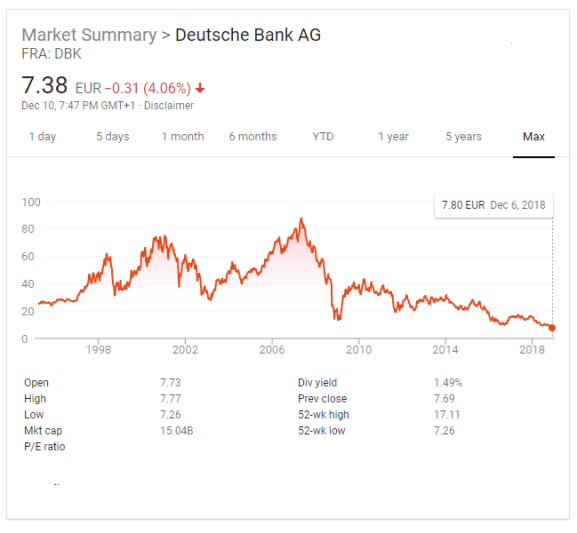
Deutsche Bank stock hit another all-time low in Frankfurt this morning,  down to €7.26 before bouncing, to close the day down 4 percent.

DB_Stock

The large U.S. banks didn’t participate in today’s yuuge reversal.  DB’s death spiral may be one reason why.

It’s schadenfreude to see your competition circling the drain unless it’s systemic.

Deutsche Bank … is one of the most important net contributors to systemic risks in the global banking system. These findings underline the importance of ensuring the resilience and stability of the bank.  – IMF, June 2016


DB_Market Cap

DB Is No Lehman

In our last post on DB, we noted the bank is no Lehman Brothers.  The German government will never let their flagship go down and already rumors of a bailout/merger is coming.

They better get on with it before things go sideways nonlinear.

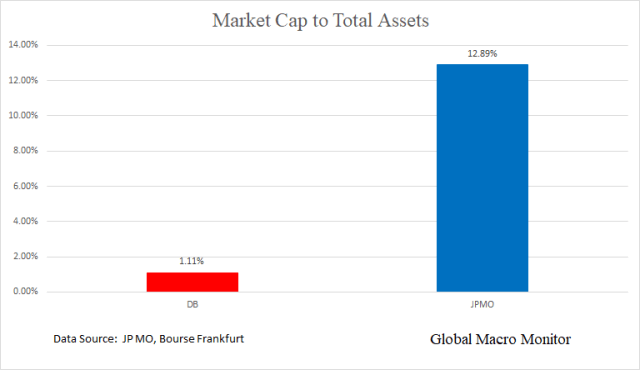
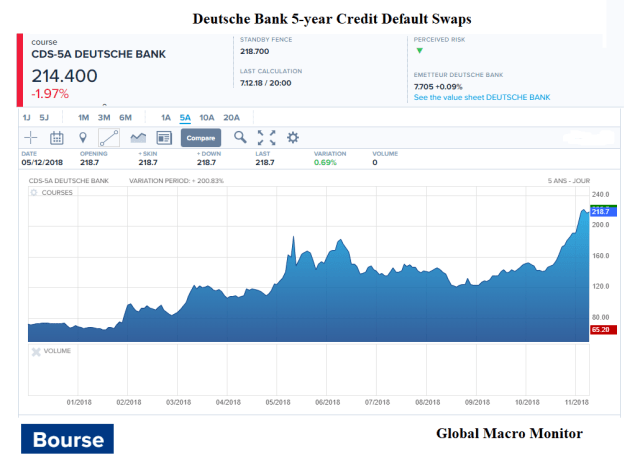
When credit officers charged with counter-party risk in large financial institutions see charts like the one above,  they are not exactly inspired with confidence and thrilled to approve bigger or even extend current counter-party limits.  WATCH THIS SPACE!

You heard it here waaay first.  If you’re gonna panic, always better to do it before everyone else.

Keep this one on your radar, folks.

Posted in Banking, Black Swan Watch, Uncategorized | Tagged , , | Leave a comment

Watching Gold

Gold is looking interesting.

Fundamentally, it shouldn’t as the Fed is tightening the screws on liquidity, the ECB is ready to stop the printing press, and international reserves continue to decline.

Check out the chart. 

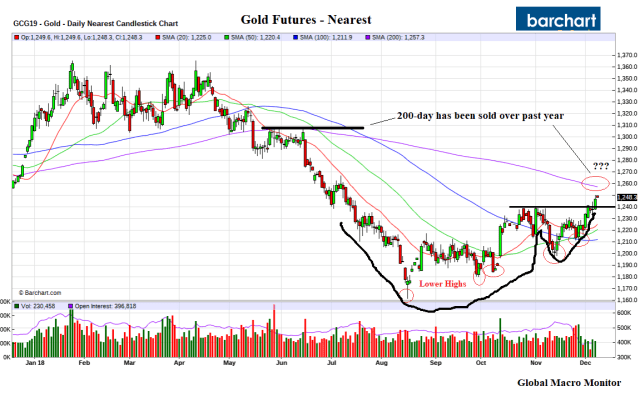
Higher lows since August,  a breakout of a crude cup-and-handle formation, and what looks like the coming test of the 200-day at 1257, which has rejected the gold price over the last year almost as many times I was in high school asking girls out on dates.

Could be gold is sniffing out an escalation of the U.S.-China conflict or it could be something altogether different.

Chinese media reports that the situation in the South China Sea is expected grow more intense over the coming year, with one senior military official also declaring that China should be prepared to attack United States naval vessels, should the U.S. violate Chinese “territorial waters.”

Dai Xu (戴旭), who is President of the Institute of Marine Safety and Cooperation, as well as a PLAAF Air Force Colonel Commandant, was quoted by the tabloid Global Times saying the following.

“If the U.S. warships break into Chinese waters again, I suggest that two warships should be sent: one to stop it, and another one to ram it… In our territorial waters, we won’t allow US warships to create disturbance.” – Taiwan News, December 9th

Double yikes.

Hope Mike Pence and John Bolton, who appear to be driving a Two-China Policy in the administration, at least to us, are reading the above.

Don’t say we didn’t warn you about a hotter Taiwan Straight, way back before it came on the radar.  See here and here.

All part of the Thucydides Trap, folks.

We will be a buyer with a close above the 200-day with a tight stop.


Gold

Posted in Gold, Uncategorized | Tagged , , | 13 Comments

Week In Review – December 7

Summary

  • Another fugly week for stocks.  It’s really shaping up to be a Trapper John year — full of bull and bear traps making it difficult for traders to make money.  The ‘bots have won, folks
  • Transports down over 8 percent for the week, which has only happened 21 weeks in the past 70 years, of which 12 have occurred in the new century.   The last time was during the European Debt Crisis in 2011
  • Yields are starting to come in over worries about the economy.  We think the Fed’s cave to the president’s pounding was a mistake, sent a bad message and confused the markets.  The funds rate is still negative in real terms.  Let’s see how inflation comes in this week
  • The flattening yield curve, which is highly distorted by past monetary action and the Treasury front loading new issuance, may cause a self-fulfilling prophecy as so many in the market still, mistakenly, in our opinion,  use it as a signal as the economic health of the nation.   Viable economies usually don’t “fall out of the sky,” which begs the question, “is the U.S. economy viable” or excessively dependent on asset markets?
  • U.S credit continues to have a horrendous Q4
  • The Dollar index a tad weaker.  EM currencies still adjusting to their wild “summer of love volatility”
  • G5 stock markets led the equities lower last week
  • Crude stabilizing.  Iron Ore was pounded last week

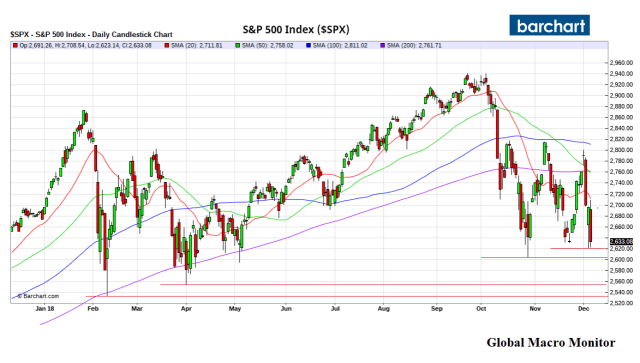
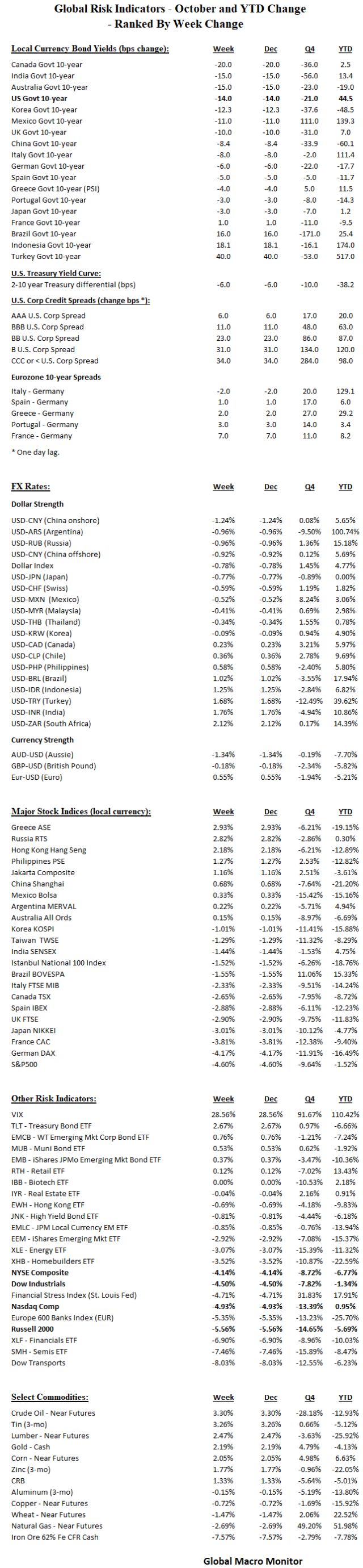
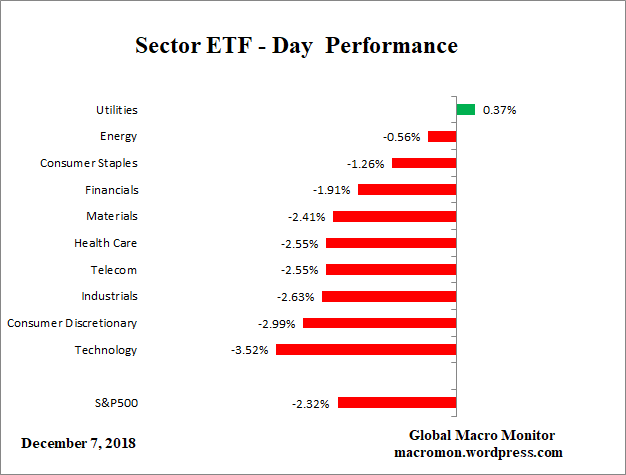
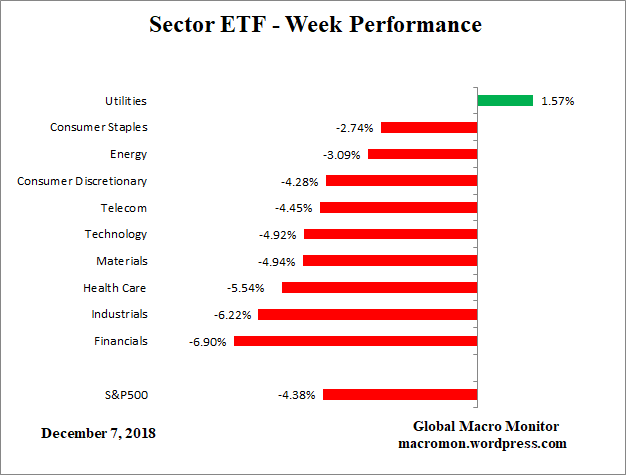
Commentary:  Feels like the S&P has traveled a million miles 1.61 million kilometers this year.  Two 10 percent corrections this year and don’t yet count out another.  The S&P sits at a critical level after testing the 2621-23 on Thursday and Friday.    If that level doesn’t hold, and we don’t expect it to, the Q4 correction low at 2603 is a 90 percent probability, which, if that breaks,  brings the 2018 low at 2532, about 4 percent lower, in play.

You knew this type of price action in 2018 was coming.

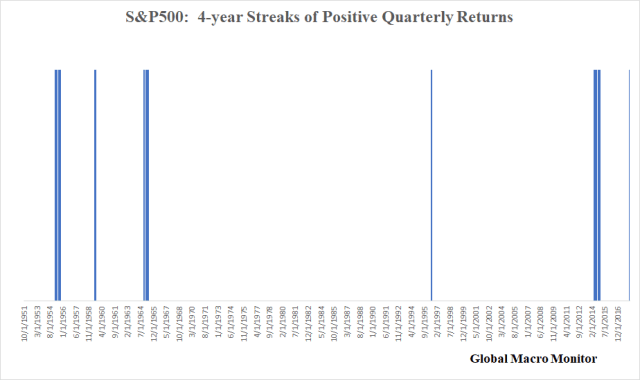
Going into Q1, the S&P500 had delivered positive returns for 16 consecutive quarters or four straight years. The chart illustrates how rare the streak has been over the past half-century.

Minsky-esque!

Apr1_Q_Rtns

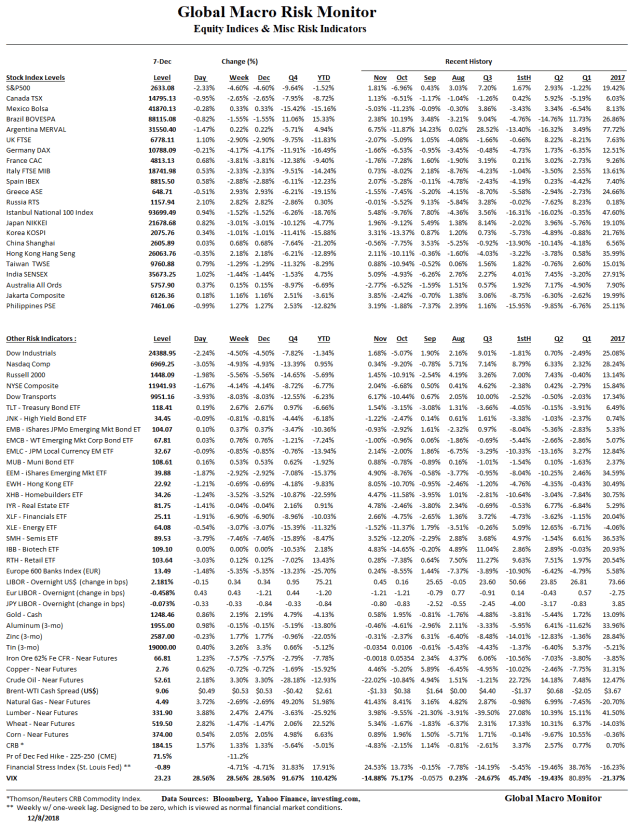
Our Global Risk Monitor illustrates that 2 of the 4 quarters (2nd and 4th) in 2018 will deliver negative returns.

What to watch:  Aside from the key S&P levels, the BREXIT vote on Tuesday,  U.S. inflation mid-week, Super Mario and the ECB on Thursday, which is big as QE is set to end in Europe, and Deutsche Bank stock making new lows.  We expect the term “Counter-Party Risk” to become all the rage of the market experts into year-end as Deutsche’s stock circles the drain.

Sounds like the German government is preparing for a bailout of DB.  Merging two weak banks will require a significant injection of capital.  Who will, if any, be bailed in?

Upshot:  Don’t like it here.  Think we are in a bear market.  Bears markets do bounce hard, however, as we have seen time and time again this year.

Capital preservation folks.  Scalpers and traders can have this market.


S&P

Week_Chart_2

DB Stock Making New Lows and CDS Blowing out – Counter-Party Risk

Week_Chart_1


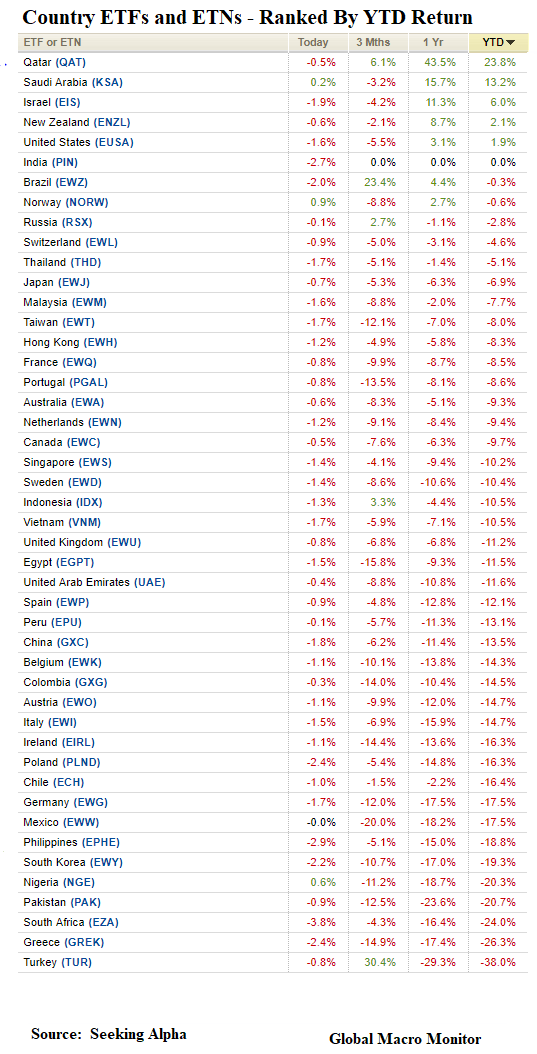
Week_2018_ETFs


Week_Table


Posted in Uncategorized, Week Ahead, Week in Review | Tagged | 2 Comments

Best Christmas Ad Of The Season

You have to be a father to really appreciate this one, folks.  Even if you’re not, still priceless.  Click it and enjoy.


Posted in Uncategorized, Video | Tagged | Leave a comment

Sector ETF Performance – December 7

ETF_Day

ETF_W

ETF_Q

ETF_YTD

Posted in Sector ETF Peformance, Uncategorized | Tagged | Leave a comment

Global Risk Monitor – December 7

RiskMon_1

RiskMon_2

Posted in Daily Risk Monitor, Uncategorized | Tagged , , , , , | Leave a comment

The Free Trade Debate: Markets Losing Patience

I bought of very nice pair of denim jeans the other night for $9.00.   When I was in grad school just a few decades ago, I paid $26.00 for a pair of lesser quality.  That is about $62.00 in 2018 dollars.

Do the math.

I now have a gain of $53.00, which is an increase in real income or purchasing power that can be spent at the local diner, farmer’s market,  theatre, or get that needed car tune-up from my local mechanic.  That $53.00 increase in real income creates real jobs.  It’s not theoretical mumbo-jumbo.  Economists call this the gains from trade.

However, the company and employees who worked in the domestic denim factory and lost their market to free trade are hurt — the losses from free trade.

Political Problems

Because politicians have mostly ignored those who have lost out from globalization, offering up only anti-trade rhetoric,  the political shit is now hitting the fan.  Trade and globalization is now a four-letter word in the world of political campaigns.  It’s hard to reason with people when emotions are running so high.   Many suffer from Einstellung, a predisposition or state of mind that prevents them from finding solutions to new problems, especially with heated political rhetoric.

If we erect trade barriers to try and bring denim factories back to the U.S. in the name of creating higher paying jobs, for example, causing the price of denim jeans to go back to, say, $62.00 per pair,  nobody will buy jeans.   There will be no market, no new factories, no new jobs created, and those who gained from the income effect of free-trade — the local waitress, the town theatre and actors, and the auto mechanic — will lose their jobs.

That is how it works, folks.   How the income effect, a net positive, of trade expands domestic growth and net jobs.   Yes, in some sense, we are talking corner solutions, that is taking our example to the extreme, but we do so to convey the much needed big picture.

Still, we haven’t even touched on the expansion of foreign markets for U.S. exporters, which creates even more growth and jobs.

Trade Adjustment Assistance

Where we have failed as a nation and leader of the free world is to take care of the workers who have been hurt by trade.  We have written extensively on this.  See here.

What’s unfair, is to offer false hopes to those struggling in the rust belt by announcing a few cosmetic tweaks to the trade deals and then declaring victory.

…The rust belt needs a new Marshall Plan — more education, and more opportunities provided by intense vocational retraining programs, coupled with income support for older workers who have little chance of recapturing their income and regaining new employment.

Also, begin new, or bolster existing programs to deal with the opioid crisis ripping through the communities, which have been left behind by the global economy. All these programs, in the form of beefed Trade Adjustment Assistance, should be financed by taxes earmarked from the gains from trade as outlined above.  – GMM,  Oct 1, 2018

 The President

We have given up on President Trump regarding his ability to understand the positive economic effects of international trade, both the gains and losses and how to effectively deal with the political backlash, instead of inflaming it.
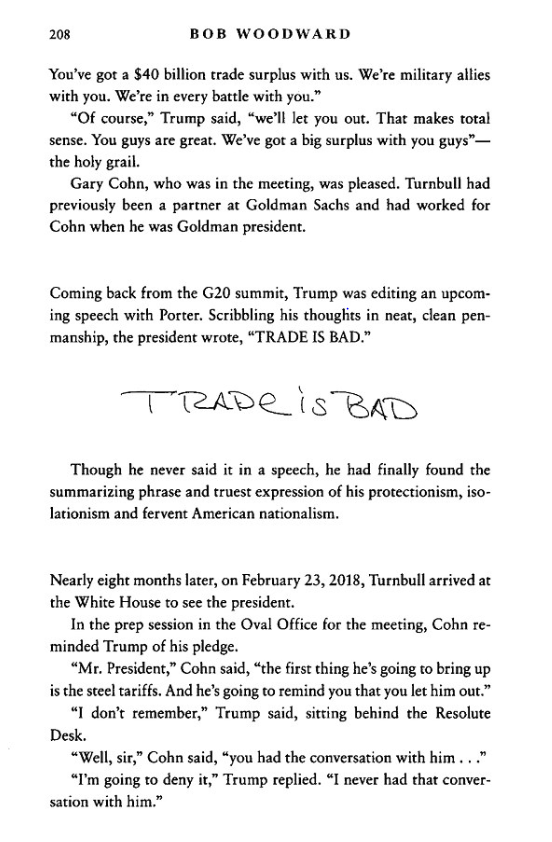
Trump Letter_2

Tariff Man.  What a joke.

Does he even understand the basic tenets of trade?   Latest reports suggest he just might. The ultimate hypocrisy.

A Marshall Plan For the Rust Belt

President Trump’s cosmetic tweaks to NAFTA 2.0  and the so-called U.S.-Korea Free Trade Agreement (KORUS)  deal will do more harm than good to the global economy in the long-term.   They are nothing more than political Potemkin trade deals, which, in reality,  have been a relief to free-traders, at least, in the short-term but will not move the needle in helping workers in the rust belt.

No proliferation of factories,  no significant increase in employment.  Only disappointment, disillusion, and even more significant political blowback in the long-term.

What should be done in, in our opinion, is to take a portion — call it a tax or fee, if that will make Grover happy — of that $53.00 savings from the imported pair of jeans we mentioned above to fund a Marshall Plan for the rust belt and also help the hollowed out middle class on a means-tested basis.

The literature on trade theory is full of ideas on trade adjustment assistance.

I would still buy those jeans even if I had to pay an extra $6.00, especially if I knew the fee was going to retrain my fellow Americans in the rust belt, fund new jobs projects, or to help subsidize the income of the senior workers, who will never find work again.   We can argue whether the government or the private sector should do it, but let’s Just Do It.

It’s time for bold leadership folks.    Mr. Market is worried the post-War order is crumbling and crumbling fast it is.

We are all stumbling in the dark to an uncertain future.  Markets don’t like uncertainty.

Certainly, China needs to reform its trade policy and we should do that by strengthening the international institutions, such as the WTO.     The U.S. and its allies should press for a “better deal” — more market access,   intellectual property rights, etc. — but another, half-baked, politically driven Potemkin unilateral trade deal with China may only goose markets in the short-term.   It will be ephemeral probably lasting about 5 minutes in today’s markets.

Markets want a long-term fix and looking for leadership to expand the global economy and commerce while fixing the fracturing political global consensus for a more liberal trading order.

The alternative is very dark and Mr. Market is starting to sense it.


Posted in Economics, Trade War, Uncategorized | Tagged , , , | 4 Comments

This Day In History

Posted in Day In History, Uncategorized | Tagged , | Leave a comment

QOTD: Goodbye, #41

41


My friends, we are not the sum of our possessions. They are not the measure of our lives. In our hearts we know what matters. We cannot hope only to leave our children a bigger car, a bigger bank account. We must hope to give them a sense of what it means to be a loyal friend; a loving parent; a citizen who leaves his home, his neighborhood, and town better than he found it. And what do we want the men and women who work with us to say when we’re no longer there? That we were more driven to succeed than anyone around us? Or that we stopped to ask if a sick child had gotten better and stayed a moment there to trade a word of friendship?  – President George H.W. Bush, Inaugural Address – Jan. 20, 1989

(QOTD – Quote of the Day)

Posted in Politics, Quote of the Day, Uncategorized | Tagged , | Leave a comment

Time To Tune Out Market Pundits

Fugly day in the stock market.

We had to post a response to the market punditry rationalization on why stocks accelerated downward today:

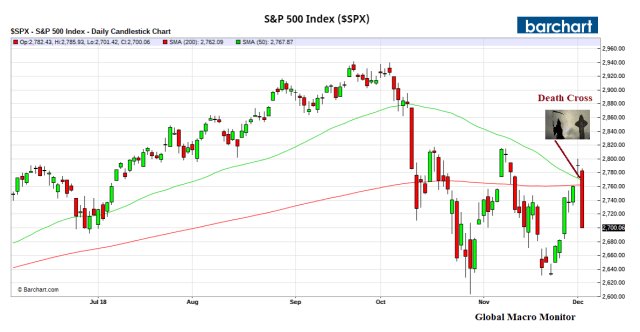
“the S&P500 broke its 200-day moving average.“

Are you fricking kidding me?

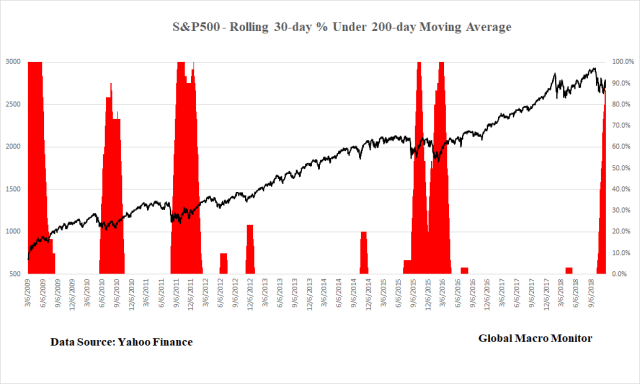
The S&P500 has been under its 200-day 87 percent of the past 30 trading days and 14 straight days prior to yesterday’s ramp.

Why then would a break of the 200-day moving average tank stocks?

Nice Chart

See the second chart below which illustrates the percentage of days over a 30-day rolling period the cash S&P500 has been below its 200-day moving average.

It is interesting that from March 16, 2016, to March 29, 2018, the S&P500 closed under its 200-day only once.  That is 1 out of 514 trading days.  Moreover,  from June 28, 2016, to March 29, 2018, the S&P500 closed above its 200-day 442 consecutive days.

Didn’t Minsky say, something to the effect, the lack of volatility, leads to complacency, which sows the seeds of higher volatility?

Stop Losses? 

We’ll concede it is possible that many, including the trading ‘bots, who got long yesterday’s ramp expecting a Christmas rally may have used the 200-day as their stop-loss.  The pundits should have qualified their explanations instead of hanging it out there that today’s break of the 200-day was somehow unique.  Come on, man!

Perverted Yield Curve And Self-Fulfilling Recessions

The noise around the “perverted” yield curve is also absurd, at least to us, and a bit dangerous as it could actually be self-fulfilling and cause the recession it is supposedly predicting.  The policymakers, who have manipulated the markets for the past decade,  just might be seeing the chickens finally coming home to roost.

Nevertheless,  as we have said many times, the only way bond yields move lower is due to haven flows.   That is other markets need to sell-off bigly.

We are working on a piece, crunching the numbers,  on the yield curve.  It should be posted in the next few days.

Stay tuned.

S&P_1.png


S&P_2


Posted in Equities, Monetary Policy, Uncategorized | Tagged , | Leave a comment