Feels Like Jackie Moon Moment Coming

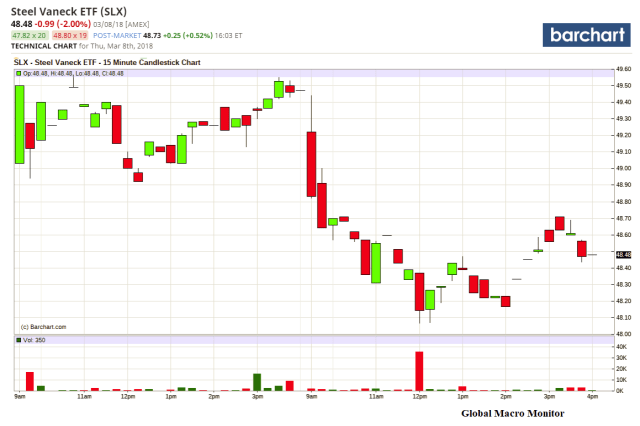
Markets are going to start to fret over potential trade wars after steel and aluminum tariffs are announced by Trump Administration.

Imagine if China retaliates by shutting market to Apple?

Can Jay Powell save the day?

If you are going to panic, always best to do it before everyone else does!

Posted in Uncategorized | Leave a comment

Charles Dickens 2.0

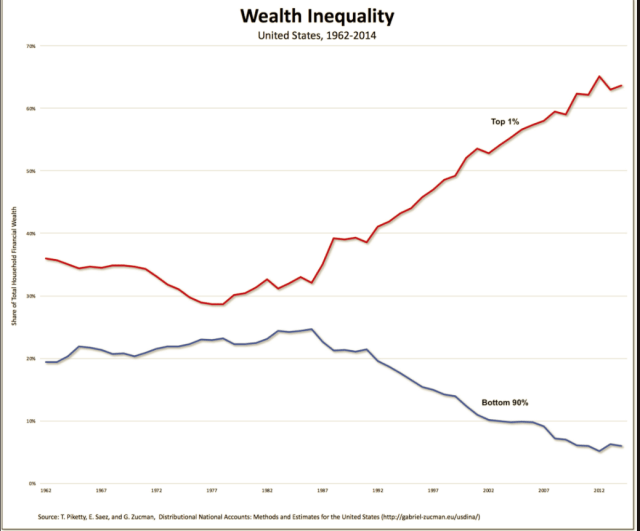
This is a f**ling outrage!  Straight out of a Dickens novel.

Don’t these idjits understand they are sowing the seeds for a mega-mega political backlash?    Can you hear Karl calling?  Or is that Marie trolling us?

Posted in Uncategorized | Leave a comment

POTD: DoJ Flipping Off The President?

It is heating up, folks.  Keep it on your radar.

Scoop: Besieged Sessions dines with Rosenstein
If Donald Trump finally follows through on his rage 
and fires Jeff Sessions, the image with this story will be printed in history books.

Tonight at 7:35pm, the Attorney General strode into a high-end Washington restaurant to dine with his deputy Rod Rosenstein and the Solicitor General Noel Francisco.

The symbolism was unmistakable: the three top ranking officials in the Justice Department appearing together in a show of solidarity on the same day Trump is publicly and privately raging about Sessions.

When Trump sees this photo he’ll have to absorb a concept that some of his aides have been trying to impress upon him for nearly a year, since he first began telling them he wanted to get rid of Sessions.

The concept: Fire Sessions, then what next? Are you going to fire Rosenstein too? And then what after that?

Sources close to the situation say today feels different than Trump’s usual rages. Sessions’ allies are deeply concerned and Trump is totally fed up with his AG.

Trump has been taunting and publicly humiliating Sessions for months now, but his tweet this morning was as rough as any he’s sent:

A source close to Sessions, who has spoken with him, says that this meeting was “in no way planned as pushback or an act of solidarity against the president.” The source said Solicitor General Noel Francisco requested the meeting some time ago to talk about carrying out various aspects of the department’s and administration’s agenda. – Axios

(POTD = Picture of the Day)

Posted in Policy, Politics, Uncategorized | Tagged , , | Leave a comment

JFK-Trump S&P500 Analog – Five Basis Points On Day 328

After 328 trading days since election day, the Trump S&P500 sits right on top of the JFK S&P500.  That is the performance of the index, 328 trading days after the election day of each president, is less than five basis points within one another.

Rather stunning, don’t you think?

Similar Volatility Shock

Recall in our earlier posts (see here and here), there have been three other massive volatility shocks since 1950,  similar to the one the S&P500 just experienced.

1) 1955: Ike’s heart attack;  2) 1962:  the “Kennedy slide” or JFK bear market; and 3) 1987:  the “crash” bear market, which lasted only 38 days.

We threw out Ike’s heart attack as it was not a prelude to a bear market.  The S&P500 recovered shortly after the sharp Monday sell-off after President Eisenhower had a heart attack on the 8th hole at Cherry Hills Country Club the prior Saturday afternoon.

Though the current S&P500 has the same theme, set-up, and backdrop as the JFK post-election rally and bear market in 1961-62,  the fundamentals drivers of the current correction are very similar to those of the 1987 rout (see here).

The run up in stocks after JFK’s election was spooked by rising inflationary pressures and the president jawboning “big steel” as he felt the executives broke an agreement with the administration and labor unions,

The pact, with ten of the nation’s 11 steel companies, called for an increase in fringe benefits worth 10 cents an hour in 1962, but no wage hikes that year. Then-AFL-CIO President George Meany said that in the pact, the union “settled on a wage increase figure somewhat less than the Steelworkers thought they would get.”

Kennedy praised the contract as “obviously non-inflationary” and said both the USW and the steel firms showed “industrial statesmanship of the highest order.” The agreement also implicitly said the companies would not raise prices, as that would be inflationary.

But on April 10, Roger Blough, CEO of U.S. Steel, the largest of the firms, with 25% of the market, met Kennedy in the Oval Office and told him the company was immediately raising prices by $6 a ton – and that other steel companies would follow. Six did. The 3.5% hike enraged the president. What he said in public was biting – but he was even more caustic in private.

In an April 11, 1962 press conference, Kennedy called the price hikes “a wholly unjustifiable and irresponsible defiance of the public interest.” He criticized “a tiny handful of steel executives whose pursuit of power and profit exceeds their sense of public responsibility.” The execs had “utter contempt” for the U.S., Kennedy said.

In private, Kennedy added: “My father always told me that all businessmen were sons of bitches, but I never believed it until now.” The line quickly became public. –  People’s World

“Sons of bitches” coming from the mouth of a president.  Where have we heard that before?

President Kennedy’s rant against steel came about a month into the S&P’s big downdraft.

True Analog Tracker?

If the analog continues to track, the S&P500 should rally around 1.27 percent in the next ten trading days from today’s close before rolling over hard, suffering a decline of 26.37 percent in the next 73 trading days, bottoming in late June.  The index would then bounce 14.26 percent from the June low the next 41 days before rolling over again to retest the low in late October.  Interesting how October is the month of market bottoms.

Of course, they will not track perfectly,  but they are thus far rhyming with each other on fairly consistent basis.

Nevertheless,  328 days after election day, with both markets experiencing similar volatility shocks – the JFK shock coming a little later than the Trump S&P500 shock – the fact both S&Ps are performing within five basis points of each other is simply amazing.

It’s Right here, Right Now for the analog in the next ten trading days. The Navarro waterfall beckons.

It is starting to get interesting.  The interns now in charge may be about to experience their baptism by fire.

Stay tuned.

JFK_Trump S&P500_Feb28

Posted in Equities, Uncategorized | Tagged | 25 Comments

QOTD: On Fed Chair, Jay Powell

Larry Kudlow just on CNBC quoting President Trump after interviewing Jay Powell for the Fed chair:

“The guy looks like a central banker.”
– President Trump (via Larry Kudlow)

(QOTD = Quote of the Day)

Posted in Monetary Policy, Quote of the Day, Uncategorized | Tagged , , | Leave a comment

Semiannual Monetary Policy Report to the Congress

February 27, 2018

Semiannual Monetary Policy Report to the Congress

Chairman Jerome H. Powell

Before the Committee on Financial Services, U.S. House of Representatives, Washington, D.C.

Chairman Hensarling, Ranking Member Waters, and members of the Committee, I am pleased to present the Federal Reserve’s semiannual Monetary Policy Report to the Congress.

On the occasion of my first appearance before this Committee as Chairman of the Federal Reserve, I want to express my appreciation for my predecessor, Chair Janet Yellen, and her important contributions. During her term as Chair, the economy continued to strengthen and Federal Reserve policymakers began to normalize both the level of interest rates and the size of the balance sheet. Together, Chair Yellen and I have worked to ensure a smooth leadership transition and provide for continuity in monetary policy. I also want to express my appreciation for my colleagues on the Federal Open Market Committee (FOMC). Finally, I want to affirm my continued support for the objectives assigned to us by the Congress–maximum employment and price stability–and for transparency about the Federal Reserve’s policies and programs. Transparency is the foundation for our accountability, and I am committed to clearly explaining what we are doing and why we are doing it. Today I will briefly discuss the current economic situation and outlook before turning to monetary policy.

Current Economic Situation and Outlook
The U.S. economy grew at a solid pace over the second half of 2017 and into this year. Monthly job gains averaged 179,000 from July through December, and payrolls rose an additional 200,000 in January. This pace of job growth was sufficient to push the unemployment rate down to 4.1 percent, about 3/4 percentage point lower than a year earlier and the lowest level since December 2000. In addition, the labor force participation rate remained roughly unchanged, on net, as it has for the past several years–that is a sign of job market strength, given that retiring baby boomers are putting downward pressure on the participation rate. Strong job gains in recent years have led to widespread reductions in unemployment across the income spectrum and for all major demographic groups. For example, the unemployment rate for adults without a high school education has fallen from about 15 percent in 2009 to 5-1/2 percent in January of this year, while the jobless rate for those with a college degree has moved down from 5 percent to 2 percent over the same period. In addition, unemployment rates for African Americans and Hispanics are now at or below rates seen before the recession, although they are still significantly above the rate for whites. Wages have continued to grow moderately, with a modest acceleration in some measures, although the extent of the pickup likely has been damped in part by the weak pace of productivity growth in recent years.

Turning from the labor market to production, inflation-adjusted gross domestic product rose at an annual rate of about 3 percent in the second half of 2017, 1 percentage point faster than its pace in the first half of the year. Economic growth in the second half was led by solid gains in consumer spending, supported by rising household incomes and wealth, and upbeat sentiment. In addition, growth in business investment stepped up sharply last year, which should support higher productivity growth in time. The housing market has continued to improve slowly. Economic activity abroad also has been solid in recent quarters, and the associated strengthening in the demand for U.S. exports has provided considerable support to our manufacturing industry.

Against this backdrop of solid growth and a strong labor market, inflation has been low and stable. In fact, inflation has continued to run below the 2 percent rate that the FOMC judges to be most consistent over the longer run with our congressional mandate. Overall consumer prices, as measured by the price index for personal consumption expenditures (PCE), increased 1.7 percent in the 12 months ending in December, about the same as in 2016. The core PCE price index, which excludes the prices of energy and food items and is a better indicator of future inflation, rose 1.5 percent over the same period, somewhat less than in the previous year. We continue to view some of the shortfall in inflation last year as likely reflecting transitory influences that we do not expect will repeat; consistent with this view, the monthly readings were a little higher toward the end of the year than in earlier months.

After easing substantially during 2017, financial conditions in the United States have reversed some of that easing. At this point, we do not see these developments as weighing heavily on the outlook for economic activity, the labor market, and inflation. Indeed, the economic outlook remains strong. The robust job market should continue to support growth in household incomes and consumer spending, solid economic growth among our trading partners should lead to further gains in U.S. exports, and upbeat business sentiment and strong sales growth will likely continue to boost business investment. Moreover, fiscal policy is becoming more stimulative. In this environment, we anticipate that inflation on a 12-month basis will move up this year and stabilize around the FOMC’s 2 percent objective over the medium term. Wages should increase at a faster pace as well. The Committee views the near-term risks to the economic outlook as roughly balanced but will continue to monitor inflation developments closely.

Monetary Policy
I will now turn to monetary policy. The Congress has assigned us the goals of promoting maximum employment and stable prices. Over the second half of 2017, the FOMC continued to gradually reduce monetary policy accommodation. Specifically, we raised the target range for the federal funds rate by 1/4 percentage point at our December meeting, bringing the target to a range of 1-1/4 to 1-1/2 percent. In addition, in October we initiated a balance sheet normalization program to gradually reduce the Federal Reserve’s securities holdings. That program has been proceeding smoothly. These interest rate and balance sheet actions reflect the Committee’s view that gradually reducing monetary policy accommodation will sustain a strong labor market while fostering a return of inflation to 2 percent.

In gauging the appropriate path for monetary policy over the next few years, the FOMC will continue to strike a balance between avoiding an overheated economy and bringing PCE price inflation to 2 percent on a sustained basis. While many factors shape the economic outlook, some of the headwinds the U.S. economy faced in previous years have turned into tailwinds: In particular, fiscal policy has become more stimulative and foreign demand for U.S. exports is on a firmer trajectory. Despite the recent volatility, financial conditions remain accommodative. At the same time, inflation remains below our 2 percent longer-run objective. In the FOMC’s view, further gradual increases in the federal funds rate will best promote attainment of both of our objectives. As always, the path of monetary policy will depend on the economic outlook as informed by incoming data.

In evaluating the stance of monetary policy, the FOMC routinely consults monetary policy rules that connect prescriptions for the policy rate with variables associated with our mandated objectives. Personally, I find these rule prescriptions helpful. Careful judgments are required about the measurement of the variables used, as well as about the implications of the many issues these rules do not take into account. I would like to note that this Monetary Policy Report provides further discussion of monetary policy rules and their role in the Federal Reserve’s policy process, extending the analysis we introduced in July.

Thank you. I would be pleased to take your questions.

Related Content
Congressional Hearing Transcripts
Hearing transcripts are posted to this website as they become available.
Back to Top
Last Update: February 27, 2018

Posted in Fed, Monetary Policy, PMIs, Policy, RSIs, Sector ETF Peformance, Sports, Uncategorized | Tagged , | Leave a comment

Ambiguity Of The Dow’s Value: -3.3% GAAP v 10.5% non-GAAP 2017 Earnings

One more example of the ambiguity of stock value  and why earnings are, or can be, the creature of  a company’s CFO.  This is exactly why we prefer top line metrics, such as sales and revenues.  See here for debate on GAAP vs. non-GAAP measures.

Posted in Earnings, Equities, Uncategorized | Tagged , , | Leave a comment

Who Is Financing The U.S. Budget Deficit?

In case you missed it in our last post, here’s an interesting chart illustrating how the U.S. budget deficit has been funded since 2010 on a quarterly basis.  The data are annualized.

During QE2 and QE3, from Q4 2010 to Q4 2014,  the Federal Reserve indirectly financed 60 percent of the deficit on an average quarterly basis.  Add to that foreign financing,  mainly central banks, and the budget deficit was indirectly overfunded,  freeing up capital for other risk assets, and for bond prices to move higher.

We just calculated foreign purchases of Treasury securities from the TIC data in Q4 2017 at a negative $12.7 billion.   The market is waking up, though not yet internalized,  to the fact the easy money to finance growing U.S. budget deficits has gone away.   Also, the Fed and foreign central banks were not price sensitive and motivated in their purchases of Treasury securities by policy concerns.

Recall Greenspan’s bond market conundrum, where the Fed lost control of the yield curve during the housing and credit bubble as foreign central banks were recycling excess dollars back into the U.S. bond market.    Greenspan lays the blame for the genesis of the housing and credit crisis on this very fact and not ultra-loose monetary policy.

The U.S. government will now have to scramble to finance trillion dollar deficits as far as the eye can see with price-sensitive capital.  Unless foreign central banks start showing up again,  the U.S. financial markets will have a trillion dollar hole to fill each year, unprecedented in this new century.

Prepare for the resurrection of the old term,  “crowding out.”  Already showing up in the housing data.

Real interest rates have only one direction to travel.  North.


Budget_Feb26

Fed Funding The Deficit_Feb24


Posted in Bonds, Uncategorized | Tagged , | 8 Comments

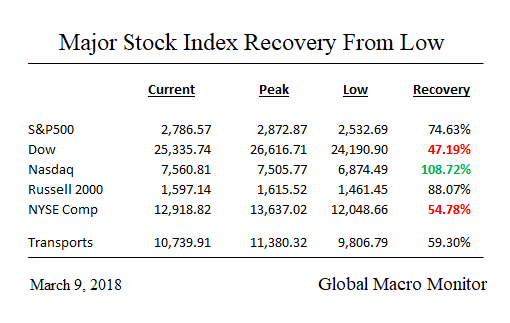
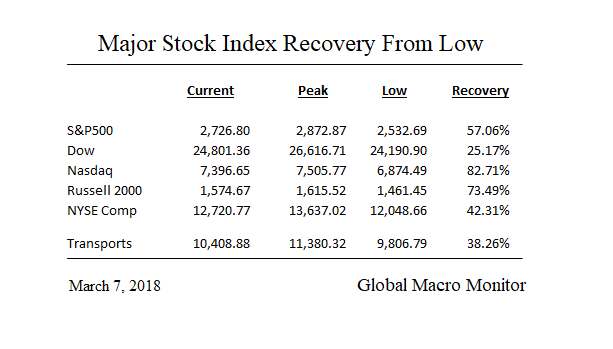
Major Stock Index Recovery Percentages

Recovery_Feb26

Posted in Equities, Uncategorized | Tagged , | Leave a comment

Stocks And Bonds Now Joined At The Hip

Market Recovery

The U.S. stock market rallied Friday on the six bps decline in the 10-year Treasury yield.  The S&P500 has now recovered 63.09 percent of its peak-to-low loss.  We are looking for 2,805 on the S&P500 for a green light and believe this level can only be obtained and sustained with a decent bond market rally.  Unlikely, however, in our opinion.


Levels_Feb24


Stock And Bond Comovements

Since the correction began on January 29th, the S&P500 has moved the same direction with the bond ETF (TLT) 15 of 19 days or almost 80 percent of the daily moves.  The two had tracked each other this closely only three other times since 2002 when TLT was created (see chart).

The table below also illustrates their daily comovements over various periods.    The normal range is around 40 percent.  That is the S&P500 moves in the same direction of the TLT about 40 percent of the time on average.  In other words, long-term interest rates and the S&P500 have moved together about 60 percent of the time since 2010 before this recent correction.

Covmovements_Feb24


Comovements_Feb25


Regime Shift? 

Over the past three weeks, the relationship has reversed dramatically.  Rising interest rates are now an anathema to the stock market.     We believe this is due to market concerns about three major structural factors that are unlikely to fade anytime in the near future.

Debt Levels Are High

First,  the stock of global debt has increased as a percent of GDP over the past ten years in all sectors with exception of the financials.  The big increase has been in government debt though some has been offset by the G4 central bank debt purchases through their respective quantitative easing programs.

The corporate sector is also vulnerable to rising interest rates as their debt relative to the economy has largely gone to finance stock buybacks in the U.S. and dubious investments in China.

Debt_Feb25

Now that the debt fears are squarely on the radar of the stock traders,  the relationship between stocks and bonds has reversed and is likely to be sustained.   Rising interest rates will be now be a stiff headwind to stocks prices.   This wouldn’t be the case and the cheerleaders would be right that rising rates won’t hurt stocks, IF debt and valuation levels were not so high.  But that, of course, is not the case.

Funding Of The U.S. Budget Deficit

Second, fiscal promiscuity in Washington is likely to drive up U.S. budget deficits to over one trillion dollars per year as far as the eye can see.  Trillion dollar deficits are nontrivial especially in an expanding economy where money becomes more dear.

Moreover, the size of the annual U.S. deficits will exceed all but 12 of the 190 country  GDPs monitored by the IMF.   Foreigners have been a large buyer of U.S. Treasuries over the past 20 years.  Let’s hope they continue to show up at the auctions.


Who is funding the deficit_Feb25

Data Source:  FRB, Flow of Funds

The End Of QE

Finally,  the Federal Reserve has stopped its indirect monetization of the U.S. budget deficit.  The table below shows that during the period of QE2 and QE3, from Q4 2010 to Q4 2014,  the Fed financed on average over 60 percent of the U.S. budget deficit.  Add foreign financing (mainly foreign central banks) and the deficit was over financed during the period, repressing and distorting interest rates across the yield curve and freeing up capital to flow into stocks and other risk assets.


Fed Funding The Deficit_Feb24

Though the Federal Reserve still holds around 30 percent of the stock of outstanding Treasury securities,  their flow has turned negative as they are now running off their balance sheet.

Higher Rates

Growing deficits coupled with declining flows from financiers who have been insensitive to market rates will certainly put a strain on interest rates in the U.S., and it unlikely to dissipate anytime soon.

No doubt, there will be periods of short covering bond rallies and bouts of flight to quality, which will drive stocks temporarily higher, but make no mistake,  “We are not in Kansas anymore.”

The U.S. government is going to have to work a bit harder and pay more to attract capital to finance itself.   “Crowding out” will increasingly become an issue.  Nevertheless, the  U.S. government will get funded and crumbs will be left for other markets.

Foreign Buyers

We sense foreign buyers of Treasuries also sense this and have become a bit more tepid in their purchases and have on the margin been sellers of the dollar as the U.S. current account deteriorates    This is a change from prior periods where central banks would intervene in their foreign exchange markets and recycle almost all the excess dollars back into the U.S. bond market.  It could be they are also diversifying their stock of FX reserves.

European Bond Market

It is also important to keep and eye on interest rates in the eurozone.  The monetary hawks are circling Mario Draghi.  

It is baffling the German economy, which is probably growing at 4-5 percent in nominal terms, has a 10-year bond yield of .65 percent.  Granted the ‘zone is a two-speed economy with the North and South, but the rule of thumb is that long-term yields should be close to nominal GDP growth.

That puts the bund yield about 300-400 bps below its equilibrium value.  The European bond market is a disaster waiting to happen, in our opinion, and will certainly have a spillover effect in the U.S. bond and equity market.

Conclusion

The global economy is a complex adaptive system which nobody fully understands. We have laid out our analysis and there you have it, folks, our best guess without the cheerleading that every little sell-off is a BTFD opportunity.

Sometimes market hurricanes do occur and, though it’s not the end of the world, it is best to tread carefully and take shelter.  We take the recent volatility shock as a warning shot across the bow.

One Big Caveat

Even if all our facts are correct,  our conclusions may be completely wrong.

To illustrate this, we like to use the story that Abraham Lincoln used to tell to try and persuade juries when he was an Illinois circuit court lawyer.

The story goes that Lawyer Lincoln was worried he had not convinced the jury during the closing argument of a civil case against a railroad.   The jurors had gone to lunch to deliberate.  Lincoln followed them and interrupted their dessert with a story about a farmer’s son gripped by panic,

“Pa, Pa, the hired man and sis are in the hay mow and she’s lifting up her skirt and he’s letting down his pants and they’re afixin’ to pee on the hay.” “Son, you got your facts absolutely right, but you’re drawing the wrong conclusion.”

The jury ruled in Lincoln’s favor.

Posted in Bonds, Equities, Sovereign Debt, Uncategorized | Tagged , , , | Leave a comment