QOTD: North Korea

Game on and, unfortunately, and it’s not just  Donkey Kong!

The North Korean crisis seems even more uncertain now and much riskier after Steve Bannon’s comments last week, which may embolden Kim Jong-un to challenge President Trump’s “fire and fury” threats.  

There’s no military solution here; they got us.” – Steve Bannon

Global Macro Monitor, August 19, 2017

(QOTD = Quote of the Day)

Posted in Uncategorized | Leave a comment

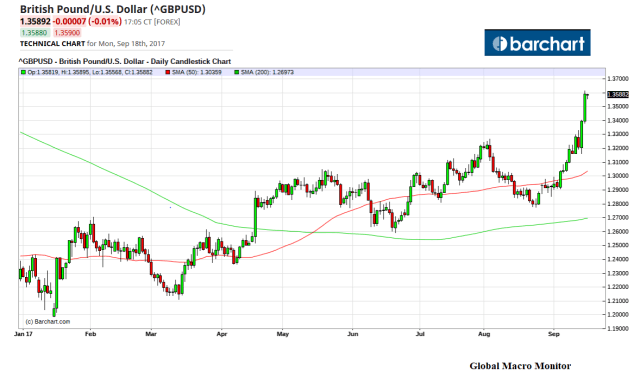
Dollar Index Breaks

https://twitter.com/simonting/status/902435505513447424

Posted in Dollar, Uncategorized | Tagged | 2 Comments

China Obsessed With Wealth Effect

We discussed the increasing role of the “wealth effect” in U.S. monetary policy and a key driver of aggregate demand in out last post,  The Gold-Bond Correlation And Other Macro Observations.

Nothing compared to China, however.

Why are investments so important to China?

The way investments drive growth for the most part this through housing prices. So for the average middle-class or upper-class person in China the focus is all on how much will property prices increase this year. They are not thinking about questions like: How can I get my salary to go up? Or how can my children get a better education so they can get a better job? They are not thinking about these fundamental economic things. They are thinking about things like: “Oh my god, I bought this villa in Langfang. The price is up 40%. Should I sell now? Or will it go up another 60%?” That’s what the government is thinking about, too, because that’s the way to drive growth and the way they get people excited and to get them to buy into the idea of the great Chinese miracle. – Anne Stevenson-Yang, J Capital, on Zero Hedge, August 28, 2017

Posted in China, Uncategorized | Tagged , , , | Leave a comment

The Gold-Bond Correlation And Other Macro Observations

We have posted several pieces over this year noting the high correlation of gold and 10-year bond futures. See here, here and here.

Here is how the gold ETF (GLD) and the Treasury ETF (TLT) have moved together over various periods. The data show the correlation is increasing. For example, over the past 20 trading days, the GLD and TLT have moved in the same direction on the same day 80 percent of the time, this compares to around 55 percent over the past ten years.

GLD_TLT_Comove

Now check out how the nearest gold and 10-year Treasury futures have tracked each other over the past six months.

Gold_Bond_6

We wrote many years ago that gold often takes on many personalities at any given time:

Gold is a weird cat with multiple personalities and more than nine lives.  The yellow metal is up almost $100 since last Friday’s weak U.S. employment report.

At any given time period  gold will assume any one of its multiple personalities based on a fundamental story and trade as:  1) a safe haven;  2) an inflation hedge;  3)  a commodity; 4)  a store of value against central bank balance sheet expansion;  5)  an alternative currency;  6)  central bank reserve currency;  7)  a diversification asset;  8)  an Armageddon hedge;  and/or 9) all of the above.
–  Global Macro Monitor, June 6, 2012

Add to that, what we have induced through market observation, the potential for a gold-bond tracking risk-on/risk-off algorithm.  That is algos programmed to track gold with the bond on an almost daily basis.

Gold As An Inflation Hedge?

Is the recent rise in gold forecasting inflation?  Don’t think so.

Why would it be tracking the bond — but…….

We are convinced the bond market signal has been so distorted by quantitative easing; it is now almost meaningless. At the very least, the level of interest rates is greatly distorted.

The Fed and foreign central banks now own more than 60 percent of Treasuries with maturities longer than one year. The Fed, alone, holds around 35 percent of Treasuries maturing in 2027-2047.

We will concede the directional change in yields may mirror changes in short-term fundamentals as traders buy and sell and whip and drive the markets.

As Mark Dow more eloquently put it:

“The bond market—in both shape and level—has been telling us very little about US economic prospects/activity. However, short-term changes do inform us as to the prevailing narrative.”  – Mark Dow

So it may be possible that bond yields are so repressed, and all the bond market vigilantes have been killed off by the central banks over the years, that any future inflation signal from bonds has been drowned out.

Any distortion in the bond market signal — the most important price in the world in which all risk markets are priced — is not good, folks.

Some think the inflation hedge has been transferred to the cryptocurrencies as a new form of money.

We sincerely doubt it.  A medium of exchange doesn’t move 5-25 percent in one day.

We do find, however,  the blockchain technology behind the cryptos fascinating and the potential for an enormously disruptive force in finance and the economy.

Is The Bond-Correlation Signalling Trouble For the Dollar?

Nope.

The dollar was soaring before the Trump slump, which began around inauguration day. Here is the one-year chart of the gold-bond correlation.

Gold_Bond_1 year

The dollar is in trouble because it had run up before the inauguration, pricing in a significant fiscal expansion — tax cuts and infrastructure spend — higher relative policy rates and economic growth.  That’s all deflating now and the European economic recovery is picking up steam.   In addition,  the  Dixie now trades with Trump’s poll ratings and currently sits at the critical level of 92.

Dolllar Index

If the long-term viability of the dollar and its reserve status were really in doubt, we would expect gold and bonds to diverge and move in the opposite directions. That is gold soaring and bonds tanking.   Watch that space.

Upshot?

Making sense of today’s markets is hard.

We have never seen this or been here before. Who would have imagined that raising policy interest rates would require more liquidity injected into the financial system rather the traditional monetary policy approach, where reserves and liquidity are drained from the system?

Maybe that is what seemed to be in the Fed’s cryptic warning in the latest FOMC minutes.

In assessing recent developments in financial market conditions, participants referred to the continued low level of longer-term interest rates, in particular those on U.S Treasury securities. The level of such yields appeared to reflect both low expected future short-term interest rates and depressed term premiums. Asset purchases by foreign central banks and the Federal Reserve’s securities holdings were also likely contributing to currently low term premiums, although the exact size of these contributions was uncertain.

…Several participants noted that the further increases in equity prices, together with continued low longer-term interest rates, had led to an easing of financial conditions. However, different assessments were expressed about the implications of this development for the outlook for aggregate demand and, consequently, appropriate monetary policy.  – FOMC Minutes from July 25-26 Meeting

We sold the lows on gold in December, by the way, as we thought it would trade down into the triple digits with the Fed raising rates, reducing their balance sheet and the central government expanding fiscal policy.   It’s tough trading these days.

What Are The Markets Signaling?

The 10-year is only six bps from the June 14th intraday low for the year, at 2.103 percent and just three bps off closing low on June 26th.

If gold is tracking the bond, which is massively distorted, do the trading ‘bots understand these distortions caused by QE and the new dynamic structure of the markets and the global economy?

Feedback Loop Between Asset Markets and Economy

Markets trade as if there is a massive feedback loop between asset prices and real economy — the risk-on/risk-off trade and gold-bond correlation, for example.  That is because there is.

The secular stagnation in real wages for those with higher propensities to consume has weakened organic aggregate demand, which is now insufficient to absorb the massive increase in global productive capacity caused by the huge positive labor supply shock of China, India, and Eastern Europe entering the world economy.  As wages converge across economies — what economists call “factor price equalization” — inequality is increasing in the developed markets, but decreasing across the developed vis-a-vis the developing economies.

With real wages, at best stagnant, in the developed world, global economic growth is now, as it has been for years, highly dependent on the wealth effect of ever higher asset prices to stimulate aggregate demand.   Witness the slow recovery in the measured inflation of goods and services even as asset prices inflate.

Enter Unorthodox Monetary Policy

Developed economies are at the end of a long-term debt cycle.  Monetary policy,  rather than working through the credit channels, as interest rates are at or still close to the lower bound,  is now more dependent on asset prices and exchange rates as the primary transmission mechanisms of stimulating aggregate demand and economic growth.

Monetary Transmission Mechanisms


QE_Transmission Mech

If the credit channel begins to really loosen up and credit flows into the real economy (rather than stock buybacks, e.g.), inflation will pick up and the global central banks will have a lot of catching up to do.  Especially given how much they have flooded the world’s financial system with high powered money over the past decade.

Machine Learning Algos

Most of the trading these days are done by machines based on so-called sophisticated algorithms.

Computers have taken over the majority of trading on Wall Street and are threatening the very nature of the trading profession. Laura French asks whether traditional traders are fighting a losing battle  – World Finance

Remember the days when the S&P500 traded almost tick for tick with the Aussie dollar? More ridiculous was the story that algos were programmed to buy Berkshire Hathaway stock when Anne Hathaway’s name was mentioned on the tape!

Some, or most, algos use machine learning or self-programming.  But what are they learning?

Developing, tracking and trading spurious correlations?  Designed and matured in the age of ZIRP, NIRP, and quantitative easing.  Is it any wonder that most asset markets and their price action now seem divorced from reality?

Record low volatility given all the event risk on the horizon?

Dhaval Joshi, chief strategist for BCA Research, says: “At our client meetings, almost everybody disbelieves that current valuations allow developed market equities to generate attractive long-term returns. Yet many investors are willing to suspend this disbelief, at least for the time being.”  – FT

But, hey, this is the market we live in today and have to adapt to make money for ourselves and our investors.

What Now?

We are not saying that the bull in risk assets can’t last for much longer than many think. As long as measured inflation appears tame, asset markets can remain overvalued much longer than shorts and cash hoarders can remain solvent.

The big question is, as Raoul Pal asks, which generation will take the hit?

The younger generations paying up for overvalued assets, not to mention all the pension liabilities and debt they have inherited.   Furthermore, at current prices, they will realize relatively small returns on their savings over their lifetime vis-a-vis the boomers.

Or will it be the baby boomers taking the hit through a significant downward asset price adjustment and bear market to cheapen assets in order to provide the basis for a decent long-run return for the millennials and other younger generations?

If the former, the seeds will be sown for a potental political rupture in America’s body politic, some of which we are now starting to experience with the rise of populism and the election of Donald Trump.   However, we think it will be the latter, but maybe a bit later than many think, with more political chop and volatility ahead.

We’ve been writing about this coming “clash of generations” for years.

Inflation:  Build It And It Will Come

We do disagree with Mr. Pal on the end game, however.  We think this all ends in higher inflation rather than Mr. Pal’s deflation scenario, though we agree there could first be a period of deflation panic.

Central banks have already shown us they will do whatever it takes to fend off deflation. If that means becoming effective employment agencies, and monetizing wages and pensions, either directly or indirectly, that is what they will do.

Still, central banks execute monetary policy using indirect transmission mechanisms, but they have resorted to policies unthinkable 20 years ago.  Directly buying stocks hoping to stimulate aggregate demand, for example.

The Bank of Japan’s controversial march to the top of the shareholder rankings in the world’s third-largest equity market is picking up pace.

Already a top-five owner of 81 companies in the Nikkei 225 stock average, the BOJ is on course to become the No. 1 shareholder in 55 of those firms by the end of next year, according to estimates compiled by Bloomberg from the central bank’s exchange-traded fund holdings.  –  The Japan Times

We are, or eventually, will be inching ever closer to direct monetization of aggregate demand if the global economy begins to slide again.

There is already talk of a  “universal basic income“, which will almost certainly be monetized,  and in the U.K. there is the “People’s QE”.

The UK policy of increasing money supply in the past has always been based on two premises to avoid hyperinflation and currency destruction: the independence of the central bank as a central pillar of monetary policy, and the constant sterilization of asset purchases (ie, what it buys is also sold to monitor market real demand). The balance sheet of the Bank of England has remained stable since 2012, coinciding with the highest economic growth period, and is below 25% of GDP.

Corbyn´s People´s QE means that the central bank will lose its independence altogether and become a government agency that prints currency whenever the government wants, but the increase of money supply does not become part of the transmission mechanism that reaches job creators and citizens in the real economy. All the new money is for the government, with the Bank of England forced to buy all the debt issued by a “Public Investment Bank”.
Zero Hedge, August 19

If not for the contraction in the money multiplier and secular decline in the velocity of money,  coupled with the reserve and hard currency status of the big four central banks — Fed., BoJ, ECB, and BoE, — where the economy has the confidence  and willingness  to hold the local currency,  QE would have descended into a burst of high inflation.

But confidence is a very fragile thing and we can’t print our way to growth.   At some point,  there is a tipping point.   Rollover risk greatly increases with the decline in the confidence in the local currency.

The timing of the coming debt ceiling debate is not optimal given the precipitous decline and current fragile nature of the dollar.  A very low probability event of a crisis, in our opinion, but an extremely high impact event.

Don’t lose sleep,  however, but at least keep it on your radar.   The upside is everybody in the world is short dollars.

Why Can’t We Just Be Long-Term Optimists?

We are.   Especially,  after monetary policies are normalized and an asset valuation adjustment takes place.

Stock prices will be higher in 10, 20, and 30 years from now.

The journey is sometimes more important than the destination, however.

As with any journey, the path we take is more important than the destination we arrive – Todd Harrison

We do admit the above analysis is based on linear thinking and that is usually not a good forecasting framework.   Economic progress and innovation usually takes place exponentially.

Emerging Markets Are The Place To Be

Finally, Green Acres emerging markets is are the place for me.   Because, to paraphrase, the bank robber, Willie Sutton, “that’s where the money growth is.”

Younger demographics, lower debt profiles, and the potential for significant productivity and efficiency gains.   Think India — with a median age of 28 years-old versus Japan and Germany’s median age of 47-years old — for the long term.

Not going big until an asset price adjustment, however.  Especially after this year’s big run up.


Posted in Bonds, Gold, Monetary Policy, Uncategorized | Tagged , , , | 10 Comments

Presidential Job Approval: Truman To Trump


Presidential Job Aprroval

Source:   Gallup

Posted in Politics, Uncategorized | Tagged , , , , , , , , , , , , , | Leave a comment

Week in Review – August 25

Global Stock Indices

Kind of a quiet week for developed markets (DM) though with an upward bias.

Emerging markets continue to rip higher with Brazil up almost 4 percent for the week on expectations of a massive sale of state assets, which will help the government reduce the growth of public debt and cut a widening budget deficit.

Watch China’s Shanghai, which closed at its highest level since January 2016 with the index closing Friday above strong resistance


Weekly_Stocks


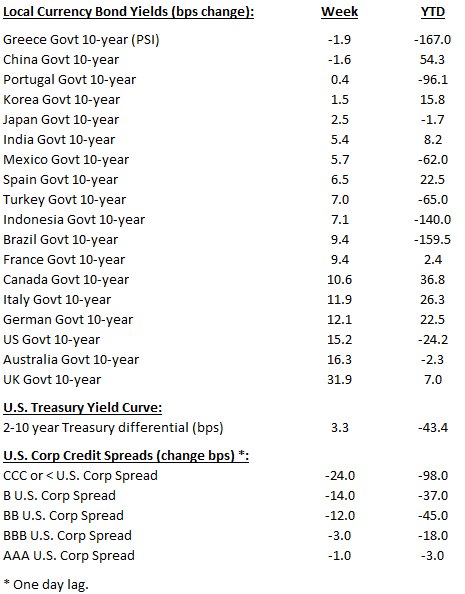
Global Bond Yields

Capital continues to flow into emerging markets, especially the high yielders, such as Turkey with ten plus percent yields. Yield chasers also going after corporate junk with U.S. single B spreads in 10 bps on the week.  The U.S. yield curve continues to pancake.


Weekly_Bonds


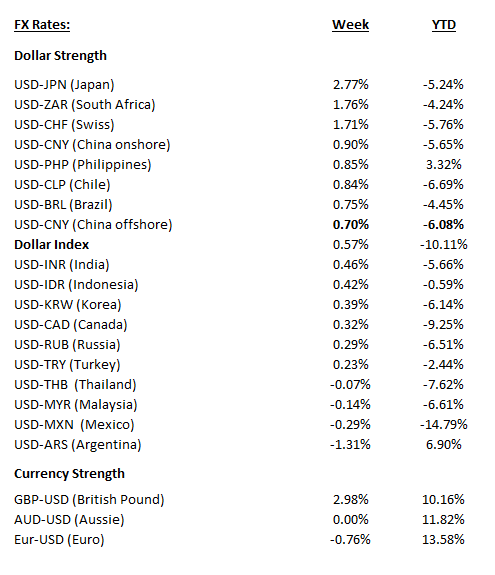
Currencies

The big event in the majors this week was the Yellen and Draghi speeches at Jackson Hole.  Most of the move in the euro came on Friday.  See the chart below how the euro/$ moved on both speeches.

A 1.20 euro/$ is going to make it tough for Draghi to swallow.   The dollar index (58 percent euro) is approaching the critical level of 92, which requires close monitoring.

Capital flows continue to bolster EM currencies.

Weekly_FX


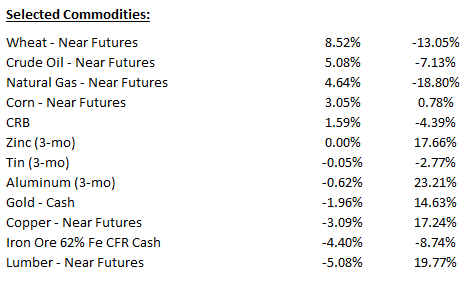
Selected Commodities

Metals and iron ore continue their rally on expectations of better China and global economy, coupled with supply worries.  After making ten-year highs, profit takers came into zinc on Friday.

Crude down, while the crack spread and gasoline soar, on concerns over Hurricane Harvey and that gas supplies, and inversely, crude demand could be affected.

Grains continue their plummet.

Weekly_Commodites


Other Risk Indicators

Emerging equity markets continue to rock.  Dow Transports bounced a bit along with the Industrials.  The VIX collapsed down to an 11 handle.


Weekly_Others

What’s On Our Radar

Next week should — emphasis on should — be quiet as the summer holiday wraps up.

Let’s see how President Trump and the markets react to Saturday’s North Korea missile test, buried in the news as Hurricane Harvey dominated the tape over the weekend.  No fears of escalation as U.S.- South Korea military exercises continue.

Watching the energy markets as “nearly one-third of the nation’s refining capacity sits in low-lying areas along the coast from Corpus Christi, Texas, to Lake Charles, Louisiana.”

Watching the Shanghai for follow through.

Can the dollar index hold 92?  Trump’s poll numbers are highly correlated  with the dollar. Keep it on your radar.

Also, we are monitoring the political fallout of the pardon of Sheriff Joe.


Key Charts

China Breakout

EURO_Aug25

Dolllar Index

Posted in Week in Review | Tagged , , , , , , | Leave a comment

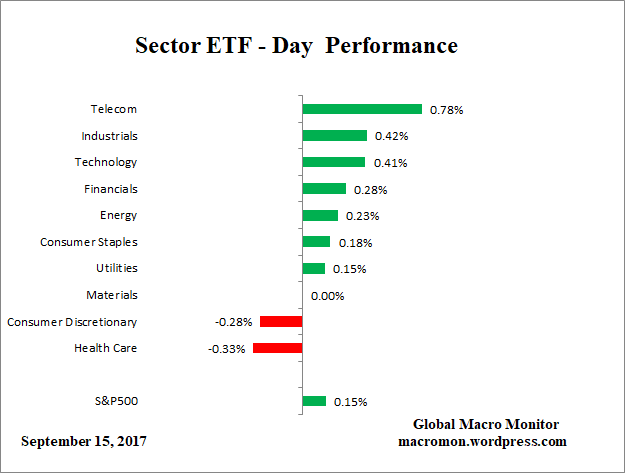
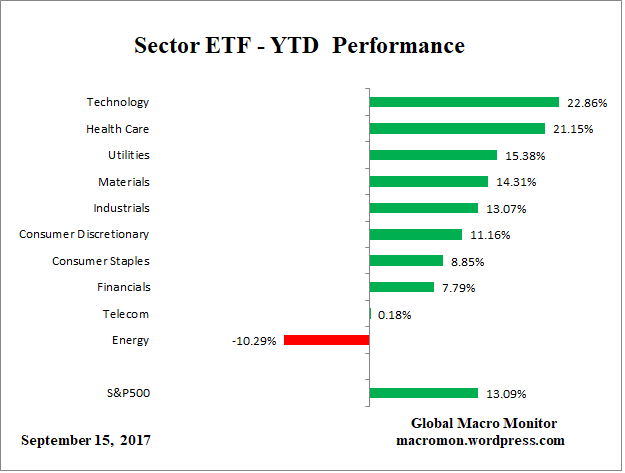
US Sector ETF Performance – August 25

ETF_DayETF_WeekETF_MonthETF_QETF_YTD

Posted in Sector ETF Peformance, Uncategorized | Tagged , | Leave a comment

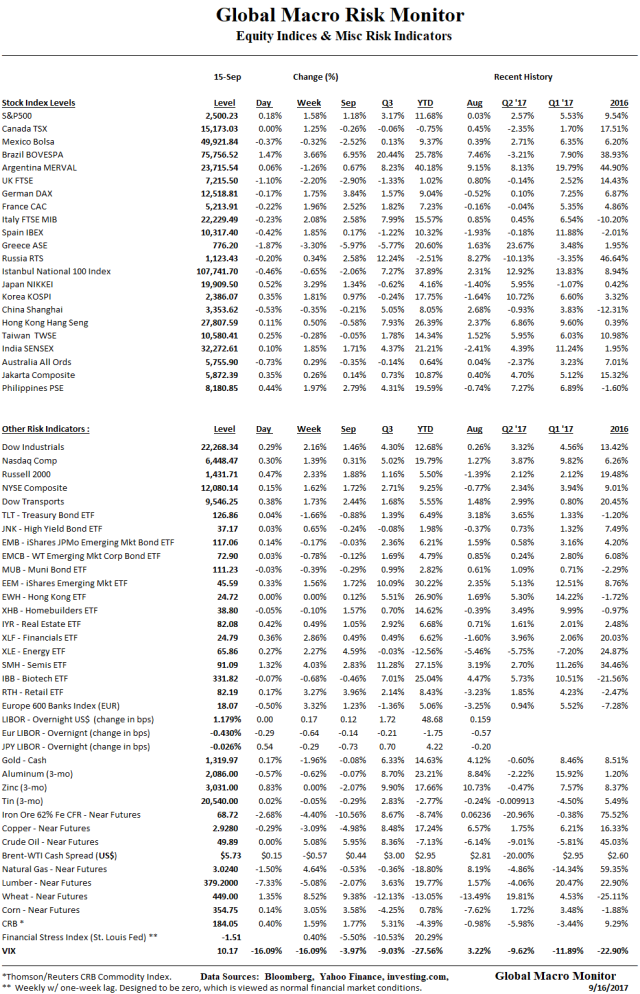
Global Risk Monitor – August 25

RiskMon_1

.RiskMon_2


Posted in Daily Risk Monitor, Uncategorized | Tagged , , , , , | Leave a comment

Speech By Mario Draghi At Jackson Hole

Sustaining openness in a dynamic global economy

Speech by Mario Draghi, President of the ECB, at the Economic Policy Symposium of the Federal Reserve Bank of Kansas City, Jackson Hole, 25 August 201

The global recovery is firming up. In some countries like the United States, this process has been visible for some years, in others like Europe and Japan, the consolidation of the recovery is at an earlier stage. So it is fitting that our discussions are now focusing not only on how to stabilise the economy, but also on how to make it more dynamic – while at the same time improving people’s welfare. At the centre of this debate is the question of how to raise potential output growth, which has slowed from around 2% in OECD countries in 2000 to around 1% today.[1]

Without stronger potential growth, the cyclical recovery we are now seeing globally will ultimately converge downwards to those slower growth rates. Slower growth will in turn make it harder to work through the debt and demographic challenges facing many advanced economies.

With the population growth rate in those economies projected to slow, the burden of raising potential growth must fall on productivity. There are a number of areas in which domestic policies can encourage an upward shift in productivity growth, such as competition, research and development, and insolvency regimes.

But when thinking about the global economy, one of the key ingredients for raising productivity is openness. Open trade, investment and financial flows play a key role in the diffusion of new technologies across borders that drive forward efficiency improvements.

The social consensus on open markets has, however, been weakening in recent years. This is driven not so much by a belief that open markets no longer create wealth, but by the perception that the collateral effects of openness outweigh its benefits. People are concerned about whether openness is fair, whether it is safe and whether it is equitable.

As Karl Polanyi observed many years ago, if the dislocation created by an open market goes beyond a certain point, protectionism is society’s natural response.[2]

So a central element of efforts to raise productivity growth – and build a dynamic global economy – must involve responding to these concerns about openness. And this is a feat countries cannot accomplish by themselves. Although domestic welfare policies are, of course, essential to the task, a commitment to working together through multilateral institutions is just as important.

This is because fears about fairness, safety and equity ultimately reflect a lack of trust in other countries’ regulation and enforcement. One of the main reasons why multilateral institutions exist is to create regulatory convergence, and therefore to increase trust between countries.[3] And perhaps the most important area where this applies today is global financial sector regulation.

Openness as the key to a dynamic global economy

One of the key questions facing the global economy is whether the trend towards ever greater economic openness, which has defined the last three decades, is coming to an end. Temporary trade barriers have indeed risen from covering around 1% of products in 2000 to more than 2.5% today, with the crisis accelerating this pattern. The same is true of anti-dumping actions.[4]

That said, at the global level openness is still viewed favourably; three-quarters of people consider growing trade and business ties with other countries to be a positive trend. But those polled in rich countries are more negative than in the pre-crisis period.[5]

Given the established gains of trade, this is plainly a concerning trend for the global economy. International trade results in a more efficient use of production factors and in specialisation where comparative advantage exists, thereby raising productivity growth.[6] And welfare gains from trade for firms and consumers follow from the wider availability of cheaper and better quality products.[7]

Moreover, for advanced economies the importance of trade may actually be growing. As economies converge towards the global technological frontier, innovation becomes more important for sustained productivity growth. And as OECD research has shown, openness to trade is a crucial factor in enabling an economy to benefit from frontier innovation. [8]

According to OECD estimates, in the case of a 2% acceleration in multi-factor productivity (MFP) growth in a frontier economy, the productivity spillover will be 0.3 percentage points higher for a country that trades intensively with the frontier economy than for one which trades less intensively. To put this in context, MFP growth has averaged only around 0.5% in OECD countries since 2000.[9]

Thus a turn towards protectionism would pose a serious risk for continued productivity growth and potential growth in the global economy. And this risk is particularly acute in the light of the structural challenges facing advanced economies.

Old-age dependency ratios are rising, putting more pressure on public finances. By 2025 there will be 35 people aged 65 and over for every 100 persons of working age in OECD countries, compared with 14 in 1950.[10] At the same time, public debt levels have surged in those countries from 56% of GDP in 2007 to around 87% today.[11] Only higher potential growth can provide a lasting solution.

So, clearly, to foster a dynamic global economy we need to resist protectionist urges. But to do so, we also need to identify how best to respond to protectionism.

The role of multilateral cooperation in making openness sustainable

Much has been written over the past few years about the negative effects of free trade and the need to pay more attention to those who benefit less from it. The debate has typically focused on the extent to which welfare policies can be used to share the gains of trade more evenly.

Though this is a complex issue,[12] I have no doubt that making better use of public policies to support the more vulnerable members of society, not just financially but also through education and retraining, is a vital part of the equation. More work needs to be done in this area and it is important to learn from best policy practices.

But the other key question is: how can we work together to make openness sustainable? What role can multilateral cooperation play towards this goal? This is the angle I would like to address today. Its importance becomes clear when one thinks about the three main areas of concern that people have about open markets that I mentioned earlier.

First, there is the concern about whether openness is fair – i.e. whether all are playing by the same rules and applying the same standards. This manifests itself in fears about currency manipulation by trading partners, dumping practices and lack of reciprocal market access.

Second, there is the concern about whether openness is safe – i.e. whether it exposes people to harmful spillovers from abroad. This is perhaps most visible, at least for economists, in the case of cross-border capital flows[13], but it also applies in areas such as agriculture and biotechnology.

Third, there is the concern about whether openness is equitable – that is, whether it disproportionately benefits some groups in society over others. Though it is not straightforward to disentangle the effects of trade and technology on inequality – and they may in fact be linked[14]– the perception that openness contributes to inequality has become more widespread.

In each case, multilateral cooperation, leading to regulatory convergence, is a precondition for addressing the underlying causes of these concerns. To demonstrate this, let me draw on our experience of managing openness within the European Union.[15]

As regards fairness, the point is obvious: regulatory convergence provides the strongest assurance that the playing field is level right across the European market. This is why, as borders have opened within Europe, common supranational powers of legislation and enforcement have strengthened in parallel.

For example, the Single European Act in 1986 not only launched the single market, it also substantially extended the powers of the EU to make laws, the role of the European courts to rule on them, and the powers of the Commission to execute them. The logic was that a single market could only be sustainable over time if all participants could be certain that they faced the same rules, and had recourse to the same courts in the case of infractions.

Despite the political events of last year, this symmetry between regulatory convergence and market deepening has, by and large, been a success. In fact, the free movement of people, goods and services within Europe is regularly mentioned in polls as one of the two most positive aspects of the EU, the other being peace among its Member States.[16]

Similarly, what has permitted the Single Market to survive various financial and consumer protection crises is its ability to restore safety by adapting market-wide regulation and enforcement.

To give an illustration, the internal market for frozen foods overcame the mis-selling scandal of 2013, when horsemeat was sold as beef, in large part because it was met with an improved food labelling and EU-wide inspection regime that restored trust. By contrast, a perceived lack of regulatory convergence between the EU and other countries, especially regarding food safety, is one reason for opposition to preferential trade agreements, such as the TTIP.

More fundamentally, following the sovereign debt crisis, the euro area experienced first-hand the risks of a diverging supervisory and regulatory framework for cross-border finance – and faced a serious threat of financial market fragmentation when those flows reversed. Safety was restored by elevating supervision and resolution to the European level with the banking union. This was key to re-establishing trust in the banking system and reviving cross-border capital flows within Europe. These are only the first steps, but the direction of travel has been drawn.

When it comes to the effects of openness on equity, it is admittedly less obvious how multilateral cooperation represents a solution to the fears being expressed. As I said, such fears typically have to be addressed by national distributional policies. But there is also an important international dimension, in particular related to tax avoidance.

Indeed, the problem many have with openness is not just that it redistributes income between different social groups. Almost everything that happens in a market economy – skill-biased innovation, churning of firms – redistributes income in some way, and we have in place mechanisms to deal with those outcomes, such as tax systems.

Where trade may differ from these other market forces, however, is in the perception that, in Dani Rodrik’s words, it “undercuts the social bargains struck within a nation and embedded in its laws and regulations”.[17] For example, increasing openness to trade and finance is perceived by some to shift the burden of taxation from footloose capital to labour, or to create pressures to reduce labour protections to boost the competitiveness of domestic producers – the “race to the bottom”.

Such perceptions, and the sense of injustice they fuel, are deeply damaging to public faith in open markets – and this is where multilateral solutions can play a role.

Addressing tax arbitrage between jurisdictions, for instance, can clearly best be achieved by countries cooperating via international institutions. Likewise, taking a stand against race-to-the-bottom dynamics that threaten labour protections, calls for a common regulatory approach. Again, our experience in Europe offers some insights into how this can work, as well as into some of the difficulties involved.

Thanks to its common legal framework, the EU has successfully upheld labour standards even as its market has expanded to lower-income countries. The Single Market has no doubt prompted some relocation of jobs across countries, and this has at times triggered fears of “social dumping”.[18] But in fact openness has not fundamentally challenged labour protections.

One main reason for this is that safeguards central to the European social model have been progressively embedded in European law, ensuring gradual convergence in labour standards among EU countries. Thus, while there is still heterogeneity, the gap between them is narrowing.

Preferences about the degree and type of social and labour protection differ across the world, and I am not claiming that those in the EU should be a model for everybody. The point here is that through multilateral decision-making, the EU has successfully built and defended the single market, addressing the perception that openness is always a source of inequality.

At the same time, in areas where unanimous decision-making is more prevalent, Europe has not always used the potential of its multilateral structure to the same extent. This is the case, for instance, in combatting profit-shifting and tax avoidance, although progress is now being made,[19] which clearly chimes with the mood of EU citizens.[20]

In short, there are certain concerns about equity that can most effectively – and perhaps only – be addressed through multilateral actions. As such, in tandem with well-targeted welfare policies, they are a key part of the policy toolbox for making openness sustainable.

Implications for the global economy

Clearly, the European model involves several unique features. In particular, it depends on a relatively advanced political structure that helps reconcile multilateral cooperation with democratic control, which is difficult to replicate elsewhere. Still, EU countries are generally more open than other advanced economies and perhaps have fewer problems of skewed income distribution.[21] So what lessons can we draw for the global economy from our experience?

The most salient is that, at a time when disaffection with openness is growing, multilateral institutions become more, not less important. They provide the best platform to address concerns about openness without sacrificing open markets.

So organisations like the WTO, which make sure that trade is governed by rules and is subject to fair arbitration, remain vital to ensuring that global trade is perceived as fair and safe – while at the same time avoiding protectionism in disguise. And bodies that foster global cooperation, such as the G20, remain just as necessary to reconcile openness with equity. The OECD/G20 initiative to combat tax base erosion and profit-shifting is just one example of such cooperation.

That said – and going by our experience in Europe – the area where we need a special focus today is cross-border finance. Organisations that facilitate convergence in financial regulation and supervision, such as the Financial Stability Board and the Basel committees, are key in this context.

Within these committees, a substantial amount of work has been done since the crisis to strengthen microprudential regulation, as well as to design and calibrate macroprudential tools. This work has been essential for at least three reasons.

The first reason is that finance is the most mobile production factor, and therefore the most likely to cause dangerous spillovers. This makes convergence in financial regulation one of the most important components of a sustainable open economy.

And we should remember that diverging financial regulation would endanger not only financial openness, but also global trade, since they are often two sides of the same coin: finance and trade are complementary in spreading knowledge and underpinning global value chains. A striking feature of the global financial crisis was indeed the collapse in world trade: between the third quarter of 2008 and the second quarter of 2009 global trade volumes declined by approximately 15%.

The second reason is that we have only recently witnessed the dangers of financial openness combined with insufficient regulation. International financial flows both contributed to and propagated the global financial crisis and the ensuing collapse of trade, output and employment.

Financial integration only survived relatively unscathed because the global regulatory response was swift and decisive, creating a financial system that posed fewer risks to the world economy. Any reversal would call into question whether the lessons of the crisis have indeed been learnt – and thus whether financial integration can still be considered safe.

Third, financial regulation interacts critically with monetary policy. Lax regulation implies an underestimation by regulators of incentives which lead to behaviour that is individually profitable, but socially costly. Given the large collective costs that we have observed, there is never a good time for lax regulation. But there are times when it is especially inopportune.

Specifically, when monetary policy is accommodative, lax regulation runs the risk of stoking financial imbalances. By contrast, the stronger regulatory regime that we have now has enabled economies to endure a long period of low interest rates without any significant side-effects on financial stability[22], which has been crucial for stabilising demand and inflation worldwide.

With monetary policy globally very expansionary, regulators should be wary of rekindling the incentives that led to the crisis.

To design and agree, in reciprocal trust, a regulation that preserves financial stability without unnecessarily restricting the flow of credit to the economy, while revisiting the post-crisis regulatory framework where necessary, the FSB and the Basel committees remain essential. This is also because, for large economies, changes in domestic regulation have international consequences. Global financial conditions account for 20-40% of the variation in countries’ domestic financial conditions, as shown by recent research from the IMF.[23]

Conclusion

Let me conclude.

To inject more dynamism into the global economy we need to raise potential output growth, and to do so with ageing societies we need to lift productivity growth. For advanced economies that are close to the technological frontier, this depends crucially on openness to trade.

Yet openness to trade is under threat, and this means that policies aimed at answering this backlash are a vital part of the policy mix for dynamic growth. Some of those policies can be implemented domestically, but some can only be effectively enacted through multilateral cooperation.

Multilateral cooperation is crucial in responding to concerns about fairness, safety and also equity. By encouraging regulatory convergence, it helps protect people from the unwelcome consequences of openness. And protection ensures that we do not lapse into protectionism over time.

The European experience provides some insights into the opportunities and challenges involved. It also shows the importance of ensuring that, at all times, openness remains under democratic control. Multilateral institutions are necessarily staffed by experts. But it is essential that they always remain accountable to elected representatives who set the parameters and have the final say.


[1] Per capita potential output growth, OECD data.

[2] Polanyi, K. (1944), The Great Transformation.

[3] See, for example, Williamson, O. (1996), The Mechanisms of Governance.

[4] Bown, C.P. (2016), Global Antidumping Database, The World Bank; World Bank Temporary Trade Barriers Database.

[5] Pew Research Center (2014), “Faith and Skepticism about Trade, Foreign Investment”, September. However, a Pew Research Center poll released in August 2017 found that, in the context of immigration, 68% of Americans believe that “America’s openness to people from all over the world is essential to who we are as a nation”.

[6] The most recent review in the literature has been published by the IMF and confirms that international trade improves welfare and strengthens economic growth. See IMF (2016), “Global Trade: What’s behind the slowdown?”, World Economic Outlook, Chapter 2, October.

[7] For more information on this topic, see Helpman and Krugman (1985), Grossman and Helpman (1991), Melitz(2003), Broda and Weinstein (2006), Melitz and Ottaviano, (2007), Antoniades (2015).

[8] Saia, A., Andrews, D. and Albrizio, S. (2015), “Productivity Spillovers from the Global Frontier and Public Policy: Industry-Level Evidence”, OECD Economics Department Working Papers, No 128.

[9] OECD data, unweighted average.

[10] OECD (2015), Pensions at a Glance 2015: OECD and G20 indicators, OECD Publishing, Paris.

[11] OECD data, unweighted average.

[12] See, for example, Antràs, P., de Gortari, A. and Itskhoki, O. (forthcoming), “Globalization, Inequality and Welfare”, Journal of International Economics.

[13] Broner, F. and Ventura, J. (2016), “Rethinking the Effects of Financial Globalisation”, Quarterly Journal of Economics, Vol. 131, Issue 3.

[14] For a review see Pavcnik, N. (2011), “Globalization and within-country income inequality”, in Bacchetta, M. and M. Jansen (eds), Making Globalization Sustainable, International Labour Organization and World Trade Organisation.

[15] See Cœuré, B. (2017), “Sustainable Globalisation: Lessons from Europe”, speech at the special public event “25 Years after Maastricht: The Future of Money and Finance in Europe”, Maastricht, 16 February 2017.

[16] See, for example, Eurobarometer Spring 2017.

[17] For a more extensive discussion of this point see Rodrik, D. (2017), “It’s Time to Think for Yourself on Free Trade”, Foreign Policy, 27 January.

[18] See, for example, the ongoing debate on the Posted Workers Directive.

[19] European Commission (2016), “Communication from the Commission to the European Parliament and the Council – Anti Tax Avoidance Package: Next Steps towards delivering effective taxation and greater tax transparency in the EU”, Commission Staff Working Document, COM(2016) 23 final.

[20] 74% of EU citizens believe the EU should take more action in the field of fighting tax fraud. See Eurobarometer Spring 2017.

[21] See Wang, C., K. Caminada and K. Goudswaard (2014), “Income redistribution in 20 countries over time”, International Journal of Social Welfare, Vol. 23, Issue 3.

[22] See Draghi, M. (2017), “The interaction between monetary policy and financial stability in the euro area”, speech at the First Conference on Financial Stability organised by the Banco de España and Centro de Estudios Monetarios y Financieros, Madrid, 24 May.

[23]IMF (2017), “Are Countries Losing Control of Domestic Financial Conditions?”, Global Financial Stability Report, Chapter 3, April.

European Central Bank

Posted in Monetary Policy, Uncategorized | Tagged , , | Leave a comment

15 predictions Bill Gates made in 1999

Gates

No. 1: Price-comparison sites.

Gates’ prediction: “Automated price comparison services will be developed, allowing people to see prices across multiple websites, making it effortless to find the cheapest product for all industries.”What we see now: You can easily search for a product on Google or Amazon and get different prices. Sites like NexTag and PriceGrabber are built specifically to compare prices.

No. 2: Mobile devices.

Gates’ prediction: “People will carry around small devices that allow them to constantly stay in touch and do electronic business from wherever they are. They will be able to check the news, see flights they have booked, get information from financial markets, and do just about anything else on these devices.”

What we see now: Smartphones, and now smartwatches, do all of this.

No . 3: Instant payments and financing online, and better healthcare through the web

Gates’ prediction: “People will pay their bills, take care of their finances, and communicate with their doctors over the internet.”

What we see now: Tech hasn’t been able to change healthcare the way Uber changed transportation, but sites like ZocDoc aim to make finding a doctor and scheduling easier. Startups like One Medical and Forward are trying to change what the doctor’s office is like by offering monthly memberships for online and data-driven healthcare.

You can also now borrow money online through sites like Lending Club and easily make payments through sites and apps like PayPal and Venmo.

No. 4: Personal assistants and the internet of things.

Gates’ prediction: “‘Personal companions’ will be developed. They will connect and sync all your devices in a smart way, whether they are at home or in the office, and allow them to exchange data. The device will check your email or notifications, and present the information that you need. When you go to the store, you can tell it what recipes you want to prepare, and it will generate a list of ingredients that you need to pick up. It will inform all the devices that you use of your purchases and schedule, allowing them to automatically adjust to what you’re doing.”

What we see now: Google Now, a smart assistant that runs on mobile devices, is starting to head in this direction. Meanwhile, smart devices like Nest collect data on your daily routines and automatically adjust your house’s temperature.

There’s also a wave of voice-controlled devices, like Amazon’s Echo and the Google Home, that you can ask to read your email to you or guide you through recipes as you cook.

No. 5: Online home-monitoring.

Gates’ prediction: “Constant video feeds of your house will become common, which inform you when somebody visits while you are not home.”

What we see now: Google bought Dropcam, the maker of a home-surveillance camera, for $555 million in 2014. But that was just the beginning — Ring makes a smart doorbell camera that can let you see who is at your door. There are even cameras like the PetCube that let you control a laser so you can play with your pets while you’re away.

No. 6: Social media.

Gates’ prediction: “Private websites for your friends and family will be common, allowing you to chat and plan for events.”

What we see now: Two billion people already use Facebook to see what their friends are doing and plan events. There’s also Snapchat, Instagram, WhatsApp, and Facebook Messenger alongside an explosion of other smaller social networks that more than cover this prediction.

No. 7: Automated promotional offers.

Gates’ prediction: “Software that knows when you’ve booked a trip and uses that information to suggest activities at the local destination. It suggests activities, discounts, offers, and cheaper prices for all the things that you want to take part in.”

What we see now: Travel sites like Expedia and Kayak offer deals based on a user’s past purchase data. Google and Facebook can offer promotional ads based on the user’s location and interests. Airbnb, which lets people stay in homes rather than hotels, started to offer specialized trips at destinations so you can live like a local, too.

No. 8: Live sports discussion sites.

Gates’ prediction: “While watching a sports competition on television, services will allow you to discuss what is going on live, and enter a contest where you vote on who you think will win.”

What we see now: A bunch of social media sites allow this, with Twitter being the clear leader — and even streaming some games. You can also leave comments in real time on sports sites like ESPN.

No. 9: Smart advertising.

Gates’ prediction: “Devices will have smart advertising. They will know your purchasing trends, and will display advertisements that are tailored toward your preferences.”

What we see now: Just look at the ads you see on Facebook or Google — most online advertising services have this feature, where advertisers can target users based on their click history, interests, and purchasing patterns.

No. 10: Links to sites during live TV.

Gates’ prediction: “Television broadcast will include links to relevant websites and content that complement what you are watching.”

What we see now: Almost every commercial these days has a callout asking the viewer to go to a website, follow the business on Twitter, or a scan a QR code to add it on Snapchat. It’s rare to see a broadcast without a website linked at all.

No. 11: Online discussion boards.

Gates’ prediction: “Residents of cities and countries will be able to have internet-based discussions concerning issues that affect them, such as local politics, city planning, or safety.”

What we see now: Most news sites have comment sections where people can have live discussions, and many sites have forums where people can ask and respond to certain questions. Twitter and Facebook played roles in political revolutions in Libya, Egypt, and Tunisia, as well as the Black Lives Matter movement in the US.

No. 12: Interest-based online sites.

Gates’ prediction: “Online communities will not be influenced by your location, but rather, your interest.”

What we see now: All kinds of news sites and online communities focus on single topics. Many news sites have expanded to include separate verticals, offering more in-depth coverage on a given topic. Reddit is a great example of a website that’s divided into subgroups, or “subreddits,” that focus on interests rather than who you know or where you are.

No. 13: Project-management software.

Gates’ prediction: “Project managers looking to put a team together will be able to go online, describe the project, and receive recommendations for available people who would fit their requirements.”

What we see now: Tons of workflow software in the enterprise space is revolutionizing how you recruit, form teams, and assign work to others.

No. 14: Online recruiting.

Gates’ prediction: “Similarly, people looking for work will be able to find employment opportunities online by declaring their interest, needs, and specialized skills.”

What we see now: Sites like LinkedIn allow users to upload résumés and find jobs based on interests and needs, and recruiters can search based on specialized skills.

No. 15: Business community software.

Gates’ prediction: “Companies will be able to bid on jobs, whether they are looking for a construction project, a movie production, or an advertising campaign. This will be efficient for both big companies that want to outsource work that they don’t usually face, businesses looking for new clients, and corporations that don’t have a go-to provider for the said service.”

What we see now: Much enterprise software is focused on social aspects, so users can reach out to other businesses and start a conversation that could lead to bigger projects directly within their apps. The so-called gig economy, with sites like Upwork, lets big businesses easily connect with freelance designers, writers, or engineers to do work they’re looking to outsource.

Posted in Technology, Uncategorized | Tagged , , | Leave a comment