

.
.
Speech by Mario Draghi, President of the ECB, at the Economic Policy Symposium of the Federal Reserve Bank of Kansas City, Jackson Hole, 25 August 201
The global recovery is firming up. In some countries like the United States, this process has been visible for some years, in others like Europe and Japan, the consolidation of the recovery is at an earlier stage. So it is fitting that our discussions are now focusing not only on how to stabilise the economy, but also on how to make it more dynamic – while at the same time improving people’s welfare. At the centre of this debate is the question of how to raise potential output growth, which has slowed from around 2% in OECD countries in 2000 to around 1% today.[1]
Without stronger potential growth, the cyclical recovery we are now seeing globally will ultimately converge downwards to those slower growth rates. Slower growth will in turn make it harder to work through the debt and demographic challenges facing many advanced economies.
With the population growth rate in those economies projected to slow, the burden of raising potential growth must fall on productivity. There are a number of areas in which domestic policies can encourage an upward shift in productivity growth, such as competition, research and development, and insolvency regimes.
But when thinking about the global economy, one of the key ingredients for raising productivity is openness. Open trade, investment and financial flows play a key role in the diffusion of new technologies across borders that drive forward efficiency improvements.
The social consensus on open markets has, however, been weakening in recent years. This is driven not so much by a belief that open markets no longer create wealth, but by the perception that the collateral effects of openness outweigh its benefits. People are concerned about whether openness is fair, whether it is safe and whether it is equitable.
As Karl Polanyi observed many years ago, if the dislocation created by an open market goes beyond a certain point, protectionism is society’s natural response.[2]
So a central element of efforts to raise productivity growth – and build a dynamic global economy – must involve responding to these concerns about openness. And this is a feat countries cannot accomplish by themselves. Although domestic welfare policies are, of course, essential to the task, a commitment to working together through multilateral institutions is just as important.
This is because fears about fairness, safety and equity ultimately reflect a lack of trust in other countries’ regulation and enforcement. One of the main reasons why multilateral institutions exist is to create regulatory convergence, and therefore to increase trust between countries.[3] And perhaps the most important area where this applies today is global financial sector regulation.
Openness as the key to a dynamic global economy
One of the key questions facing the global economy is whether the trend towards ever greater economic openness, which has defined the last three decades, is coming to an end. Temporary trade barriers have indeed risen from covering around 1% of products in 2000 to more than 2.5% today, with the crisis accelerating this pattern. The same is true of anti-dumping actions.[4]
That said, at the global level openness is still viewed favourably; three-quarters of people consider growing trade and business ties with other countries to be a positive trend. But those polled in rich countries are more negative than in the pre-crisis period.[5]
Given the established gains of trade, this is plainly a concerning trend for the global economy. International trade results in a more efficient use of production factors and in specialisation where comparative advantage exists, thereby raising productivity growth.[6] And welfare gains from trade for firms and consumers follow from the wider availability of cheaper and better quality products.[7]
Moreover, for advanced economies the importance of trade may actually be growing. As economies converge towards the global technological frontier, innovation becomes more important for sustained productivity growth. And as OECD research has shown, openness to trade is a crucial factor in enabling an economy to benefit from frontier innovation. [8]
According to OECD estimates, in the case of a 2% acceleration in multi-factor productivity (MFP) growth in a frontier economy, the productivity spillover will be 0.3 percentage points higher for a country that trades intensively with the frontier economy than for one which trades less intensively. To put this in context, MFP growth has averaged only around 0.5% in OECD countries since 2000.[9]
Thus a turn towards protectionism would pose a serious risk for continued productivity growth and potential growth in the global economy. And this risk is particularly acute in the light of the structural challenges facing advanced economies.
Old-age dependency ratios are rising, putting more pressure on public finances. By 2025 there will be 35 people aged 65 and over for every 100 persons of working age in OECD countries, compared with 14 in 1950.[10] At the same time, public debt levels have surged in those countries from 56% of GDP in 2007 to around 87% today.[11] Only higher potential growth can provide a lasting solution.
So, clearly, to foster a dynamic global economy we need to resist protectionist urges. But to do so, we also need to identify how best to respond to protectionism.
The role of multilateral cooperation in making openness sustainable
Much has been written over the past few years about the negative effects of free trade and the need to pay more attention to those who benefit less from it. The debate has typically focused on the extent to which welfare policies can be used to share the gains of trade more evenly.
Though this is a complex issue,[12] I have no doubt that making better use of public policies to support the more vulnerable members of society, not just financially but also through education and retraining, is a vital part of the equation. More work needs to be done in this area and it is important to learn from best policy practices.
But the other key question is: how can we work together to make openness sustainable? What role can multilateral cooperation play towards this goal? This is the angle I would like to address today. Its importance becomes clear when one thinks about the three main areas of concern that people have about open markets that I mentioned earlier.
First, there is the concern about whether openness is fair – i.e. whether all are playing by the same rules and applying the same standards. This manifests itself in fears about currency manipulation by trading partners, dumping practices and lack of reciprocal market access.
Second, there is the concern about whether openness is safe – i.e. whether it exposes people to harmful spillovers from abroad. This is perhaps most visible, at least for economists, in the case of cross-border capital flows[13], but it also applies in areas such as agriculture and biotechnology.
Third, there is the concern about whether openness is equitable – that is, whether it disproportionately benefits some groups in society over others. Though it is not straightforward to disentangle the effects of trade and technology on inequality – and they may in fact be linked[14]– the perception that openness contributes to inequality has become more widespread.
In each case, multilateral cooperation, leading to regulatory convergence, is a precondition for addressing the underlying causes of these concerns. To demonstrate this, let me draw on our experience of managing openness within the European Union.[15]
As regards fairness, the point is obvious: regulatory convergence provides the strongest assurance that the playing field is level right across the European market. This is why, as borders have opened within Europe, common supranational powers of legislation and enforcement have strengthened in parallel.
For example, the Single European Act in 1986 not only launched the single market, it also substantially extended the powers of the EU to make laws, the role of the European courts to rule on them, and the powers of the Commission to execute them. The logic was that a single market could only be sustainable over time if all participants could be certain that they faced the same rules, and had recourse to the same courts in the case of infractions.
Despite the political events of last year, this symmetry between regulatory convergence and market deepening has, by and large, been a success. In fact, the free movement of people, goods and services within Europe is regularly mentioned in polls as one of the two most positive aspects of the EU, the other being peace among its Member States.[16]
Similarly, what has permitted the Single Market to survive various financial and consumer protection crises is its ability to restore safety by adapting market-wide regulation and enforcement.
To give an illustration, the internal market for frozen foods overcame the mis-selling scandal of 2013, when horsemeat was sold as beef, in large part because it was met with an improved food labelling and EU-wide inspection regime that restored trust. By contrast, a perceived lack of regulatory convergence between the EU and other countries, especially regarding food safety, is one reason for opposition to preferential trade agreements, such as the TTIP.
More fundamentally, following the sovereign debt crisis, the euro area experienced first-hand the risks of a diverging supervisory and regulatory framework for cross-border finance – and faced a serious threat of financial market fragmentation when those flows reversed. Safety was restored by elevating supervision and resolution to the European level with the banking union. This was key to re-establishing trust in the banking system and reviving cross-border capital flows within Europe. These are only the first steps, but the direction of travel has been drawn.
When it comes to the effects of openness on equity, it is admittedly less obvious how multilateral cooperation represents a solution to the fears being expressed. As I said, such fears typically have to be addressed by national distributional policies. But there is also an important international dimension, in particular related to tax avoidance.
Indeed, the problem many have with openness is not just that it redistributes income between different social groups. Almost everything that happens in a market economy – skill-biased innovation, churning of firms – redistributes income in some way, and we have in place mechanisms to deal with those outcomes, such as tax systems.
Where trade may differ from these other market forces, however, is in the perception that, in Dani Rodrik’s words, it “undercuts the social bargains struck within a nation and embedded in its laws and regulations”.[17] For example, increasing openness to trade and finance is perceived by some to shift the burden of taxation from footloose capital to labour, or to create pressures to reduce labour protections to boost the competitiveness of domestic producers – the “race to the bottom”.
Such perceptions, and the sense of injustice they fuel, are deeply damaging to public faith in open markets – and this is where multilateral solutions can play a role.
Addressing tax arbitrage between jurisdictions, for instance, can clearly best be achieved by countries cooperating via international institutions. Likewise, taking a stand against race-to-the-bottom dynamics that threaten labour protections, calls for a common regulatory approach. Again, our experience in Europe offers some insights into how this can work, as well as into some of the difficulties involved.
Thanks to its common legal framework, the EU has successfully upheld labour standards even as its market has expanded to lower-income countries. The Single Market has no doubt prompted some relocation of jobs across countries, and this has at times triggered fears of “social dumping”.[18] But in fact openness has not fundamentally challenged labour protections.
One main reason for this is that safeguards central to the European social model have been progressively embedded in European law, ensuring gradual convergence in labour standards among EU countries. Thus, while there is still heterogeneity, the gap between them is narrowing.
Preferences about the degree and type of social and labour protection differ across the world, and I am not claiming that those in the EU should be a model for everybody. The point here is that through multilateral decision-making, the EU has successfully built and defended the single market, addressing the perception that openness is always a source of inequality.
At the same time, in areas where unanimous decision-making is more prevalent, Europe has not always used the potential of its multilateral structure to the same extent. This is the case, for instance, in combatting profit-shifting and tax avoidance, although progress is now being made,[19] which clearly chimes with the mood of EU citizens.[20]
In short, there are certain concerns about equity that can most effectively – and perhaps only – be addressed through multilateral actions. As such, in tandem with well-targeted welfare policies, they are a key part of the policy toolbox for making openness sustainable.
Implications for the global economy
Clearly, the European model involves several unique features. In particular, it depends on a relatively advanced political structure that helps reconcile multilateral cooperation with democratic control, which is difficult to replicate elsewhere. Still, EU countries are generally more open than other advanced economies and perhaps have fewer problems of skewed income distribution.[21] So what lessons can we draw for the global economy from our experience?
The most salient is that, at a time when disaffection with openness is growing, multilateral institutions become more, not less important. They provide the best platform to address concerns about openness without sacrificing open markets.
So organisations like the WTO, which make sure that trade is governed by rules and is subject to fair arbitration, remain vital to ensuring that global trade is perceived as fair and safe – while at the same time avoiding protectionism in disguise. And bodies that foster global cooperation, such as the G20, remain just as necessary to reconcile openness with equity. The OECD/G20 initiative to combat tax base erosion and profit-shifting is just one example of such cooperation.
That said – and going by our experience in Europe – the area where we need a special focus today is cross-border finance. Organisations that facilitate convergence in financial regulation and supervision, such as the Financial Stability Board and the Basel committees, are key in this context.
Within these committees, a substantial amount of work has been done since the crisis to strengthen microprudential regulation, as well as to design and calibrate macroprudential tools. This work has been essential for at least three reasons.
The first reason is that finance is the most mobile production factor, and therefore the most likely to cause dangerous spillovers. This makes convergence in financial regulation one of the most important components of a sustainable open economy.
And we should remember that diverging financial regulation would endanger not only financial openness, but also global trade, since they are often two sides of the same coin: finance and trade are complementary in spreading knowledge and underpinning global value chains. A striking feature of the global financial crisis was indeed the collapse in world trade: between the third quarter of 2008 and the second quarter of 2009 global trade volumes declined by approximately 15%.
The second reason is that we have only recently witnessed the dangers of financial openness combined with insufficient regulation. International financial flows both contributed to and propagated the global financial crisis and the ensuing collapse of trade, output and employment.
Financial integration only survived relatively unscathed because the global regulatory response was swift and decisive, creating a financial system that posed fewer risks to the world economy. Any reversal would call into question whether the lessons of the crisis have indeed been learnt – and thus whether financial integration can still be considered safe.
Third, financial regulation interacts critically with monetary policy. Lax regulation implies an underestimation by regulators of incentives which lead to behaviour that is individually profitable, but socially costly. Given the large collective costs that we have observed, there is never a good time for lax regulation. But there are times when it is especially inopportune.
Specifically, when monetary policy is accommodative, lax regulation runs the risk of stoking financial imbalances. By contrast, the stronger regulatory regime that we have now has enabled economies to endure a long period of low interest rates without any significant side-effects on financial stability[22], which has been crucial for stabilising demand and inflation worldwide.
With monetary policy globally very expansionary, regulators should be wary of rekindling the incentives that led to the crisis.
To design and agree, in reciprocal trust, a regulation that preserves financial stability without unnecessarily restricting the flow of credit to the economy, while revisiting the post-crisis regulatory framework where necessary, the FSB and the Basel committees remain essential. This is also because, for large economies, changes in domestic regulation have international consequences. Global financial conditions account for 20-40% of the variation in countries’ domestic financial conditions, as shown by recent research from the IMF.[23]
Conclusion
Let me conclude.
To inject more dynamism into the global economy we need to raise potential output growth, and to do so with ageing societies we need to lift productivity growth. For advanced economies that are close to the technological frontier, this depends crucially on openness to trade.
Yet openness to trade is under threat, and this means that policies aimed at answering this backlash are a vital part of the policy mix for dynamic growth. Some of those policies can be implemented domestically, but some can only be effectively enacted through multilateral cooperation.
Multilateral cooperation is crucial in responding to concerns about fairness, safety and also equity. By encouraging regulatory convergence, it helps protect people from the unwelcome consequences of openness. And protection ensures that we do not lapse into protectionism over time.
The European experience provides some insights into the opportunities and challenges involved. It also shows the importance of ensuring that, at all times, openness remains under democratic control. Multilateral institutions are necessarily staffed by experts. But it is essential that they always remain accountable to elected representatives who set the parameters and have the final say.
[1] Per capita potential output growth, OECD data.
[2] Polanyi, K. (1944), The Great Transformation.
[3] See, for example, Williamson, O. (1996), The Mechanisms of Governance.
[4] Bown, C.P. (2016), Global Antidumping Database, The World Bank; World Bank Temporary Trade Barriers Database.
[5] Pew Research Center (2014), “Faith and Skepticism about Trade, Foreign Investment”, September. However, a Pew Research Center poll released in August 2017 found that, in the context of immigration, 68% of Americans believe that “America’s openness to people from all over the world is essential to who we are as a nation”.
[6] The most recent review in the literature has been published by the IMF and confirms that international trade improves welfare and strengthens economic growth. See IMF (2016), “Global Trade: What’s behind the slowdown?”, World Economic Outlook, Chapter 2, October.
[7] For more information on this topic, see Helpman and Krugman (1985), Grossman and Helpman (1991), Melitz(2003), Broda and Weinstein (2006), Melitz and Ottaviano, (2007), Antoniades (2015).
[8] Saia, A., Andrews, D. and Albrizio, S. (2015), “Productivity Spillovers from the Global Frontier and Public Policy: Industry-Level Evidence”, OECD Economics Department Working Papers, No 128.
[9] OECD data, unweighted average.
[10] OECD (2015), Pensions at a Glance 2015: OECD and G20 indicators, OECD Publishing, Paris.
[11] OECD data, unweighted average.
[12] See, for example, Antràs, P., de Gortari, A. and Itskhoki, O. (forthcoming), “Globalization, Inequality and Welfare”, Journal of International Economics.
[13] Broner, F. and Ventura, J. (2016), “Rethinking the Effects of Financial Globalisation”, Quarterly Journal of Economics, Vol. 131, Issue 3.
[14] For a review see Pavcnik, N. (2011), “Globalization and within-country income inequality”, in Bacchetta, M. and M. Jansen (eds), Making Globalization Sustainable, International Labour Organization and World Trade Organisation.
[15] See Cœuré, B. (2017), “Sustainable Globalisation: Lessons from Europe”, speech at the special public event “25 Years after Maastricht: The Future of Money and Finance in Europe”, Maastricht, 16 February 2017.
[16] See, for example, Eurobarometer Spring 2017.
[17] For a more extensive discussion of this point see Rodrik, D. (2017), “It’s Time to Think for Yourself on Free Trade”, Foreign Policy, 27 January.
[18] See, for example, the ongoing debate on the Posted Workers Directive.
[19] European Commission (2016), “Communication from the Commission to the European Parliament and the Council – Anti Tax Avoidance Package: Next Steps towards delivering effective taxation and greater tax transparency in the EU”, Commission Staff Working Document, COM(2016) 23 final.
[20] 74% of EU citizens believe the EU should take more action in the field of fighting tax fraud. See Eurobarometer Spring 2017.
[21] See Wang, C., K. Caminada and K. Goudswaard (2014), “Income redistribution in 20 countries over time”, International Journal of Social Welfare, Vol. 23, Issue 3.
[22] See Draghi, M. (2017), “The interaction between monetary policy and financial stability in the euro area”, speech at the First Conference on Financial Stability organised by the Banco de España and Centro de Estudios Monetarios y Financieros, Madrid, 24 May.
European Central Bank

No. 1: Price-comparison sites.
Gates’ prediction: “Automated price comparison services will be developed, allowing people to see prices across multiple websites, making it effortless to find the cheapest product for all industries.”What we see now: You can easily search for a product on Google or Amazon and get different prices. Sites like NexTag and PriceGrabber are built specifically to compare prices.
No. 2: Mobile devices.
Gates’ prediction: “People will carry around small devices that allow them to constantly stay in touch and do electronic business from wherever they are. They will be able to check the news, see flights they have booked, get information from financial markets, and do just about anything else on these devices.”
What we see now: Smartphones, and now smartwatches, do all of this.
No . 3: Instant payments and financing online, and better healthcare through the web
Gates’ prediction: “People will pay their bills, take care of their finances, and communicate with their doctors over the internet.”
What we see now: Tech hasn’t been able to change healthcare the way Uber changed transportation, but sites like ZocDoc aim to make finding a doctor and scheduling easier. Startups like One Medical and Forward are trying to change what the doctor’s office is like by offering monthly memberships for online and data-driven healthcare.
You can also now borrow money online through sites like Lending Club and easily make payments through sites and apps like PayPal and Venmo.
No. 4: Personal assistants and the internet of things.
Gates’ prediction: “‘Personal companions’ will be developed. They will connect and sync all your devices in a smart way, whether they are at home or in the office, and allow them to exchange data. The device will check your email or notifications, and present the information that you need. When you go to the store, you can tell it what recipes you want to prepare, and it will generate a list of ingredients that you need to pick up. It will inform all the devices that you use of your purchases and schedule, allowing them to automatically adjust to what you’re doing.”
What we see now: Google Now, a smart assistant that runs on mobile devices, is starting to head in this direction. Meanwhile, smart devices like Nest collect data on your daily routines and automatically adjust your house’s temperature.
There’s also a wave of voice-controlled devices, like Amazon’s Echo and the Google Home, that you can ask to read your email to you or guide you through recipes as you cook.
No. 5: Online home-monitoring.
Gates’ prediction: “Constant video feeds of your house will become common, which inform you when somebody visits while you are not home.”
What we see now: Google bought Dropcam, the maker of a home-surveillance camera, for $555 million in 2014. But that was just the beginning — Ring makes a smart doorbell camera that can let you see who is at your door. There are even cameras like the PetCube that let you control a laser so you can play with your pets while you’re away.
No. 6: Social media.
Gates’ prediction: “Private websites for your friends and family will be common, allowing you to chat and plan for events.”
What we see now: Two billion people already use Facebook to see what their friends are doing and plan events. There’s also Snapchat, Instagram, WhatsApp, and Facebook Messenger alongside an explosion of other smaller social networks that more than cover this prediction.
No. 7: Automated promotional offers.
Gates’ prediction: “Software that knows when you’ve booked a trip and uses that information to suggest activities at the local destination. It suggests activities, discounts, offers, and cheaper prices for all the things that you want to take part in.”
What we see now: Travel sites like Expedia and Kayak offer deals based on a user’s past purchase data. Google and Facebook can offer promotional ads based on the user’s location and interests. Airbnb, which lets people stay in homes rather than hotels, started to offer specialized trips at destinations so you can live like a local, too.
No. 8: Live sports discussion sites.
Gates’ prediction: “While watching a sports competition on television, services will allow you to discuss what is going on live, and enter a contest where you vote on who you think will win.”
What we see now: A bunch of social media sites allow this, with Twitter being the clear leader — and even streaming some games. You can also leave comments in real time on sports sites like ESPN.
No. 9: Smart advertising.
Gates’ prediction: “Devices will have smart advertising. They will know your purchasing trends, and will display advertisements that are tailored toward your preferences.”
What we see now: Just look at the ads you see on Facebook or Google — most online advertising services have this feature, where advertisers can target users based on their click history, interests, and purchasing patterns.
No. 10: Links to sites during live TV.
Gates’ prediction: “Television broadcast will include links to relevant websites and content that complement what you are watching.”
What we see now: Almost every commercial these days has a callout asking the viewer to go to a website, follow the business on Twitter, or a scan a QR code to add it on Snapchat. It’s rare to see a broadcast without a website linked at all.
No. 11: Online discussion boards.
Gates’ prediction: “Residents of cities and countries will be able to have internet-based discussions concerning issues that affect them, such as local politics, city planning, or safety.”
What we see now: Most news sites have comment sections where people can have live discussions, and many sites have forums where people can ask and respond to certain questions. Twitter and Facebook played roles in political revolutions in Libya, Egypt, and Tunisia, as well as the Black Lives Matter movement in the US.
No. 12: Interest-based online sites.
Gates’ prediction: “Online communities will not be influenced by your location, but rather, your interest.”
What we see now: All kinds of news sites and online communities focus on single topics. Many news sites have expanded to include separate verticals, offering more in-depth coverage on a given topic. Reddit is a great example of a website that’s divided into subgroups, or “subreddits,” that focus on interests rather than who you know or where you are.
No. 13: Project-management software.
Gates’ prediction: “Project managers looking to put a team together will be able to go online, describe the project, and receive recommendations for available people who would fit their requirements.”
What we see now: Tons of workflow software in the enterprise space is revolutionizing how you recruit, form teams, and assign work to others.
No. 14: Online recruiting.
Gates’ prediction: “Similarly, people looking for work will be able to find employment opportunities online by declaring their interest, needs, and specialized skills.”
What we see now: Sites like LinkedIn allow users to upload résumés and find jobs based on interests and needs, and recruiters can search based on specialized skills.
No. 15: Business community software.
Gates’ prediction: “Companies will be able to bid on jobs, whether they are looking for a construction project, a movie production, or an advertising campaign. This will be efficient for both big companies that want to outsource work that they don’t usually face, businesses looking for new clients, and corporations that don’t have a go-to provider for the said service.”
What we see now: Much enterprise software is focused on social aspects, so users can reach out to other businesses and start a conversation that could lead to bigger projects directly within their apps. The so-called gig economy, with sites like Upwork, lets big businesses easily connect with freelance designers, writers, or engineers to do work they’re looking to outsource.
Source: World Economic Forum (WEF)
August 25, 2017
Financial Stability a Decade after the Onset of the CrisisFinancial Stability a Decade after the Onset of the Crisis
Chair Janet L. Yellen
At “Fostering a Dynamic Global Recovery,” a symposium sponsored by the Federal Reserve Bank of Kansas City, Jackson Hole, Wyoming
.
A decade has passed since the beginnings of a global financial crisis that resulted in the most severe financial panic and largest contraction in economic activity in the United States since the Great Depression. Already, for some, memories of this experience may be fading–memories of just how costly the financial crisis was and of why certain steps were taken in response. Today I will look back at the crisis and discuss the reforms policymakers in the United States and around the world have made to improve financial regulation to limit both the probability and the adverse consequences of future financial crises.
A resilient financial system is critical to a dynamic global economy–the subject of this conference. A well-functioning financial system facilitates productive investment and new business formation and helps new and existing businesses weather the ups and downs of the business cycle. Prudent borrowing enables households to improve their standard of living by purchasing a home, investing in education, or starting a business. Because of the reforms that strengthened our financial system, and with support from monetary and other policies, credit is available on good terms, and lending has advanced broadly in line with economic activity in recent years, contributing to today’s strong economy.1
At the same time, reforms have boosted the resilience of the financial system. Banks are safer. The risk of runs owing to maturity transformation is reduced. Efforts to enhance the resolvability of systemic firms have promoted market discipline and reduced the problem of too-big-to-fail. And a system is in place to more effectively monitor and address risks that arise outside the regulatory perimeter.
Nonetheless, the scope and complexity of financial regulatory reforms demand that policymakers and researchers remain alert to both areas for improvement and unexpected side effects. The Federal Reserve is committed to continuing to evaluate the effects of regulation on financial stability and on the broader economy and to making appropriate adjustments.
I will start by reviewing where we were 10 years ago. I will then walk through some key reforms our country has put in place to diminish the chances of another severe crisis and limit damage during times of financial instability. After reviewing these steps, I will summarize indicators and research that show the improved resilience of the U.S. financial system–resilience that is due importantly to regulatory reform as well as actions taken by the private sector. I will then turn to the evidence regarding how financial regulatory reform has affected economic growth, credit availability, and market liquidity.
Developments 10 Years Ago
The U.S. and global financial system was in a dangerous place 10 years ago. U.S. house prices had peaked in 2006, and strains in the subprime mortgage market grew acute over the first half of 2007.2 By August, liquidity in money markets had deteriorated enough to require the Federal Reserve to take steps to support it.3 And yet the discussion here at Jackson Hole in August 2007, with a few notable exceptions, was fairly optimistic about the possible economic fallout from the stresses apparent in the financial system.4
As we now know, the deterioration of liquidity and solvency within the financial sector continued over the next 13 months. Accumulating strains across the financial system, including the collapse of Bear Stearns in March 2008, made it clear that vulnerabilities had risen across the system. As a result, policymakers took extraordinary measures: The Federal Open Market Committee (FOMC) sharply cut the federal funds rate, and the Federal Reserve, in coordination with the Treasury Department and other agencies, extended liquidity facilities beyond the traditional banking sector, applying to the modern structure of U.S. money markets the dictum of Walter Bagehot, conceived in the 19th century, to lend freely against good collateral at a penalty rate.5 Still, the deterioration in the financial sector continued, with Fannie Mae and Freddie Mac failing in early September.6
But the deterioration from early 2007 until early September 2008‑‑already the worst financial disruption in the United States in many decades‑‑was a slow trickle compared with the tidal wave that nearly wiped out the financial sector that September and led to a plunge in economic activity in the following months. Not long after Fannie and Freddie were placed in government conservatorship, Lehman Brothers collapsed, setting off a week in which American International Group, Inc. (AIG), came to the brink of failure and required large loans from the Federal Reserve to mitigate the systemic fallout; a large money market fund “broke the buck” (that is, was unable to maintain a net asset value of $1 per share) and runs on other money funds accelerated, requiring the Treasury to provide a guarantee of money fund liabilities; global dollar funding markets nearly collapsed, necessitating coordinated action by central banks around the world; the two remaining large investment banks became bank holding companies, thereby ending the era of large independent investment banks in the United States; and the Treasury proposed a rescue of the financial sector. Within several weeks, the Congress passed–and President Bush signed into law–the Emergency Economic Stabilization Act of 2008, which established the $700 billion Troubled Asset Relief Program; the Federal Reserve initiated further emergency lending programs; and the Federal Deposit Insurance Corporation (FDIC) guaranteed a broad range of bank debt.7 Facing similar challenges in their own jurisdictions, many foreign governments also undertook aggressive measures to support the functioning of credit markets, including large-scale capital injections into banks, expansions of deposit insurance programs, and guarantees of some forms of bank debt.
Despite the forceful policy responses by the Treasury, the Congress, the FDIC, and the Federal Reserve as well as authorities abroad, the crisis continued to intensify: The vulnerabilities in the U.S. and global economies had grown too large, and the subsequent damage was enormous. From the beginning of 2008 to early 2010, nearly 9 million jobs, on net, were lost in the United States. Millions of Americans lost their homes. And distress was not limited to the U.S. economy: Global trade and economic activity contracted to a degree that had not been seen since the 1930s. The economic recovery that followed, despite extraordinary policy actions, was painfully slow.
What the Crisis Revealed and How Policymakers Have Responded
These painful events renewed efforts to guard against financial instability. The Congress, the Administration, and regulatory agencies implemented new laws, regulations, and supervisory practices to limit the risk of another crisis, in coordination with policymakers around the world.
The vulnerabilities within the financial system in the mid-2000s were numerous and, in hindsight, familiar from past financial panics. Financial institutions had assumed too much risk, especially related to the housing market, through mortgage lending standards that were far too lax and contributed to substantial overborrowing. Repeating a familiar pattern, the “madness of crowds” had contributed to a bubble, in which investors and households expected rapid appreciation in house prices. The long period of economic stability beginning in the 1980s had led to complacency about potential risks, and the buildup of risk was not widely recognized.8 As a result, market and supervisory discipline was lacking, and financial institutions were allowed to take on high levels of leverage. This leverage was facilitated by short-term wholesale borrowing, owing in part to market-based vehicles, such as money market mutual funds and asset-backed commercial paper programs that allowed the rapid expansion of liquidity transformation outside of the regulated depository sector. Finally, a self-reinforcing loop developed, in which all of the factors I have just cited intensified as investors sought ways to gain exposure to the rising prices of assets linked to housing and the financial sector. As a result, securitization and the development of complex derivatives products distributed risk across institutions in ways that were opaque and ultimately destabilizing.
In response, policymakers around the world have put in place measures to limit a future buildup of similar vulnerabilities. The United States, through coordinated regulatory action and legislation, moved very rapidly to begin reforming our financial system, and the speed with which our banking system returned to health provides evidence of the effectiveness of that strategy. Moreover, U.S. leadership of global efforts through bodies such as the Basel Committee on Banking Supervision, the Financial Stability Board (FSB), and the Group of Twenty has contributed to the development of standards that promote financial stability around the world, thereby supporting global growth while protecting the U.S. financial system from adverse developments abroad. Preeminent among these domestic and global efforts have been steps to increase the loss-absorbing capacity of banks, regulations to limit both maturity transformation in short-term funding markets and liquidity mismatches within banks, and new authorities to facilitate the resolution of large financial institutions and to subject systemically important firms to more stringent prudential regulation.
Several important reforms have increased the loss-absorbing capacity of global banks. First, the quantity and quality of capital required relative to risk-weighted assets have been increased substantially.9 In addition, a simple leverage ratio provides a backstop, reflecting the lesson imparted by past crises that risk weights are imperfect and a minimum amount of equity capital should fund a firm’s total assets. Moreover, both the risk-weighted and simple leverage requirements are higher for the largest, most systemic firms, which lowers the risk of distress at such firms and encourages them to limit activities that could threaten financial stability.10 Finally, the largest U.S. banks participate in the annual Comprehensive Capital Analysis and Review (CCAR)‑‑the stress tests. In addition to contributing to greater loss-absorbing capacity, the CCAR improves public understanding of risks at large banking firms, provides a forward-looking examination of firms’ potential losses during severely adverse economic conditions, and has contributed to significant improvements in risk management.
Reforms have also addressed the risks associated with maturity transformation. The fragility created by deposit-like liabilities outside the traditional banking sector has been mitigated by regulations promulgated by the Securities and Exchange Commission affecting prime institutional money market funds. These rules require these prime funds to use a floating net asset value, among other changes, a shift that has made these funds less attractive as cash-management vehicles. The changes at money funds have also helped reduce banks’ reliance on unsecured short-term wholesale funding, since prime institutional funds were significant investors in those bank liabilities. Liquidity risk at large banks has been further mitigated by a new liquidity coverage ratio and a capital surcharge for global systemically important banks (G-SIBs). The liquidity coverage ratio requires that banks hold liquid assets to cover potential net cash outflows over a 30-day stress period. The capital surcharge for U.S. G-SIBs links the required level of capital for the largest banks to their reliance on short-term wholesale funding.11
While improvements in capital and liquidity regulation will limit the reemergence of the risks that grew substantially in the mid-2000s, the failure of Lehman Brothers demonstrated how the absence of an adequate resolution process for dealing with a failing systemic firm left policymakers with only the terrible choices of a bailout or allowing a destabilizing collapse. In recognition of this shortcoming, the Congress adopted the orderly liquidation authority in Title II of the Dodd-Frank Wall Street Reform and Consumer Protection Act (Dodd-Frank Act) to provide an alternative resolution mechanism for systemically important firms to be used instead of bankruptcy proceedings when necessary to preserve financial stability. The orderly liquidation authority contains a number of tools, including liquidity resources and temporary stays on the termination of financial contracts, that would help protect the financial system and economy from the severe adverse spillovers that could occur if a systemic firm failed. Importantly, any losses incurred by the government in an Orderly Liquidation Authority resolution would not be at the expense of taxpayers, since the statute provides that all such losses must be borne by other large financial firms through subsequent assessments. In addition, the Congress required that the largest banks submit living wills that describe how they could be resolved under bankruptcy.12 And the Federal Reserve has mandated that systemically important banks meet total loss-absorbing capacity requirements, which require these firms to maintain long-term debt adequate to absorb losses and recapitalize the firm in resolution. These enhancements in resolvability protect financial stability and help ensure that the shareholders and creditors of failing firms bear losses. Moreover, these steps promote market discipline, as creditors–knowing full well that they will bear losses in the event of distress–demand prudent risk-taking, thereby limiting the problem of too-big-to-fail.
Financial stability risks can also grow large outside the regulated banking sector, as amply demonstrated by the events of 2007 and 2008. In response, a number of regulatory changes affecting what is commonly referred to as the shadow banking sector have been instituted. A specific example of such risks, illustrative of broader developments, was the buildup of large counterparty exposures through derivatives between market participants and AIG that were both inappropriately risk-managed and opaque. To mitigate the potential for such risks to arise again, new standards require central clearing of standardized over-the-counter derivatives, enhanced reporting requirements for all derivatives, and higher capital as well as margin requirements for noncentrally cleared derivatives transactions.13
Another important step was the Congress’s creation of the Financial Stability Oversight Council (FSOC). The council is responsible for identifying risks to financial stability and for designating those financial institutions that are systemically important and thus subject to prudential regulation by the Federal Reserve. Both of these responsibilities are important to help guard against the risk that vulnerabilities outside the existing regulatory perimeter grow to levels that jeopardize financial stability.14
The Financial System Is Safer
The evidence shows that reforms since the crisis have made the financial system substantially safer. Loss-absorbing capacity among the largest banks is significantly higher, with Tier 1 common equity capital more than doubling from early 2009 to now.15 The annual stress-testing exercises in recent years have led to improvements in the capital positions and risk-management processes among participating banks. Large banks have cut their reliance on short-term wholesale funding essentially in half and hold significantly more high-quality, liquid assets. Assets under management at prime institutional money market funds that proved susceptible to runs in the crisis have decreased substantially. And the ability of regulators to resolve a large institution has improved, reflecting both new authorities and tangible steps taken by institutions to adjust their organizational and capital structure in a manner that enhances their resolvability and significantly reduces the problem of too-big-to-fail.
The progress evident in regulatory and supervisory metrics has been accompanied by shifts in private-sector assessments that also suggest enhanced financial stability. Investors have recognized the progress achieved toward ending too-big-to-fail, and several rating agencies have removed the government support rating uplift that they once accorded to the largest banks. Credit default swaps for the large banks also suggest that market participants assign a low probability to the distress of a large U.S. banking firm. Market-based assessments of the loss-absorbing capacity of large U.S. banks have moved up in recent years, and market-based measures of equity now lie in the range of book estimates of equity. To be sure, market-based measures may not reflect true risks–they certainly did not in the mid-2000s–and hence the observed improvements should not be overemphasized.16 But supervisory metrics are not perfect, either, and policymakers and investors should continue to monitor a range of supervisory and market-based indicators of financial system resilience.
Economic research provides further support for the notion that reforms have made the system safer. Studies have demonstrated that higher levels of bank capital mitigate the risk and adverse effects of financial crises.17 Moreover, researchers have highlighted how liquidity regulation supports financial stability by complementing capital regulation.18 Economic models of the resilience of the financial sector–so called top-down stress-testing models–reinforce the message from supervisory stress tests that the riskiness of large banks has diminished over the past decade.19 Similarly, model-based analyses indicate that the risk of adverse fire sale spillovers across banks or broker-dealers have been substantially mitigated.20
Is This Safer System Supporting Growth?
I suspect many in this audience would agree with the narrative of my remarks so far: The events of the crisis demanded action, needed reforms were implemented, and these reforms have made the system safer. Now–a decade from the onset of the crisis and nearly seven years since the passage of the Dodd-Frank Act and international agreement on the key banking reforms–a new question is being asked: Have reforms gone too far, resulting in a financial system that is too burdened to support prudent risk-taking and economic growth?
The Federal Reserve is committed individually, and in coordination with other U.S. government agencies through forums such as the FSOC and internationally through bodies such as the Basel Committee on Banking Supervision and the FSB, to evaluating the effects of financial market regulations and considering appropriate adjustments. Furthermore, the Federal Reserve has independently taken steps to evaluate potential adjustments to its regulatory and supervisory practices. For example, the Federal Reserve initiated a review of its stress tests following the 2015 cycle, and this review suggested changes to reduce the burden on participating institutions, especially smaller institutions, and to better align the supervisory stress tests with regulatory capital requirements.21 In addition, a broader set of changes to the new financial regulatory framework may deserve consideration. Such changes include adjustments that may simplify regulations applying to small and medium-sized banks and enhance resolution planning.22
More broadly, we continue to monitor economic conditions, and to review and conduct research, to better understand the effect of regulatory reforms and possible implications for regulation. I will briefly summarize the current state of play in two areas: the effect of regulation on credit availability and on changes in market liquidity.
The effects of capital regulation on credit availability have been investigated extensively. Some studies suggest that higher capital weighs on banks’ lending, while others suggest that higher capital supports lending.23 Such conflicting results in academic research are not altogether surprising. It is difficult to identify the effects of regulatory capital requirements on lending because material changes to capital requirements are rare and are often precipitated, as in the recent case, by financial crises that also have large effects on lending.
Given the uncertainty regarding the effect of capital regulation on lending, rulemakings of the Federal Reserve and other agencies were informed by analyses that balanced the possible stability gains from greater loss-absorbing capacity against the possible adverse effects on lending and economic growth.24 This ex ante assessment pointed to sizable net benefits to economic growth from higher capital standards–and subsequent research supports this assessment.25 The steps to improve the capital positions of banks promptly and significantly following the crisis, beginning with the 2009 Supervisory Capital Assessment Program, have resulted in a return of lending growth and profitability among U.S. banks more quickly than among their global peers.
While material adverse effects of capital regulation on broad measures of lending are not readily apparent, credit may be less available to some borrowers, especially homebuyers with less-than-perfect credit histories and, perhaps, small businesses. In retrospect, mortgage borrowing was clearly too easy for some households in the mid-2000s, resulting in debt burdens that were unsustainable and ultimately damaging to the financial system. Currently, many factors are likely affecting mortgage lending, including changes in market perceptions of the risk associated with mortgage lending; changes in practices at the government-sponsored enterprises and the Federal Housing Administration; changes in technology that may be contributing to entry by nonbank lenders; changes in consumer protection regulations; and, perhaps to a limited degree, changes in capital and liquidity regulations within the banking sector. These issues are complex and interact with a broader set of challenges related to the domestic housing finance system.
Credit appears broadly available to small businesses with solid credit histories, although indicators point to some difficulties facing firms with weak credit scores and insufficient credit histories.26 Small business formation is critical to economic dynamism and growth. Smaller firms rely disproportionately on lending from smaller banks, and the Federal Reserve has been taking steps and examining additional steps to reduce unnecessary complexity in regulations affecting smaller banks.27
Finally, many financial market participants have expressed concerns about the ability to transact in volume at low cost–that is, about market liquidity, particularly in certain fixed-income markets such as that for corporate bonds. Market liquidity for corporate bonds remains robust overall, and the healthy condition of the market is apparent in low bid-ask spreads and the large volume of corporate bond issuance in recent years. That said, liquidity conditions are clearly evolving. Large dealers appear to devote less of their balance sheets to holding inventories of securities to facilitate trades and instead increasingly facilitate trades by directly matching buyers and sellers. In addition, algorithmic traders and institutional investors are a larger presence in various markets than previously, and the willingness of these institutions to support liquidity in stressful conditions is uncertain. While no single factor appears to be the predominant cause of the evolution of market liquidity, some regulations may be affecting market liquidity somewhat. There may be benefits to simplifying aspects of the Volcker rule, which limits proprietary trading by banking firms, and to reviewing the interaction of the enhanced supplementary leverage ratio with risk-based capital requirements. At the same time, the new regulatory framework overall has made dealers more resilient to shocks, and, in the past, distress at dealers following adverse shocks has been an important factor driving market illiquidity. As a result, any adjustments to the regulatory framework should be modest and preserve the increase in resilience at large dealers and banks associated with the reforms put in place in recent years.
Remaining Challenges
So where do we stand a decade after the onset of the most severe financial crisis since the Great Depression? Substantial progress has been made toward the Federal Reserve’s economic objectives of maximum employment and price stability, in putting in place a regulatory and supervisory structure that is well designed to lower the risks to financial stability, and in actually achieving a stronger financial system. Our more resilient financial system is better prepared to absorb, rather than amplify, adverse shocks, as has been illustrated during periods of market turbulence in recent years. Enhanced resilience supports the ability of banks and other financial institutions to lend, thereby supporting economic growth through good times and bad.
Nonetheless, there is more work to do. The balance of research suggests that the core reforms we have put in place have substantially boosted resilience without unduly limiting credit availability or economic growth. But many reforms have been implemented only fairly recently, markets continue to adjust, and research remains limited. The Federal Reserve is committed to evaluating where reforms are working and where improvements are needed to most efficiently maintain a resilient financial system.
Moreover, I expect that the evolution of the financial system in response to global economic forces, technology, and, yes, regulation will result sooner or later in the all-too-familiar risks of excessive optimism, leverage, and maturity transformation reemerging in new ways that require policy responses. We relearned this lesson through the pain inflicted by the crisis. We can never be sure that new crises will not occur, but if we keep this lesson fresh in our memories–along with the painful cost that was exacted by the recent crisis–and act accordingly, we have reason to hope that the financial system and economy will experience fewer crises and recover from any future crisis more quickly, sparing households and businesses some of the pain they endured during the crisis that struck a decade ago.
1. Over the 12 quarters ending in the first quarter of this year, borrowing by the nonfinancial business sector increased at an annual rate just above 6 percent, on average, and borrowing by households and nonprofit institutions rose at an annual rate of 3-1/4 percent, on average; the corresponding average pace of increase in nominal gross domestic product was 3-3/4 percent. Over the same period, lending by private depository institutions advanced at an annual rate of nearly 6-1/2 percent. Return to text
2. A contemporaneous perspective on subprime mortgage market developments at this time is provided in Ben S. Bernanke (2007), “The Subprime Mortgage Market,” speech delivered at the Federal Reserve Bank of Chicago’s 43rd Annual Conference on Bank Structure and Competition, Chicago, May 17. Return to text
3. On August 17, 2017, the Federal Reserve Board reduced the primary credit rate at the discount window by 50 basis points and announced a change to the Reserve Banks’ usual practices to allow the provision of term financing for as long as 30 days, renewable by the borrower. The changes were announced to remain in place until the Federal Reserve determined that market liquidity had improved materially. See Board of Governors of the Federal Reserve System (2007), “Federal Reserve Board Discount Rate Action,” press release, August 17. Return to text
4. The proceedings from the 2007 conference are instructive about the range of views regarding housing-related developments preceding the acute phase of the financial crisis. See Federal Reserve Bank of Kansas City (2007), Housing, Housing Finance, and Monetary Policy, proceedings of an economic policy symposium (Kansas City: FRBKC). Return to text
5. For a discussion of the correspondence between the steps taken by the Federal Reserve and those suggested by Walter Bagehot in the 19th century, see Brian F. Madigan (2009), “Bagehot’s Dictum in Practice: Formulating and Implementing Policies to Combat the Financial Crisis,” speech delivered at the Federal Reserve Bank of Kansas City’s annual economic symposium, Jackson Hole, Wyo., August 21. Return to text
6. A timeline of developments in the United States over the financial crisis is available on the Federal Reserve Bank of St. Louis’s website at https://www.stlouisfed.org/financial-crisis/full-timeline. The failure of Fannie Mae and Freddie Mac is marked by the decision of the Federal Housing Finance Agency (FHFA) to place Fannie Mae and Freddie Mac in government conservatorship on September 7, 2008. Links to documents outlining the actions taken around this time are available on the FHFA’s website at https://www.fhfa.gov/Media/PublicAffairs/Pages/Conservatorship-of-Fannie-Mae-and-Freddie-Mac.aspx. Return to text
7. In the fall of 2008, the three largest investment banks were (in alphabetical order) Goldman Sachs, Merrill Lynch, and Morgan Stanley. Merrill Lynch agreed to be acquired by Bank of America, and the remaining two firms became bank holding companies. Return to text
8. The notion that popular sentiment may contribute to mispricing of assets–for example, the power of the madness of crowds–is attributed to Charles Mackay (1841), Memoirs of Extraordinary Popular Delusions and the Madness of Crowds (London: Richard Bentley). A more modern perspective, and one using a phrase as memorable as the madness of crowds, is provided by Robert J. Shiller (2016), Irrational Exuberance, 3rd ed. (Princeton, N.J.: Princeton University Press). The notion that economic stability can generate a buildup of imbalances that subsequently contributes to instability is presented in Hyman P. Minsky (1974), “The Modeling of Financial Instability: An Introduction,” in Modeling and Simulation, Vol. 5, Part 1, proceedings of the Fifth Annual Pittsburgh Conference (Pittsburgh: Instrument Society of America), pp. 267-72. A related discussion of how financial excesses often precede downturns (and even panics) is provided in Charles P. Kindleberger and Robert Z. Aliber (2005), Manias, Panics, and Crashes: A History of Financial Crises, 5th ed. (Hoboken, N.J.: John Wiley & Sons). Return to text
9. These improvements encompass a number of changes. The regulatory requirements for capital have been increased and focus on Tier 1 common equity, which proved more capable of absorbing losses than lower-quality forms of capital. The role of bank internal models in determining risk-weighted assets also has been significantly constrained in the United States. In addition, exposures previously considered off balance sheet have been incorporated into risk-weighted assets. Return to text
10. The Federal Reserve Board, the FDIC, and the Office of the Comptroller of the Currency adopted a final rule to strengthen the leverage ratio standards for the largest, most interconnected U.S. banking organizations on April 8, 2014. Under the final rule, covered bank holding companies must maintain a leverage buffer of 2 percentage points above the minimum supplementary leverage ratio requirement of 3 percent, for a total of 5 percent, to avoid restrictions on capital distributions and discretionary bonus payments (see Board of Governors of the Federal Reserve System, Federal Deposit Insurance Corporation, and Office of the Comptroller of the Currency (2014), “Agencies Adopt Enhanced Supplementary Leverage Ratio Final Rule and Issue Supplementary Leverage Ratio Notice of Proposed Rulemaking,” joint press release, April 8). The Federal Reserve approved a final rule imposing risk-based capital surcharges on the largest, most systemically important U.S. bank holding companies on July 20, 2015; in connection with the final rule, the Board issued a white paper describing the calibration of the risk-based capital surcharges (see Board of Governors of the Federal Reserve System (2015), “Federal Reserve Board Approves Final Rule Requiring the Largest, Most Systemically Important U.S. Bank Holding Companies to Further Strengthen Their Capital Positions,” press release, July 20). Return to text
11. Moreover, the Federal Reserve’s Comprehensive Liquidity Analysis and Review, in which supervisors analyze the liquidity risks and practices at large banks, has promoted improvements in liquidity-risk management. The U.S. banking agencies also have proposed a net stable funding ratio (NSFR) to help ensure that large banks have a stable funding profile over a one-year horizon, and we are working toward finalization of the NSFR. Return to text
12. In addition to these steps, the Board issued another proposal to make G-SIBs more resolvable in May of last year (see Board of Governors of the Federal Reserve System (2016), “Federal Reserve Board Proposes Rule to Support U.S. Financial Stability by Enhancing the Resolvability of Very Large and Complex Financial Firms,” press release, May 3). This proposed rule would impose restrictions on G-SIBs’ qualified financial contracts–including derivatives and repurchase agreements (or repos)–to guard against the rapid, mass unwinding of those contracts during the resolution of a G-SIB. The proposed restrictions are a key step toward G-SIB resolvability because rapidly unwinding these contracts could destabilize the financial system by causing asset fire sales and toppling other firms. Return to text
13. One area in which regulations have shifted to a lesser degree in the United States is that of time-varying macroprudential tools, in which regulatory requirements are adjusted to address changes in vulnerabilities that may affect the financial system. For example, U.S. regulatory authorities have adopted rules that allow use of the countercyclical capital buffer, but other time-varying tools are limited in the United States. This issue is discussed in, for example, Stanley Fischer (2015), “Macroprudential Policy in the U.S. Economy,” speech delivered at “Macroprudential Monetary Policy,” 59th Economic Conference of the Federal Reserve Bank of Boston, Boston, October 2. Return to text
14. For example, the FSOC contributed, through its identification process, to the development of the Securities and Exchange Commission reforms affecting money market funds. The FSOC has also designated four firms as systemically important–AIG, GE Capital, Prudential, and MetLife. GE Capital chose to shrink, adjust its business model, and reduce its footprint in short-term wholesale funding markets–and hence reduce a source of systemic risk. These actions caused the FSOC to subsequently remove its designation as systemically important last year–illustrating how the designation process allows both identifying systemic firms and removing such designations when appropriate. Return to text
15. The increase in Tier 1 common equity among bank holding companies has been sizable, especially for the largest banks. If the largest banks are defined as either the eight U.S. global systemically important banks or the U.S. bank holding companies that participated in the CCAR in 2017 (and for which data are available for 2009:Q1), Tier 1 common equity has more than doubled in dollar terms and relative to risk-weighted assets from the first quarter of 2009 to the most recent observations. Return to text
16. For example, Natasha Sarin and Lawrence Summers have reviewed market-based measures of bank equity and related measures of bank risks and concluded that such measures have not improved since the mid-2000s. This assessment may understate the improvement in fundamental risk within the banking sector, as it takes the elevated valuations and low assessment of default risk implied by market prices during the earlier period as indicative of fundamentals. Despite these shortcomings, their analysis is a useful reminder of the importance of considering both regulatory metrics and assessments implied by market prices. See Natasha Sarin and Lawrence H. Summers (2016), “Understanding Bank Risk through Market Measures (PDF),” Brookings Papers on Economic Activity, Fall, pp. 57-109. Return to text
17. For example, see the review of evidence in Simon Firestone, Amy Lorenc, and Ben Ranish (2017), “An Empirical Economic Assessment of the Costs and Benefits of Bank Capital in the US (PDF),” Finance and Economics Discussion Series 2017-034 (Washington: Board of Governors of the Federal Reserve System, April). Some research is less supportive of the role of bank capital in limiting the risk of financial crises but suggests that higher levels of bank capital limit the economic costs of a financial crisis (for example, Òscar Jordà, Björn Richter, Moritz Schularick, and Alan M. Taylor (2017), “Bank Capital Redux: Solvency, Liquidity, and Crisis,” NBER Working Paper Series 23287 (Cambridge, Mass.: National Bureau of Economic Research, March)). Some of the differences in findings across studies may be due to the degree to which the studies incorporate data from different countries and over different periods, as researchers disagree over the extent to which comparisons across countries or periods appropriately account for other factors that differ across such dimensions. Return to text
18. For example, Charles A.E. Goodhart, Anil K. Kashyap, Dimitrios P. Tsomocos, and Alexandros P. Vardoulakis (2013), “An Integrated Framework for Analyzing Multiple Financial Regulations,” International Journal of Central Banking, supp. 1, vol. 9 (January), pp. 109-43; and Gazi I. Kara and S. Mehmet Ozsoy (2016), “Bank Regulation under Fire Sale Externalities (PDF),” Finance and Economics Discussion Series 2016-026 (Washington: Board of Governors of the Federal Reserve System, April). Return to text
19. For example, researchers at the Federal Reserve Bank of New York have developed a top-down stress-testing model, and simulation results from the model suggest that the resilience of the U.S. banking system has improved since the crisis; see Beverly Hirtle, Anna Kovner, James Vickery, and Meru Bhanot (2014), “Assessing Financial Stability: The Capital and Loss Assessment under Stress Scenarios (CLASS) Model (PDF),” Staff Report 663 (New York: Federal Reserve Bank of New York, February; revised July 2015). Return to text
20. For example, see Fernando Duarte and Thomas Eisenbach (2013), “Fire-Sale Spillovers and Systemic Risk (PDF),” Staff Report 645 (New York: Federal Reserve Bank of New York, October; revised February 2015). Return to text
21. In response to the Federal Reserve’s review and other information, the Board finalized a rule adjusting its capital plan and stress-testing rules, effective for the 2017 cycle, on January 30, 2017. The final rule removes large and noncomplex firms from the qualitative assessment of the Federal Reserve’s CCAR, reducing significant burden on these firms and focusing the qualitative review in CCAR on the largest, most complex financial institutions. More generally, changes to improve regulatory and supervisory practices related to stress testing by reducing unnecessary burden while preserving resilience are under consideration. Possible changes have been discussed in Daniel K. Tarullo (2016), “Next Steps in the Evolution of Stress Testing,” speech delivered at the Yale University School of Management Leaders Forum, New Haven, Conn., September 26. Return to text
22. An overview of a set of principles that may guide such adjustments is discussed by Jerome H. Powell (2017), “Relationship between Regulation and Economic Growth,” statement before the Committee on Banking, Housing, and Urban Affairs, U.S. Senate, June 22. In addition, the Federal Reserve Board has continued to engage in international efforts to assess the effects of reforms and possible adjustments; in this context, the FSB has developed a framework for the post-implementation evaluation of the effects of the Group of Twenty financial regulatory reforms; see Financial Stability Board (2017), Framework for Post-Implementation Evaluation of the Effects of the G20 Financial Regulatory Reforms (PDF) (Basel, Switzerland: FSB, July). Return to text
23. The related literature is sizable. An early contribution is Ben S. Bernanke and Cara S. Lown (1991), “The Credit Crunch,” Brookings Papers on Economic Activity, no. 2, pp. 205-47. Research finding a sizable negative relationship between capital requirements and lending includes Shekhar Aiyar, Charles W. Calomiris, and Tomasz Wieladek (2014), “Does Macro-Prudential Regulation Leak? Evidence from a UK Policy Experiment,” Journal of Money, Credit and Banking, vol. 46 (s1; February), pp. 181-214. Research finding little relationship between lending and capital ratios (outside financial crises) includes Mark Carlson, Hui Shan, and Missaka Warusawitharana (2013), “Capital Ratios and Bank Lending: A Matched Bank Approach,” Journal of Financial Intermediation, vol. 22 (October), pp. 663-87. Research suggesting that higher capital levels may increase lending includes Leonardo Gambacorta and Hyun Song Shin (2016), “Why Bank Capital Matters for Monetary Policy (PDF),” BIS Working Papers 558 (Basel, Switzerland: Bank for International Settlements, April). Return to text
24. For example, see Basel Committee on Banking Supervision (2010), An Assessment of the Long-Term Economic Impact of Stronger Capital and Liquidity Requirements (PDF) (Basel, Switzerland: BCBS, August); and Macroeconomic Assessment Group (2010), Interim Report: Assessing the Macroeconomic Impact of the Transition to Stronger Capital and Liquidity Requirements (PDF) (Basel, Switzerland: MAG, August). Return to text
25. The ex ante studies from the Basel Committee and the Macroeconomic Assessment Group referenced in note 24 pointed to sizable net benefits from higher capital requirements. More academic research pointing to similar conclusions using macroeconomic models (and typically focused on model-specific measures of economic welfare) includes Michael T. Kiley and Jae W. Sim (2014), “Bank Capital and the Macroeconomy: Policy Considerations,” Journal of Economic Dynamics and Control, vol. 43 (June), pp. 175-98; Laurent Clerc, Alexis Derviz, Caterina Mendicino, Stephane Moyen, Kalin Nikolov, Livio Stracca, Javier Suarez, and Alexandros P. Vardoulakis (2015), “Capital Regulation in a Macroeconomic Model with Three Layers of Default,” International Journal of Central Banking, vol. 11 (June), pages 9-63; and Juliane Begenau (2016), “Capital Requirements, Risk Choice, and Liquidity Provision in a Business Cycle Model,” unpublished paper, Harvard Business School, September. Subsequent analyses, albeit ones that follow similar approaches, also suggest that there are net benefits to higher capital standards. One example is the analysis by Firestone, Lorenc, and Ranish, “An Empirical Economic Assessment,” in note 17. Another is Ingo Fender and Ulf Lewrick (2016), “Adding It All Up: The Macroeconomic Impact of Basel III and Outstanding Reform Issues (PDF),” BIS Working Papers 591 (Basel, Switzerland: Bank for International Settlements, November). Indeed, this research points to benefits from capital requirements in excess of those adopted, a conclusion also reached in Wayne Passmore and Alexander H. von Hafften (2017), “Are Basel’s Capital Surcharges for Global Systemically Important Banks Too Small? (PDF)” Finance and Economics Discussion Series 2017-021 (Washington: Board of Governors of the Federal Reserve System, February). Return to text
26. This conclusion is consistent with, for example, the findings in Federal Reserve Banks (2017), 2016 Small Business Credit Survey: Report on Employer Firms (PDF) (New York: Federal Reserve Bank of New York, April). Return to text
27. As I have discussed previously, the Federal Reserve has been considering improvements through a number of work streams. For example, the Federal Reserve and the other banking agencies have recently completed the Economic Growth and Regulatory Paperwork Reduction Act (EGRPRA) review. Under EGRPRA, the federal banking agencies are required to conduct a joint review of their regulations every 10 years to identify provisions that are outdated, unnecessary, or unduly burdensome. The Federal Reserve viewed this review as a timely opportunity to step back and identify ways to reduce regulatory burden, particularly for smaller or less complex banks that pose less risk to the U.S. financial system. I discussed preliminary emerging themes from this review in Janet L. Yellen (2016), “Supervision and Regulation,” statement before the Committee on Financial Services, U.S. House of Representatives, September 28. For the final EGRPRA report to the Congress, see Board of Governors of the Federal Reserve System, Office of the Comptroller of the Currency, Federal Deposit Insurance Corporation, and National Credit Union Administration (2017), Joint Report to Congress: Economic Growth and Regulatory Paperwork Reduction Act (PDF) (Washington: Federal Financial Institutions Examination Council, March). Return to text
Last Update: August 25, 2017
Note, mountain time — add two hours for NY time. No expectations of policy from Yelen or Draghi. Nothing priced. Either a big yawn or big market move.

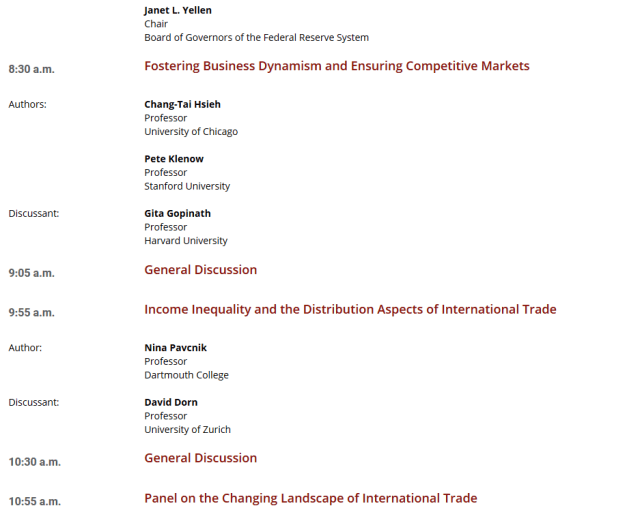


Source: Kansas City Federal Reserve Bank
New cover of Bloomberg BusinessWeek. Go Dubs! Number three in 2017–18. Money!
About three years ago, in February 2014, Andre Iguodala spent an off-day during the NBA season at the offices of venture capital firm Andreessen Horowitz in Menlo Park, Calif. Over the course of four hours in a conference room, the Golden State Warriors small forward heard pitches from a handful of startups in Andreessen’s portfolio. One shared its plan to disrupt the hair extensions business by selling directly to salons. Another explained how a mobile platform could help the secondhand clothing market move upscale. A third showed how an on-demand business model could transform the phone-screen-repair business. “We just banged them out in one day,” Iguodala says. – Bloomberg Businessweek

.
.
Political risk rising. Watch the “American Street.”
When we held positions overnight on Wall Street, we used to go home worried about global instability and what was going on in the “Arab Street.” Now we worry about the American Street. – GMM, Circus Trumps Politic, Feb 24, 2017
I believe that a) most realities happen over and over again in slightly different forms, b) good principles are effective ways of dealing with one’s realities, and c) politics will probably play a greater role in affecting markets than we have experienced any time before in our lifetimes but in a manner that is broadly similar to 1937.
I’m essentially an economic mechanic who focuses on how reality works by studying the cause:effect relations and how they played out in history to help me bet on what’s likely to occur. For reasons previously explained in “Populism…” it seems to me that we are now economically and socially divided and burdened in ways that are broadly analogous to 1937. During such times conflicts (both internal and external) increase, populism emerges, democracies are threatened and wars can occur. I can’t say how bad this time around will get. I’m watching how conflict is being handled as a guide, and I’m not encouraged.
History has shown that democracies are healthy when the principles that bind people are stronger than those that divide them, when the rule of law governs disputes, and when compromises are made for the good of the whole—and that democracies are threatened when the principles that divide people are more strongly held than those that bind them and when divided people are more inclined to fight than work to resolve their differences. Conflicts have now intensified to the point that fighting to the death is probably more likely than reconciliation.
Average numbers hide the depths of the divisions. For example, by looking at average figures, one might conclude that the United States economy is doing just fine, yet when one looks at the numbers that comprise those averages, it’s clear that some are doing extraordinarily well and others are doing terribly, with gaps in wealth and income being the greatest since the 1930s.
Largely as a function of these economic differences and differences in the principles that people believe most deeply in, we are seeing large and increasingly firm political differences, which are apparent only by looking below the averages. For example, Donald Trump’s approval rating of 35% is a result of 79% support among Republicans and 7% among Democrats (Gallup). Of those who approve of President Donald Trump, 61% say they can’t think of anything Trump could do that would make them disapprove of his job as President, and 57% who disapprove of Trump say they are never going to change their minds on the President’s job performance (Monmouth). Similarly 40% of those polled (PRRI) would favor Donald Trump’s impeachment, which consists of 72% of Democrats and 7% of Republicans, and most of them won’t change their minds.
In other words, the majority of Americans appear to be strongly and intransigently in disagreement about our leadership and the direction of our country. They appear more inclined to fight for what they believe than to try to figure out how to get beyond their disagreements to work productively based on shared principles.
So, where does that leave us?
While I see no important economic risks on the horizon, I am concerned about growing internal and external conflict leading to impaired government efficiency (e.g. inabilities to pass legislation and set policies) and other conflicts.
I of course hope that the principles that bind us together are stronger than the ones that divide us. I believe that this is a time when it is especially important for us a) to be explicit about what our principles are in order to be clear about what we agree and disagree on, b) to practice the art of thoughtful disagreement, and c) to respect our ways of getting past our disagreements so we can start rowing in the same direction. I believe that how well this is done will have a greater effect on the economy, markets and our overall well-being than classic monetary and fiscal policies, so I continue to closely watch how conflict is handled while tactically reducing our risk to it not being handled well. – Linkedin, August 21, 2017
We once heard the late Yale prof., Stephen Ross, say that “if you stare at the clouds long enough, you can see pink elephants.”
We kind of feel that way, though not completely, about seeing patterns in stock charts.

Interesting charts from the CME group’s August 1st earnings release.
It’s not just the VIX that has been tanking over the past few years, but the volatility in almost all financial instruments and commodities has declined this decade and are now below their medium-term historical averages. Maybe with the exception of the vol spike in foreign exchange in the second half of 2016 and the July 2014 to Feb. 2016 crude oil crash. Even natural gas, the original widow maker, is at the low in of its range.
You can blame quantitative easing (QE), that great flood of central bank money pumped into the financial global system over the past decade, which has doused price and economic volatility, coupled with the emotionless algo programmed trading ‘bots void of confirmation bias (CB) — or , maybe, full of CB, with their machine learned trend following and correlation algos — and all the trading/investment vices of the human investor and trader.
Minsky Moment? Build it, and it will come?
Or, has the volatility of asset prices “…reached what looks like a permanently high low plateau“?
You decide.
.
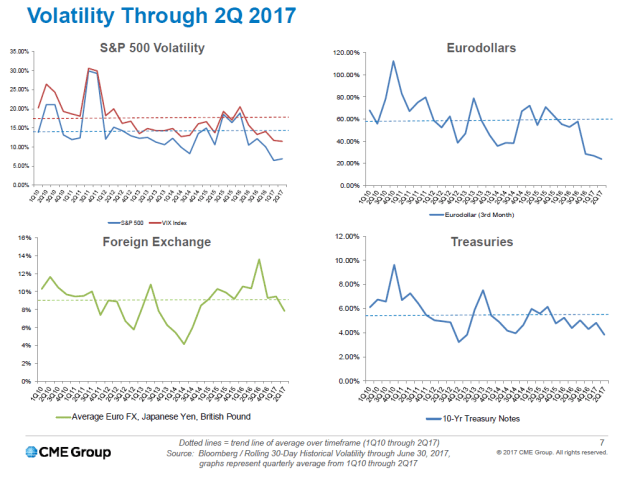
.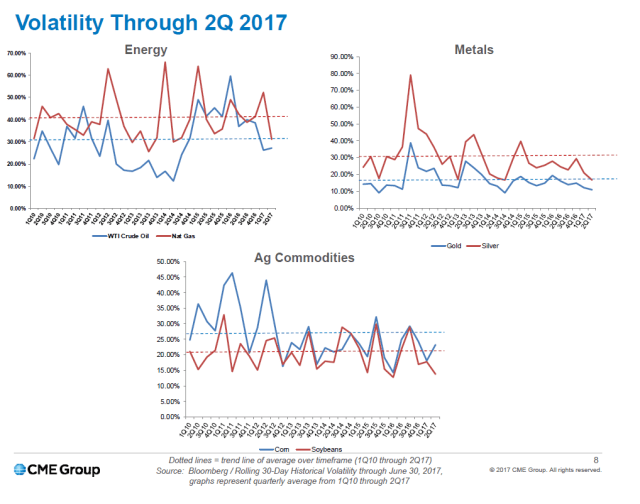
We have finally made the time to more closely review the release of last week’s Fed minutes from the July 25-26 meeting. We kind of like what we see.
Debate Breaking Out Among FOMC Members?
A debate appears to breaking out between members and staff of the Federal Reserve’s FOMC about the impact of QE on long-term interest rates and their impact on asset markets.
On the one side are what we call the Bubblistas, who believe and are concened the repressed low long-term U.S. interest rates are leading to excess asset speculation.
On the other, the academic “Efficient Marketistas,” — who, by the way, we believe were partly responsible for the 1990’s equity bubble and the 2003-07 credit bubble — think the markets are pricing all information and fundamentals correctly.
How do you think they explain Italian junk yields trading through U.S. Treasuries? Covered interest rate parity? That is expectations of continued appreciation of the euro/dollar? Such absurdity.
What Is The Bond Market Telling Us?
We also always chuckle when we hear market commentators talk about, “what is the bond market telling us?” We completely agree, and have been expressing the same view for years, of what Mark Dow wrote last month on the Behavioral Macro blog,
“The bond market—in both shape and level—has been telling us very little about US economic prospects/activity. However, short-term changes do inform us as to the prevailing narrative.” – Mark Dow
FOMC Minutes
Have a look at our annotated version of a few key paragraphs of of the Fed minutes released last week and what we believe telegraphed the subject of Chariman Yellen’s Jacksole Hole speech later this week on financial stability.
Minutes of the Federal Open Market Committee
July 25-26, 2017
..Asset purchases by foreign central banks and the Federal Reserve’s securities holdings [see our Table below] were also likely contributing to currently low term premiums [QE/ZIRP distortions – Bubblistas], although the exact size of these contributions was uncertain. A number of participants pointed to potential concerns about low longer-term interest rates, including the possibility that inflation expectations were too low [Efficient Marketistas] , that yields could rise abruptly [see our “beach ball effect” on repressed interest rates], or that low yields were inducing investors to take on excessive risk in a search for higher returns [fear of yield chasers and financial destabilization – Bubblistas].
Several participants noted that the further increases in equity prices, together with continued low longer-term interest rates, had led to an easing of financial conditions [see our post, Market Liquidity Conditions Still Loose As A Goose]
However, different assessments were expressed about the implications of this development for the outlook for aggregate demand [uncertain over wealth effect of rising asset prices] and, consequently, appropriate monetary policy. According to one view, the easing of financial conditions meant that the economic effects of the Committee’s actions in gradually removing policy accommodation had been largely offset by other factors influencing financial markets [concerns of losing control to the markets], and that a tighter monetary policy than otherwise was warranted [Bubblisitas]. According to another view, recent rises in equity prices might be part of a broad-based adjustment of asset prices to changes in longer-term financial conditions [Efficient Marketistas], importantly including a lower neutral real interest rate, and, therefore, the recent equity price increases might not provide much additional impetus to aggregate spending on goods and services.- FOMC Minutes from July 25-26 Meeting – Released August 16, 2017
We produced this table in March and do not believe the data have changed much, though with more Treasury issuance the percentage of the U.S. Treasuries held by the Fed and foreign central banks is certainly lower.

Nevertheless, at the time, 65 percent of all long-term Treasuries, with maturities longer than one year, were held by the Fed and foreign central banks. That is by non-price sensitive holders. Add to that foreign private holders, forced into the U.S. bond market by negative interest rates in Europe and Japan, and not much of the cash market is available for domestic investors.
Stunningly, more than 80 percent of Treasury securities longer than one year are held by the Fed and foreigners, making short selling or straying from your benchmark a very dangerous proposition.
From The Great Moderation To The Great Distortion
The supply of bonds and notes taken out of the market by the Fed and foreign central banks, coupled with foreign private bond flows (due to foreign QE and NIRP), has resulted in a massive distortion of long-term risk-free interest rates. Since, most risk assets are priced off of these rates, then, by simple logic, risk in all asset markets is mispriced.
The Truman Show Markets
Fake news, fake economies (based on fake demand dependent on asset bubbles and the wealth effect), fake markets (dependent on QE and low interest rates). It’s the Truman Show, folks.
The 75 trillion dollar (size of global economy) question is when will Truman Burbank realize his world is fake?
We think when policy rates rise another 100-200 basis points and/or double digit percent reductions in the monetary bases of the G3, maybe with the exception of Japan, which we may never see. Whatever the case, it may take some time.
Stock Versus Flow Of Bank Reserves
The fear of overshooting interest rates and bursting asset bubbles may be one reason the Fed, alternatively, wants to start shrinking its balance sheet. We agree with the Fed that it is the stock (or level) of reserves in the financial system that matter and not the flows, at least for now. At some point, however, the markets will worry the level of reserves are approaching drought level conditions and financial liquidity is becoming too tight.
Nevertheless, as long as interest rates remain repressed and low, the mispricing of asset markets can last much longer than many think. It already has, and, remember, “the market can remain irrational longer than you can remain solvent.”
Investors, traders and ‘bots, for that matter, also have to make money in the market they are dealt. Not the market that should be or the one they want it to be.
Furthermore,
It is hard to pop a bubble of financial exuberance, however, when the predominant investor sentiment appears to be grudging rationalisation of high prices, absent much enthusiasm. Dhaval Joshi, chief strategist for BCA Research, says: “At our client meetings, almost everybody disbelieves that current valuations allow developed market equities to generate attractive long-term returns. Yet many investors are willing to suspend this disbelief, at least for the time being.” – FT
In other words, many market participants are acting as Truman Burbank, forcing themselves to believe the island of Seahaven is for real. Fitting in our new world of virtual reality and 24/7 reality television.
There will come a day when Truman discovers or rediscovers reality and walks off the set, not like the financial collapse and Lehman moment of ’08, as there is too much liquidity in the global financial system. More of a sustained period of secular stagnation before the major central banks capitulate and effectively become employment agencies and either directly, or indirectly, monetize wages. Contrary to conventional wisdom, we believe inflation, rather than deflation will be the ultimate end game. Though a period of sustained deflation will sow the seeds and set the stage for the inflation.
Central Banks Gone Wild
After all, major central banks are already engaging in activities almost unthinkable 20 years ago.
The Bank of Japan’s controversial march to the top of the shareholder rankings in the world’s third-largest equity market is picking up pace.
Already a top-five owner of 81 companies in the Nikkei 225 stock average, the BOJ is on course to become the No. 1 shareholder in 55 of those firms by the end of next year, according to estimates compiled by Bloomberg from the central bank’s exchange-traded fund holdings. – The Japan Times, August 15
In the U.K. there is already talk of the “People’s QE”.
The UK policy of increasing money supply in the past has always been based on two premises to avoid hyperinflation and currency destruction: the independence of the central bank as a central pillar of monetary policy, and the constant sterilization of asset purchases (ie, what it buys is also sold to monitor market real demand). The balance sheet of the Bank of England has remained stable since 2012, coinciding with the highest economic growth period, and is below 25% of GDP.
Corbyn´s People´s QE means that the central bank will lose its independence altogether and become a government agency that prints currency whenever the government wants, but the increase of money supply does not become part of the transmission mechanism that reaches job creators and citizens in the real economy. All the new money is for the government, with the Bank of England forced to buy all the debt issued by a “Public Investment Bank”.
– Zero Hedge, August 19
The Monetary And Political Debates Begin
Nonetheless, we are encouraged the FOMC seems to now be debating such issues. A debate that should have taken place before the 2007-08 credit bubble popped, which could have prevented much economic pain and indirectly and partially caused the political instability the U.S. is now experiencing.
Whether the central bankers can and/or have the courage to try and guide the global economy and markets to a safe landing and rid the distortions, which are both apparent and the ones we have no idea even exist, from 10 years of zero interest rates and quantitative easing, is highly questionable. It is clear from the minutes, the FOMC members don’t even know themselves.
Nevertheless, the debate we have long been looking for among the monetary policy makers appears to have finally begun.
Similarly, the legacy issues of slavery and the confederacy, which should have been dealt with 150 years ago, but were circumvented by the presidental election of 1876, have finally boiled to the surface in the U.S. and have added additional event risk to the markets. We are, at least, encouraged the issue is finally being discussed, debated, and hopefully will be addressed, which should be good for the country in the longer term if it doesn’t permanently rupture the body politic, first.
Our Market View
You know our market view. A volatile autumn, culminating in a sharp, quick sell off around or in October that should be bought. It makes us nervous, however, many already believe and are beginning to arrive at the same view.
Finally, we leave you with some more money quotes from the FOMC minutes (via Bloomberg). Looks like they are going to the pull the trigger on quantitative tightening (QT) in September, unless markets become too volatile.
- most market participants now anticipated that the FOMC would announce at its September meeting a date for implementation of a change in reinvestment policy, although a couple of survey respondents expressed the view that the timing could be affected by developments regarding the federal debt ceiling
- The overall labor force participation rate edged up in June
- new home sales in May partly reversed the previous month’s decline.
- The most cited reason for the lackluster loan demand was subdued investment spending by nonfinancial businesses, but banks also reported that some borrowers had shifted to other sources of external financing or to internally generated funds.
- This overall assessment incorporated the staff’s judgment that, since the April assessment, vulnerabilities associated with asset valuation pressures had edged up from notable to elevated, as asset prices remained high or climbed further, risk spreads narrowed, and expected and actual volatility remained muted in a range of financial markets.
- In this projection, the staff scaled back its assumptions regarding the magnitude and duration of fiscal policy expansion in the coming years. However, the effect of this change on the projection for real GDP over the next couple of years was largely offset by lower assumed paths for the exchange value of the dollar and for longer-term interest rates.
- Participants noted that the fundamentals underpinning consumption growth, including increases in payrolls, remained solid.
- uncertainty about the course of federal government policy, including in the areas of fiscal policy, trade, and health care, was tending to weigh down firms’ spending and hiring plans.
- measured aggregate wage growth was being held down by compositional changes in employment associated with the hiring of less experienced workers at lower wages than those of established workers.
- some likelihood that inflation might remain below 2 percent for longer than they currently expected
- they differed in their assessments of whether inflation expectations were well anchored.
- A number of participants noted that much of the analysis of inflation used in policymaking rested on a framework…A few participants cited evidence suggesting that this framework was not particularly useful in forecasting inflation. However, most participants thought that the framework remained valid
- Participants agreed that it would not be desirable for the current regulatory framework to be changed in ways that allowed a reemergence of the types of risky practices that contributed to the crisis.
- Most saw the outlook for economic activity and the labor market as little changed from their earlier projections and continued to anticipate that inflation would stabilize around the Committee’s 2 percent objective over the medium term. However, some participants expressed concern about the recent decline in inflation, which had occurred even as resource utilization had tightened, and noted their increased uncertainty about the outlook for inflation. They observed that the Committee could afford to be patient under current circumstances in deciding when to increase the federal funds rate further and argued against additional adjustments until incoming information confirmed that the recent low readings on inflation were not likely to persist and that inflation was more clearly on a path toward the Committee’s symmetric 2 percent objective over the medium term.
- the extent of current downward pressure on longer-term yields arising from the Federal Reserve’s asset holdings and how this pressure would diminish over time as balance sheet normalization proceeded, the strength and degree of persistence of other domestic and global factors that had contributed to the easing of financial conditions and elevated asset prices, and whether and how much the neutral rate of interest would rise as the economy continued to expand.
- in the Committee’s post meeting statement and its Addendum to the Policy Normalization Principles and Plans. Participants generally agreed that, in light of their current assessment of economic conditions and the outlook, it was appropriate to signal that implementation of the program likely would begin relatively soon, absent significant adverse developments in the economy or in financial markets.
- several participants were prepared to announce a starting date for the program at the current meeting, most preferred to defer that decision until an upcoming meeting while accumulating additional information on the economic outlook and developments potentially affecting financial markets.
– FOMC Minutes from July 25-26 Meeting – Released August 16, 2017


