Apple’s Problem? A Matter of Scale

Apple’s brutal downdraft continues, now down over $20 on the day as we post.

What’s the problem?  Lack of lines for the iPhone5 in China?  Maybe today’s catalyst.

We think, however, the market is coming to the conclusion the company has a scale problem.   That is, it is just too darn large.

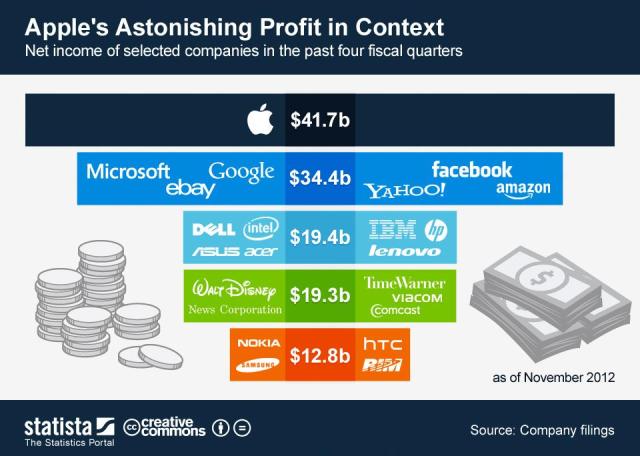
We posted earlier in the week about the relative size of Apple’s earnings.  In the last four quarters, for example,  Apple’s earnings totaled $41.7 billion, which was 21 percent more than the combined earnings of Microsoft, eBay, Google, Yahoo, Facebook, and Amazon!

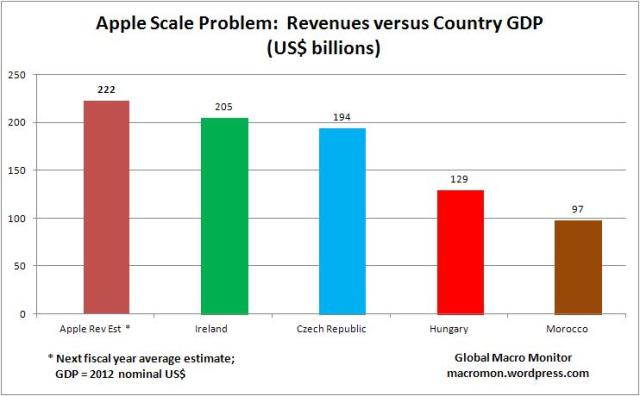
For even more perspective  take a look at the chart below.   Apple’s average revenue estimate for next fiscal year is $222 billion, which, would rank as the 47th largest GDP out of the 186 countries monitored by the IMF.

Thus, with relatively little reoccurring revenue,  Apple has to wake up on the first day of every fiscal year and generate annual sales of iPhones, iPads, and iMacs equivalent to Ireland’s GDP or a combined Hungary and Morocco.    That’s a big nut.

This is a problem probably very few companies experience.

Is growth still possible?  No doubt. And if any company can do it, it’s Apple.   But the growth rate is starting to run up against a hard wall of the law of large numbers, or, at least, the perception that it is.  Maybe this why the stock looked so cheap in terms of its PE during the last few years of extraordinary growth
Dec14_Apple

(click here if chart is not observable)
Posted in Apple | Tagged , , , | 8 Comments

The Fed on Food Stamps

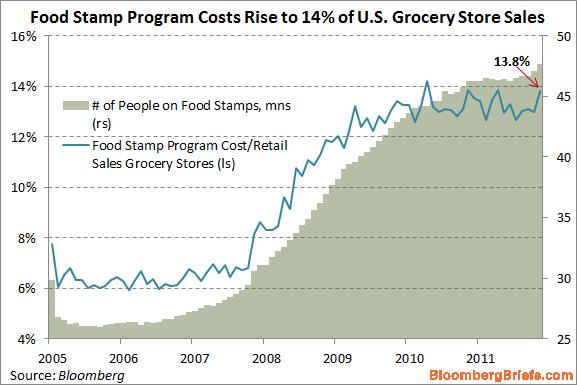
Wow!   The food stamp program is now equivalent to 14 percent of all U.S. grocery store sales.

Though the Fed indirectly finances the food stamp program with its purchase of treasury securities — $45 billion per month starting in January — we wouldn’t be surprised someday that the central bank actually begins to print food stamps.  This wouldn’t pack the potential punch of creating “high powered” bank reserves, which can be multiplied in a healthy financial system through credit creation, however.  But at least the “printed money food stamps” would lead to direct demand creation, rather than, as most of it does now,  sits on  deposit at the Fed in the form of excess bank reserves.

Seriously.  Monetary policy has almost become this absurd.

What if the Fed’s policies actually contribute to unemployment?   Such as repressing and changing the relative cost of capital.  This makes it easier for companies to finance machinery which either enhances labor productivity,  reducing the need for more workers,  or less costly to replace workers with robots.   Clearly, some of this is currently taking place.

The Fed’s  policy of repressing government borrowing costs and indirect deficit financing  reduces the government’s  incentive to implement the necessary structural reforms to put the budget on a sustainable path.  This would reduce uncertainty and maybe give the business sector more confidence to hire and spend their cash hoard.

We’re starting to think that the business sector behaves according to the Ricardian equivalence model.  Consumers?  We are not so sure.   Great thesis for a Ph.D. dissertation, by the way.

In other words,   the probability the Fed has the wrong, or, at the very least,  flawed model of the economy (think Apple maps instead of Google maps) is much larger than is priced,  in our opinion.   This wouldn’t be the first time.   No problem now, but if the Fed loses cred with such a ballooned balance sheet,  the demand for money could become more unstable or collapse.

It would, at first,  feel nice as equities would shoot to the moon.  Beyond the short-term, however, we would be in a heap of trouble, with a capital T, right here in River City!   Big trouble.

Just got back from the grocery store.   Inflation cometh!

P.S.  Negative real interest rates are immoral.

Dec13_Foodstamps

(click here if chart is not observable)

Posted in Banking, Monetary Policy | Tagged , , | 1 Comment

Charlie’s Greenroom with The Full Mario Monti

Charlie RoseSee the personal side of Italy’s Prime Minister, Mario Monti.

Click here for the 2 minute Q&A interview. 

Dec13_Monti

(click here if picture is not observable)

Posted in Interviews | Tagged , , | Leave a comment

Japan’s Tankan Survey Tanks to 3-year Low

Japan’s Tankan index measuring business confidence fell to a 3-year low.   Here’s Bloomberg,

Big Japanese manufacturers are the most pessimistic in almost three years after a diplomatic dispute with China and Europe’s austerity measures dragged exports to a fifth monthly decline in October.

The quarterly Tankan index for large manufacturers fell to minus 12 in December from minus 3 in September, the Bank of Japan (8301) said in Tokyo today, a fifth straight negative reading and the lowest since March 2010. The median estimate of 25 economists surveyed by Bloomberg News was for minus 10. A negative figure means pessimists outnumber optimists.

Cue Abe and the Bank of Japan.

Dec13_Tankan2Click table to enlarge.

Dec13_Tankan(click here if chart and tables are not observable)

Posted in Japan | Tagged , | Leave a comment

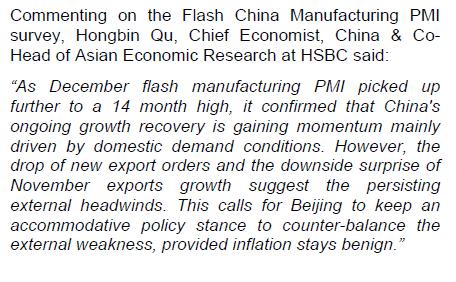
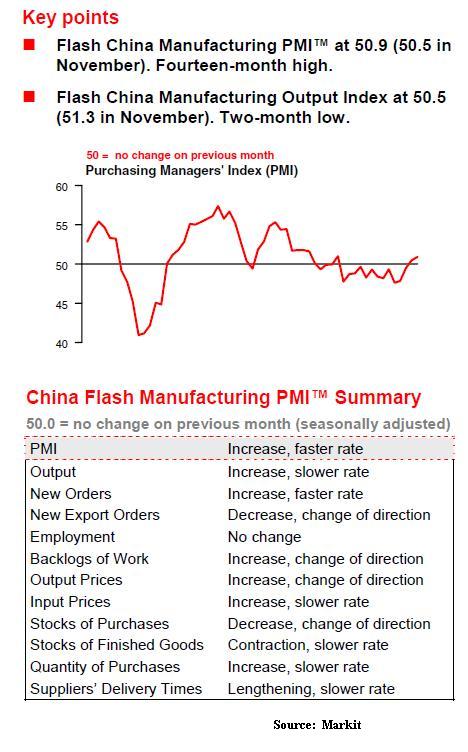
China Flash PMI at 50.9, 14-month High

Markit just reported,

China_PMI2Dec13_ChinaPMI(click here if charts are not observable)

Posted in China, PMIs | Tagged , | 1 Comment

Quote of the Day: Trade Reversals

Shipping lines used to sail one full container to Asia fromEurope for every three loaded with China-made goods that came back. Those “massive” imbalances are easing now as Europe consumes less and China more, according to BIMCO shipping analyst Peter Sand. Already, shipping lines send two containers to Asia for every three to Europe, he said.

Bloomberg

Posted in China, Uncategorized | Tagged , , | Leave a comment

China’s Skyscraper Curse

We Dubai Chinese stocks because they’re down so much.   This gives us pause, however.

(click here if video not observable)

Posted in China | Tagged , | 1 Comment

Chart of the Day: Operation Twisted Yield Curve

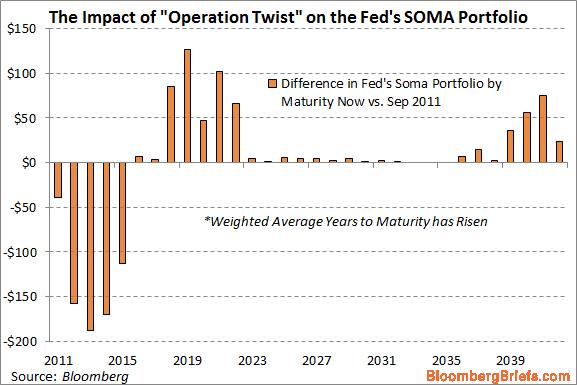
Interesting chart from Bloomberg on how the Fed’s treasury holdings have changed under operation twist, or more formally, the Maturity Extension Program and Reinvestment Policy.

After the end of the month no more selling of the short end to buy long end.   Just print and buy bonds, baby!

The Committee also will purchase longer-term sTreasury securities after its program to extend the average maturity of its holdings of Treasury securities is completed at the end of the year, initially at a pace of $45 billion per month. The Committee is maintaining its existing policy of reinvesting principal payments from its holdings of agency debt and agency mortgage-backed securities in agency mortgage-backed securities and, in January, will resume rolling over maturing Treasury securities at auction.

FOMC statement,  December 12, 2012

That should finance a little less than half the Federal government’s 2013 budget deficit under the CBO’s Alternative Fiscal Scenario.  

Welcome to the Totally Distorted Economy (TDE).   More crack.   The pressure builds.

Dec12_Twist

(click here if chart is not observable)

Posted in Bonds, Chart of the Day, Economics, Monetary Policy | Tagged , , | 1 Comment

Apple’s Profits in Context

How big is Apple?  Big.

Statista’s nice graphic juxtaposes Apple’s profits against others – combined!

If an an independent country, Apple’s annual profits would rank as the 85th largest GDP in the world out of the 186 countries monitored by the International Monetary Fund.     That’s big and maybe why the market is grappling with Apple’s future growth prospects and puts such a low multiple on the stock.

Dec11_Apple's Profits

(click here if graphic is not sustainable)

Posted in Apple | Tagged , , | 1 Comment

Charlie Rose: Jeff Bezos, The Ultimate Disrupter

Charlie RoseGreat interview with Amazon’s Jeff Bezos.

He was recently named Fortune’s 2012 Businessperson of the Year.   Listen and you’ll begin to understand why the market gives Amazon’s stock such a high multiple.

Bezos, a computer science and electrical engineer graduate from Princeton,  first went to Wall Street to work for David Shaw’s quantitative hedge fund.   He “programmed the computers, which made the trades.”

He says Amazon likes to think of itself as inventors and is about three big ideas: 1) long-term thinking;  2) customer obsession;  and 3) the willingness to invent.   Bezos warns the  Stuxnet computer virus was a huge wake up call as it illustrates malware can actucally destroy physical infrastructure.

He thinks the “anything you do for profit model” is preferable to nonprofits, such as government, because the model is self sustaining.  If the same competitive zeal could be applied to educational software,  for example, the country’s education system would be greatly disrupted.  Exactly what we need, no?

The interview took place November 16, 2012.   Fascinating interview.  Have a listen.

Click here for full interview. 

Dec10_Bezos

(click here if picture is not observable)

Posted in Interviews, Technology | Tagged , | Leave a comment