Charlie Rose: Joe Stiglitiz, Housing’s Not Coming Back

Professor Stiglitz’ Nobel credentials really shine with his current understanding of the U.S. economy in this interview with Charlie, which took place last month.  They discuss many issues,  including LIBOR,  derivatives,  European banks,  too big to fail, the fiscal cliff, and his new book, The Price of Inequality.  He also claims many of the 1 percent are rent seekers.

We once had dinner with him just after he was appointed President Clinton’s chief economist in 1993.  He asked,  “what does Wall Street want”?   We replied,  “lower taxes.”   His reply?  “You’re not going to get that!”

Money quotes from the  interview,

There are two big gaps in our economy relative to, say, 2007, before crisis.   One is real estate… Now real estate investment is half of what it was.  No way is that going to recover soon… The second part of the problem is consumption…Before the crisis we were saving close to zero out of our disposable income. That wasn’t sustainable…but it sustained the economy… Once in awhile you hear…the consumers coming back..that’s not the basis of sustained long-term growth..with consumption weak and investment in real estate weak it’s very hard to get a robust economy…

It [housing] may be leveling off and it may even turn up a little bit, but were not going to go back to anywhere near where we were because that was a distorted economy.  The bubble was a distorted economy.  We might feel relaxed we have hit bottom…but that’s still not clear because there is  a massive amount of foreclosures down the line.

At about 22:30 minutes he touches on one of our favorite topics of how technology is creating the structural transformation of moving the labor force from a manufacturing economy  into service industries.   Gotta love dismal scientists!

Click here for full interview

(click here if picture is not observable)

Posted in Economics, Housing, Whales | Tagged , , , | Leave a comment

Quote of the Day: Campaign Promises

We love this story.

In the closing days of the 1932 campaign, Franklin Roosevelt promised a crowd in Pittsburgh that he’d balance the federal budget while cutting “government operations” by 25 percent. Wisely, he attempted neither, but four years later as he prepared for another campaign trip to western Pennsylvania, he asked his speechwriter Sam Rosenman what he should say if his earlier vow came up. “Deny you were ever in Pittsburgh,” Rosenman replied.

(click here if photo is not observable)

Posted in Politics, Quote of the Day | Tagged , | Leave a comment

Letters (e-mails) from Beijing

A good friend of ours – and one smart dude – who works for a very large asset manager was in Beijing this past week kicking the tires and meeting with locals to discuss markets and the economy.   Here is part of the e-mail he sent to us over the weekend,

China is going to blow. It is just a ? of when.

Record liquidity injection is because of rolling bad loans made as part of stimulus. Receivables and payables are rising and liquidity is gridlocked.

Govt will not let banks write down bad debt and has to inject liquidity. Repo rates 20% on Shanghai stock exchange so some are selling stocks to do repo. Heads up.

Swan alert!  Keep it on your radar, folks.

Posted in China | Tagged , , , | 2 Comments

Crunch time in DC, Beijing and Athens – Reuters

(click here if video is not observable)

Posted in China, Politics, Video | Tagged , , , , | Leave a comment

A Jobs Recovery Built On Temp Help, Waiters & Bartenders

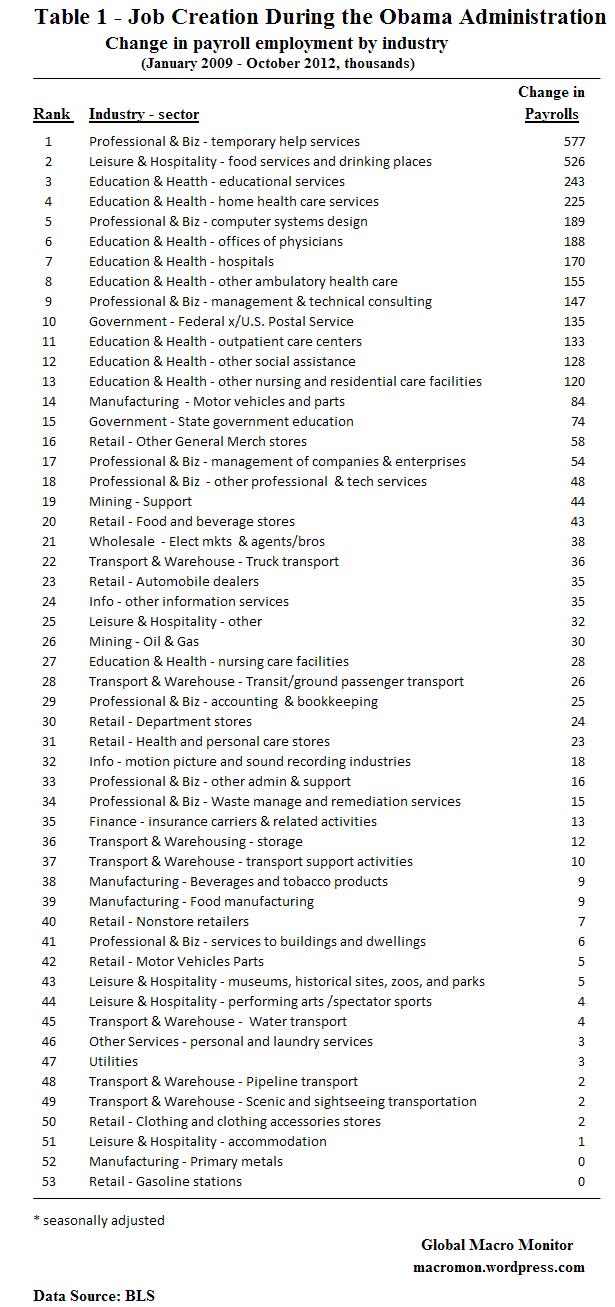
As we suspected in our last post many of the net new jobs created during the entire tenure of the Obama administration have been low quality and in areas of low pay. a/  Table 1 illustrates this point as temporary help services ranks number in jobs creation followed by food services & drinking places – i.e., waiters and bartenders.

The 1.1 million new jobs in these two industries represent almost 30 percent of the positive change in payrolls since January 2009.  It also fits a trend which  of the NY Times wrote about last week,

“Over the past two decades, many major retailers went from a quotient of 70 to 80 percent full-time to at least 70 percent part-time across the industry,” said Burt P. Flickinger III, managing director of the Strategic Resource Group, a retail consulting firm.

No one has collected detailed data on part-time workers at the nation’s major retailers. However, the Bureau of Labor Statistics has found that the retail and wholesale sector, with a total of 18.6 million jobs, has cut a million full-time jobs since 2006, while adding more than 500,000 part-time jobs.

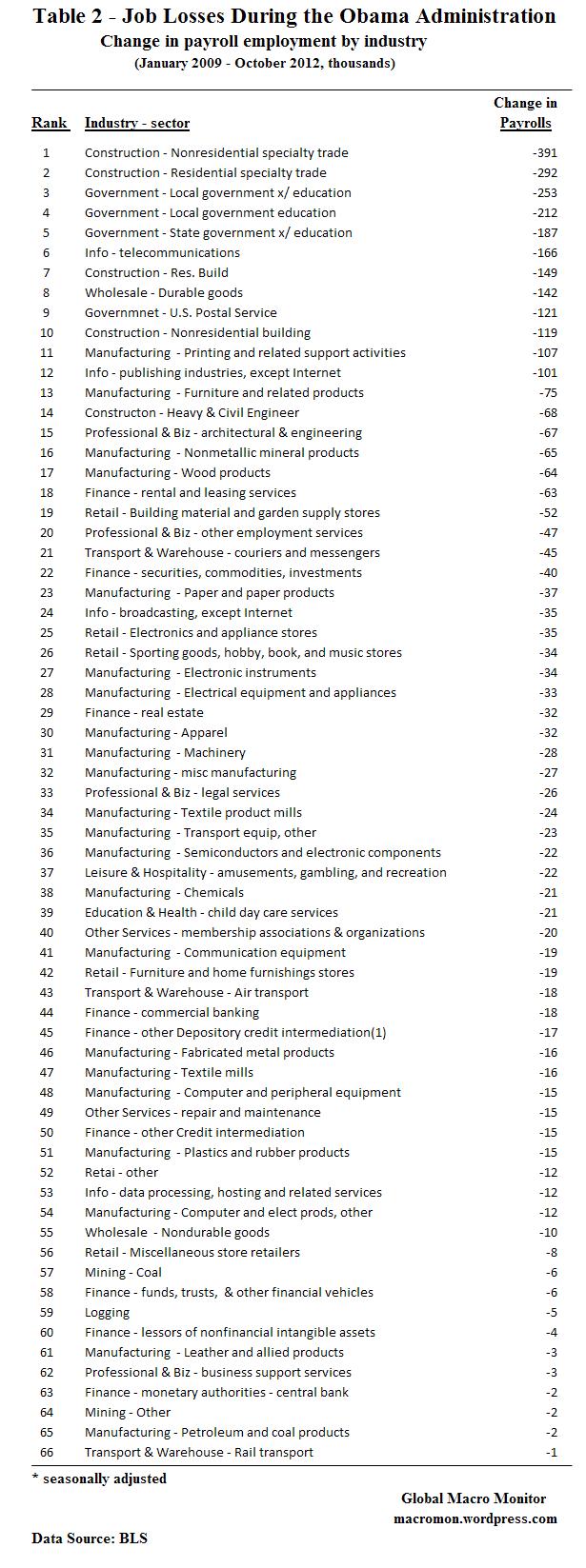
Table 2 shows that construction workers, mainly specialty trade contractors, such as plumbers and electricians have been hammered over the past four years.  We’ve  posted in depth analysis on this sector and it was good to finally see a positive print of 17K in Friday’s jobs numbers.  Hopefully it’s the beginning of a trend.  Fingers crossed.

Table 2 also shows that state and local government workers have fared poorly, including teachers.    Also interesting in the data are the loss of 107k jobs in printing and 101K in publishing, which we suspect are related to technological innovation.   All these lost jobs have been in relatively high paying industries.

The upshot?   To understand what has happened to the American middle class go no further than the data in Table 2.

a/ This includes both jobs lost earlier in the term and jobs created over the past two years (see last chart).

(click here if tables are not observable)

Posted in Employment | Tagged , , , , | Leave a comment

Job Creation During the Obama Administration

We’ve analyzed total job creation during the Obama administration and present the results here in a format similar to the monthly payrolls report.    We’ve also broken down the government sector into federal, state, and local, further breaking out the reduction in U.S. postal workers from the federal workforce.

More work needs to be done, but our first impression is that, in general,  many of the jobs that have been created over the past four years have been in relatively low paying sectors versus those that have been lost.  Certainly,  some high quality jobs have been generated, such as the 189K in computer systems design, which is included in the professional and business services category.   But, 577 K of those 933K  jobs were in temporary help services.  It’s also important to keep in mind the data refers to net changes in payrolls.

More analysis and detail forthcoming.  Stay tuned.

(click here if charts are not observable)

Posted in Employment | Tagged , , , | 1 Comment

Global Trend Indicators

(click here if tables are not observable)

Posted in Global Trend Indicators | Tagged , , , , , , , , | 2 Comments

Picture of the Day: ‘Cause Baby, You’re a Firework

Thank goodness it will be over Tuesday night.  Or will it?

(click here if photo and video are not observable)

Posted in Politics, Video | Tagged , , , | Leave a comment

How the mighty have fallen

Peak Japan seems just like yesterday.

We remember the days, or daze, working as grad student interns in the U.S. G when all govie economists were studying Theory Z, a Japanese management style and all the rage in business schools during the 1980’s.   That peaked on December 29, 1989, however, when the Nikkei hit its all-time high of 38,957 and is now 77 percent lower almost twenty three years later.

Why do we have this gut feeling Japan and France will be the countries of focus next year? We believe the U.S. road to Greece travels first through France, the U.K., and Japan.  Yikes!

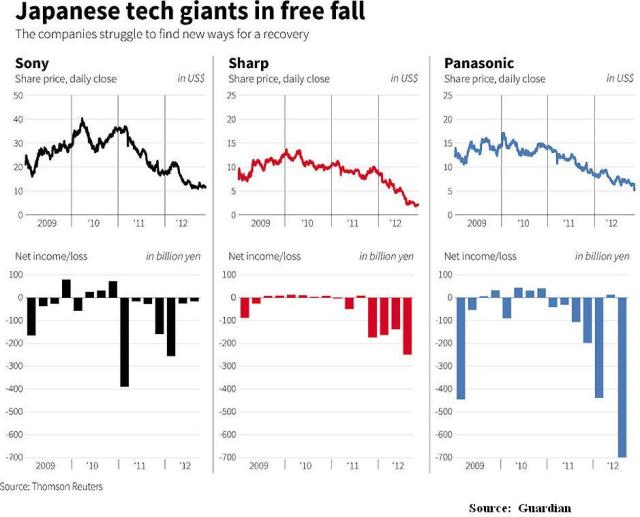
The following chart also fits perfectly into the presentation Hugh Hendry gave at this year’s Economist  Buttonwood Gathering.    Here’s Hendry,

I go to Japan…It’s hard to believe equities and properties have fallen 80 percent over the past twenty years…The impossible is happening today in Japan. Some of the largest Japanese corporates are on the verge of bankruptcy…

Click here for that interview.

(click here if chart is not observable)

Posted in France, Japan | Tagged , , , | Leave a comment

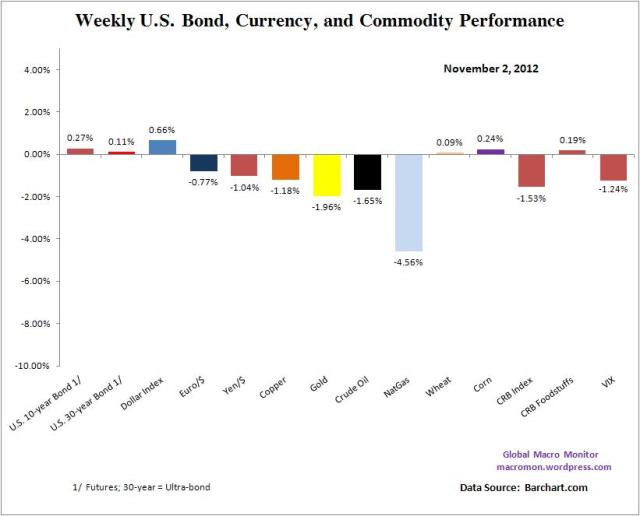
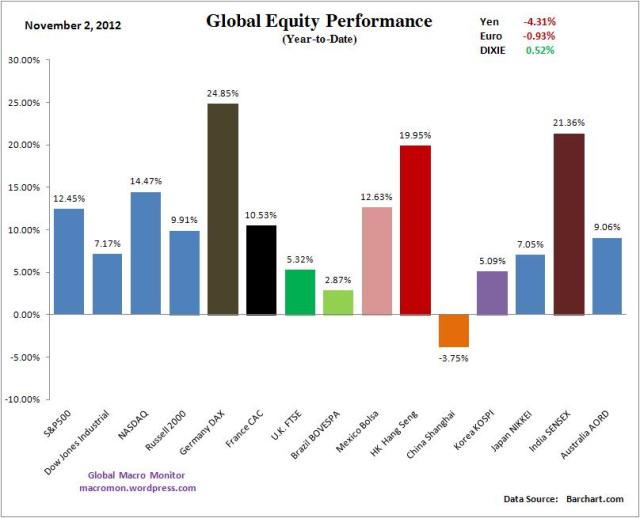
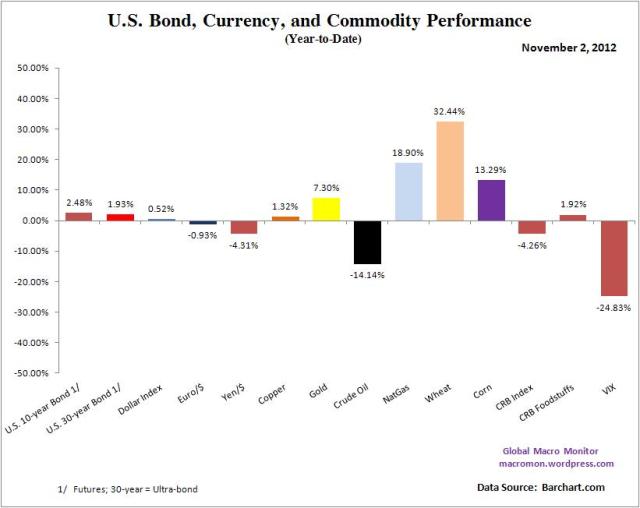
Week in Review

(click here if charts are not observable)

Posted in Week in Review | Tagged , , , , , | Leave a comment