Gold Dispensing ATMs Arrive in China

Here’s something the Chinese can celebrate on their National Day, the celebration of the 62nd year of the communist party’s rise to power.  These machines are made in Germany and  illustrate the growing influence of China as a destination of exports.

Gold has been trading sloppy and is probably a reflection of the liquidity squeeze taking place in emerging market currencies.   The global monetary base shrinks as hot money comes out of the emerging markets and central banks are forced to intervene to smooth the decline in their currencies.

(click here if video is not observable)

Posted in BRICs, China, Gold | Tagged , | Leave a comment

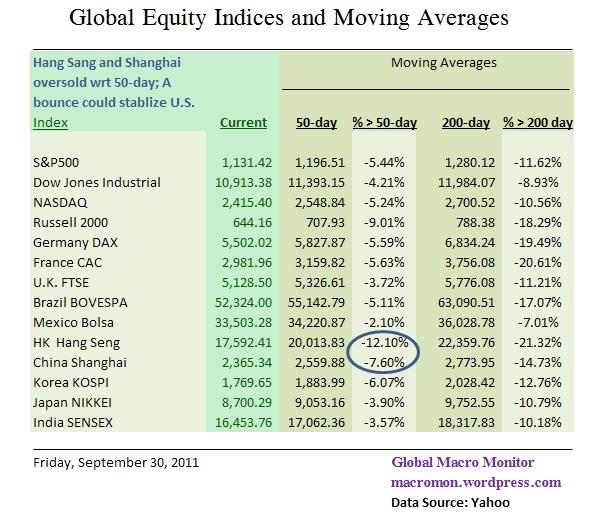
Global Trend Indicators

(click here if tables are not observable)

Posted in Global Trend Indicators | Tagged , , , , , , , | Leave a comment

Sarkozy: Europe “morally obliged” to help Greece

(click here if video is not observable)

Posted in Black Swan Watch, Bonds, Budget Deficit, PIIGS, Sovereign Debt, Sovereign Risk, Video | Tagged , , | Leave a comment

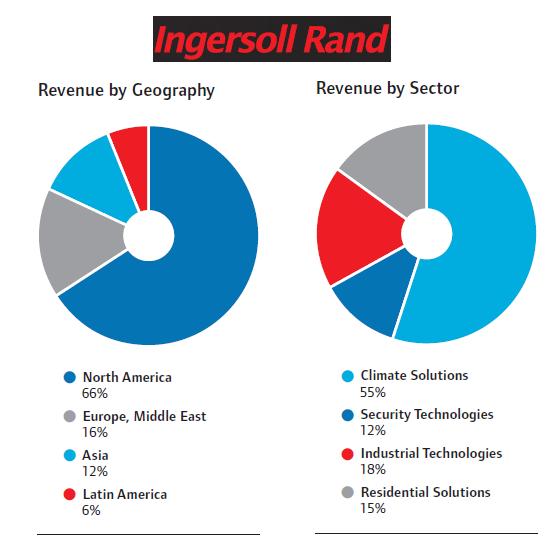
Ingersoll-Rand Warns, Stock Swan Dives

Here’s what they said:

Revenues were negatively affected by slower than expected end-markets in several businesses. Consumer-related businesses, such as residential heating, ventilation and air conditioning (HVAC), golf and residential security, were the most significantly affected, accounting for the majority of the lower volume since the previous guidance. Commercial security activity was also slower than expected. Transport, industrial and commercial HVAC revenues have remained strong. Operating income for the third quarter was negatively impacted by lower volumes and by unfavorable product mix in the residential and security segments.

Here’s the reaction:

Mr. Market has little patience for those missing the mark.  Micron, one of our trading favorites a few weeks ago, is another stock getting slammed today on an earnings miss.

(click here if charts are not observable)

Posted in Economics, Equities, Global Stock Performance | Tagged , , | Leave a comment

QE and the “Crowding Out” of the Bond Market Vigilante

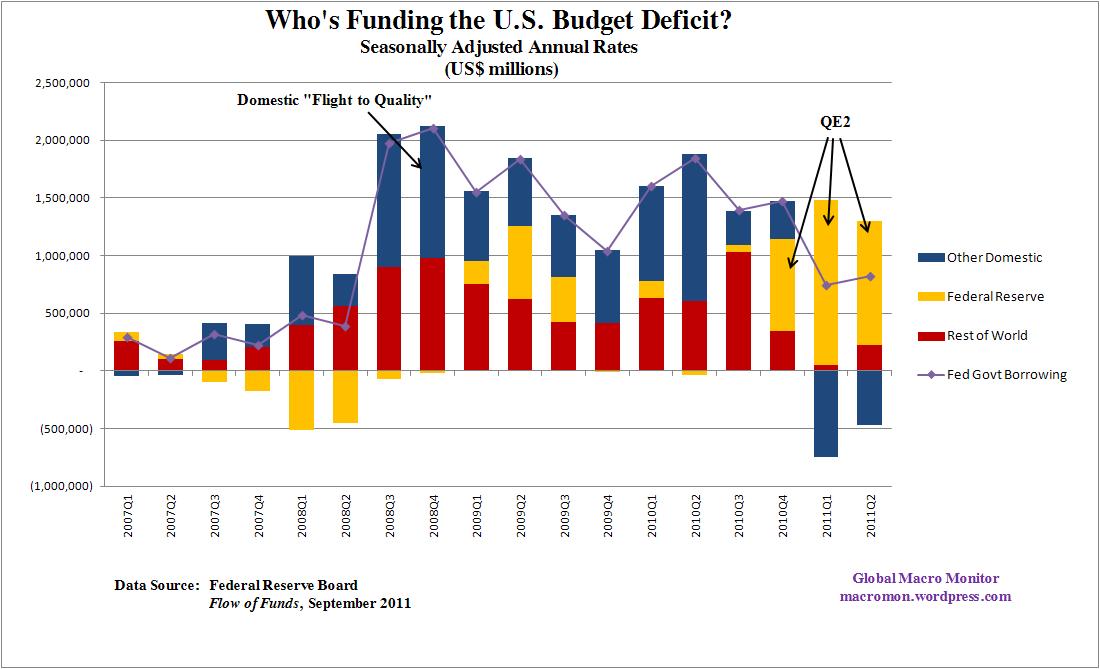
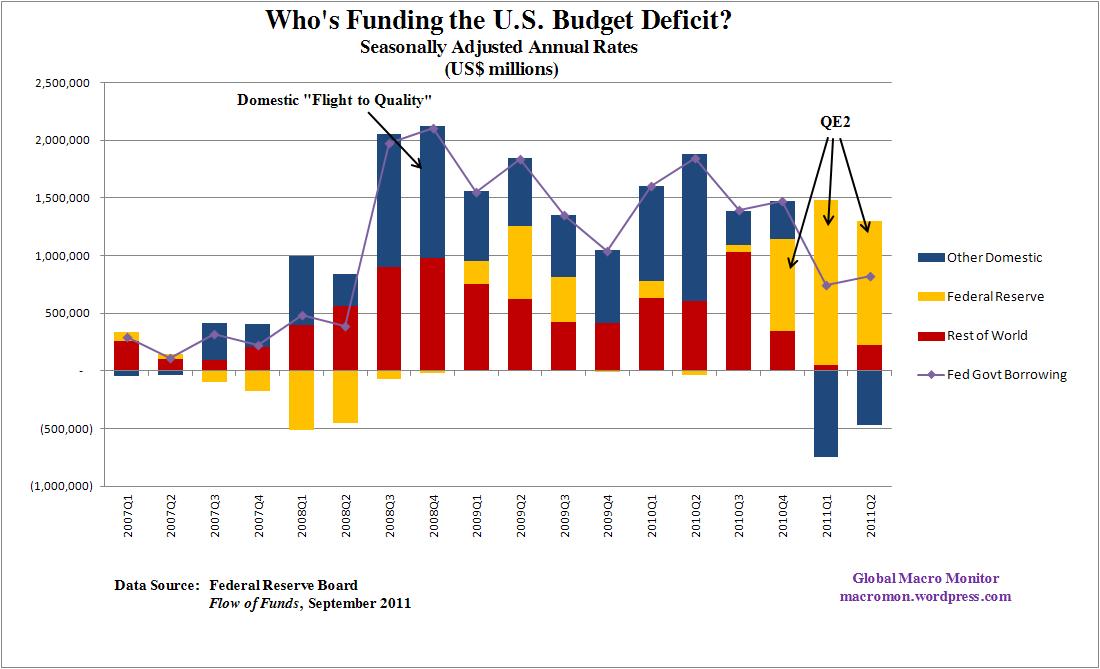
We’ve updated our chart of the sources of financing of the U.S. budget deficit from the Fed’s Flow of Funds data released on September 16th.   The chart illustrates how the Fed and foreign central banks have been indirectly fully funding the  massive U.S. budget deficit for the last three quarters.   It will be interesting to see the data for the quarter ending today as no doubt there will be less yellow with the end of Q2 on June 30 and more “flight to quality” blue (domestic) and red (rest of world).

Ronald McKinnon, professor of international finance at Stanford University, has an excellent piece in today’s Wall Street Journal about the damage the Fed’s zero interest rate policy (ZIRP) is doing to the U.S. and global economy.  One of his main points is the Fed and other central banks, who are not yield sensitive,  have been financing the U.S. budget deficit and crowding out the now extinct U.S. bond market vigilante.

As you know the Global Macro Monitor is not a fan of ZIRP and believes it one factor that ails the economy not what will cure it.  We take comfort to be the same company of such an intellectual heavyweight as Professor McKinnon.

The professor makes several excellent points in his piece,

Without the [bond market] vigilantes in 2011, the federal government faces no immediate market discipline for balancing its runaway fiscal deficits.

…the vigilantes have been crowded out by central banks the world over.  [see the yellow/red bars in the chart]

Central banks generally are not yield-sensitive.

True, in the last two months, this “bubble” of hot money into emerging markets and into primary commodities has suddenly burst with falls in their exchange rates and metal prices. But this bubble-like behavior can be traced to the Fed’s zero interest rates.

Beyond just undermining political discipline and creating bubbles, what further economic damage does the Fed’s policy of ultra-low interest rates portend for the American economy?

First, the counter-cyclical effect of reducing interest rates in recessions is dampened…

Second, financial intermediation within the banking system is disrupted…

Third, a prolonged period of very low interest rates will decapitalize defined-benefit pension funds—both private and public—throughout the country…

Perhaps Fed Chairman Ben Bernanke should think more about how the Fed’s near-zero interest rate policy has undermined fiscal discipline while corrupting the operation of the nation’s financial markets.

Amen!

(click here if chart is not observable)

Posted in Black Swan Watch, Bonds, Budget Deficit, Charts, Fiscal Policy, Monetary Policy, Sovereign Debt | Tagged , , | 5 Comments

Angry Greeks Protest Arrival of Trioka

(click here if video is not observable)

Posted in Black Swan Watch, Euro, PIIGS, Politics, Sovereign Debt, Sovereign Risk | Tagged , , , , | Leave a comment

Third Macro Panda Huffs and Puffs…

Over the weekend we posted a piece on the three McBears weighing on global markets.  As all eyes continue to focus on Europe the third macro bear — China — is beginning to growl a little louder.   Greece is no longer the word, in our opinion, and the next big story is going to be the increasing probability of a hard landing in China.

The unintended consequences of a massive credit induced stimulus and negative real interest rates (sound familiar?)  are coming home to roost.  The hard landing scenario is not priced, in our opinion,  and could be the origins of next panic, which breaks the S&P500 support at 1101.   Traders in the U.S. are starting to focus on the story and we think it explains the inability of the equity markets to hold their opening gains over the past few days.

Property developers in China are now having to pay 6-10 percent per month in the private lending markets.  How long can that last before the real estate markets collapse or the central government is forced to intervene?

Here’s the report from Market News International,

Interest rates are already at 6% to 10% a month and are driving some smaller property developers into bankruptcy, the official China Securities Journal said, citing unidentified sources and without elaborating.

The reports come amid growing concerns about the financial health of China’s property sector following government efforts this year to tighten onshore liquidity conditions.

Standard & Poor’s warned Tuesday that weakening property sales and tightening credit conditions at home and abroad could increase risks for smaller and niche developers, who could face refinancing risks next year. A 30% drop in sales could mean even large, rated players suffer “severe liquidity strain,” the ratings agency said.

We’ve been worried about China, among other things, for  much of the past year (click here and here and here) and not sure how this all ends, but it does feel the China story is about to come under its first difficult test.

Stay tuned.


Posted in Black Swan Watch, BRICs, China, Credit, Equities | Tagged , | Leave a comment

Nonlinear Thinking: Nanotube Cables to Replace Copper?

In the midst of the current swan dive in copper prices Technology Review reports the following,

For the first time, researchers have made carbon-nanotube electrical cables that can carry as much current as copper wires. These nanotube cables could help carry more renewable power farther in the electrical grid, provide lightweight wiring for more-fuel-efficient vehicles and planes, and make connections in low-power computer chips. Researchers at Rice University have now demonstrated carbon-nanotube cables in a practical system and are designing a manufacturing line for commercial production.

Making lightweight, efficient carbon nanotube wiring as conductive as copper has been a goal of nanotechnologists since the 1980s. Individual carbon nanotubes—hollow nanoscale tubes of pure carbon—are mechanically strong and an order of magnitude more conductive than copper. But unless carbon nanotubes are put together just so, larger structures made from them don’t have the superlative properties of the individual tubes.

Chalk one up for tech in the epic battle between technological advancement versus the Malthusian struggle for natural resources.  At least we hope this is the case.  Good stuff!

(click here if video is not observable)

Posted in Commodities, Electric Vehicles, Nonlinear Thinking, Technology | Tagged , , , | 1 Comment

Austerians Rising

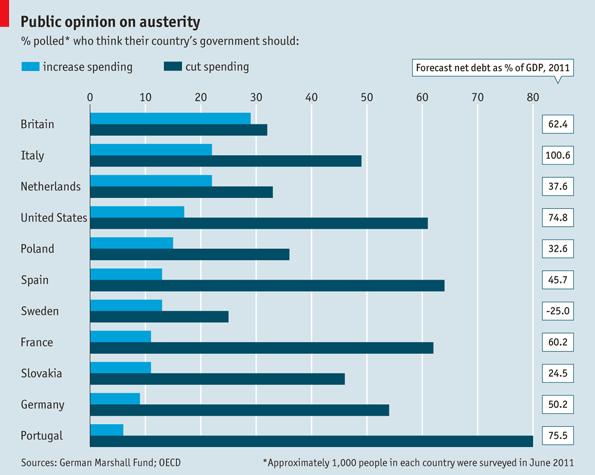
Interesting chart from the Economist.  Note the Brits are  much less supportive of spending cuts as they are actually experiencing the pain of an austerity program.  In other countries austerity is more of a concept than a reality.

The Economist also points out,

The biggest change in sentiment can be seen in the euro area. In 2009 only 8% of Italians thought their government was spending too much compared to 49% who now want it cut. In Portugal and Spain nearly one-third of those asked two years ago thought that too little was being spent, an opinion now held by only a fraction of that.

Let’s see how this chart looks in a year or two when austerity programs in many of these countries start to bite.

It is also important to internalize this data into your macro view of the sources of potential global demand.  Politics matter.

(click here if chart is not observable)

Posted in Budget Deficit, Charts, Fiscal Policy, Policy, Politics | Tagged , , , | Leave a comment

Problems in China’s Financial Sector Escalate

(click here if video is not observable)

Posted in China, Monetary Policy | Tagged , , | Leave a comment