It’s that time of year and as Opening Day approaches we look at a great article on Mickey Mantle in today’s L.A. Times and last’s night rerun of David Letterman’s interview with Hank Aaron. Relax for a few and enjoy the article and the video. Those were the daze! What a great time to be a kid.
The home run that launched the myth of Mickey Mantle – LA Times
Sixty years ago in an exhibition game against USC, a young Mickey Mantle hit a home run that became baseball legend and spawned a mystery: Just how far did it go?
(click here if picture and video are not observable)
Li & Fung, a Hong Kong-based consumer goods sourcing and logistics company, warned that “a new era in sourcing with higher prices” has begun, as manufacturers pass on the rising costs of both raw materials and Chinese labour to customers. – FT
China
How China should rule the world – FT
New tax on China rare earth minerals – ShanghaiDaily.com
Nuclear safer than coal, China official says – Reuters
Commodities
Prices for Chinese rare earths break through $100,000 per ton – China Economic Review
Economics
Australian Dollar Hits Fresh High – WSJ
Li & Fung warns of end of cheap China goods – FT
New home sales hit record low in February – LAT
The future of macroeconomic policy: Nine tentative conclusions – O. Blanchard, VOX
Why Stimulus Failed to Boost Infrastructure in US: A Comparison With China –EconOne
Emerging Markets
Boomtown 2025: A Special Report – FP
Brazil current account gap widens slightly in Feb – Reuters
Brazil’s Push to Oust Vale’s CEO Reflects Trend – WSJ
Powerhouse economies lure staff – FT
Equities
Buffett Buying Opportunity Meets Next Big One: William Pesek – Bloomberg
Emerging Market Equity Funds See Worst Yearly Start on Record – WSJ
Mutual Funds Extend Inflow Streak to 10th Week – WSJ
Europe
A Nation of Dropouts Shakes Europe – WSJ
‘At Some Point, People Will Speculate against Germany’ – Der Spiegel
Germany Steps Away From European Unity – NY Times
Irish economy grows despite a tough bond market – CSM
Portugal as EU Sovereign Debt Swan Song – Forbes
Sovereign Debt Should Also Bear Stress Tests, IMF’s Vinals Says – Bloomberg
Spain in line of fire amid Portugal troubles – FT
Fiscal Policy
In California City, Layoffs for Nearly Half the Staff – NY Times
The plan to fix California’s budget has run into problems – Economist
Geopolitical
Europe’s Libya Intervention: A Special Report – STRATFOR
Foreign policy: A reticent America – FT
The six power brokers who are looking to run the new Middle East – FP
Japan
Japan radiation scare spreads to Tokyo water – FT
Monetary Policy
Another year of living dangerously – Economist
Crises Scramble Fed’s Inflation Calculus – WSJ
Fed Official Hoenig to Retire – WSJ
ECB’s Nowotny Sees No Policy Change Due to Japan, Welt Reports – Bloomberg
US monetary policy and the saving glut – VOX
Technology
A powerful experimental battery that can be recharged completely in minutes – Economist
A Hexacopter That Sees Motion and Hears Breathing, Even Through Walls – Pop Sci
Better Batteries for Electric Cars – Science Daily
High-Temperature Superconductor Spills Secret: A New Phase of Matter? – Science Daily
Video
Leonardo da Vinci would love this robo-bird – CNET
We posted yesterday about the end of Chimerica and have written several pieces on the rapid increase in Chinese manufacturing wages and end of the secular disinflation caused by the entry of the country’s labor force into the global economy. Li & Fung, which sources goods for WalMart and the Gap, just announced that “a new era in sourcing with higher prices” has begun and that manufacturers will start passing on the rising costs raw materials and Chinese labour to customers. The FT reports,
William Fung, the company’s group managing director, said heightened competition for labour in China, which has resulted in wage increases of about 20 per cent this year, heralded the end of China-led deflation for the world economy.
This, of course, could all change if China’s economy experiences a hard landing, but you better prepare for sticker shock at WalMart, the Gap, and Costco in the near future. This is also a major factor why we believe the U.S. may be on the verge or in the midst of manufacturing renaissance. Stay tuned.
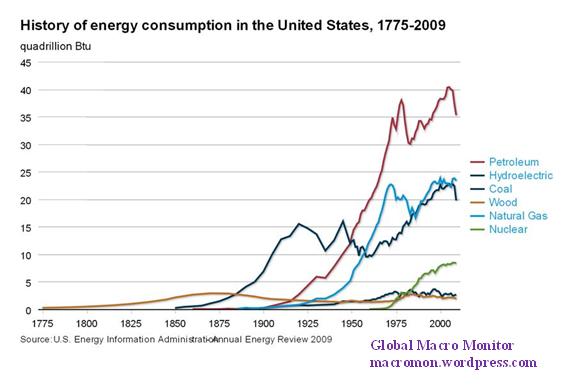
At today’s closing prices, crude oil is now trading more than 4x its BTU energy equivalent price relative to natural gas. If sustained, which we have our doubts, it will interesting to see how this chart develops over the next few years. Note, 87 percent of current U.S. energy consumption is from fossil fuels.
If not for the bold policy actions during the height of the financial crisis, some, including us, believe we would have seen a big spike in the consumption of wood.
…by far the most massive falloff in young manpower is set to take place in China. Over the next 20 years, by the Census Bureau‘s projections, this key working age group will be falling in China by fully 100 million persons—or over 30 percent. – AEI
We knew that China has a demographic problem, but the following chart from the American Enterprise Institute did surprise us a bit. China’s medium age is only about one year younger than the U.S. and because their population is large relative to the rest of the world, looking at non normalized data relationships (size of population, for example) such as in the following chart can distort reality. But……………… The AEI writes,
Over the past 20 years, the two greatest centers of manpower growth were India and China—which of course also happened to be two of the world‘s most rapidly growing economies at the time. Over the next 20 years, by contrast, the greatest single share of the world‘s increase in working-age manpower (well over a third of total manpower growth) is set to accrue to sub-Saharan Africa—the region with the modern world‘s very worst overall record of long-term economic performance…
On the other hand, a growing number of countries and regions are set to experience shrinkage in their working-age manpower over the next two decades. These include Japan, Western Europe, Eastern Europe, the Baltic and CIS countries, and China—in other words, most of the current advanced OECD economies, and many of the contemporary world‘s seemingly most promising ―emerging markets…
The situation does not look better when we break down prospective global manpower growth into its subsidiary age-group components. In modern economies, younger workers are especially important to prospects for growth, for they typically have the highest levels of educational attainment, and bring the latest knowledge and the newest technical skills with them to the job. Over the next 20 years, however, the worldwide pool of young manpower will undergo a severe deceleration. According to Census Bureau projections, the total global increase in young manpower (ages 15-29) between now and 2030 would be just 4%, or 70 million persons—barely a fifth of the aggregate increase over the two decades just past.
Only sub-Saharan Africa stands to see an appreciable growth in youth manpower. In fact, the sub-Sahara will account for over 100% of total growth in the world‘s 15-29 population, because many regions will find their pools of young manpower shrinking over the next two decades. Japan and Europe as a whole are both on course for significant absolute declines in this key manpower pool over the next 20 years (prospective drops of almost 25%). But by far the most massive falloff in young manpower is set to take place in China. Over the next 20 years, by the Census Bureau‘s projections, this key working age group will be falling in China by fully 100 million persons—or over 30 percent.
Now you know. The Facebook/Twitter demographic in China is about to get a lot smaller. The shifting world demographic will have a profound impact on the global economy and geopolitics going forward. The recent increases in Chinese wages and the MENA uprising are just a taste of what’s to come. The Chimerica/Bretton Woods II model which drove the global economy over the past 15 years is dead, in our opinion.
The world has entered a period of uncertainty where markets are grappling with this new reality. We are not sure how and what new model will develop, but the markets definitely seem to be voting it won’t be Dollar centric. Stay tuned.
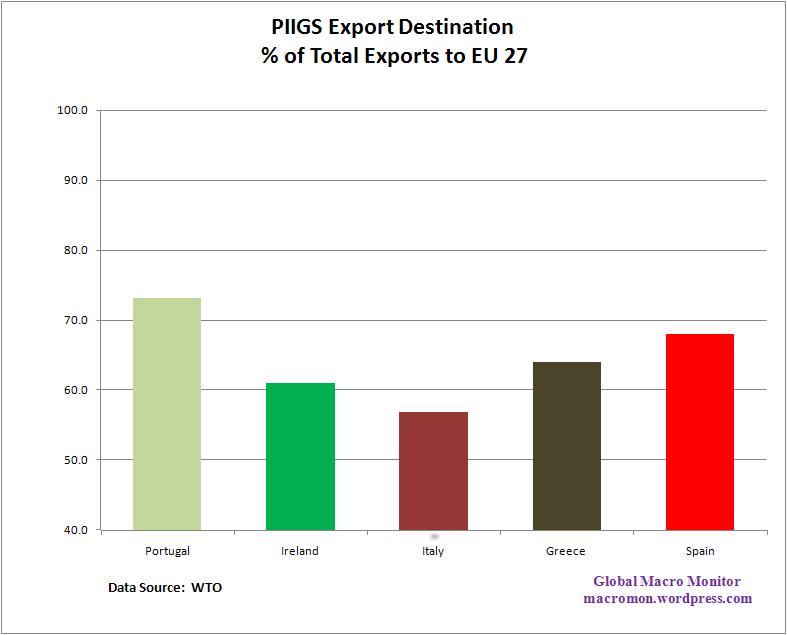
The Euro keeps moving higher on expectations of an ECB interest rate hike and what is beginning to appear almost terminal dollar weakness. The export destination mix of Ireland, for example, is around 60 percent to the EU 27 and 40 percent outside Europe. Find us a country that grew its way out of a debt overhang with a strengthening currency and rising interest rates.
These countries need to get more competitive and a stronger currency puts even more onus on wage adjustments or the hope and prayer of individual country productivity miracles. Forcing some to raise corporate tax rates is a move in the opposite direction.
On the one hand the newly announced bailout measures makes the periphery more short term liquid and on the other, expected rate hikes and a stronger Euro makes some of the PIIGS more long-term insolvent. Policy anarchy reigns. Can you hear the rivets popping? (click here if charts are not observable)
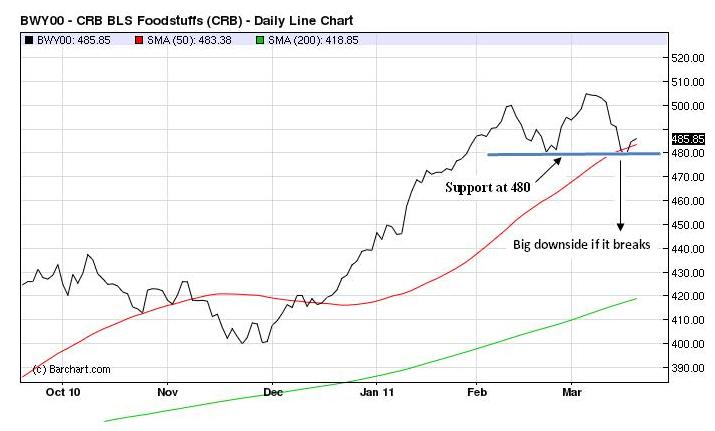
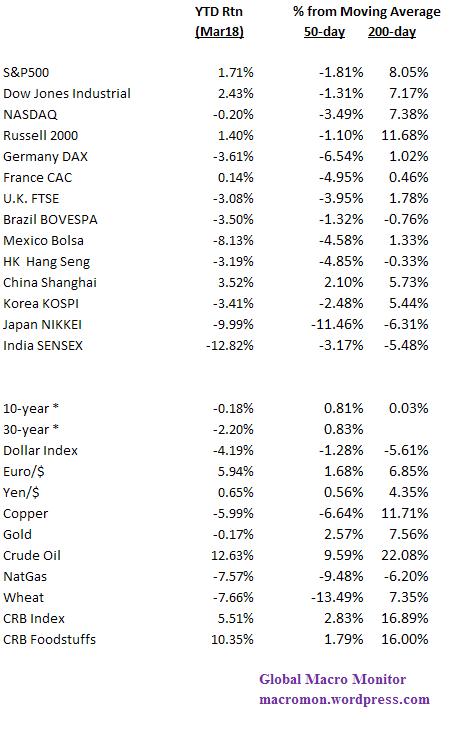
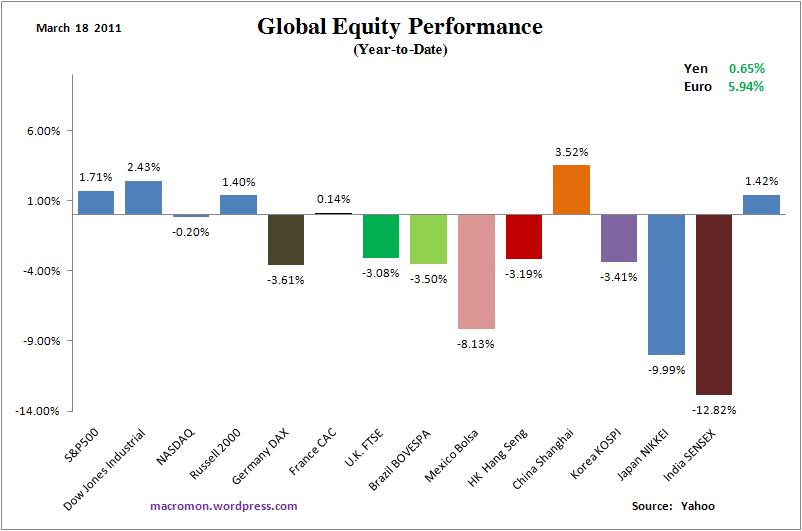
We’re a little late posting last week’s review. It’s history after today’s rally so not much to write about. Do note the weakness in Mexico, however. Brazil, Korea, and the Shanghai showing relative strength due to expectations of manufacturing shift from Japan. CRB Foodstuffs holding a a key technical level.
Let’s see how high they can take them, which should establish the parameters of a trading range, which will be in effect, in our opinion, until some of these issues haunting the markets are resolved: 1) Japan nuclear and supply chain shocks; 2) Geopolitical and $4-5 gas price; 3) Euro tightening; 4) the end/or renewal of QE2; and 5) earnings impact of all of the above. (click here if charts are not observable)