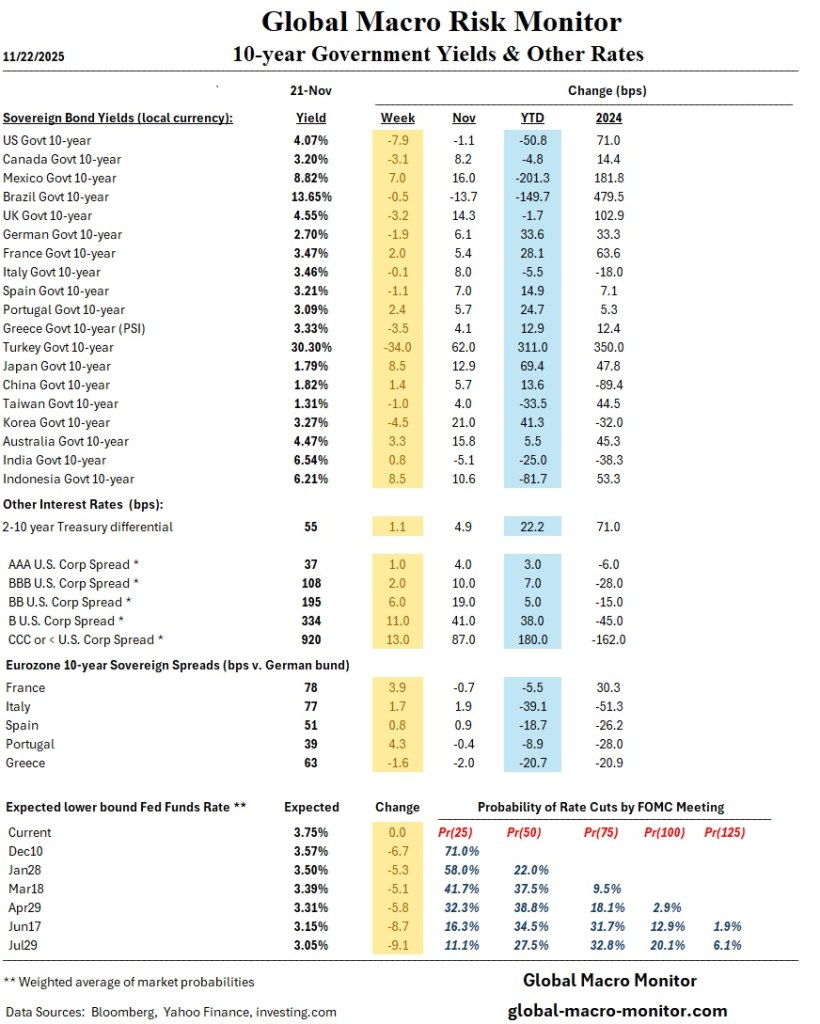
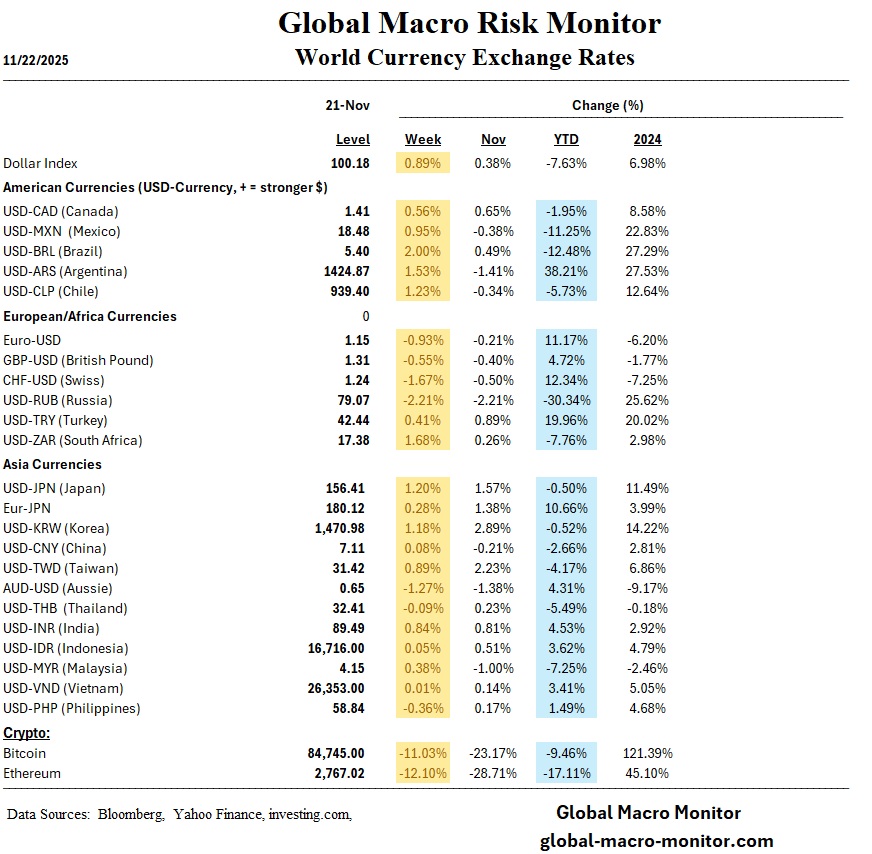
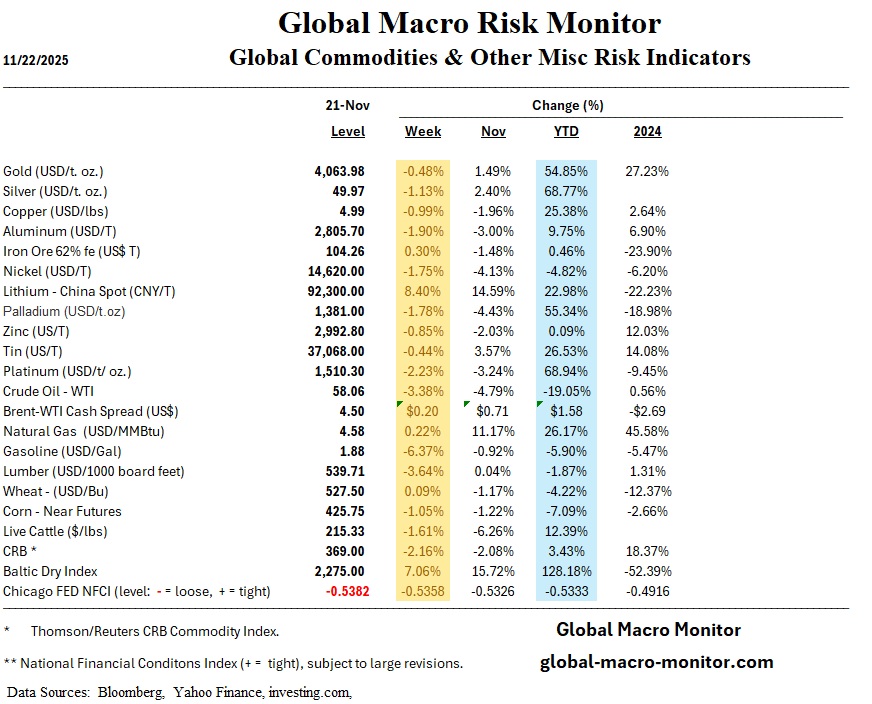
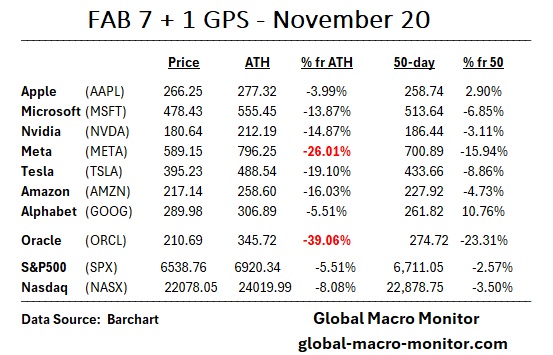
Global Risk Monitor: Weekly Update – May 30

Global markets ended the month of May on relatively firm footing, with equity indexes rebounding modestly, inflation easing slightly, and consumer confidence stabilizing. However, beneath this surface calm lies a deeper undercurrent of concern—a growing alarm over sovereign debt and deficits that is beginning to reverberate through financial markets, particularly in the U.S. bond market. As summer approaches, deficits and debt sustainability are poised to dominate financial and policy discourse, propelled by mounting warnings from influential voices in finance and an increasingly precarious fiscal landscape.

Market Snapshot

Markets digested a mix of macroeconomic signals during the holiday-shortened week. U.S. equities rallied early on news that President Trump postponed a 50% EU tariff, but ended the week below their highs due to revived trade friction with China and legal uncertainties surrounding the administration’s tariff authority.

Treasury yields, which had spiked the previous week, cooled off, with the 30-year bond slipping from its psychological 5% threshold. Meanwhile, PCE inflation data—closely watched by the Federal Reserve—showed a continued moderation, offering tentative hope for rate cuts later in the year.

Globally, the ECB is widely expected to cut rates in June, while Japan and China are contending with both inflation pressures and deteriorating industrial output. Latin America’s current accounts remain manageable, but risks tied to global trade policies persist.

Spotlight on Debt & Deficit

The most urgent issue facing global markets is not immediate trade disruption or short-term inflation—it is the increasingly untenable trajectory of U.S. government debt. This theme was sharply underscored in two pivotal developments this week:

  1. Jamie Dimon’s Alarm Bell: The JPMorgan Chase CEO warned that the U.S. bond market could “crack” under the weight of federal debt expansion. “I just don’t know if it’s going to be a crisis in six months or six years,” he cautioned, referencing rising yields, foreign investor retreat, and mounting Treasury issuance.
  2. Wall Street’s Pushback on Trump’s Tax Plan: According to a Washington Post investigation, top Wall Street executives have privately warned the Trump administration that its new tax package—projected to add at least $2.3 trillion in new debt—could destabilize bond markets and raise borrowing costs across the economy.

Investors are increasingly vocal, describing the tax plan as a “poisoned chalice” that could exacerbate term premiums and crowd out private investment. The Treasury’s ballooning $29 trillion market, already strained by high rates, faces diminished demand from foreign buyers and banks, many of which are urging regulators to ease bond trading restrictions to prevent a liquidity crunch.

Why This Matters: The Long-Term Implications

Rising deficits may feel abstract, but their impact is concrete: higher interest rates on mortgages, car loans, and business credit; lower government spending on essential services due to growing debt-service obligations; and potential erosion of confidence in the U.S. dollar as the global reserve currency.

The convergence of fiscal expansion, global de-dollarization trends, and mounting geopolitical tensions suggests that the bond market is at a critical inflection point. With the Congressional Budget Office projecting debt-to-GDP to exceed WWII-era highs and rating agencies like Moody’s already downgrading the U.S., this is not a distant threat—it is a present and pressing one.

Outlook: Summer of Reckoning

The summer of 2025 may mark a pivotal period in global market evolution. With major fiscal legislation under debate, expected central bank moves in the U.S., Europe, and Asia, and judicial rulings looming over tariff legality, investor sentiment may become increasingly reactive. The Treasury market will likely serve as a sensitive barometer for investor confidence in U.S. fiscal responsibility.

Expect further volatility in long-duration bond yields, persistent debates over deficit-financed growth strategies, and a growing chorus of market voices calling for structural fiscal reform.

Recommended Summer Reading: Understanding Debt and Deficits

To deepen understanding of these pivotal issues, consider these insightful books:

  • “This Time is Different” by Carmen Reinhart & Kenneth Rogoff – A historical analysis of sovereign debt crises and why fiscal excess often ends badly.
  • “Fiscal Reckoning: The Looming Debt Crisis and What It Means for You” by James L. Payne – A clear-eyed examination of the political and economic roots of America’s debt problem.
  • “Debt: The First 5,000 Years” by David Graeber – A broader anthropological and historical take on the social contracts behind monetary debt.

Markets may appear stable for now, but this equilibrium is fragile. As summer begins, the conversation must shift from short-term trade skirmishes to long-term fiscal strategy. The U.S. bond market’s ability to absorb vast new issuance without significant dislocation will define not only domestic financial conditions but also global capital flows and investment strategies. Investors, policymakers, and voters alike must confront the reality that fiscal sustainability is no longer a theoretical debate—it is an urgent, market-moving imperative.

Markets

U.S. Market Analysis

  • U.S. equity markets posted weekly gains despite late-session volatility, driven by easing Treasury yields and improved consumer confidence data.
  • The S&P 500 rose 1.88%, while the Nasdaq led major indexes with a 2.01% gain; small-cap indexes underperformed but finished in positive territory.
  • Treasury yields cooled after a strong 7-year auction, with the 30-year yield pulling back below 5%, calming recent rate pressure.
  • Trade tensions re-emerged after President Trump accused China of violating their trade deal, briefly reversing earlier gains in tech stocks.
  • Positive inflation data and delayed EU tariffs helped sustain bullish momentum through most of the week.

Global Market Analysis

  • European stocks advanced modestly, supported by softening inflation and postponed U.S. tariff hikes; the STOXX Europe 600 added 0.65%.
  • Japan’s Nikkei 225 rebounded 2.17% as U.S.-Japan trade talks showed signs of progress, while BoJ policy remained steady amid strong Tokyo inflation.
  • Chinese markets declined slightly due to light economic data and limited trade news; infrastructure stimulus is expected to support growth in the near term.
  • Hungary’s central bank left its base rate unchanged at 6.50%, citing persistent inflation risks and uncertainty tied to global trade dynamics. Policymakers flagged potential upside risks to inflation from international market volatility and maintained a restrictive stance.
  • South Korea’s central bank cut its policy rate by 25 bps to 2.50%, responding to expectations of slowing domestic growth. Officials noted stable inflation near 2% but expressed concern over rising household debt and currency volatility under accommodative conditions.

Economics

U.S. Economic Overview

  • April’s core PCE inflation cooled to 2.5% YoY—the lowest since 2021—boosting market expectations for potential Fed rate cuts later in 2025.
  • Consumer confidence rebounded sharply in May, with the Conference Board index rising to 98.0, breaking a five-month decline.
  • The U.S. bond market remains under scrutiny as Wall Street and policymakers grow increasingly concerned over the sustainability of federal deficits.
  • Jamie Dimon and other financial leaders warned of an impending “crack” in the Treasury market if debt levels continue rising unchecked.
  • A federal court’s temporary block on Trump’s tariffs raised short-term uncertainty, though markets appeared resilient in the face of legal and policy volatility.

Global Economic Overview

  • The ECB is widely expected to cut rates next week as headline inflation eased in Spain, Italy, and France, reinforcing a dovish policy outlook.
  • Germany reported a larger-than-expected increase in unemployment and weakening business sentiment, highlighting diverging growth patterns across the EU.
  • Japan’s Tokyo core CPI rose to 3.6% YoY in May, the highest in over two years, while industrial production and job data signaled a mixed outlook.
  • China’s economy showed signs of stabilization, but structural reforms remain elusive; planned infrastructure investment may support momentum into Q3.
  • Hungary’s inflation outlook remained elevated, with core inflation at 5.0% in April. Central bank officials emphasized caution amid tariff-related uncertainty and vowed to maintain tight monetary conditions to anchor expectations.
  • South Korea’s economic growth forecast was revised down, with policymakers anticipating modest recovery in domestic demand. Inflation is expected to hover around 2%, while exports face downside risks from U.S. tariffs and slowing global demand.

Week Ahead

Key U.S. & Global Events

  • Markets will watch for White House commentary following renewed tariff threats against China and the EU.
  • G7 meetings in mid-June may set the stage for broader policy coordination on trade, fiscal strategy, and geopolitical risk.
  • Legal proceedings related to U.S. tariff authority could shape investor sentiment around trade and inflation expectations.

Upcoming Economic Data

  • Monday: ISM Manufacturing Index, Construction Spending
  • Tuesday: Factory Orders, Conference Board Consumer Confidence
  • Wednesday: ADP Employment Change, ISM Services Index, EIA Petroleum Status
  • Thursday: Initial & Continuing Jobless Claims, Revised Productivity, Trade Balance
  • Friday: Nonfarm Payrolls, Unemployment Rate, Core PCE, Average Hourly Earnings

Notable Earnings Reports

  • Tuesday: Dollar General, CrowdStrike, Hewlett Packard Enterprise
  • Wednesday: Dollar Tree, MongoDB, Five Below
  • Thursday: Broadcom, Lululemon, Samsara
  • Friday: No major earnings scheduled

Posted in Uncategorized | Tagged , , , , | 1 Comment

Fiscal Scorecard: How COVID Torched the Budget

When President Donald Trump took office in January 2017, he inherited a relatively stable fiscal environment. The federal budget deficit stood at approximately $581 billion, or 3.05% of GDP—a level widely regarded as sustainable by historical standards. Ironically, that same 3.0% benchmark has since resurfaced as the stated deficit target for the Trump 2.0 administration.

Trump 1.0

Early in his first term, President Trump pledged to restore fiscal discipline and reduce the deficit. However, those ambitions quickly faded amid sweeping legislative changes. The passage of the Tax Cuts and Jobs Act of 2017 reduced federal revenues, particularly from corporate and individual income taxes, while discretionary spending, most notably on defense, continued to climb. As a result, the deficit steadily expanded throughout Trump’s first term.

COVID Deficits

The fiscal situation worsened dramatically in 2020 with the outbreak of the COVID-19 pandemic. In response to the public health emergency and economic shutdowns, the federal government launched a series of massive relief packages, including direct stimulus payments, enhanced unemployment benefits, and business assistance programs. While these measures were crucial in mitigating the economic fallout, they came at a steep fiscal cost. By March 2020, the rolling 12-month deficit had already reached $1.036 trillion (4.77% of GDP). Within months, it ballooned to $3.35 trillion, or 15.17% of GDP, by the end of Trump’s first term.

Federal Reserve  Financing of COVID Deficits

This explosion in borrowing marked the largest one-year deficit expansion since World War II, underscoring the magnitude of the crisis and the aggressive fiscal response. What began as an effort to rein in a manageable deficit quickly morphed into an era of unprecedented federal borrowing, all or most of it monetized by the Federal Reserve, laying the groundwork for subsequent inflationary pressures and long-term fiscal challenges (see, No Trouble… table below).

Biden Administration

President Joe Biden inherited this fiscal turbulence, taking office with a deficit nearing 15% of GDP. His administration enacted additional large-scale spending, including the American Rescue Plan, while also attempting to wind down pandemic-era outlays. Although the deficit declined from its peak, it remained far above pre-pandemic norms. By December 2024, at the close of Biden’s term, the rolling 12-month deficit was $2.03 trillion (6.84% of GDP) and ticked up slightly to $2.07 trillion (6.92% of GDP) by March 2025. The cumulative deficit during Biden’s tenure reached $7.8 trillion, or 26.3% of GDP, mirroring the scale of Trump’s borrowing.

Fiscal Revenues

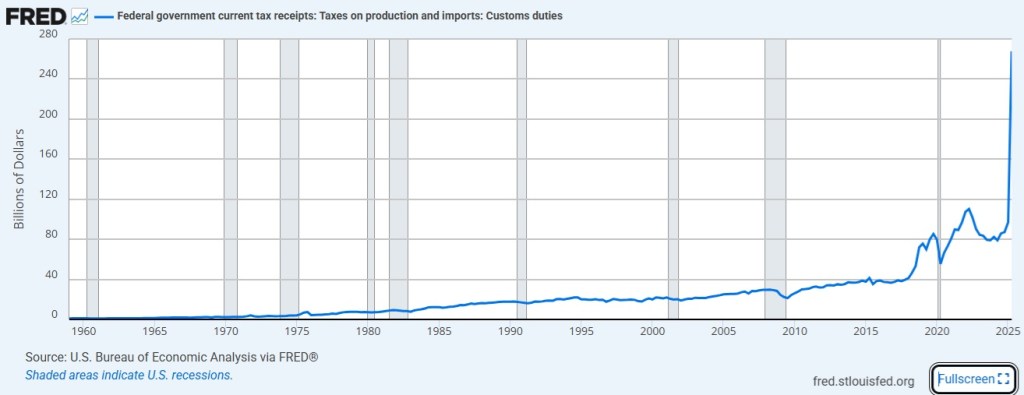
On the revenue side, thus far during FY 2025 (October 2024–April 2025), individual income taxes were the largest source, totaling $1.681 trillion, up 7.0% from the prior year. Social insurance and retirement receipts followed at $1.018 trillion (+3.5%), while customs duties surged 34.4%, likely reflecting renewed tariff enforcement. In contrast, corporate tax revenues fell 9.2%, signaling economic softness or increased use of tax offsets.

Government Expenditures

On the spending side, the Department of Health and Human Services led all agencies at $1.058 trillion, a 10.7% year-over-year increase. Social Security expenditures rose 8.7% to $945 billion, and interest on the national debt jumped 9.6% to $684 billion—now exceeding defense spending ($509 billion) by over 30%, highlighting the growing weight of debt service in an era of higher interest rates.

In sum, the U.S. fiscal trajectory over the last two presidential terms has shifted from post-recession recovery under Obama to crisis-driven deficits under Trump, and into a structurally imbalanced, high-deficit environment under Biden. The road ahead requires confronting unsustainable entitlement growth, rising interest burdens, and sluggish revenue expansion, while safeguarding the broader economic foundation.

The big question is: can we get there before investors throw in the towel and a bond market crisis erupts?

Stay frosty, folks. 

FED Financing of COVID Deficits

Posted in Uncategorized | Tagged , , , , | Leave a comment

Memorial Day: France Still Weeps, We Should Too

Memorial Day, 2025

Remembering our fallen – the best of the best – in France.

On this Memorial Day, let us pause—not just for a moment, but with full hearts—to remember the men and women who made the ultimate sacrifice. Their courage, their devotion, and their willingness to lay down their lives are the very reasons we are free to gather, to speak, to live, and to hope.

It has been said—perhaps callously —that “a single death is a tragedy, a million deaths a statistic.” But today, we push back against that cold arithmetic. Today, we say each life matters. Each name etched in stone is someone’s son, someone’s daughter, someone’s love. Their absence is not a number—it is a wound felt in homes, in memories, in empty seats at the table.

Some of us know that grief firsthand. Some have felt that sharp, silent moment when the knock comes at the door and time stands still. Others have been spared that pain, but few among us do not have, somewhere in our family tree or in our circle of friends, someone who answered the call and never came home.

So today, let us remember them—not just as soldiers, but as people. Let us summon empathy, and let that empathy stir us to action. Comfort those who mourn. Stand with those who carry silent sorrow. Uplift those who feel forgotten.

And most of all, live with gratitude. Let your freedom remind you that it came at a cost. Let your daily joys be acts of honor for those who can no longer share in them.

Take courage, as they did. Live well, as they hoped we would.

And let us never, ever forget.

Thank you.
Gregor

It’s staggering to consider that the Civil War claimed the lives of roughly 750,000 Americans—about 2% of the population at the time. To put that in perspective, it would be equivalent to losing over 7 million people today. In the wake of such immense national grief, Americans across the country began holding tributes to honor those who had fallen. These observances coalesced into what became known as Decoration Day, a solemn tradition of adorning soldiers’ graves with flowers and flags. The first official nationwide commemoration took place on May 30, 1868, as declared by Union veterans’ leader General John A. Logan. Chosen because it was not the anniversary of any particular battle, the date symbolized unity and remembrance. Over time, Decoration Day evolved into Memorial Day, a national holiday dedicated to honoring all U.S. military personnel who gave their lives in service. What began as a gesture of mourning became a cornerstone of national memory and gratitude.

Posted in Uncategorized | Tagged , , , , , , , | 1 Comment

Young Warren Buffett on Mr. Market

Posted in Uncategorized | Leave a comment

Meet the Stealthy Wealthy

Must view, folks.

Posted in Uncategorized | Leave a comment

Global Risk Monitor: Weekly Update – May 23

Last week’s Global Risk Monitor (GRM) warned of potential instability in global tariff negotiations, and unfortunately, those concerns proved prescient. Markets stumbled under the weight of fiscal volatility, erratic policy pronouncements, and renewed trade threats—all driven by the chaotic and impulsive style of President Donald Trump. The deterioration in investor confidence was not merely a reaction to weak economic data or disappointing earnings; rather, it was the product of policymaking that has come to resemble more of a hostile boardroom than a functional democracy.

Trump’s latest salvo—a proposed 50% tariff on European Union imports and a 25% penalty on iPhones—has thrown global supply chains and diplomatic alliances into disarray. These punitive measures, which followed a social media tirade declaring that trade talks with the E.U. were “going nowhere,” came without congressional input or interagency coordination. Apple’s stock fell over 7.6% for the week, wiping billions in market value, a move emblematic of the broader market damage caused by unfiltered threats and unpredictable governance.

New Jersey Generals

This isn’t the first time Trump has weaponized unpredictability as a strategy. One need only revisit his ill-fated foray into professional sports with the New Jersey Generals in the USFL. Then, as now, Trump demonstrated a profound misunderstanding of strategic pacing, long-term coalition building, and institutional integrity. His push to move the USFL to a fall schedule—directly challenging the NFL—was driven more by ego, revenge, and spectacle rather than viability. The result? Collapse. And it’s hard to ignore the parallels: antagonizing allies, ignoring systemic constraints, and opting for maximalist stances that backfire economically and diplomatically.

Flop and Chop

Markets this week bore the brunt of that same impulsiveness. The S&P 500 dropped 2.6%, the Dow fell 2.2%, and the Russell 2000—particularly sensitive to fiscal and trade shocks—plunged 3.5%, extending its year-to-date loss to 8.6%. Small caps, discretionary stocks, energy, and tech all led to the downside. Treasury yields spiked following a disastrous 20-year bond auction, sending the 30-year yield to a cycle high above 5%. The root cause? Rising fiscal deficits, compounded by Trump’s budgetary “Big Beautiful Bill,” add more long-term debt, undermining the U.S.’s creditworthiness.

Despite positive May PMI data showing a modest rebound in U.S. business activity, any optimism is being offset by a resurgence in price pressures, most of them, ironically, linked directly to tariffs. Export orders fell, and supply chain delays worsened. Chris Williamson of S&P Global noted that much of the demand surge was likely front-running further policy risk. Companies aren’t investing in growth—they’re bracing for another round of economic whiplash.

Threat of Retaliation

Even America’s allies are growing wary. The EU is preparing a carefully measured but firm response to Trump’s tariff threats, signaling the potential for a tit-for-tat escalation that markets are ill-prepared for. Japan, similarly, has hardened its negotiating position amid Trump’s economic belligerence, recognizing the dangers of being dragged into a game of political brinkmanship that endangers long-term regional stability.

And while Trump insists these moves will “bring back jobs,” the data suggests otherwise. Manufacturing gains remain elusive, with firms citing labor shortages, automation challenges, and investment hesitancy—issues that tariffs alone cannot solve. As his tenure in the USFL compellingly illustrates, Trump has long confused aggression with strategy and disruption with innovation. The net result—then and now—is institutional erosion and self-inflicted damage.

Heavy Metal Rock & Roll

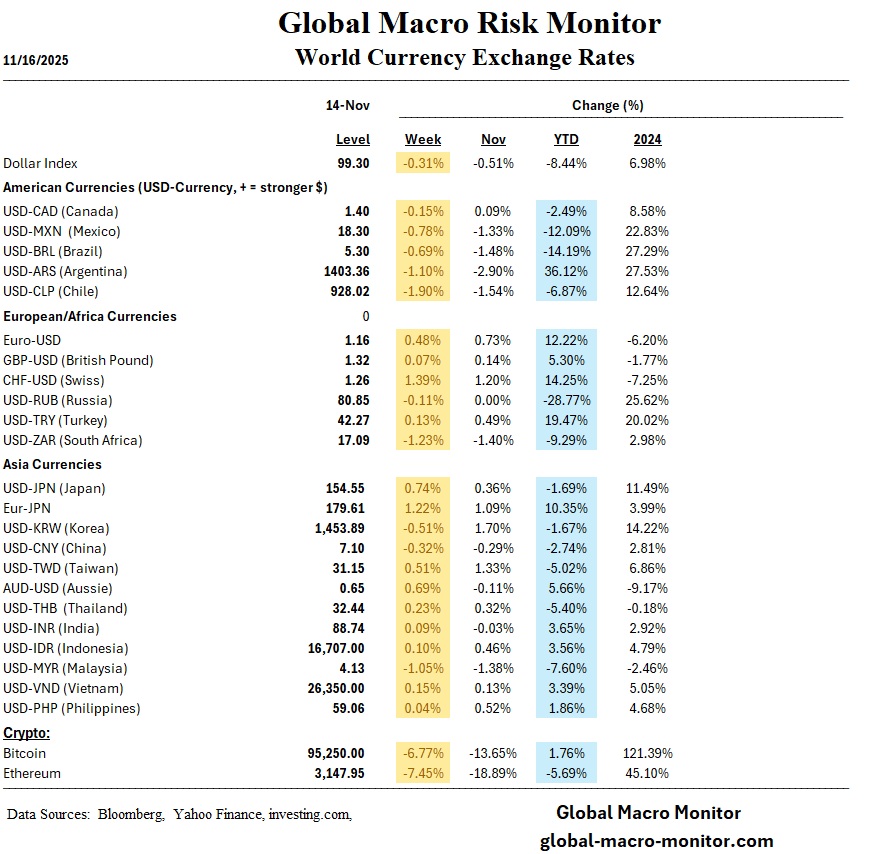
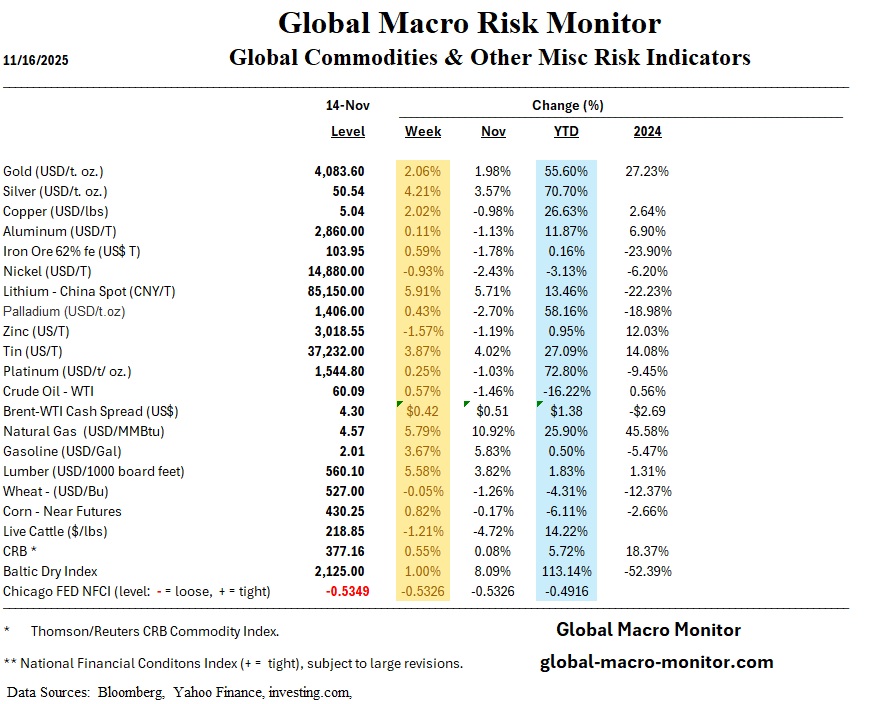
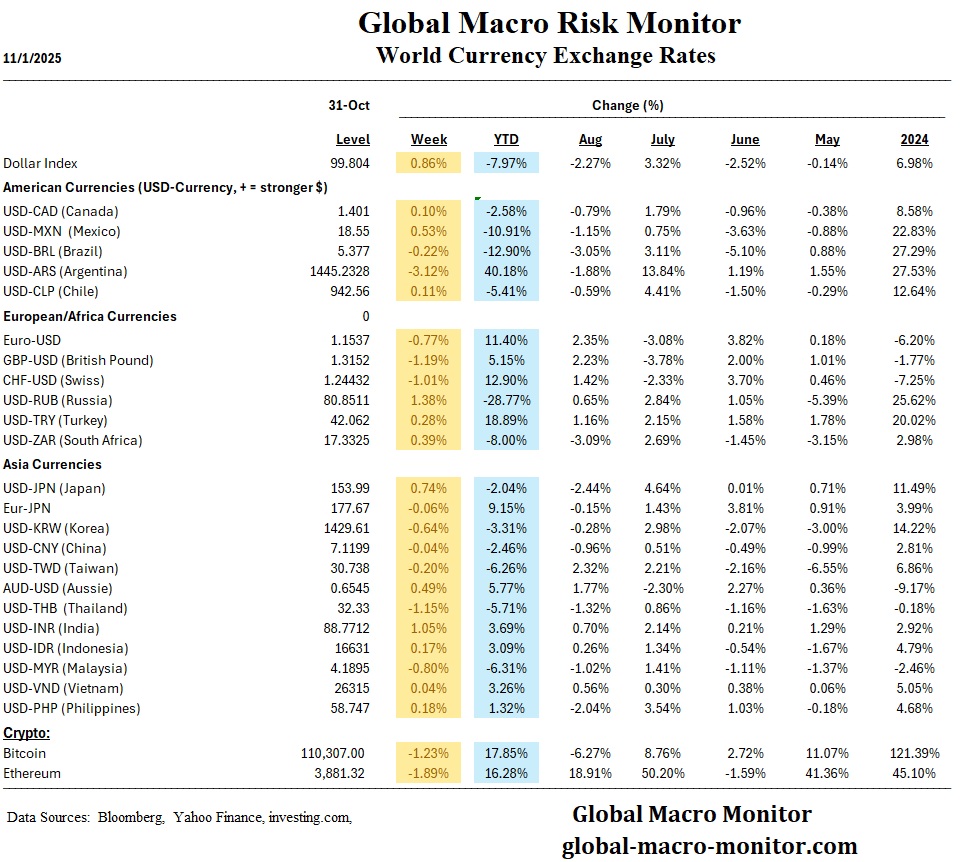
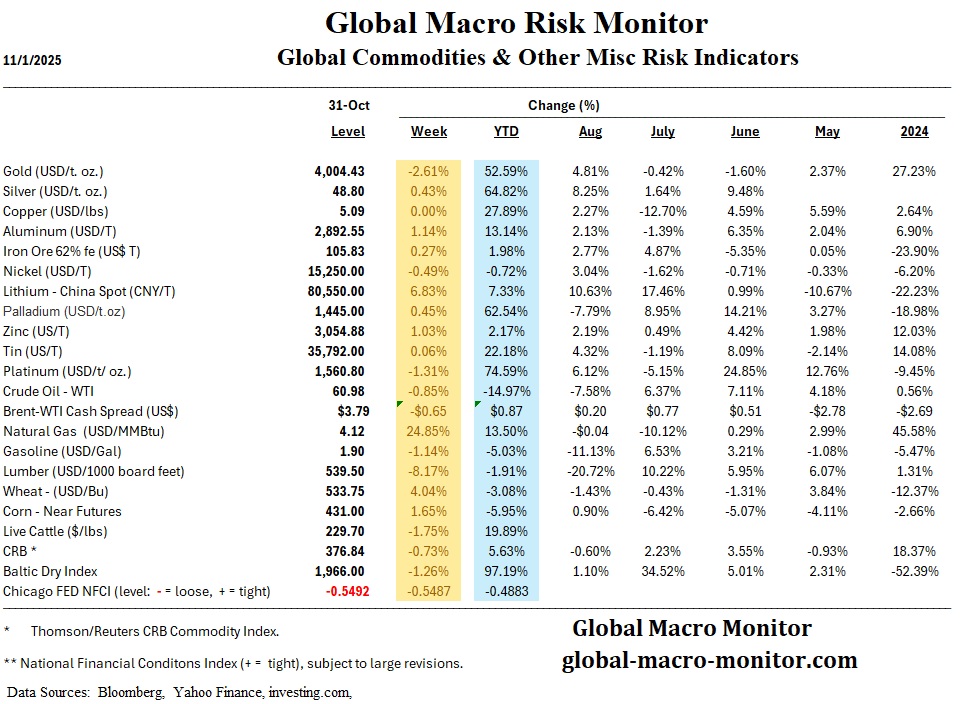
Gold, copper, and platinum all surged this week, up 5%, 6%, and 10% respectively—some some, of which are traditional hedges in times of political instability. Meanwhile, the dollar weakened 2% and the Chicago Fed’s NFCI showed significant easing in financial conditions, more a function of defensive repositioning than macro strength.

In conclusion, the current administration’s erratic policymaking, marked by threats instead of treaties and volatility instead of vision, is exacting a growing toll on markets, governance, and global credibility. Like the USFL, this experiment in economic brinkmanship may well end not in resurgence but in collapse. Investors, allies, and citizens alike would be wise to prepare for more turbulence unless—and until—strategic sobriety returns to the helm.

Markets

U.S. Market Analysis

  • U.S. equities declined across the board, with small- and mid-cap indices underperforming; the Russell 2000 fell over 3.5% on the week, now down 8.6% YTD.

  • Market pressure intensified after a weak 20-year Treasury auction and a surge in long-term yields, signaling increased investor concern over fiscal stability.

  • President Trump’s announcement of a proposed 50% tariff on EU goods and a 25% tariff on iPhones triggered a late-week selloff, contributing to a sharp pullback in tech stocks, including a 7.5% drop in Apple shares.

  • The Dow Jones Industrial Average and S&P 500 closed the week back in negative territory for the year, reversing gains from the prior week.

Global Market Analysis

  • European equity markets were shaken by tariff threats from the U.S., with the EU preparing limited but deliberate retaliatory measures.

  • Japan’s financial sector faced headwinds amid a sharp rise in domestic bond yields and pressure from rising global interest rates.

  • Chinese markets were supported by a continued pause in U.S.-China tariff escalation, although the absence of structural reform progress remains a concern.

Economics

U.S. Economic Overview

  • Moody’s downgraded U.S. sovereign debt, citing mounting deficits and fiscal risk, pressuring Treasury markets and contributing to yield curve volatility.

  • April existing home sales dropped to their lowest level since 2009, while new home sales surprised to the upside, albeit amid declining median prices.

  • Flash PMI data for May showed a rebound in both manufacturing and services sectors, but firms warned that tariffs were driving input costs higher and export orders lower.

  • Inflation expectations surged: 1-year expectations hit 7.3%, their highest since 1981, intensifying concerns about future consumer behavior and purchasing power.

Global Economic Overview

  • Eurozone trade surplus hit a record high, supported by March’s robust industrial production; however, services PMIs declined, reflecting uneven growth.

  • Japan’s core CPI strengthened into the new fiscal year, with inflation led by food and services.

  • China’s retail sales moderated in April but remained stronger than Q1 averages, while industrial production growth slightly outperformed expectations.

Week Ahead

Key U.S. & Global Events

  • Investors will monitor formal responses from the EU regarding retaliatory trade measures following Trump’s 50% tariff proposal.

  • The White House’s public messaging on trade, particularly in relation to Japan and Apple, will be key for sentiment.

  • G7 meetings in Canada could serve as a backdrop for coordinated pushback or policy alignment on U.S. trade actions.

Upcoming Economic Data

  • Tuesday: Durable Goods Orders, FHFA House Price Index, Conference Board Consumer Confidence

  • Wednesday: MBA Mortgage Applications, FOMC Minutes

  • Thursday: Initial Jobless Claims, Revised Q1 GDP, Pending Home Sales

  • Friday: Personal Income & Spending, Core PCE Price Index, Chicago PMI, Final University of Michigan Consumer Sentiment

Notable Earnings Reports

  • Tuesday: AutoZone, PDD Holdings, Okta

  • Wednesday: NVIDIA, Salesforce, HP Inc., Synopsys

  • Thursday: Costco, Dell Technologies, Best Buy, Marvell Technology

  • Friday: Shoe Carnival

Posted in Uncategorized | Tagged , , , , | 1 Comment

Notes from the U.S. Supply Chain – May 22

Manufacturers stocked up on inputs, generally citing concerns over potential tariff-related price increases and supply shortages, the latter reflected in suppliers’ delivery times lengthening in May to the greatest extent since October 2022. The increase in buying activity was the highest since July 2022 and the resulting rise in inventories of purchases was the largest recorded in the 18-year survey history.

Prices

Average prices charged for goods and services jumped higher in May, rising at a rate not witnessed since August 2022, when pandemic-related shortages caused widespread price inflation.

An especially steep rise was seen for manufacturers’ selling prices, which posted the largest monthly increase since September 2022. Charges levied for services rose to the greatest extent since April 2023

The latest rise in output prices was overwhelmingly linked to tariffs, having directly driven up the cost of imported inputs or caused suppliers to pass through tariff-related cost increases. Manufacturing input costs rose at the sharpest rate since August 2022 while service sector costs rose at the fastest rate since June 2023.  – S&P Global

Posted in Uncategorized | Leave a comment

QOTD: Signals, Signals Everywhere

QOTD = Quote of the Day

What a contrast between the current Citi CEO and the former who danced his bank over the edge and right into the Global Financial crisis. 

…if you’re looking for signals, they’re everywhere. Treasury yields rose even as equity markets wobbled. The U.S. dollar, typically a safe haven, has weakened at moments when it used to rally. That tells us something deeper is going on, investors aren’t just pricing near-term risks; they’re reevaluating the credibility of long-held certainties. It’s showing up in how capital moves. Pensions and asset managers are tilting more towards Japan, India and parts of Europe. Hedge funds are being selective and didn’t chase the April equity bounce. Sovereign wealth funds are diversifying more aggressively. Hedging against the dollar is now at levels we haven’t seen in years. – Jane Fraser, Citigroup CEO

When the music stops, in terms of liquidity, things will be complicated. But as long as the music is playing, you’ve got to get up and dance. We’re still dancing. – Chuck Prince, Citigroup CEO July 2007

Posted in Uncategorized | 1 Comment

HOTD: Back to Liberation Day?

HOTD = Headline of the Day

As we suspected in yesterday’s Global Risk Monitor, recent developments confirm a deteriorating trajectory in U.S. trade negotiations. Today’s Financial Times headline underscores the hardening U.S. stance, signaling heightened tariff risks for non-cooperative trade partners. This shift, when viewed alongside Moody’s downgrade of the U.S. sovereign credit rating announced post-market close on Friday, is likely to unsettle investor sentiment and amplify concerns over global economic stability.

Posted in Uncategorized | Tagged , , , , | 1 Comment

Global Risk Monitor: Weekly Update – May 16

Financial markets continued to rebound this week, buoyed by temporary trade de-escalations and looser financial conditions. However, beneath the surface of this rally lies a landscape of historically elevated valuations and persistent uncertainty. Market participants should temper optimism, as the sustainability of recent gains remains highly contingent on volatile policy developments and fragile macroeconomic signals.  Nevertheless, it feels like the FOMO crowd wants to challenge the all-time highs made in February.

Euro Banks

European banks, often overlooked in recent years, have delivered an unexpected year-to-date return of 33% in euro terms, with an added 7% benefit from currency movements. Their outperformance, by over 40% relative to NVIDIA, for example, would have been dismissed as implausible and crazy at the start of the year. 

Semis

The semiconductor sector led with outsized gains, with its SMH ETF advancing 10% this week and 16% in May. Renewed demand for AI infrastructure and chip exports contributed to this performance. Nonetheless, such sharp movements in high-beta sectors raise concerns about potential overextension, particularly in a market where overall valuations, such as the S&P 500’s forward price-to-earnings ratio of 22, already stand at historically elevated levels.

Fed Cut Pushed Out

The Federal Reserve’s decision to delay rate cuts has pushed out market expectations for the first cut at the September 17 FOMC meeting, with the second cut expected in  December. Despite recent inflation readings coming in below expectations, the Fed appears unwilling to declare victory prematurely. Treasury markets reflected this prudence: the 10-year yield breached 4.5% this week, rising 32 basis points in May alone. While narrowing credit spreads may suggest improved sentiment, they could also reflect a mispricing of lingering risks.

Trade Risk Still On the Table

Complicating the macro outlook further are renewed trade tensions. President Trump announced that the U.S. will soon issue letters unilaterally setting new tariff rates for hundreds of countries, citing the impracticality of individualized negotiations.  Markets may interpret this as a signal that the negotiation process is proving more contentious than anticipated. This blunt and unilateral approach injects further uncertainty into the global trade environment and could prove destabilizing if retaliatory measures follow.  There is no question tariffs are headed higher from already historically elevated rates. 

Japan’s position in the ongoing trade saga is illustrative of broader tensions. Facing domestic political challenges, Tokyo has hardened its stance, resisting any agreement that fails to deliver meaningful relief on the 25% U.S. auto tariff. While this impasse may delay resolution, it also reflects a pragmatic effort to avoid structurally imbalanced outcomes. The Japanese government is seeking to protect critical industries while engaging in high-stakes diplomacy with a U.S. administration increasingly focused on unilateral action.

Markets have moved on from the tariff debacle, but we say not so fast. 

Keep this on your radar, folks.

Germany and Spain Über Alles

European equity markets, particularly in Germany and Spain, are among the stronger performers year-to-date, aided by robust industrial output and a 7% currency gain for unhedged foreign investors. However, the durability of this momentum is far from assured, especially as broader global demand remains uneven and subject to policy disruption.

Crude Oil and Gasoline Divergence

Commodities present a mixed picture: crude oil prices have fallen 13% year-to-date, while wholesale gasoline prices climbed 7%, reflecting possible supply chain inefficiencies or seasonal demand effects. These divergences add complexity to inflation forecasts, which remain central to monetary policy decisions.  Furthermore, the political dividend of a drop in crude oil prices is almost completely cannibalized by the surprising increase in gas prices. 

Apple and Consumer Sentiment

Apple saw renewed investor interest, a potentially positive sign for consumer tech sentiment. Yet, such gains may also reflect momentum-driven positioning rather than fundamental improvement, particularly as consumer sentiment remains weak. The University of Michigan’s May index fell for the fifth consecutive month, with inflation expectations climbing—further highlighting the disconnect between soft data and asset pricing.

Easing Financial Conditions

Although financial conditions eased significantly in May, as reported by the Chicago Fed’s NFCI, the breadth and quality of this easing merit scrutiny. Much of the recent rally has been driven by multiple expansion rather than earnings growth, suggesting vulnerability if macro data or geopolitical developments disappoint.

In sum, while financial markets have posted strong returns in May, this strength masks underlying fragility. With valuations stretched, geopolitical risks intensifying, and macroeconomic signals mixed, a neutral to slightly bearish outlook is warranted. Investors should remain vigilant, as the path forward is likely to be shaped more by volatility and policy missteps than by sustained fundamental momentum.   That said, the momentum whores (of which, we are one at times) have taken control of the markets and it wouldn’t be a surprise to see a continued move to the old highs. 

Markets

U.S. Market Analysis

Markets Rise on Trade Optimism
U.S. equities rebounded sharply as the White House and Beijing reached a 90-day tariff suspension, with U.S. tariffs on Chinese goods lowered from 145% to 30%, and China reducing its tariffs from 125% to 10%. This temporary reprieve lifted risk sentiment and propelled major indices upward:

  • Nasdaq Composite: +7.15%

  • S&P 500: +5.27%

  • Dow Jones Industrial Average: +3.41%

  • Russell 2000: +4.5%, still down 5.3% YTD

Investor Sentiment Remains Cautiously Bullish
While the rally broke key technical levels (e.g., Nasdaq and S&P 500 moving above their 200-day SMAs), gains were underpinned by short covering, underexposure, and tactical positioning rather than fundamentals. Despite these technical wins, market breadth remains uneven and valuations stretched, with the S&P 500 trading at a 22x forward P/E—above historical norms.

Tariff Volatility Still a Risk
Although trade tensions with China have temporarily eased, no long-term agreement has been reached. The path of tariffs remains fluid, and uncertainty continues to weigh on capital expenditure and production decisions, particularly among small businesses and manufacturers.

Global Market Analysis

Europe Responds with Diplomacy
European stocks followed U.S. markets higher. Germany’s DAX (+1.14%), France’s CAC 40 (+1.85%), and Italy’s FTSE MIB (+3.27%) rose as optimism grew around renewed trade talks. Germany’s industrial output (+3.1% in March) and a record eurozone trade surplus (EUR 36.8B) offered support.

Germany Seeks Trade Reset
Calls for a structured, zero-tariff trade framework by German officials aim to restore competitiveness and regulatory alignment. This reflects Europe’s attempt to play a stabilizing role in global trade while avoiding direct confrontation.

China Not Yet Aligned
Chinese stocks rose modestly (CSI 300 +1.12%, Hang Seng +2.09%) as the trade reprieve met nearly all of Beijing’s demands. However, the easing of tensions also reduced pressure on Beijing to announce major stimulus, tempering equity gains.

Economics

U.S. Economic Overview

Tariff Intentions Still Unclear
Markets remain uncertain whether tariff policy is aimed at reshoring supply chains, extracting concessions, or supporting fiscal goals. With the pause in place, attention has shifted to whether similar concessions will be made with the EU or Japan.

No Formal Progress with China
Despite the 90-day pause, the deal lacks structural reform commitments. Consumers and businesses remain wary, as the effective tariff level of 30% is still significantly elevated relative to pre-April rates.

Price Pressures on Horizon
April’s CPI rose 2.3% YoY and core CPI held at 2.8%, both below expectations. PPI fell 0.5% MoM, driven by margin compression. However, forward inflation expectations surged:

  • 1-year inflation expectations: 7.3% (highest since 1981)

  • 5–10-year expectations: 4.6% (highest since 1991)
    Consumers increasingly cite tariffs as a dominant economic concern.

Retail Sales and Sentiment
Retail sales slowed to +0.1% MoM, with weakness in autos, sporting goods, and apparel. Sentiment plunged to the second-lowest level on record (University of Michigan Index: 50.8), highlighting deep consumer unease.

Global Economic Overview

Germany Advocates Efficiency Through Free Trade
Eurozone industrial production rose 2.6% in March, the fastest in two years. Employment also accelerated. Germany argues that tariff reduction could preserve industrial competitiveness and supply chain integration.

Structural Conflict with U.S. Goals
U.S. trade policy—focused on tariffs as revenue and domestic stimulus—clashes with Europe’s zero-tariff, rules-based approach. Tensions could rise if no common framework is agreed.

Europe Seeks Stability Before Recession Risk Builds
The ECB is in no rush to cut rates, citing improving growth data. However, risks from prolonged trade disputes, particularly if the U.S. targets auto tariffs, remain elevated.

Week Ahead: May 19–23, 2025

Economic Data Releases

  • Monday, May 19

    • No major U.S. economic data scheduled.

  • Tuesday, May 20

    • Eurozone Inflation (April Final): Final figures for April’s consumer price index (CPI) will be released, providing insight into inflation trends within the Eurozone.

  • Wednesday, May 21

    • U.S. Existing Home Sales (April): Data on existing home sales will offer a snapshot of the housing market’s performance during the spring selling season.

  • Thursday, May 22

    • U.S. Initial Jobless Claims (Week Ending May 17): Weekly data on unemployment claims will indicate the health of the labor market.

    • U.S. New Home Sales (April): Figures on new home sales will provide further insight into the housing sector’s condition.

  • Friday, May 23

    • U.S. Flash PMI (May): Preliminary Purchasing Managers’ Index data for manufacturing and services sectors will shed light on business activity and economic momentum.

Corporate Earnings Reports

  • Monday, May 19

    • Trip.com: Expected to report a nearly 10% decline in earnings per share (EPS) to $0.75, with revenue growth of approximately 17% to $1.92 billion.

    • Qifu Technology: Anticipated to post a 71% increase in EPS to $1.72, with an 11% rise in revenue to $637 million.

  • Tuesday, May 20

    • Home Depot: Analysts expect a 1% decline in EPS and an 8% drop in revenue, reflecting challenges in the home improvement sector.

    • Gap Inc.: Projected to report a 7% increase in EPS to $0.44, with sales growth of less than 1% to $3.41 billion.

    • Workday: Expected to announce a 15% rise in EPS to $2.01, with revenue increasing by 11% to $2.22 billion.

    • Keysight Technologies: Forecasted to report a 17% increase in EPS to $1.65, with a 5% rise in sales to $1.28 billion.

  • Wednesday, May 21

    • Target: Anticipated to see a 19% decline in EPS to $1.65, with a 1% decrease in sales to $24.28 billion, amid slowing traffic and tariff concerns.

    • Lowe’s: Expected to report a 5.5% drop in EPS and a 2% decline in sales, reflecting challenges in the retail sector.

    • Urban Outfitters: Projected to post a 21% increase in EPS to $0.84, with revenue growth of 7.5% to $1.29 billion.

    • TJX Companies: Forecasted to report a 5% decline in EPS to $0.91, with a 4.2% increase in revenue to just under $13 billion.

    • Baidu: Expected to see a 28% decline in EPS to $1.98, with a 1.5% decrease in revenue to $4.3 billion.

    • XPeng: Anticipated to report a loss of $0.20 per share, with revenue surging 130% to $2.075 billion, driven by strong demand for its Mona 03 model.

  • Thursday, May 22

    • Ralph Lauren: Projected to report a 19% increase in EPS, with approximately 5% sales growth for its Q4 results.

    • Burlington Stores: Expected to announce EPS of $1.42, with revenue rising 7% to $2.65 billion.

    • BJ’s Wholesale: Anticipated to post an 8% increase in EPS, with a 5.4% rise in revenue.

    • Analog Devices: Forecasted to report a 21% increase in EPS to $1.70, with sales up 16% to $2.51 billion.

    • Autodesk: Expected to announce a 15% rise in EPS to $2.15, with a 13% increase in sales to $1.61 billion.

    • Intuit: Projected to report a 10% increase in EPS to $10.90, with sales rising 12% to $7.56 billion.

    • Atour Lifestyle: Anticipated to post a 6 cent increase in EPS to $0.32, with 28% revenue growth to $261 million.

  • Friday, May 23

    • No major earnings reports scheduled.

Global Events and Developments

  • May 20–22: G7 Summit in Banff, Canada

    • Finance ministers and central bankers will convene to discuss global economic challenges, including trade policies and currency volatility.

  • May 21: Google I/O Conference

    • Alphabet is expected to unveil new AI-related products and updates, potentially impacting the technology sector.

  • May 19: UK-EU Summit

    • A summit between the UK and EU is anticipated to address post-Brexit relations, with potential implications for trade and economic policies.

Posted in Uncategorized | Tagged , , , , | 1 Comment