What works for China works for Kansas, no?
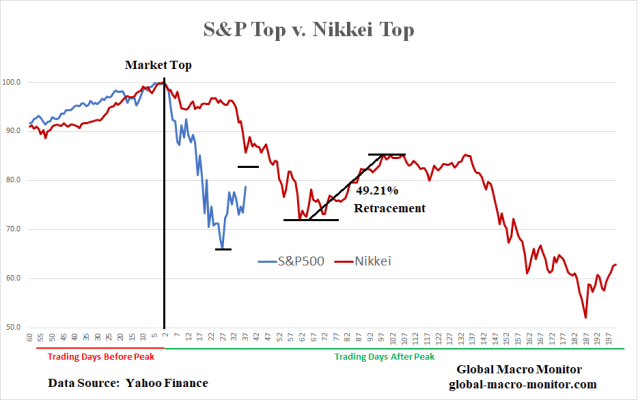
We’ve created an S&P/Nikkei analog to compare how the current bear market is performing relative to the first month of trading after the Nikkei stock index peak on December 29, 1989. Japanese stocks have been in an uber 30-year bear market.
At today’s close, the S&P is down 28.55 percent, 24 trading days after the February 19th closing high. This compares to the Nikkei, which was down only 3.21 percent on the 24th trading day after its closing high. It took Japanese stocks 62 trading days to register a similar decline, which marked a short-term low and sparked an 18.54 percent bounce lasting 45 trading days (or 9 weeks). Similarly, stocks may be able to muster a short-term bounce right here but it will likely be met by heavy selling and not be as vigorous as the Nikkei’s first bear market bounce.
Not Your Father’s Bear
This current bear is not your father’s bear market as the global economy has effectively shut down, unprecedented in the modern economy. There is still great uncertainty and the days are about to get much darker. Moreover, the bursting of multiple asset bubbles, including stocks and bonds, has caused a mass deleveraging, which, in part, explains the S&P’s rapid descent since the February high.
Multilateral Solution
While the rest of the world is leaning on each other during this global crisis, the U.S. is becoming increasingly isolated simply due to the President’s colossal failure of leadership.
See here for the Reuters article.
Also The Guardian,
Experts say that, while these humanitarian efforts are real, they have political ends that deserve attention. In a phone call with the Italian prime minister, Giuseppe Conte, this week, Xi said he hoped to establish a “health silk road” as part of China’s global One belt, One Road initiative, which has come under criticism from countries wary of expanding Chinese leverage and influence. — The Guardian
In the short-term many more Americans will die and the long-term consequence will be disastrous for America’s global standing. Maybe that is why the market now tends to sell-off when Trump takes to the dais and issues tweets such as this,
It doesn’t take the algos long to adjust.
This morning, he referred to COVID-19 as “the Chinese virus.”
In doing so, he was retreating, like a child to his blanket, to the kind of degenerate culture-war squabble in which he feels most secure and his supporters most aggrieved. Here’s the gullibility test: When you read “the Chinese virus,” are you most offended by Trump’s insistence on racializing the pandemic, or by the administration’s cowardice and incompetence, which may kill hundreds of thousands of Americans and have already decimated the economy several times over? — The Atlantic
Good God, this is how wars start.
Only Multilateralism Can Save Us
The current crisis is even more deserving of a multilateral response, because it presents challenges above and beyond those previous threats. In what amounts to an economic perfect storm, the pandemic has combined with preexisting recessionary pressures, the broader disruption to global trade, and a new and somewhat unexpected complication: a sharp drop in oil prices. – Anne Krueger, Project Syndicate
Beware Of The Bottom Callers
It’s disheartening, in our opinion, to see some calling a bottom here in stocks and that “long-term” investors should start buying. We are not surprised, however.
It is difficult to get a man to understand something, when his salary depends on his not understanding it. – Upton Sinclair
At the close this morning, the Nikkei is still down 57.47 percent from its December 1989 high.
We are not saying the S&P is going to replicate the Nikkei’s performance but we are saying bull markets and V-shaped recoveries are not an entitlement.


Hat Tip: Vanessa Otero @vlotero
Joe Biden all but wrapped up the Democratic nomination with key wins in Florida, Illinois, and Arizona tonight. If we were advising him, which we are not, here is the next steps he should take:
Here are the latest prediction odds for Uncle Joe’s choice for Vice President.

Just a quick heads up. The S&P500 has already taken out 2750.10, the first key Fib retracement of the 400 plus percent long bull market from Mar’09 to Feb ’20, and is now approaching another key Fibo at 2351.91, which also coincides with the December 26, 2018 low at 2346.58. We are not expecting it to hold but do not believe a test of the generational low of 666.79 is likely.


Based on the both historic price action of the two financial bubbles that have burst in the past twenty years and our favorite valuation metric — Market Capitalization-to-GDP or the Wilshire 5000 Index to Nominal GDP — stocks still have about 30-35 percent to fall before we believe the “bottom is near.”
Stock Market Valuation Is Still Higher Than Pre-GFC Peak
It is stunning that even after a 27 percent decline in the Wilshire 500, the U.S. stock market cap-to-GDP ratio is still above its pre-GFC (Great Financial Crisis) peak!
Where Is Value — A Market Cap-to-GDP of 77 Percent?
We don’t know, nor does anyone else, but a market cap-to-GDP of around 77 percent is in the neighborhood where stocks start to look cheap, in our opinion. Caveat emptor, however, markets almost always overshoot.
Assuming a -5.0 percent Q2 contraction in nominal GDP, which is generous, and the bottom comes at the end June, the 2020 bear market decline in the Wilshire 5000 (use it as proxy for other indices) from the Feb 19th closing high to a hypothetical June low would be between 50-55 percent, which is right in line of the recent bears.
Caveat Reader
We admit the above analysis could be very wrong and readers should take it simply for what it is, conjecture, along with every other analysis out there, by the way. We could be wrong on the levels or the time frame or both. Nobody. Knows. The. Future.
Use Valuation Metrics As A Gas Gauge
The valuation metric has worked for us, and we compare it to a gas gauge to inform us that the tank is running low or high — i.e, how much potential upside/downside there is in current prices — and not the exact spot where the market runs out of gas. Trying to top-tick the high is a mug’s game, ask Issac Newton.
The higher the black line moves above past highs, the harder and more painful the fall, or a meaner regression to the mean.
Write that down, folks.
The question is have stock valuations “reached a permanently high plateau” as the famous economist, Irving Fisher, stated just a few weeks before Black Thursday 1929?
Believe it, if you wish. After all, we now live in a culture and political environment where,
It’s not a lie if you believe it.
To that, we say hogwash. — GMM, Feb 17th (two days before peak S&P500)

Watch The Bond Market
Ugly price action in bonds.
Read our post from yesterday, Some Perspective, for our view on what is driving bonds. The upshot is bonds are mispriced given the deluge of supply that is coming. It is our, opinion that there are very few real long-term buyers of duration at sub-1 percent yields.
Watch this space, which is probably more important that the price action in stocks.

Shame on the stock pumpers.
Stay frosty, folks.
Blast From The Past (BFTP).
Happy St. Patrick’s (Maweyn Succat) Day!
St. Patrick, Ireland, St. Patrick’s Day. Simple, right? The man wasn’t even Irish! He was actually born in Britain around the turn of the 4th century. At 16 years old, Irish raiders captured him in the midst of an attack on his family’s estate. The raiders then took him to Ireland and held him captive for six years. After escaping, he went back to England for religious training and was sent back to Ireland many years later as a missionary. St. Patrick was actually born Maewyn Succat, according to legend; he changed his name to Patricius, or Patrick, which derives from the Latin term for “father figure,” when he became a priest. – Time
The Irish Comeback
Ireland has come a long way since this post, which was just after the European debt crisis. The government just placed €1.03 billion of 10-year bonds in mid-February at a stunning yield of 0.85 percent. The auction had a bid-to-cover of 2.24.
Yeah, got it, distorted due to ECB asset-buying program. But still well below the Euro periphery bond yields.

Though the Irish economy is slowing and there is much uncertainty around Brexit, still it’s been one helluva comeback, and the Irish are a resilient bunch, now positioning themselves with U.S. and Canadian companies as the “only English-speaking common-law country in the whole of the European Union.”
Me “finks [sic]” part of the success was thumbing their nose and ignoring the advice and dictates of the Eurocrats in Brussels.
Plus, Ireland still has Bono and U2, Andrea and the rest of the Corrs, and the many, if not all the great people of Ireland, we love so much, including my late grandmother and her side of the family. That is the upside of being an American. We are all mutts and can claim to be citizens of many cultures. Don’t think POUTS has got the memo quite yet.
Rory
How great would be to see an Irishman win the PGA’s coveted Players Championship on St. Paddy’s Day? Rory tees it up in today’s final round one back.
Getting long Rory as I write. Pour me one in Dublin and Hollywood, CD in the wee hours tomorrow to celebrate! You heard it here first. Unleash the Leprechauns!

Source: Golf Digest
In case you’re wondering, Maweyn Succat was St. Patrick’s real name and he wasn’t even Irish!. Click here for some great background and history of St. Patrick’s Day.
Go Paddy, Rory, Graeme, and Darren!
Happy St. Patrick’s Day! Not too many green beers, folks!
By the way, there has been one huge bond rally in Ireland over the past year.
It’s becoming pretty clear to us that the world is going to look much different on the other side of this crisis. Diminished global supply chains and more nationalism. Slower growth and higher inflation.
Much will depend on the outcome of the November presidential election.