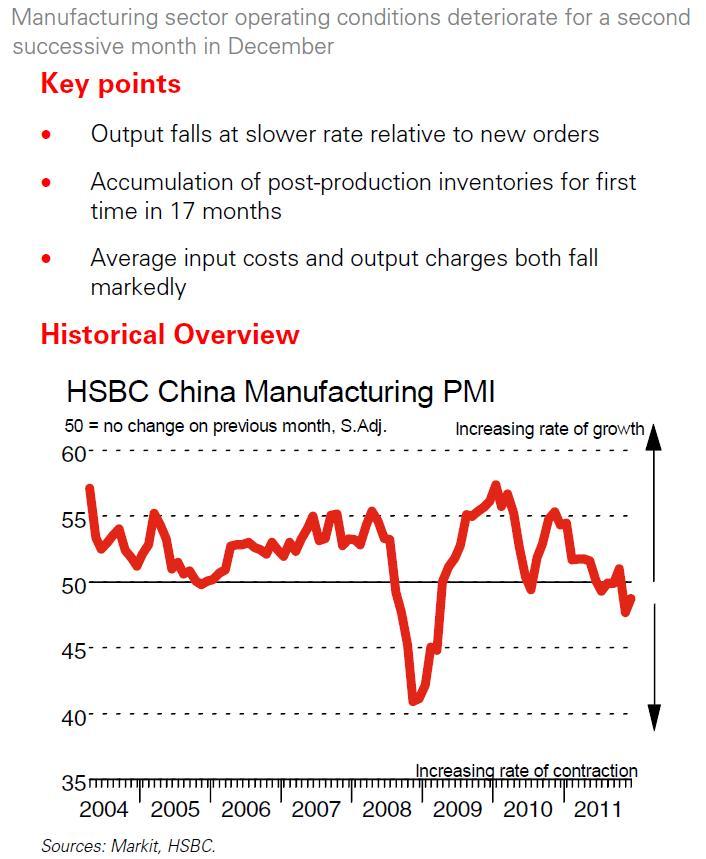
HSBC China PMI Contracts for Second Successive Month

“While the pace of slowdown is stabilizing somewhat, weakening external demand is starting to bite. This, plus the ongoing property market corrections, adds to calls for more aggressive action on both fiscal and monetary fronts to stabilize growth and jobs, especially with prices easing rapidly. Hard landings should be avoided so long as easing measures filter through in the coming months.” 

– Hongbin Qu, Chief Economist, China & Co-Head of Asian Economic Research at HSBC

(click here if chart is not observable)

Posted in China | Tagged , | 2 Comments

The Haunting (of the Sovereign Bonds)

A consistent theme we have heard over and over this year is that there is no credit risk for a sovereign borrower that has an independent central bank and can resort to debt monetization.   Even Martin Fedstein in his excellent Project Syndicate piece, The French Don’t Get It, writes,

French officials have now reacted to the prospect of a credit rating downgrade by lashing out at Britain. The head of the central bank, Christian Noyer, has argued that the rating agencies should begin by downgrading Britain. The finance minister, Francois Baroin, recently declared that, “You’d rather be French than British in economic terms.” And even the French Prime minister, Francois Fillar, noted that Britain had higher debt and larger deficits than France.

French officials apparently don’t recognize the importance of the fact that Britain is outside the eurozone, and therefore has its own currency, which means that there is no risk that Britain will default on its debt. When interest and principal on British government debt come due, the British government can always create additional pounds to meet those obligations. By contrast, the French government and the French central bank cannot create euros.

But will they?

Unlike the relatively benign quantitative easing of the past few years to goose markets and the economy, the consequences of monetizing bond maturities due to a loss of confidence in a sovereign’s ability or willingness to pay its debt would have severe consequences.  Initial conditions and state variables,  such as confidence and the monetary transmission mechanism,  matter significantly when a central bank decides to crank up the printing press.

If faced with the prospect of a sovereign default, monetary authorities and policymakers would be forced to make a political choice of who pays the debt:  1) bond holders by allowing the sovereign to default; or 2) domestic residents through the loss of their savings during a hyperinflationary debt monetization.

Some countries, such as Bulgaria in the mid-1990’s monetized their debts, which resulted in hyperinflation and inflicted severe pain on their residents.   Russia, on the other hand, defaulted on their domestic debt in 1998, much of which was held by foreigners, including hedge funds, such as David Tepper.

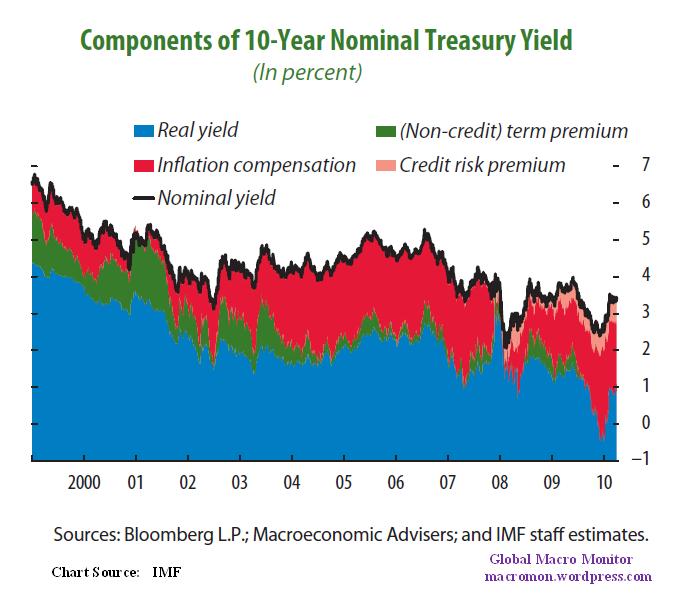
Unfortunately, it’s very difficult to decompose the various risk premia in a sovereign bond yield.  The IMF made a valiant effort with the 10-year U.S. Treasury yield in 2010.  Note the credit risk premium entering the picture after the bursting of the credit bubble in 2007/08.

We sense a dangerous complacency haunting the bond markets.

(click here if chart is not observable)

Posted in Black Swan Watch, Bonds, Sovereign Debt, Sovereign Risk | Tagged , , | 5 Comments

Nonlinear Thinking: Robot Soldiers

Great piece from our friends at Al Jazeera.    Looks like the military is no longer going to be the “employer of last resort.”   Future veterans are going to highly trained in the cutting edge technology that will shape the next hundred years.   Gives new meaning to “boots  bots on the ground.”

“Mamas don’t let your children grow up to be cowboys.”

Today there are more than 7,000 drones and 12,000 ground robots in use by all branches of the military.

(click here if video is not observable)

Posted in Nonlinear Thinking, Technology | Tagged , | 3 Comments

Quote of the Day: The Big Think

“Tech companies are creating plenty of jobs for robots.”
—
Daniel Honan,  The Robot Hiring Boom Has Arrived

Posted in Employment, Nonlinear Thinking | Tagged , , , | Leave a comment

Euro Swan Dives Splashes Santa

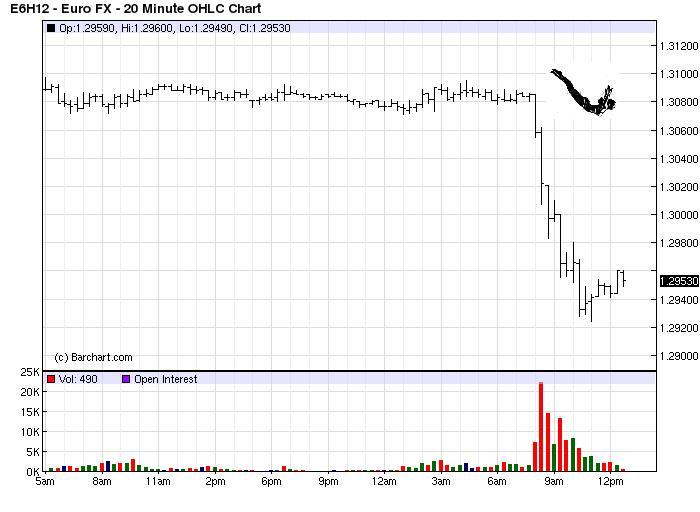
This morning’s swan dive in the euro stopped the Santa rally right in its tracks.

We have two questions:  1)  Has the ECB shot its wad as the lender of last resort providing massive liquidity to the banking system and leaving little ammunition for the distressed sovereigns;  2)  Will money demand remain stable in the eurozone as the monetary base explodes?  That is, will the Germans keep their money in Europe?

As we’ve stated many times on this blog, monetizing debt that nobody wants is much different than quantitative easing in an effort to goose the economy.   Furthermore,  economists have yet to come up with a clear definition of money.    As base money explodes in Europe the overall monetary aggregates can still decline as credit contracts.   This can partially offset any potential down shift in money demand without causing inflation.

This assumes liabilities of the central bank remain in the system as they are in the U.S., in the form of excess bank reserves.   If bond investors sell their bonds to the ECB,  either directly or indirectly, and take their money out,   Super Mario will have a problem.

Many competing economic theories are being tested in real time in the laboratory that has been forced upon the global economy since the bursting of the credit bubble.   See here for an interesting debate on Ricardian Equivalence.   Stay tuned.

(click here if chart is not observable)
Posted in Black Swan Watch, Equities, Euro | Tagged , , , , | 1 Comment

The 2012 Macro Swan of the East

Nothing captures better the angst of the macro swan of the east than a long-term chart of the Shanghai Composite.   Our friends at The Chart Store do a great job charting anything and everything and have not disappointed on this one.

This Shanghai looks hopeless with the October 2008 low seeming to be the magnet as to where the index is moving.  Unless, of course, we see a policy response — i.e., monetary easing — from the government that will send the shorts reaching for the you know you what.  Tough to sell a less than transparent market that is down 31 percent in the past year.

Nevertheless,  China is the blind side swan that could really sack the markets, including commodities,  in 2012, in our opinion.  Keep it on your radar.

(click here if chart is not observable)
Posted in China | Tagged , | 4 Comments

Viva Brasil! Overtakes UK in economic league table

Congrats to one of our favorite countries to work and play!   The land of our favorite dental floss,  beautiful women,  great food,  world class football,  the 2014 World Cup, 2016 Olympics, and, of course, our good friend,  Amenio Fraga!

(click here if video is not observable)

Posted in BRICs | Tagged , , | 2 Comments

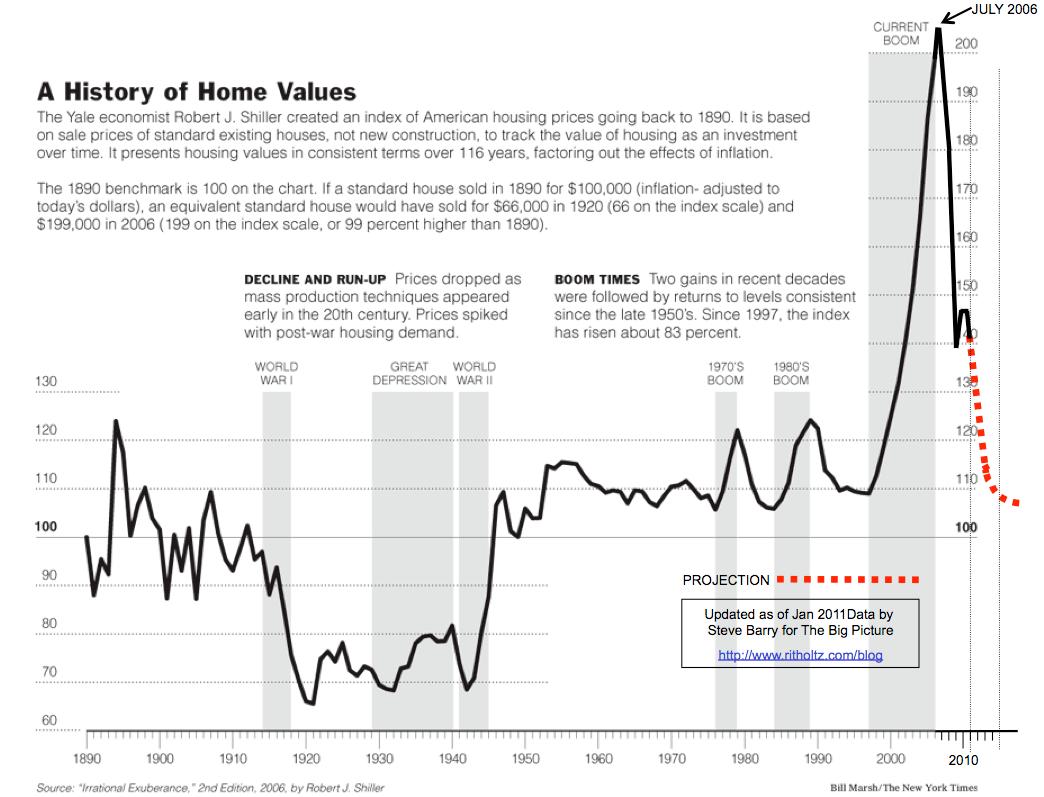
History of Real Housing Prices

Wow!  This chart reprinted by The Atlantic brings flashbacks.

We recall showing the Robert Schiller chart to many of our friends warning of a massive bubble and potential economic collapse.  They wouldn’t hear any of it.  We luckily sold our ocean view house in late 2004/early 2005 and have been a happy renter every since.   Still too much hopium for a rebound in housing prices for a bottom, in our opinion.

The demand for housing is based primarily on the cost of the monthly mortgage payment, but interest rates have no where to go but up over the long term.   What does that say about the secular direction of home prices?   The boom that began in the early 1980’s coincided with interest rates in the high teens.

Maybe the Fed can generate another housing bubble, but the value of housing in a mature market should move with bond prices unless a large dislocation takes place such as the one we’re currently experiencing.

Best to focus on wealth creation by becoming more productive rather than levering up on real estate and hope it moves your way.   In today’s world that means reinventing yourself and becoming an entrepreneur. Much easier said than done, but what choice do most have?

(click here if chart is not observable)

Posted in Housing | Tagged | 3 Comments

Snapshot of the U.S. Labor Market

Some interesting data on the U.S. labor market from the BLS.

The charts illustrate that office and administrative support is the largest occupational group in the United States, totaling 17 percent of employment.  Sales and related occupations were second and made up 11 percent of employment.

Occupational groups with below average wages are more than two thirds of private sector employment versus less than one third of public sector employment.   Education, training, and library  totaled 30 percent of public sector employment, but only 2 percent of private sector employment.

Don’t you think it’s time for some structural adjustment policies to improve the occupational footprint of the U.S. labor market?  Creating bubbles to make secretaries feel rich through manipulating interest rates, the stock market, and easy credit has run its course, which we are now paying a hefty price.    Beating swords into plowshares and training retail clerks to learn and run higher tech manufacturing is a start.  Click on charts to enlarge and for better resolution.

(click here if charts are not observable)

Posted in Charts, Demographics, Employment | Tagged , | Leave a comment

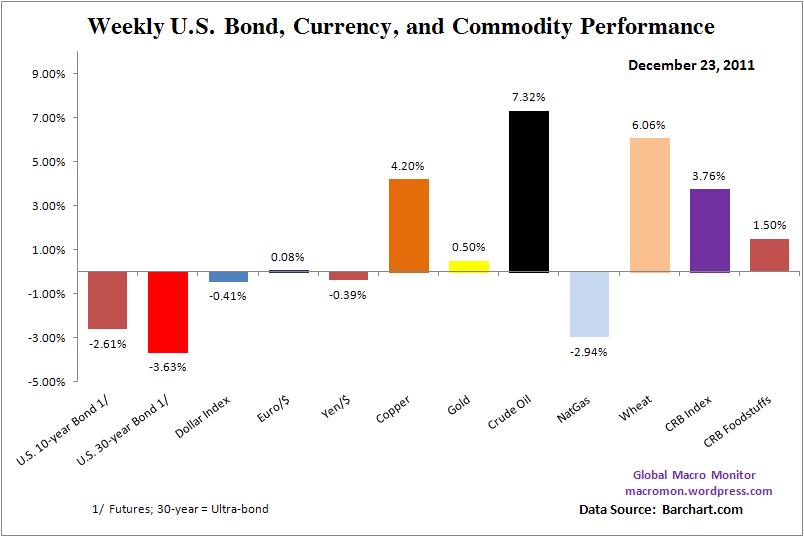
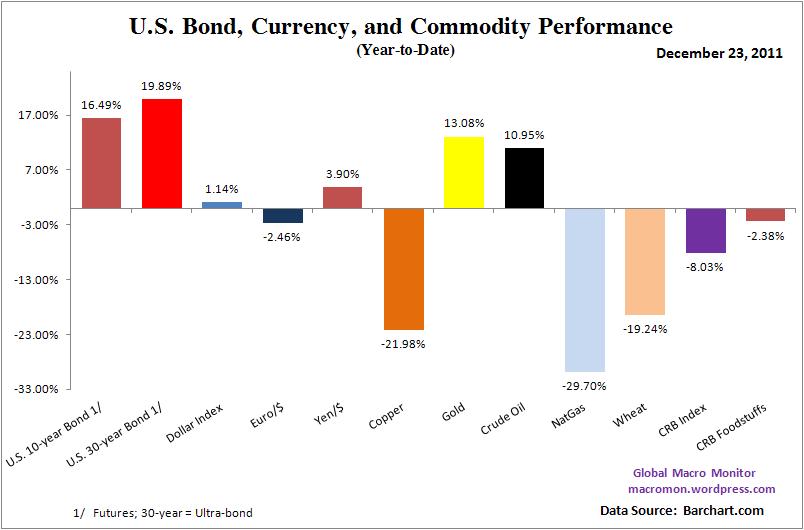
Week in Review: Low Volume Ramp

(click here if charts are not observable)

Posted in Week in Review | Tagged , , , , , | 1 Comment