Merkel: euro crisis can’t be solved overnight

(click here if video is not observable)

Posted in Black Swan Watch, Euro, Sovereign Debt, Sovereign Risk | Tagged , , , | Leave a comment

Global Trend Indicators

(click here if tables are not observable)

Posted in Global Trend Indicators | Tagged , , , , , , , | 1 Comment

Stock Market Melt Up: November 1998 or December 2008?

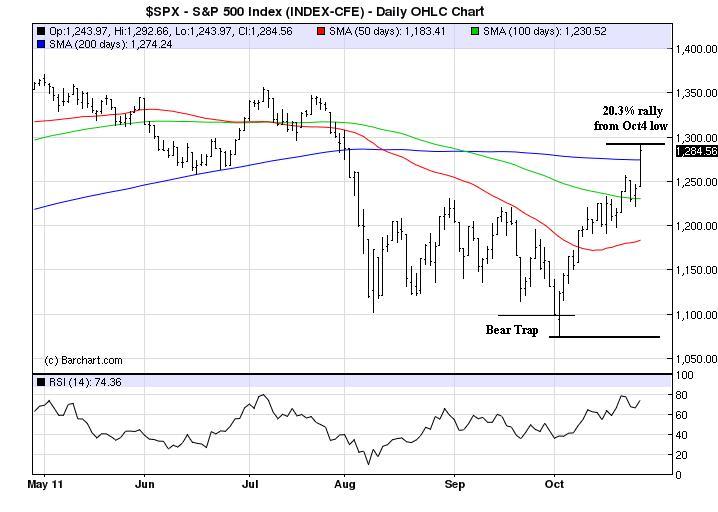
Stunning!  The S&P500 at its high today was up 20.3 percent from the October 4th intraday low of 1074.77. We’re talking the S&P500, not the Brazilian BOVESPA or Hang Seng Index!  This kind of initial move in the S&P500 in just 17 trading days has happened only six times in the past sixty years.

Today’s move blew through the yearly breakeven level of 1257.64 and the 200-day moving average at 1274, which is now a huge technical support level if the market is going to continue to run.

The question is where to for year end?   Is this the November 1998 melt-up after the Russian debt default and failure of Long-Term Capital Management or is it the December 2008 head fake before the March 2009 bottom?   We’re not sure so let’s go to the charts.

The current S&P is in much better shape than in Dec. 2008 as it is now above the 50, 100, and 200-day moving averages.  The slope of the 50-day has turned up and 100 and 200-day moving averages are starting to flatten out.

It’s clear from the 1998 chart that the S&P500 was still in a major uptrend, which can’t be said of today’s market.  Interestingly the 1998 20.7 percent 17-day spike started with a similar nasty bear trap.

We’re hearing of big institutional inflows into high-yield bonds, which augurs well for risk and dividend yielding stocks.  Our sense is we continue higher as the panic for return really gets going into year end.  The 200 and 100-day are now  important support levels.   The market is overbought and should consolidate and the under invested will be buying the dips.

The Euro plan?  Lots of unanswered questions, short on detail, and not a long-term solution, in our opinion.   But Mr. Market is running over those who wait for the perfect solution and just flattening the macro bears.

Remember, John Bull can stand many things, but he can’t stand two zero percent and will trump almost any rational discourse of the fundamentals once he takes control of the market.   Always with a stop, comrades.    Good luck!

(click here if charts are not observable)

Posted in Charts, Equities, Global Stock Performance | Tagged , , | 12 Comments

Greece Private Bondholders to Reduce Claims by 50%

The FT reports,

European leaders reached a deal with Greek debtholders on Thursday morning that would see private investors take a 50 per cent cut in the face value of their bonds, a deep haircut that officials believe will reduce Greek debt levels to 120 per cent of gross domestic product by the end of the decade.

The agreement, made just before 4am after nearly 11 hours of talks at a summit of eurozone leaders, includes a new €130bn bail-out of Greece by the European Union and the International Monetary Fund.

We applaud the deal and don’t think the EU had much of a choice.   But there are risks, the most important, of which, is contagion to other highly indebted eurozone countries.  The new bond options should trade well below 5o percent of current face value as they do now and we really cannot determined the values until more details are released.

The global equity and risk markets seem to like it, or at least pleased with the announcement,  and have bolted like Kentucky Derby thoroughbreds from the starting gate.  Now let’s see how far they can run before being spooked by the potential fallout.   Stay tuned.

                                               (click here if picture is not observable)

Posted in Black Swan Watch, Economics, Equities, Euro | Tagged , | Leave a comment

Protests as Shanghai Property Values Plunge

(click here if video is not observable)

Posted in China, Real Estate | Tagged , , , | 1 Comment

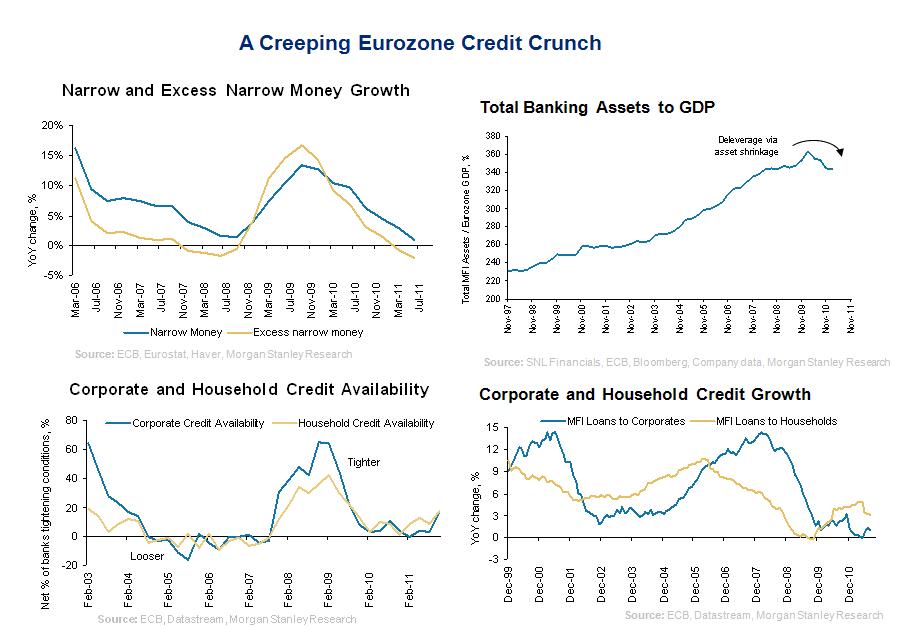
The Creeping and Coming Eurozone Credit Crunch

Here’s a very informative chart via Morgan Stanley showing the deterioration in the Eurozone’s key credit indicators.  Banks will no doubt sell assets, at least in part, as a way to meet their required capital targets.

During the 1997 Asian financial crisis, Japanese banks,  getting killed with a falling Nikkei and their credit extended to Thailand and Indonesia,  found that rolling off interbank lines to Korea the easiest way to shrink their balance sheets.   American and European banks, not wanting to be the last out of Korea,  panicked and followed the Japanese banks thus sucking in another country into the Asian crisis.

The Korean banks having to raise dollar liquidity sold their Brazilian and other emerging market bonds.   Brazilian banks long their sovereign’s bonds that were declining in price had to raise liquidity and sold their Russian assets.   The global margin call was on and  fueled a full blown contagion and ended with the Russian debt default and LTCM crisis.    Let’ hope it doesn’t come to this.  Stay tuned and stay vigilant.

(click here if chart is not observable)

Posted in Black Swan Watch, Credit, Economics, Euro, Sovereign Debt, Sovereign Risk | Tagged , , | 1 Comment

Euros Playing w/ Fire

(click here if video is not observable)
Posted in Black Swan Watch, PIIGS, Sovereign Debt, Sovereign Risk | Tagged , , , | Leave a comment

Gold Breaks Out – Print Away!

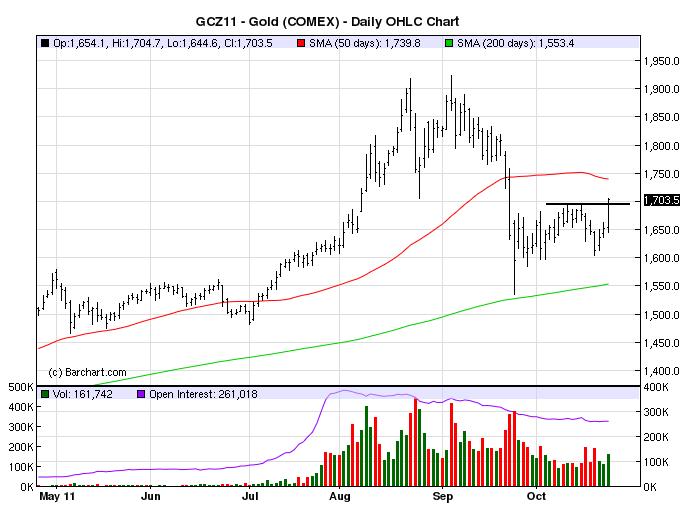
Gold is up big today and trading like the monetary printing presses are ready to kick into overdrive.    We believe the recent Fed speak about QE3, possible BofJ intervention to weaken the yen, and  growing expectations that tomorrow’s announcement by the EU may fall short and force the ECB to monetize bond purchases are contributing to the move.  In addition, given the recent PMI data out of Europe,  the ECB may be forced to ease sooner rather than later and even hearing hints and rumors floating around the ether of China easing.

At the end of the day we don’t know why gold moves the way it does and given its ambiguity of value it is the one commodity most dominated by technicals, in our opinion.   Note how it traded down and held its 200-day just like a textbook on technical analysis says  it should.   The next move should be to fill the Sept 23rd gap down, which also coincides with the 50-day at around $1740 in the December contract or the $169.50-170 level in the GLD.

Always with a stop!

(click here if chart is not observable)

Posted in Commodities, Gold | Tagged , , | 3 Comments

The Pain in Spain – 3.302% 6-month Bills

The NY Times reports,

The Treasury said in Madrid that it had sold bills valued at €3.48 billion, or $4.9 billion, of short-term paper — substantially all of the €3.5 billion it had been targeting. It sold three-month securities priced to yield 2.292 percent on average — well above the 1.692 percent the securities fetched at a similar auction last month.

The bid-to-cover ratio, a measure of demand, rose to 3.07 times for the three-month securities from 2.47 percent in September.

Spain also sold six-month bills at an average yield of 3.302 percent, up from 2.665 percent in September. For the six-month securities, the demand ratio fell to 2.59 from 3.95 in September.

Spanish 10-year bonds were trading to yield 5.52 percent, little changed, Tuesday afternoon.

(click here  if video is not observable)

Posted in Black Swan Watch, PIIGS, Sovereign Debt, Sovereign Risk | Tagged , , | Leave a comment

Ray Dalio’s Must Read FT Opinion Piece

After last week’s  excellent interview with Charlie Rose,  Ray Dalio of Bridgewater,  the world’s largest hedge fund, follows up with a great piece in today’s Financial Times,
“Risk on the rise as political leaders give in to mob rule.”

He begins,

We are in the midst of a deleveraging, we are nearly out of ammunition and we are at each other’s throats. Being in a deleveraging and nearly out of ammunition is a very difficult position to be in. But, being at each other’s throats is our biggest problem.

Nails it.  So true.  Mr. Dalio then issues this warning,

Our character and our political and social systems are now being tested in ways that have typically been tested in past deleveragings. In deleveragings bad economic conditions typically lead to emotional reactions, social and political fragmentation, poor decision-making and increased conflict. When this occurs in democracies, the checks and balance system, which is intended to yield the best decisions for the whole, can stand in the way of thoughtful leadership and lead to ineffective “mob” rule. This dynamic can lead to a self-reinforcing downward spiral.

Frustrations increase, the established ways of doing things come under attack and frustrations over the ineffectiveness of government creates the perceived need for someone to gain control of the mess. Plato spoke of this dynamic. It was the reason Hitler was elected in 1933.

Hitler?  Heavy stuff.   Last week we conveyed our same concerns and fears,

We must admit our fear and squeamishness when we see large emotional groups scapegoating a small minority for all that is wrong with the world.  It’s just a small step to attribute the evils of the “1 percent” to ethnicity, religion, or whatever.  

Mr. Dalio also has a lot to say in the article about the risks to economic policy.

This growing populism will have important implications for monetary, fiscal and trade policies and will significantly increase risks of a markets downturn and a global depression.

Regarding monetary policy, the mob is at the gates of the Federal Reserve and wants to grab control while those on the inside are in disagreement about what should be done. Fed chairman Ben Bernanke and those who helped him save the country from depression are now under siege. These challenges are being faced in different forms by most central banks at the same time as they are nearly out of ammunition – i.e., their capacities to ease are very limited because they cannot stimulate private credit creation and because they cannot get money in the hands of people who will spend it. For these reasons there is greater risk that central banks cannot save us as they have always saved us in the past.

The battle between the left that wants to tax the rich more and the right that wants to cut entitlement spending is at a fierce stalemate that is likely to intensify in more scary ways. As a result, fiscal policy is unlikely to be supportive to economic growth.

Stay tuned.

Posted in Black Swan Watch, Economics, Politics, Whales | Tagged , , | 1 Comment