Wow! Take a listen to this. President Kennedy had trouble understanding monetary policy and most economists are in the same boat. We wonder how many in the OWS crowd can. Long moats in Greenwich.
(click here if video is not observable)
Wow! Take a listen to this. President Kennedy had trouble understanding monetary policy and most economists are in the same boat. We wonder how many in the OWS crowd can. Long moats in Greenwich.
(click here if video is not observable)
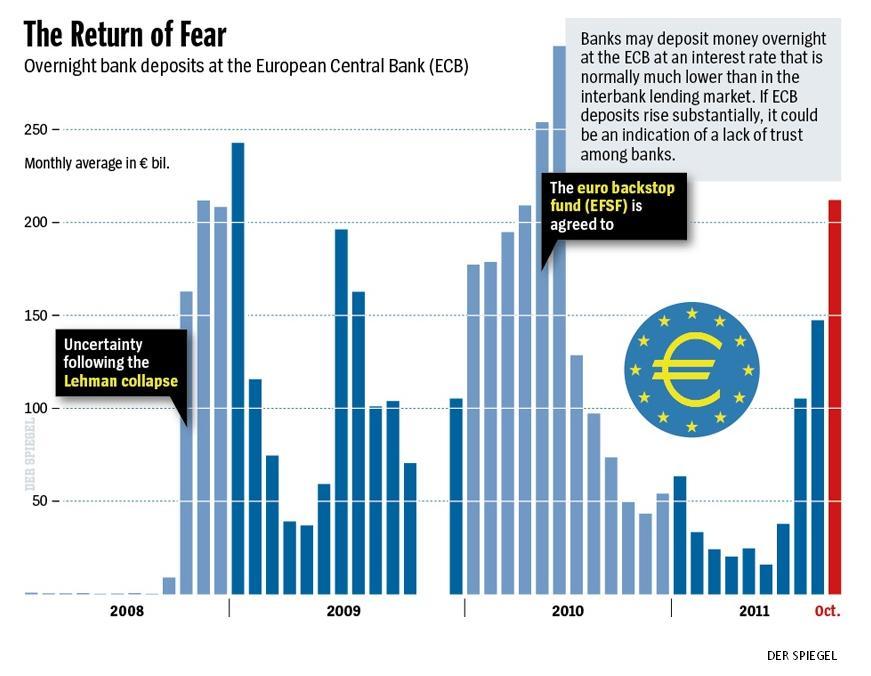
The Wall Street Journal reports Euro-zone banks’ overnight deposits at the ECB increased again last week “reflecting deepening distrust in interbank lending markets.” The Journal writes,
Overnight deposits Friday rose to €255.57 billion ($341.88 billion), surpassing Thursday’s 2011 high of more than €229 billion.
The focus of the sovereign crisis in recent days and weeks has shifted to concerns about the health of the euro zone’s banks, reflected in large part by the poorly functioning funding markets…
Aside from market tensions, overnight deposits tend to rise towards the end of the ECB’s reserve period, which is Tuesday, as banks store excess liquidity in the facility after meeting their own reserve requirements for the month.
The ECB’s all-time overnight deposit high of €384.3 billion was reached in June 2010, driven by uncertainty about the then nascent debt crisis and an abundance of liquidity in the market as banks prepared to repay a 12-month ECB refinancing operation.
 (click here if chart is not observable)
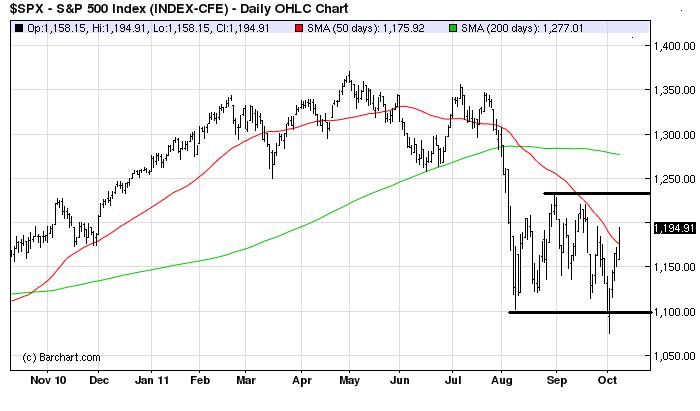
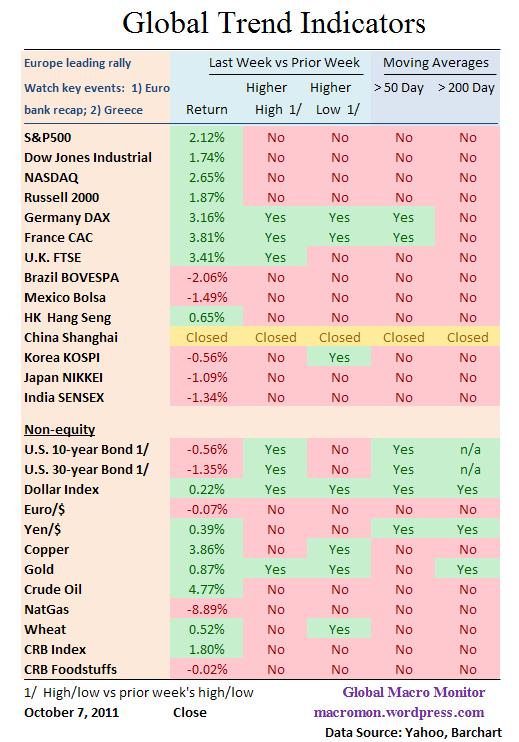
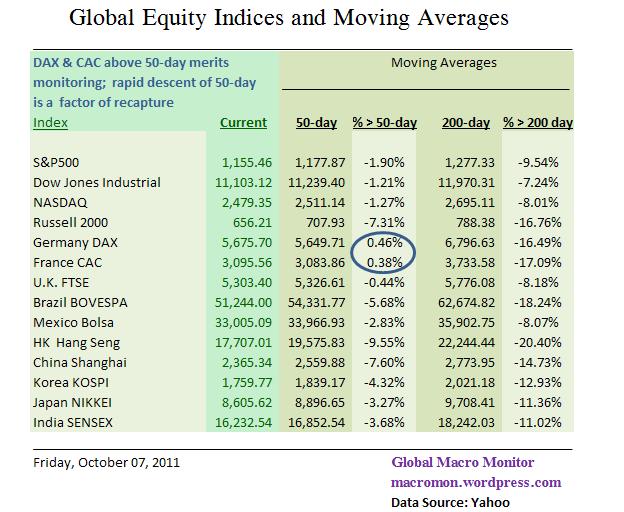
We asked last week if the S&P500 (our proxy for risk markets) was capable of clearing the “red zone”, the zone of resistance between 1175-1195, which included the 50-day moving average. The market’s answer? Like a hot knife through butter!
Interestingly, the S&P500 closed at its high of the day at? 1194.91! Not a sold out crowd today as the volume was super light. Nevertheless, impressive. The bears need to take a goal line stance right here and push back the momentum or the next stop is S&P500 1230, the top of the recent trading range which began with the August collapse.
We have posted several pieces on the three macro bears that have been weighing on equities: 1) Europe’s sovereign debt and banking crisis; 2) The slowing of the U.S. economy and employment problem; and 3) China hard landing concerns. We’re not sure — and have our doubts — all three bears have gone into hibernation for the winter, but they do appear to be, at least, napping.
Today’s intervention to support the banking system by the Chinese government was a big, yet under appreciated, catalyst for the rally, in our opinion. The FT writes,
Central Huijin, the domestic arm of China’s sovereign wealth fund, will purchase shares in Agricultural Bank of China, Bank of China, China Construction Bank and Industrial and Commercial Bank of China, the official Xinhua news agency announced on Monday. Xinhua added that the purchases by Huijin – its first such public intervention since a similar decision at the onset of the financial crisis three years ago – would “support the healthy operations and development of key state-owned financial institutions and stabilise the share prices of state-owned commercial banks”.
The announcement came too late for the Chinese stock market, which had closed at a 30-month low, but had an immediate effect on late trading in Hong Kong. ICBC’s Hong Kong-listed shares, which had been down 3 per cent, rallied to close up 1 per cent.
The U.S. economic data looks to be improving and Europe has a plan to have a plan to recapitalize the banks and fire break the contagion of a Greek default.
We’re always flying blind with China due the country’s lack of transparency, but the equity markets have been hammered over there and should rebound on the intervention news providing more confidence for the global markets. The announcement of intervention came after the market closed but Asian ETFs were up big in New York trading.
The U.S. data, including Friday’s employment number, are not great, but beating to the upside. The key now is for earnings to confirm the U.S. economy is not sliding into recession. Company outlooks are more important in this season than almost any we can recall.
We’re most worried about Europe. There is more time for the markets to continue to hope as the E.U. summit meeting has been postponed to October 23rd to give policymakers more time to hammer out the details. They really need to get this right.
A big commitment by a national government to backstop its banking system could have adverse consequences for the sovereign’s credit rating, which negates the positive contribution of the recapitalization. This destablizing feedback took down Ireland and the worries seem to be the biggest point of disagreement between Merkel and Sarkozy.
The markets aren’t focused on these concerns and want to believe the three bears are hibernating for winter. They want to rebound from the August collapse like a beach ball held underwater. And that they are. Stay tuned.
 (click here if chart is not observable)
(click here if video is not observable)
Here’s something from Digitimes that should be closely monitored:
PCB suppliers see drop in 4Q11 orders
Combined orders placed with Taiwan-based PCB manufacturers for the fourth quarter of 2011 are likely to slip 15% or more sequentially, according to industry sources. Demand across all PC and display applications appears to be slower than in previous years.
Demand for smartphones, the main force behind PCB makers’ sales growth, also turned weak recently, the sources said.
The order slump was anticipated also in part due to fewer-than-expected orders from Apple, the sources indicated. Suppliers to Apple were informed that orders for the fourth quarter have been revised downward because of the sluggish US and Europe economies, the sources revealed.
Compeq Manufacturing, Nan Ya PCB (NPC), Tripod Technology and Unimicron Technology reportedly are among the PCB suppliers for iPhone devices. And Taiwan-based companies pinpointed by industry insiders as suppliers for iPad tablets include Compeq, Gold Circuit Electronics (GCE), NPC and Tripod.
Not good and may have been responsible for part of Apple’s weakness on Friday. Keep it on your radar.



 (click here if charts are not observable)
(click here if video is not observable)
 (click here if tables are not observable)
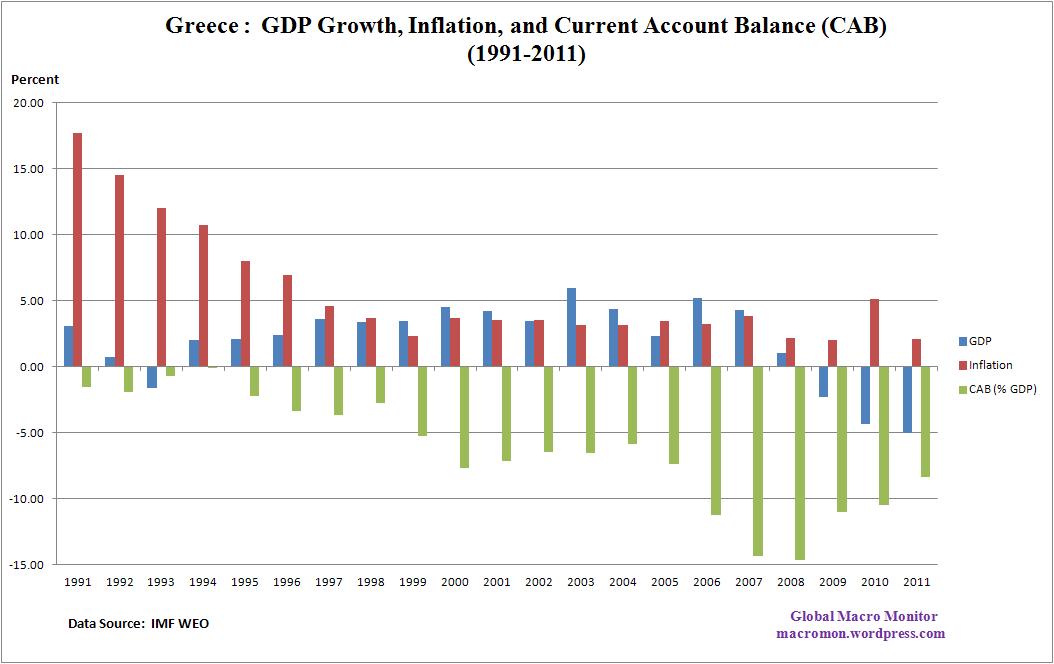
Here is some context to our last post on Greece nominal bond yields. What really matters is real bond yields – nominal rate less inflation. This chart illustrates that though Greek nominal yields were over 20 percent in 1993 when Maastricht was ratified, inflation was running at 12-15 percent, the current account was close to balance, and the country had an autonomous central bank and a national currency.
After the round-tripping, 10-year Greek yields are back to over 20 percent, the country’s inflation is close to zero and will have to move negative for Greece to become competitive — if it stays in the Euro — , the current account has a structural deficit, and Greece effectively has no central bank and has given up its national currency.
Furthermore, Greece 10-years are a reflection of the recovery value of the bond rather than the rate at what the country can borrow long-term euros Always in context, folks.
 (click here if chart is not observable)