-
In economics, things take longer to happen than you think they will, and then they happen faster than you thought they could.
-
Join 1,201 other subscribers
Contribute To GMM
Categories
- 3D Printing
- Agriculture
- AI
- Algos
- Apple
- Automation
- Banking
- BFTP
- Bitcoin
- Black Swan Watch
- Bonds
- Brazil
- Brexit
- BRICs
- Budget Deficit
- Capital Flows
- Cartoon of the Day
- Cashless Society
- Chart of the Day
- Charts
- China
- Clean Tech
- Climate Change
- Coach C
- Commodities
- Coronavirus
- COVID
- Credit
- Crude Oil
- Currency
- Cyprus
- Daily Risk Monitor
- Day In History
- Debt
- Demographics
- Disinflaton
- Dollar
- Earnings
- ECB
- Economics
- Economist
- Egypt
- Electric Vehicles
- Emerging Markets
- Employment
- Energy
- Environment
- Equities
- Equity
- Euro
- Eurozone Sovereign Spreads
- Exchange Rates
- Fed
- Finance and the Good Society
- FinTech
- Fiscal Cliff Monitor
- Fiscal Policy
- Food Prices
- France
- Futurist
- Game Theory
- General Interest
- Geopolitical
- Geopolitics
- German Bund
- Germany
- Global Macro Watch
- Global Reset
- Global Risk Monitor
- Global Stock Performance
- Global Trend Indicators
- Gold
- Greece
- Healthcare
- Heat Map
- Hedge Funds
- Housing
- Human Interest
- Immigration
- Impeachment
- India
- Inequality
- Inflation/Deflation
- Infographics
- Innovation
- Institutional Investors
- Interest Rate Monitor
- Interest Rates
- Interviews
- Italian Yields
- Italy
- Japan
- Jobs
- Lectures
- Macro Notes from Conference Calls
- Manufacturing
- Masters
- Mexico
- Monetary Policy
- Movies
- Muni Bonds
- Muni Market
- Natural Gas
- News
- Nonlinear Thinking
- North Korea
- Overbought Markets
- Picture of the Day
- PIIGS
- PMIs
- Policy
- Politics
- Population
- Populism
- Poverty
- President Trump
- Qunat Strategies
- Quote of the Day
- Quotes
- Rare Earth Elements
- Readership
- Reads
- Real Estate
- Relative Strength Index
- Robert Shiller
- RSIs
- S&P500
- Sector ETF Peformance
- Semiconductor prices
- Semiconductors
- Social Media
- Socialism
- Song for the Week
- Sovereign Debt
- Sovereign Risk
- Spain
- Sports
- State and Local Government
- Tail Risk
- Technical Analysis
- Technology
- The Big Reset
- The Weekend Read
- This Day In Financial History
- Trade War
- Trades
- Tweet of the Day
- Ugly Chart Contest
- Uncategorized
- US Releases
- Video
- Volatility
- Wages
- Week Ahead
- Week in Review
- Weekend Reads
- Weekly Eurozone Watch
- Whales
-
Recent Posts
Meta
Nonlinear thinking: Going Gaga Over Transformative Tech
One of the great problems of asset bubbles is not only the creation of too much capacity, but the misallocation of resources. Our good friend and market guru extraordinaire, Barry Ritholtz, wrote of one such case back in 2005, during the height of the housing bubble,
Gary sent in these very interesting comments:
Geez, just as the dot.com distorted the allocation of capital and resources (i.e., too much broadband, not enough energy infrastructure), so too is the housing bubble!
What is he referring to? He was pointing to this article in the Washington Post:
“It feels as if Playboy’s Playmate of the Month for May is speaking for the entire country.
Fort Lauderdale native Jamie Westenhiser, 23, told the magazine recently that she is ditching her modeling career to take up real estate investing.
In the magazine’s May issue, Westenhiser poses in her lacy lavender baby doll, wearing nothing else except furry boots, leaning on a computer desk next to a stack of books with titles including “All About Escrow” and “Real Estate Principles.” In her “playmate data sheet,” she writes that her ambition in life is to have a “successful career in real estate.”
That’s correct, a potentially lucrative career as a model is being tossed aside for real estate investing. Gary calls that a misallocation of resources.
And apparently, you don’t need to be a scantily clad purty young thing to do it.
Misallocation of resources, indeed!
What makes us more optimistic about the economy we’re rebuilding today as opposed to the bubble economy of 2005 is reflected in the following video. If Lady Gaga is allocating her resources in advancing transformative tech, there is hope! And we do hope this is the Lady Gaga our children emulate and use as a role model as opposed to the Lady Gaga of the stage!
We’re not certain how transformative her sunglasses that take pictures and video will be, but we’re sure the folks in Langley will find them interesting. The Economist writes,
Gaga’s goggles. Another set of spectacles that caught Babbage’s attention were worn by Lady Gaga, who showed up at the show to promote a new line of products that she helped design for Polaroid. The picture-taking sunglasses that the pop star modelled capture and display external images on the inside of the lenses. The data for the pictures are transferred to a USB earpiece and can be sent to a printer via a Bluetooth link. So long as one doesn’t mind walking round looking pretty ridiculous—clearly not a problem for Lady G—then these giant wraparound shades are for you.
Commodities are so last year’s trade and just too Malthusian. In fact, some commodities are reaching “tipping point” prices, which will be disruptive to the economy and to society. We suspect regulators and policymakers will soon get more aggressive and start their “whack a mole” games with speculators. Expect the trend for higher margins, position limits, and tougher regulation on specs to continue.
Transformative tech is where were placing our bet and is the hope and future of our children. We’re on the elbow of the exponential tech curve and these disruptive technologies are going blow our mind and force real adjustments in the economy and labor market, probably even more so than the internet. Stay tuned.
Posted in Apple, Black Swan Watch, Demographics, Employment, Equities, Technology, Video
Tagged CES, Commodities, Lady Gagam, Transformative Technology
Leave a comment
“Tea Party” Opposition to the Euro Grows in Germany
We can’t believe we missed this over the holidays. Germany’s SpiegelOnline reported on December 27,
In a survey conducted in early December by the polling firm Infratest dimap, 57 percent of respondents agreed with the statement that Germany would have been better off keeping the mark than introducing the euro… Germans, it seems, are gripped once again by their historic fear of inflation: According to the Forschungsgruppe Wahlen polling institute, 82 percent of the population is worried about the stability of their currency.
The article opens,
Surveys show that many Germans are worried about the future of the euro, but the country’s political parties are not taking their fears seriously. The number of grassroots initiatives against the common currency is increasing, and political observers say a Tea Party-style anti-euro movement could do well…
As a playwright, Rolf Hochhuth knows how to use timing to achieve the greatest possible impact…Now Hochhuth is campaigning against the euro — and his stage is Germany’s Constitutional Court. “Why should we help rescue the Greeks from their sham bankruptcy?” he asks. “Ever since Odysseus, the world has known that the Greeks are the biggest rascals of all time. How is it even possible — unless it was premeditated — for this highly popular tourist destination to go bankrupt?”
Doesn’t this sound a lot like the political economy and rhetoric in the United States? We posted on Friday how the new House Budget Chairman, Paul Ryan, opposes bailing out states that are in fiscal trouble. Bloomberg reported on Friday,
We are not interested in a bailout,” the Republican from Wisconsin said yesterday in Washington. Ryan said some states are “already telling us” that, when asked how he would respond if he was told one was in danger of defaulting…
Should taxpayers in frugal states be bailing out taxpayers in profligate states?” Ryan asked during a forum near the Capitol. “Should taxpayers in Indiana, who have paid their bills on time, who have done their job fiscally, be bailing out Californians, who haven’t? No, that’s a moral hazard we are not interested in creating.
If you don’t understand the realpolik of the European sovereign debt crisis go no further than Washington. We emphasize that most American states don’t face crushing debt burdens but suffer large cash flow problems and a lack of political will and/or political structure to reduce their deficits. The politics of deficits and debt is the same around the world, however.
As with the U.S. government, the European bureaucrats similarly must have a credible plan that addresses long-term structural issues, must be decisive, and move quickly. We believe 2011 is the make or break year for the Euro as we know it.
This article, at least, to us, illustrates the Eurozone body politic is getting very restless. Politics can sometimes be almost as volatile, unpredictable, and, at times, unstable as markets. Brussels not only risks losing the markets it is now at risk of losing popular support across a wide political and economic spectrum. The general election in Ireland will be a huge political test for Euro sustainability.
SpeigelOnline reports that even Patrick Adenauer, the grandson of the postwar Germany’s first chancellor, Konrad Adenauer, is critical of the Euro,
Adenauer feels that people are avoiding the issue. “The days of the euro as a single currency for countries from Ireland to Greece are numbered, if no debt refinancing with creditor liability is pushed through now,” says Adenauer, who is the head of a German association of family-owned companies. “I’m amazed that political parties and large industry associations are not openly saying this.” Adenauer is sure that his grandfather would also see things this way. “He would look into the question of whether the common currency is really necessary for everyone in this situation, or whether the pressure to adapt will end up being too big and the EU will suddenly find itself politically damaged.”
We also find Hans-Olaf Henkel, former head of Germany’s leading employers’ association, the Federation of German Industries (BDI), ideas on the ultimate outcome similar to Dennis Gartman’s North/South Euro. Der Speigal writes,
Henkel has a mission: He wants to divide the euro. All of the “olive countries” — as Henkel dubs the Greeks, the Italians and the French — should pay in southern euros in the future, he says. The north — in other words, primarily Germany — would pay with the northern euro.
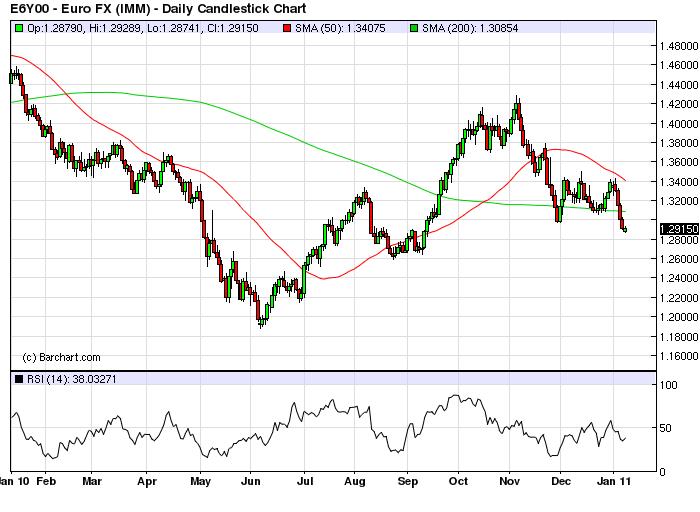
The $/Euro is now at risk of breaking key technical support and the shoulder line of a six-month head and shoulders pattern at 1.26, which, if broken, could take it down to 1.18, its birth rate and long-term support level. Stay tuned.
Posted in Black Swan Watch, Bonds, Economics, Euro, Fiscal Policy, Geopolitical, Monetary Policy
Tagged Euro, European Sovereign Debt Crisis
1 Comment
S&P500 and Years That End In ‘1
“Nowhere does history indulge in repetitions so often or so uniformly as in Wall Street.” — Edwin Lefèvre, Reminiscences Of A Stock Operator
Years That End ‘1 Exhibit Strong Seasonality
The above was cited in an article in this month’s Technical Analysis of Stocks and Commodities titled Chart Analog Scenarios. Check it out, it’s a good read.
We also like to look at chart analogs. Recall the markets obsession with Doug Short’s Mega-Bear Quartet (see below) during the downtrend. Everyone and their mother thought we were tracking the 1930’s almost tick-for-tick. Paul Tudor Jones made a killing trading the 1987 stock market crash with 1929 analog, so money can be made and they can’t be dismissed so casually.
The Presidential Stock Cycle is pretty powerful analog, especially the third year of the first Presidential term, which we have analyzed in an earlier post. Click here to view the post.
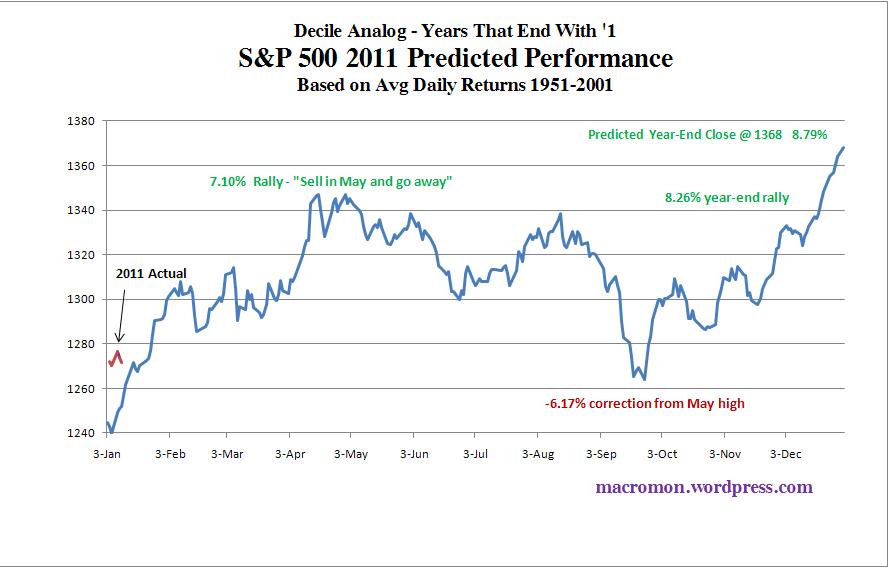
Traders and investors like to look at all kinds of analogs. We’ve looked at a decile analog, the S&P500’s performance in years that end in ‘1, from 1951 to 2001. The table shows the index has returned and annual average of 8.97 percent from 1951 to 2001, with four up years and two down years. The average distorts the individual year returns as the market has been either up double digits, or down close to double digits. In two of the up years, the S&P returned over 20 percent.
The S&P500 predicted performance chart, which is an extrapolation of average daily returns is interesting as it reflects all the traditional seasonality trends: 1) a January to May rally of 7.10 percent; 2) a “sell in May and go away” 6.17 percent, which bottoms in late September; and 3) a Q4 year-end rally of 8.26 percent.
Of course, the S&P500 won’t play out 2011 tick-for-tick as the chart predicts. Furthermore, the chart is not a true analog as it averages daily returns for the six years.
It does illustrate, however, years that end in ‘1 exhibit strong traditional seasonality. This year may be different, nobody knows. We do place stronger — but not full — confidence in the Presidential Stock Cycle analog as there is not only more observations, but at least some fundamental explanation of its significant stock market outperformance.
The Graying of Calfornia’s Flower Children
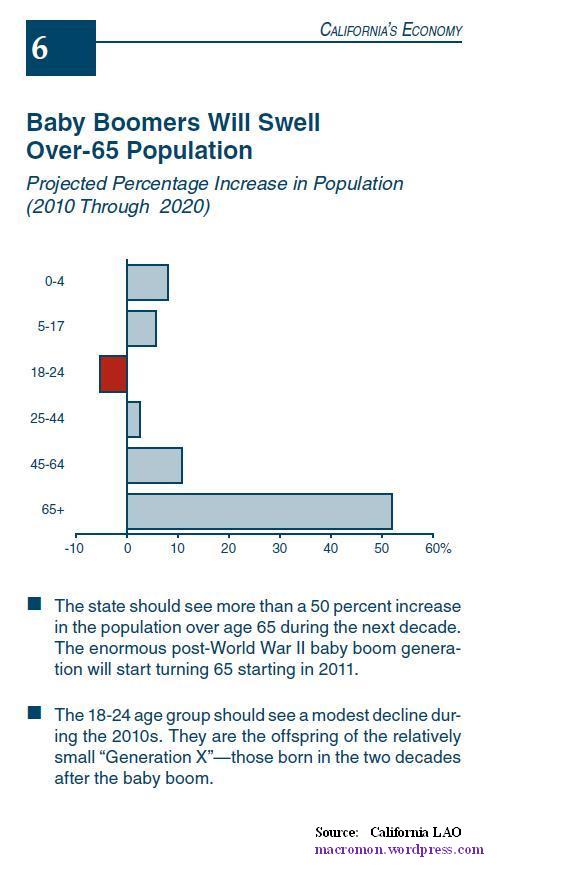
Well this is a depressing chart and remember California usually leads the nation. We fear us baby boomers risk eating all the “seed corn” and leaving nothing for the younger generations to invest in their future, which the quality of our retirement ultimately depends.
We’ve urged our fellow boomers, who can afford it, to play Top Flite instead of Titlest and leave something for the children, otherwise, we risk generational warfare.
Posted in Bonds, Budget Deficit, Demographics, Muni Market, Policy, Politics
Tagged Aging Baby Boomers, California Demographics
Leave a comment
Godspeed, Congresswoman Giffords
The Global Macro Monitor prayers go out for your full recovery and for the families of those who suffered such a great loss in today’s tragic and senseless event.
We also hope and pray this tragedy will not be lost and used to bring the nation and world together and to realize that by only working together — not withstanding our vast political, economic, religious and cultural differences — will we make a better world for our children.
Nobody has been better than Minyanville’s Todd Harrison, and a must read, at predicting and observing the rise of the societal angst in the nation and world,
While societal acrimony will persist and people will continue to point fingers, we’ll likely see an “inside-out” spiritual recovery on a much broader basis, and those who ‘see the light’ will be much better for it. A return to basic truths, including the joy of family, friends, pets, and the simple pleasures in life will serve as the “other side” of the “Civil War” mentality that is making its way through the mainstream.
The Congresswoman seems to really understand the concept of “burden sharing,” which is our only hope from emerging from the current crisis, and what America’s real national security threat truly is. Click video.
Related Articles
Arizona Congresswoman Gabrielle Giffords wounded in shooting – azcentral.com Rep. Gabrielle Giffords shot in Tucson rampage; federal judge killed – Washington Post
In Attack’s Wake, Political Repercussions – NY Times
The [First] Week in Review: A Capital Flows Sandwich?
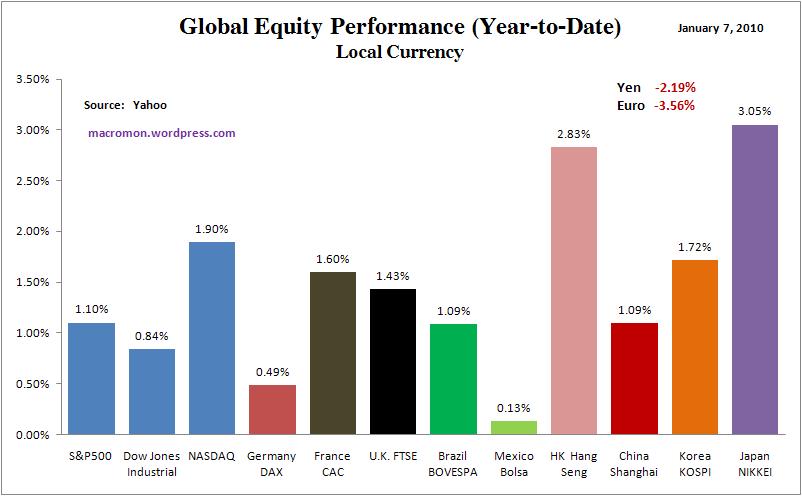
Not a bad start to the year if you were in the right space. A Frenchman with a long position in “Apple the Sovereign” was up over 8 percent in Euros. Note, Apple rose another $2.00 to $338 after Friday’s close on the Verizon deal announcement. Mrs. Watanabe, long “nattie” in the U.S., was up over 7 percent in yen. On the other hand, Joe the MOTU with a convoluted long gold in euro trade got clocked for over 7 percent this week.
The first week confirmed our view the dollar and U.S. transformative tech are the place to be in 2011. Though the nonfarm payroll report disappointed, the trend is in the right direction, one month’s data point is noise, and we feel strongly the markets are signaling a better than expected jobs recovery in 2011. Economists and bureaucratic data look backward, markets look forward.
We really can’t get a handle on and are a little nervous about China’s tightening and its implications for commodities and emerging equities so we have little exposure in those markets for now. We also fear “regulatory risk” as there will be little patience for speculators if commodities continue to rise in 2011. Gold is a relatively benign store of value, wheat and crude are not. Food riots are just beginning to breakout.
The risk and uncertainty from the East – China tightening — coupled with those from the West — Europe’s sovereign debt crisis — could create a “Capital Flows Sandwich”, where the U.S. is in the middle and receiving end of money flowing back into its market at the beginning of 2011.
We don’t like bonds, the euro, or the yen. The Hang Seng is signaling risk will be rewarded, however, and as a friend, and well known market veteran, told us today over lunch, “rigged markets always go up.”
Next week California’s new governor announces a budget plan and the fireworks really begin in Europe as some of the PIIGs start the refinancing of the periphery’s Euro 450 BN plus bonds which mature this year. The Euro is close to breaking support of a head and shoulders pattern, which could take it down to its birth rate and long-term support of $1.19-1.20. We suspect the “powers that be” will make the auctions a “success.” Watch how the European banks perform next week as a gauge to what the markets really think. Stay flexible, humble, thankful, and always afraid of losing capital, and stay tuned!
Posted in Apple, Bonds, Charts, China, Commodities, Currency, Economics, PIIGS, Sovereign Debt, Sovereign Risk
Tagged China tightening, dollar, Equites, Euro, European Debt Crisis, Stocks, Week in Review, Yen
Leave a comment
House Budget Chief Ryan Channels His “Inner” Angela Merkel
Bloomberg is reporting Angel Merkel Rep. Paul Ryan, Republican “Young Gun”and new House Budget Committee chairman, says he and his party won’t bailout states who are facing potential defaults. Just after the November election we posted this was coming.
Listen to Ryan and you can fully understand and appreciate German Chancellor Angela Merkel’s tough position on Europe’s sovereign debt crisis. Bloomberg writes,
“We are not interested in a bailout,” the Republican from Wisconsin said yesterday in Washington. Ryan said some states are “already telling us” that, when asked how he would respond if he was told one was in danger of defaulting.
U.S. states face a combined $140 billion in deficits in the next fiscal year, the Washington-based Center on Budget and Policy Priorities said Dec. 16. State tax collections remain below pre-recession levels, according to the Nelson A. Rockefeller Institute of Government in Albany, New York. No state has defaulted on its debt since Arkansas did in 1933.
“Should taxpayers in frugal states be bailing out taxpayers in profligate states?” Ryan asked during a forum near the Capitol. “Should taxpayers in Indiana, who have paid their bills on time, who have done their job fiscally, be bailing out Californians, who haven’t? No, that’s a moral hazard we are not interested in creating.”
Unlike some of the PIIGS, most American states, though rollover risk is increasing, do not have crushing debt burdens, but do have large cash flow problems, i.e., budget deficits, that need to be financed by borrowing from an increasingly unreceptive market.
State and local politicians — in all parties, from those left of the salad fork to those so far right, also left of the salad fork — have failed to address their massive revenue deflation, some, of which, is cyclical and some structural.
Never underestimate the possibility of a movement to rise up in California demanding the state leave the Euro Dollar and create its own Central Bank! In fact, local currency movements — which are just a step above bartering — are big in California. They always seem to fail because they get the exchange rate wrong. For example, one unit of local currency can buy an hour of gardening services or a visit to the local doctor. Nice arbitrage, no?
Related Artices
Senate Budget Panel Working on Plan to Help States; Bernanke Does Not See States Defaulting on Muni Debt – Bond Buyer
Chaffetz Looks to Fire Warning Shot On Pension Fund Bailout – KCPW
Bond investors rattled by Illinois’ budget woes – Breaking Business
2011 Risk: China Watch
Getting China right in 2011 will make or break the P&L this year. The direction of the China’s economy will determine the direction of many markets, including commodities and emerging equities.
We’re still trying to get a handle on the economy, which grew its money supply by over 30 percent and is now in tightening mode. This article from Dow Jones doesn’t help us very much,
China’s monetary policy has been in focus in recent weeks after a surprise interest-rate hike by policymakers over the Christmas holiday. But concerns linger about the People’s Bank of China’s capacity to get ahead of rising price pressures, in part because high levels of poorly disclosed internal debt make it harder for Beijing policymakers to raise rates too much.
In China “the largest debtors and the largest borrowers in the banking system are state-owned entities and local government investment corporations,” says Northwestern University, professor Victor Shih. “Obviously the government doesn’t want to raise interest rates on itself.”…
Many experts aren’t expecting any immediate blow-up in the financial system. But they say that if monetary policy isn’t tightened sufficiently enough to hold down inflation, households and their consumption will come under pressure. High inflation tends to reduce the buying power of consumers, as well as the value of their savings. That, in turn, hurts economic growth.
Something doesn’t smell right to us and it looks like Chinese policymakers are in difficult spot. Our bias is increasing that their monetary policy dilemma, coupled with the country’s lack of transparency, is not fully priced into the commodity markets and certain emerging equity markets.
Posted in BRICs, China, Economics, Monetary Policy, Sovereign Debt, Sovereign Risk
Tagged BRIC, China, Monetary Policy
4 Comments
California [Bad] Dreamin’
Posted in Employment, Muni Bonds, Muni Market
Tagged California Employment, Construction
Leave a comment