Nonlinear Thinking: The Coming iApp Economic Revolution

2011 – The Year of the App

This is freaking amazing!  It’s our sense that in five years Apple may well have reinvented itself into a mobile medical company, where an iPhone/iPad-type device becomes a medical clinic in, say,  a rural village in Africa.   Remember folks, we are at the elbow of the exponential tech curve.  Huge venture money is pouring into App development and what’s coming is going to blow our mind, in our opinion!

Imagine how this could lower medical costs as baby boomers age.  All the Malthusian doom and gloom will prove about as right as the original Malthus.    This is an example of the innovation that help America and the world emerge from the current economic malaise and could even risk sparking  another dot.com like tech bubble.  The stage is set.

An economy based on creating and consuming housing wealth is so passe.  We believe 2011 will be the “The Year of Cat App.”

Related Articles
Latest iPhone app: Baby EKG – IBJ
Lifetone iPhone ECG Monitoring App iPhonECG (video) – Geeky Gadgets

H

Posted in Apple, Economics, Equities, Video | Tagged , , | 3 Comments

Quote of the Day

LBJ has a treasure and given our economics background,  this is one of his best,

Making a speech on economics is a lot like pissing down your leg. It seems hot to you, but it never does to anyone else.

We often feel the same about our blog posts! 

Posted in Economics, Quote of the Day, Quotes | Tagged , | 2 Comments

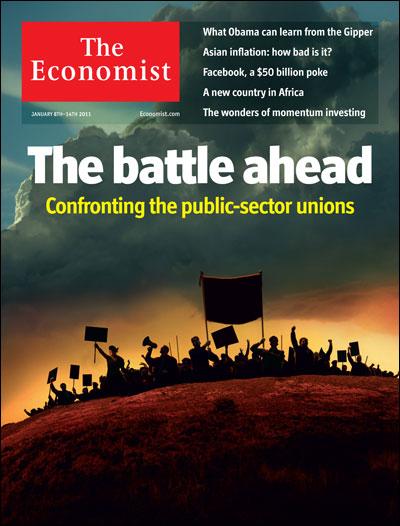
State and Local Governments, Man Your Battle Stations!

Take a look at the new cover of the Economist. We have been all over the coming “battle royal” between the state and local governments and their public sector unions, but not as much as Mike Shedlock over at the Global Economic Trend Analysis blog.    We love teachers, fighter fighters, policemen, and all productive public servants, but think they are being led over the cliff by their unions.

You should hear the conversations in our golf foursomes.  On one side, our plumber and contractor buddies, who’ve seen their 401Ks go to 201Ks and back 301Ks.  On the other, retired at 55 public sector buddies, who are living on annual pensions equivalent to 80-90 percent of the salary of their last year worked.  We’re not making this up and it gets nasty as the debate is always ends up about fairness.   In the end, it’s really a contrast between defined contribution pensions versus defined benefit pensions.

The November election results were not just about another hard learned lesson by Democrats and reality check that the majority of the country lives, not on the Michael Moore left, but in the political center, but it was also about anger.   Anger from those who feel that they do the right thing, work hard, pay their taxes,  pay their mortgage, and accept the consequences of their actions and fume while they watch others receive preferential treatment by their government for doing the wrong thing.

Whether it’s Wall Street bailouts or seeing their neighbors continue to live, in some cases, for  years in their homes without making a mortgage payment, while they continue to pay in full and receive the cold shoulder when trying to modify their own underwater mortgages.   It is our bet “burden sharing” will become a big part of 2011 political lexicon.

The Economist writes,

LOOK around the world and the forces are massing. On one side are Californian prison guards, British policemen, French railworkers, Greek civil servants, and teachers just about everywhere. On the other stand the cash-strapped governments of the rich world. Even the mere mention of cuts has brought public-sector workers onto the streets across Europe. When those plans are put into action, expect much worse.

“Industrial relations” are back at the heart of politics—not as an old-fashioned clash between capital and labour, fought out so brutally in the Thatcherite 1980s, but as one between taxpayers and what William Cobbett, one of the great British liberals, used to refer to as “tax eaters”. People in the private sector are only just beginning to understand how much of a banquet public-sector unions have been having at everybody else’s expense (see article). In many rich countries wages are on average higher in the state sector, pensions hugely better and jobs far more secure. Even if many individual state workers do magnificent jobs, their unions have blocked reform at every turn. In both America and Europe it is almost as hard to reward an outstanding teacher as it is to sack a useless one.

Governor Brown just appointed a California Teachers Association union lobbyist to the Board of Education, in a state where education consumes over 50 percent of the general fund (see chart below).  This could be, and we sure hope it is, a very shrewd political move.   President Lyndon Johnson said it best when reappointing someone who may have been more damaging outside his administration,   It’s probably better to have him inside the tent pissing out, than outside the tent pissing in.


Posted in Black Swan Watch, Bonds, Budget Deficit, Muni Bonds, Muni Market, Sovereign Risk | Tagged , , , | 1 Comment

Direction of Crude Oil? Watch the Trannies…

This is a great piece and chart by Rigzone sent to us by Dougie, one of the smartest energy hedge fund energy traders out there.  You should know by now that canaries are our favorite bird, with the Hang Seng index our ultimate “canary in the coal mine” for global risk appetite.

Rigzone looks at the Dow Jones Transportation Index as a leading indicator for the downside direction of crude.  Makes total sense.  The transportation sector consumes over 70 percent of U.S.  petroleum production and imports (see this chart).   And there is a “tipping point” price which really starts to weigh on the economy and push it over the edge.  Nobody knows or sees that price — or the equilibrium crude price, for that matter —  and it is no better illustrated by the debate currently taking place among OPEC members.

We suggest you link to Rigzone and read the whole piece.  Here are the money quotes,

In past cycles a drop in the transports has signaled the end of a rally for crude. After rallying approximately 25% in 2010, the Dow Jones Transportation Average has entered territory not seen since 2008. Should this Monday’s 52-week high of 5219.8 turn out to be an inflection point for the index, then any meaningful reversal of course could again signal lower prices in crude…

Over the last two cycles, a retreat in transport prices has been followed by a significant decline in spot WTI prices. In July 2006, the transports signaled the end of the rally nearly one month ahead of a correction in crude prices. Subsequent to faltering transports, crude oil prices fell 20%+ over the following three months. A similar occurrence took place during the summer of 2008 with transportation stocks peaking in early June and crude finding its peak in early July. Then WTI crude prices fell 30% over the following three months and proceeded to bottom out 79% below the peak, before the calendar year had even ended…

We suggest keeping a close eye on the transports as the proverbial “canary in the coal mine” in preparation of rotating out of the energy sector ahead of what historically has signaled grief for the industry.


Posted in Commodities, Crude Oil | Tagged , , | 1 Comment

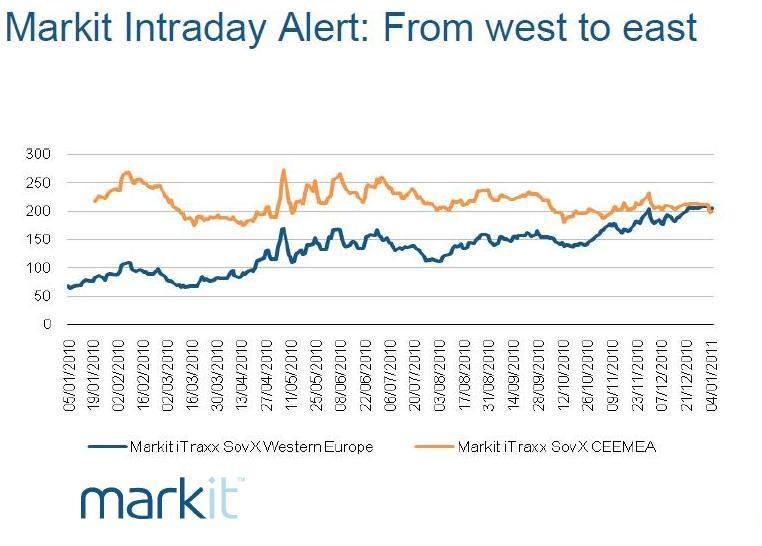
It’s Official! Western Europe Now An Emerging Market

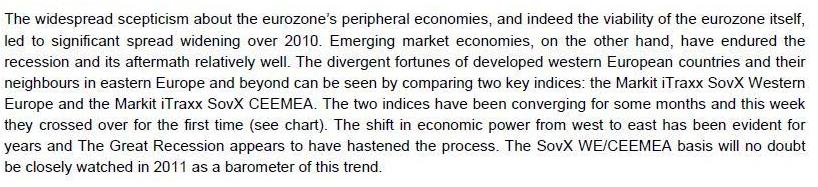
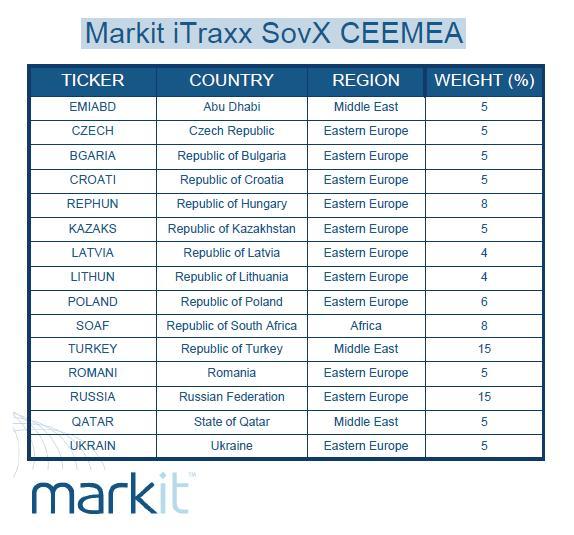
The Markit SovX CEEMEA CDS index has traded through the SovX Western Europe CDS index for the first time.   Just a little over a decade ago, some of these countries in the CEEMEA were either: 1)  in hyperinflation; 2)  in default on local and/or external debt;  3)  in a depression;  or 4) all of the above.  Some got lucky with a massive improvement in their terms of trade.  Nevertheless,  their recovery gives hope for the highly indebted Western economies.

The West’s journey to recovery will be similarly painful.   And, will no doubt require the same trip to the barbershop for some of the countries’ creditors,  where “haircuts” will be – as it was for the emergings – a necessary condition for recovery.   The sooner the politicos have their “epiphany” and recognize this reality, the better for everyone, including for those who will eventually sit in the barber seat.   If they act quickly, they can avoid some of the same painful economic consequences the crushing debt burden inflicted on the formerly highly indebted emerging countries.

Markit writes of the historic credit default swap (CDS) crossover,

Posted in Black Swan Watch, Bonds, Euro, Fiscal Policy, Sovereign Debt, Sovereign Risk | Tagged , , | 1 Comment

POMO: Fed Buys $1.5 BN of 17 to 30-year Bonds

Posted in Bonds, Monetary Policy | Tagged , , , | Leave a comment

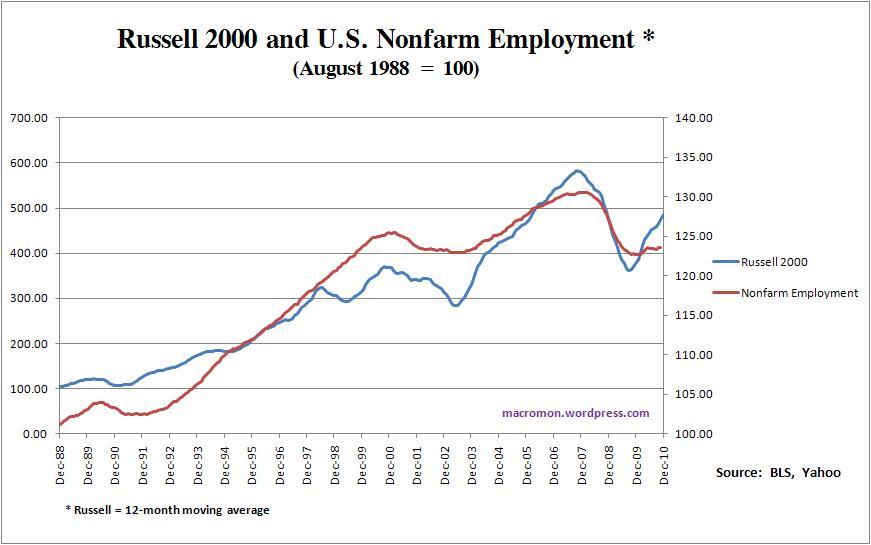
Did the Russell 2000 predict the better than expected ADP?

Did you notice the better than expected ADP employment report this morning.  It was the largest monthly jump ever in this report, with most of the jobs created in small and medium sized businesses?

Recall we wrote on January 3rd the 25 percent increase in the Russell 2000 was signaling a better than expected 2011 jobs market, which we based, in part, on the remarkable below chart of the Russell 2000 and nonfarm employment.

MarketWatch writes,

Private-sector employment gained 297,000 in December, according to Automatic Data Processing Inc.’s employment report released Wednesday. Employment in the service-producing sector rose 270,000, the largest monthly increase on record.

The downside to employment is the “depression economics”  of state and local governments, who are having difficulty negotiating wage and benefit flexibility with their public sector unions in order to save jobs, and where layoffs loom wide and large.

A stronger than expected jobs recovery has big implications for equities, bonds, commodities, and the dollar.    We highly recommend you read our full piece.  Click here.

Related Articles
Russell 2000 Doubling S&P 500 as Economy Drives Rally – Bloomberg
Betting on a Jobs Recovery, Christie, and Brown

Posted in Budget Deficit, Currency, Employment, Fiscal Policy, Muni Bonds, News, Policy, Politics | Tagged , , , , | 2 Comments

Risk 2011: Fate of Commodities in China’s Hands

We begin our analysis with a little perspective on how we view the crisis.   The pre-crisis global aggregate demand was primarily driven by an over leveraged U.S. consumer, who was spending “fake wealth” created by a housing bubble financed by credit expansion.  This was fueled by three years of negative real short-term interest rates in the U.S. and massive accumulation of foreign exchange reserves by global central banks.

China and other countries expanded capacity to supply the U.S. consumer, while some emerging markets experienced rapid growth as commodity suppliers to China.   The financial and credit crisis caused aggregate demand to collapse,  sending the global economy into a deep recession, with lots of excess capacity and not enough demand.

Policymakers, after doing a good job of stabilizing the financial situation tried to shift aggregate demand back to pre-crisis levels through classic Keynesian  government spending and monetary policy.   The Federal Reserve, stuck with an impaired banking system and limited demand for credit from households and businesses, drove rates to zero and increased or limited the decline in the money supply, by expanding the monetary base.  That is, printing money.

China, on the other hand, which we really don’t have a good handle on, increased demand by expanding its money supply growth by over 30 percent.  Rather than the Central bank printing the bulk of the money, China’s banking system created the money through credit expansion and loans.

We just don’t know and have to do more homework as to where the credit went, if China created more excess capacity, and if the loans were allocated efficiently.  There does appear to be property bubbles throughout Asia, however.  And as they try to reign in rapid money growth and inflation, we will, as Warren Buffett says, see who “ has been swimming naked as the tide goes out.”

It is not our base case, but not certain if the country will have a hard landing, which should send commodities reeling into a cyclical decline.   A soft landing and pick-up in the U.S. will allow the secular story of commodities to dominate the cyclical softness.   Our sense, the commody markets will oscillate until it becomes more clearer, so we are keeping positions light.   This scenario of limited and periodic weakness will likely be interpreted as positive for the U.S. market,  in our opinion.

Because of our ignorance, we are watching what we can — the Shanghai and Heng Sang, which are bouncing off and holding support fairly well for now.  A hard break of either could signal a hard landing and a difficult year for commodities, in our opinon.   In the meantime,  the trend for commodities is still moving up and betting on something that may or may not happen has proven not very profitable for us.

Former Fed Chairman, William McChesney Martin, was famous for saying the Fed’s role was “to take away the punch bowl just before the party got going.”  The Fed’s punch bowl is now primed with super concentrated “high powered” money, that, if diluted by an unexpected surge of credit expansion, could, many worry, spark a nasty round of inflation.   The China punchbowl, which we profess our ignorance, but do know, the Chinese authorities appear to believe has been highly diluted with excess credit expansion and is now flowing over with inflation.  Soft handing, or hard landing?  We’re not sure and lean soft.  Watch the Hang Seng and Shanghai.

Posted in Black Swan Watch, China, Commodities, Credit, Crude Oil, Equities, Monetary Policy, Sovereign Risk | Tagged , , , , | Leave a comment

Apple the Sovereign (Patch)

We knew we should have added in our Apple the Sovereign post that market cap and cash and investments are stock variables and the GDP data are flow variables,  similar to the variables of balance sheets and those of income statements.   The exercise was to give some  perspective on Apple’s size and maybe should have used Market Cap/GDP as the metric,  but wanted to keep it simple.  Point taken.

By the way,  Bank Assets/GDP ratio has now become a crucial metric in measuring sovereign risk after the European crisis.

Posted in Apple | Leave a comment

Apple the Sovereign

Apple traded at $333 in the pre-market this morning as it continues the march to overtake Exxon as the country’s largest company in terms of market capitalization.   We thought we’d share a little perspective.

If Apple’s market cap were a sovereign economy, it would rank as the 31st largest in the world.   Larger than Denmark,  Hong Kong,  Singapore, and Israel.    If just the cash and investments on Apple’s balance sheet were a sovereign economy, it would rank 73 out of the 183 countries monitored by the IMF.    And Apple has no “sovereign” debt!    That is not priced, in our opinion!

Posted in Apple, Equities | Tagged , | 6 Comments