William Daley, Chief of Staff?… Excellent!

The Washington Post is reporting,

White House officials are considering tapping William Daley, the former commerce secretary and brother of Chicago’s mayor, for a senior administration position, most likely chief of staff, people familiar with the situation said Monday.

This guy is good!   He is tough, understands and respects markets,  and was instrumental in getting NAFTA passed for Clinton.   The President has learned his survival depends on governing from the center. 


Posted in Uncategorized | Leave a comment

Quote of the Day

“There are definitely times when you don’t want to get in front of a bullish freight train or catch a falling knife. If one doesn’t get you the other one will. The crowd is right during the trends, but wrong at both ends.”  –Bernie Schaeffer

Posted in Quote of the Day, Quotes, Whales | Leave a comment

Betting on a Jobs Recovery, Christie, and Brown….

Like others, we can’t help but notice the massive outperformance of small caps in 2010, with the Russell 2000 doubling the performance of the S&P500. The Russell was up over 25 percent in 2010.  Isn’t this only supposed to happen in the emerging markets?

If the Russell is a proxy for smaller businesses, which do the bulk of the hiring in the economy, and the index incorporates, at least, a modicum of information about the sector’s current and future fundamentals, could economists be underestimating the recovery in the labor market?

We looked at the Russell 2000 12-month moving average and U.S. nonfarm employment since 1988 in the below chart and was surprised to see how closely they both track each other, with the Russell leading by about one to twelve months.   At the end of the day, projecting the future is, at best, an educated guess.  How you arrive at your projection is what counts,  in our book.

We once worked with a bond salesman, who was the classic “Monday morning quarterback,” always second guessing our trades.  To make a point and to shut him up, we asked his 3-year old daughter at a weekend party at his house if we should buy or sell a certain bond.  She said buy.  We bought that Monday morning.  The bond was up 2 points at the close.  We sold.   He got the point.

Sometimes, however, having no model is better or less dangerous than having the wrong model.   Chairman Greenspan and Bernanke, and unfortunately,  the country and world, learned that painful lesson the hard way.

We don’t pretend to have sophisticated 900 equation econometric models, but based on some anecdotal data of our friends working in the construction sector, who are seeing more work after lowering their prices and wages, coupled with our Russell/employment analysis, we’re taking the “over” and betting on a stronger jobs recovery this year.

The risk to our bet is the “depression economics” being practiced by the state and local governments, who are experiencing massive revenue deflation and where layoffs loom wide and large.  Public sector unions are just too strong and their resistance to wage and benefit flexibility in order to save jobs is too great.   Even Keynes, in his, General Theory of Employment, Interest, and Money, stated that the unemployment of the Great Depression was caused by “sticky” nominal wages that failed to adjust to declining prices.

We’re watching two state governors and betting on their meteoric rise as we believe they will be transformative in tackling their states fiscal woes.  California’s new/old governor, Jerry Brown,  and New Jersey Governor Chris Christie.  A crisis and meltdown in the municipal bond market will be more of a political choice rather than an inevitability,  in our opinion.

Governor Brown may just be the Nixon/China, Reagan/Soviet Union political metaphor, where he is the only one in the state with the credibility to negotiate the large and necessary public sector union concessions.   Governor “Moonbeam”, as he was known in the 1970’s during his first run as governor, is just too old for us to bet as “Presidential timber,” however.

Governor Christie’s tough stance is bolstering his reputation throughout the nation as strong leader and it’s our conjecture he will be hailed as the “New Reagan” of the Republican Party by year-end.  The “snow scandal” is noise and will melt away as soon as the state gets back to work.  He is just starting to show up on the national radar.

Christie is way underestimated as a national candidate and is given only a 2.8 probability at Intrade of winning the 2012 Republican nomination.  We’re big buyers. And that’s not a political statement.

Related Articles
Russell Doubling S&P 500 Return Signals Economy Will Drive 2011 Rally – Bloomberg
Brown serves up hot dogs, austerity for California – Reuters
New Jersey Gov. Chris Christie leads in 2012 GOP presidential poll – Des Moines Register

Posted in Bonds, Budget Deficit, Economics, Employment, Equities, Fiscal Policy, Muni Bonds, Muni Market, Politics | Tagged , , , | 2 Comments

Nonlinear Thinking: Synthetic Palladium

Linear thinking dominates economics and finance and was one of root causes of the recent financial crisis.  It is clear to us, the economy and financial markets are nonlinear systems.  In hindsight,  the collapse of the financial system showed risk had grown exponentially and and the potential for systemic collapse was totally underestimated.

We’ve written about how we’re sitting right at the elbow of exponential curve for technology and what’s coming will blow our minds. We came across this article from the Telegraph this morning about how Japanese scientists have developed a synthetic version of the rare earth metal palladium.

As “we are running out of everything” and as prices rise, the relative cost of R&D and technology declines.  Just as robotics replace manufacturing labor when wage rates reach a certain “tipping point”, so to it is with other input prices and this is great example of what is going to happen in the commodity space.    The Telegraph writes,

Researchers at Kyoto University achieved the world-first by uniting molecules of rhodium and silver, which do not naturally combine, through the fusion of ultramicroscopic particles of the metals after they had been reduced to a fine solution spray.

Each particle is a mere 10 nanometers in diameter, Professor Hiroshi Kitagawa told the Yomiuri newspaper, but the new alloy has the same properties as palladium.

Exports from China of palladium – which is a crucial part of catalysers for next-generation engines and serves to clean exhaust gases and absorb high levels of hydrogen – were abruptly halted in the wake of a territorial dispute between Beijing and China.

As  commodities prices rise,   technological substitution is going to be huge.   Think the world will be the same with $100 plus oil?  Think again!

Hope our leaders  are preparing and start laying the educational foundation for the “new normal future.”   Long engineers/short American Idol hopefuls and linear thinking economists


Posted in Apple, Clean Tech, Commodities, Economics, Policy, Rare Earth Elements, Technology | Tagged , | Leave a comment

2011 Radar: Japan Sovereign Risk

It’s late but want to start with a quick post on what we see as potential off-radar risks that could potentially derail the equity rally.   Let’s focus tonight on Japan, which is on the mind of very few traders and investors, in our opinion.   The first chart from the IMF shows Japan’s  relative debt to GDP and 2011 public financing needs as percent of GDP are off the charts.

Martin Feldstein has recently written the country is heading for a savings crisis,

Japan is heading toward a savings crisis. The potential future clash between larger fiscal deficits and a low household saving rate could have powerful negative effects on both Japan and the global economy…

The household saving rate therefore continued to fall until it was below 5% at the end of the 1990’s and reached just above 2% in 2009. At the same time, the fiscal deficit is more than 7% of GDP.

The combination of low household saving and substantial government dissaving would normally force a country to borrow from the rest of the world. But Japan maintains a current-account surplus and continues to send more than 3% of its GDP abroad, providing more than $175 billion of funds this year for other countries to borrow. This apparent paradox is explained by a combination of high corporate saving and low levels of residential and non-residential fixed investment. In short, Japan’s national savings still exceed its domestic investment, allowing Japan to be a net capital exporter.

We suggest you read the full piece.   On the positive side,  Japan finances itself primarily with domestic savings,  with commercial banks and the financial sector holding the bulk of JGBs.   This does raise the potential risk of balance sheet problems for the banking sector if interest rates rise.

The country’s large deficits also likely crowd out flows into equities, which may help explain the dismal performance of the country’s stock market.   The market has rallied on the recent announcement the Bank of Japan will be buying equity ETFs.   It seems the market does need a surge of foreign inflows to sustain an equity rally, however.

We have been long the dollar against the yen and have been losing money.  We anticipated more aggressive action by the Bank of Japan, but may not hold on much longer as Feldstein’s scenario may already be playing out.

Nevertheless,  institutions have been betting against Japanese sovereign credit for years and have been losing.   We will take a look at Japan again in further posts.

Posted in Black Swan Watch, Bonds, Japan, Sovereign Debt | Tagged , , | Leave a comment

Confirmation Bias Confirmed!

We’re a bit surprised at the response to our post, “If the is Socialism,  call me Comrade.” No, not really.  The title was a bit provocative and the comments about “Joe the Plumber” maybe should have been excluded.   We think of ourselves as pretty nonpartisan, ticket splitting,  radical centrists,  who usually, but not always, vote against incumbents.    We have voted for both Republican and Democratic Presidents.

We suggested to one college professor who offered up some excellent comments that he show the raw data/chart to his class, ask them to comment, then solicit their political parties/views and graph the results.   Filtering data with strongly held biases is a dangerous proposition in trading and investing and have sent many to the poor house.  Politics is a different story, however,  where one must “spin to win’.

We did study the impact of the stock market performance on mid-term elections back in early November, just after election day.  Click here for post.  We found the results very counter-intuitive.

Prior stock market performance does not matter in the mid-term elections for first-term Presidents since Ike.  In fact, the correlation to the number of Congressional seats won/lost by a sitting President was surprisingly negative.   We emphasize correlation and not causation.

Nevertheless,  the President’s prospects for a second-term are going to be determined largely by how the economy and job market performs over the next two years.   Traders at intrade are currently making him a 56 percent probability of being reelected.    If you think they’re wrong,  go place you’re bets.

The stock market, as measured by the S&P500, in President Clinton’s third year was up over 34 percent, which led the economic expansion and proved insurmountable for the Dole/Kemp 1996 Republican ticket.

As traders,  going into the third year of the first term of the Presidential Cycle, where the S&P500 has not had a down year since 1955 (when didn’t study early years),  we just believe the President is way oversold.  Just as President Clinton was after his mid-term spanking.  This is not our political view, it is our conclusion as analysts!

Now let’s all — Republican, Democrat, liberal, conservative, socialist, libertarian, et al — go make some money this year!   Good luck to everyone!

Posted in Equities, Politics | Tagged , , | Leave a comment

Are we too short Bernanke?

Sometimes we like to channel our inner bull, as in bovine, which is rare for ex-bond traders.  Trying to see all angles of the dimly lit statue we call the market is a necessity to manage the risk that: a)  our view may be wrong;  and b)  we end up broke.   So perma-bears, hang with us, for moment, as we still are hammering out our 2011 market view.

The common theme is we’re in a “new normal” or balance sheet growth recession — the U.S. consumer is saddled with too much debt and can’t spend,  housing is weak and headed south, and the FED  is monetizing a massive deficit,  which,  eventually someday “will come home to roost.”  All true.  All known.  Not all fully priced if the roosters decide to come home sooner rather than later.

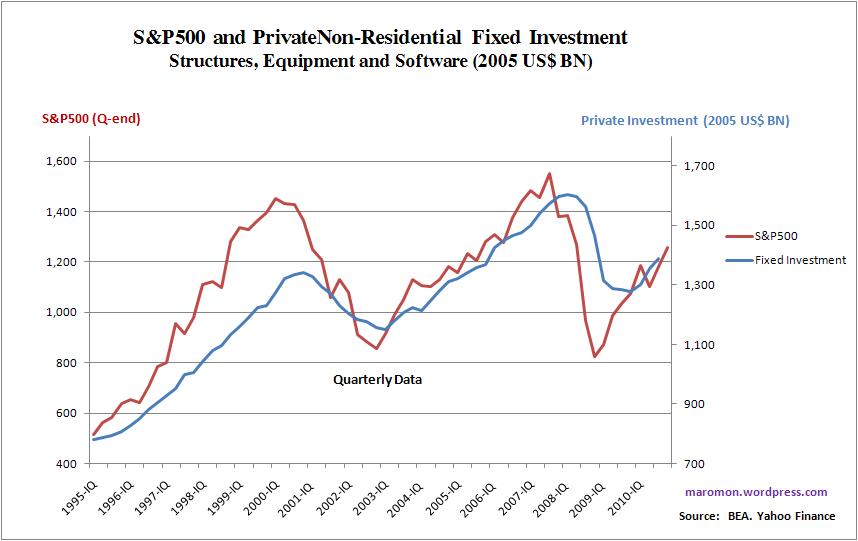
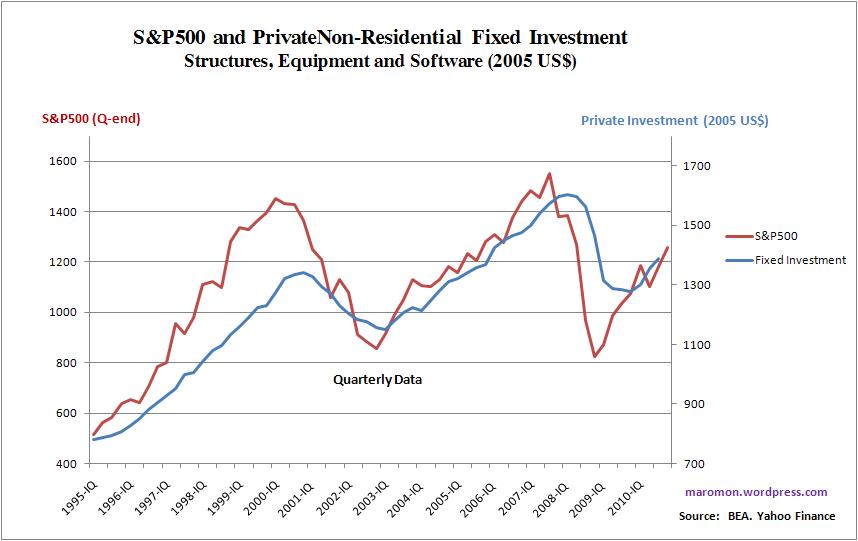
But take a look at this chart and see how the S&P500  leads U.S. real private non-residential investment  by about two quarters.   The balance sheet of the corporate sector is in relatively good shape with some companies possessing massive piles of cash, larger than even the GDP of some countries.

If the stock market continues to rise and businesses start spending and hiring,  a reinforcing feedback loop may develop, if it already hasn’t,  and the economy could reach what the economists call “escape velocity“.  Remember, it was business investment that drove the 1990’s boom.

Bet the ranch?  Absolutley, not.   But, maybe, we’ve sold Chairman Bernanke too short, thinking he is just trying to reflate the old housing and consumption bubble.  He did write,

Easier financial conditions will promote economic growth. For example, lower mortgage rates will make housing more affordable and allow more homeowners to refinance. Lower corporate bond rates will encourage investment. And higher stock prices will boost consumer wealth and help increase confidence, which can also spur spending. Increased spending will lead to higher incomes and profits that, in a virtuous circle, will further support economic expansion.

Interest rates are higher than when he wrote on November 4th,  but would a 2 percent 10-year bond rate instill or reflect growing econonomic confidence?  We recall when the bond was at 2.5o percent in August,  one prominent British strategist stating, “we’re in a depression. That is what the bond market is telling us.”

Benanke’s call on interest rates just proves he is no better than us, or anyone else, at guessing the direction of interest rates in the short-term.  And they would be higher if not for the Fed’s bond purchases.    The fact, is the S&P500 is 5 percent higher than when the Fed moved and when he wrote,  and a 2 percent bond with a 1250 S&P500 is about as compatible as oil is with water.   His end-game is to spur spending and revive the economy, not to drive rates lower.

So in fact, what if he is thinking the above and trying to unleash the strength of corporate balance sheets with QE2?   Sure, all this can be derailed by the ugly events that are on our 2011 radar, which we’ll discuss in later posts.   But, the stage is set.  All we need is a story to get the “animal spirits” fired up.  A new technological breakthrough and/or bipartisan agreement in dealing with the long-term structural deficit?   Your’re guess is as good as ours as to what it will be.

If it unfolds,  it will be hailed as the financial equivalent of Apollo 13 beating the odds and returning home safely.   And remember, folks,  it’s all about the journey, not the destination.

Posted in Black Swan Watch, Bonds, Budget Deficit, Charts, Economics, Equities, Fiscal Policy, Sovereign Risk | Tagged , , , | 1 Comment

Outrage Grows Over Public Sector Unions – NY Times

We’ve posted how underfunded state and local pensions are going to be a huge economic and political issue in 2011.   Go no further than the New Year’s Day NY Times article,

Across the nation, a rising irritation with public employee unions is palpable, as a wounded economy has blown gaping holes in state, city and town budgets, and revealed that some public pension funds dangle perilously close to bankruptcy. In California, New York, Michigan and New Jersey, states where public unions wield much power and the culture historically tends to be pro-labor, even longtime liberal political leaders have demanded concessions — wage freezes, benefit cuts and tougher work rules…

In California, pension costs now crowd out spending for parks, public schools and state universities; in Illinois, spiraling pension costs threaten the state with insolvency.

And taxpayer resentment simmers.

The politcos just don’t  understand cutting current government services without dealing with underfunded public pensions is not only bad economics and bad politics,  it will hurt everyone, including the pensioners, in the long run.

Imagine, for example,  taking your family to a Yankee game and shelling out $200 for tickets, hot dogs, peanuts, beer and soda.   After finally taking your seats just before the opening pitch,  your hear these words from Paul Olden, the public address announcer,

Ladies and Gentleman,  welcome to Yankee Stadium!  Because of budget constraints, the Yankees and Red Sox will only be playing two innings today.   Reggie Jackson,  Don Mattingly, and Bucky Dent DO thank you for their pensions.

Nothing less than a freaking riot would ensue!   We’re certainly not stating that public  pensions are the only cause of the fiscal woes of state and local governments.   The situation is further complicated by a lack of transparency.   The public doesn’t have the time, nor the patience to listen to debates and obfuscation on what investment return assumption a pension fund manager should or should not use.

The Tea Party backlash could be, at least in part,  the beginning of the coming intergenerational  war that many have written about.  We thought Obama’s election may have been the start,  but the young seem to have taken a sabattical from politics, at least, in the November election. Can you blame them?   Kentucky’s new Senator, Rand Paul, did, however, refer to Medicaid as “intergenerational welfare,” during his campaign.

Mish’s Global Economic blog has been all over this important issue.   We’ve saddled the younger generation with massive debt and liabilities and now it seems they’re about to revolt.  And, if they don’t, the markets will.   The politicians have failed miserably in addressing these “third rail” issues and maybe its the just the way the system is rigged.  And this not just an American issue, but a global one, and potentially more acute in other Western countries.

So how ’bout this for a New Year’s resolution.   Maybe we baby boomers, who can afford it,  start playing Top Flite instead of Titlelist.   That is, engage in some burden sharing for our younger brethren.  Take one for the kids.  We’re fighting enough wars, let’s not have another one between generations.

The first Baby Boomer turned 65 today.

Posted in Muni Bonds, Policy, Politics, Sovereign Risk | Tagged , , , | 5 Comments

If this is Socialism, call me Comrade

No politics or partisanship here, “just the facts ma’am”.  The stock market as measured by the S&P500 is up just about 50 percent since President Obama’s inauguration to today’s close.   Only Eisenhowser comes close, but not even in the same zip code.   A 50 percent stock move does a lot of “spreading the wealth around” and Joe the Plumber’s pension is in much better shape today than it was in November 2008!

Sure, sure, there are a  ton of reasons to explain the differences, but this is politics folks!    A CapEX spending led economic acceleration and pick-up in hiring in 2011, which usually follows such a strong equity performance,  will make the President look unbeatable same time next year, in our opinion.  Stay tuned.


Posted in Equities, Politics | Tagged , , | 17 Comments

The S&P500 in 2011: What’s past is prologue?

Let’s be honest and a little humble as we venture into the “great wide open” of 2011. Nobody really has a clue what path the markets will take.  Given what we’ve all been through and the uncertainty and plethora of risks going into the new year, we feel a bit like Rod Taylor and Teppi Hedren mid-movie into Hitchcock’s,  The Birds.  And those sea gulls look a lot like black swans to us.

The anxiety of the uncertain future causes investors and traders like us to seek out gurus, astrology, and ghosts of markets past to provide some comfort and conviction as we develop a trading plan for the upcoming year.   One market analog that many very smart people follow is the Presidential Election Cycle developed by market historian Yale Hisch.

We must admit to our shock and awe after crunching the data and looking at the S&P500 performance in the third year of an American President’s  first term in office. The S&P500 has remarkably not had a down year in the third year of a first term since 1950 (we didn’t look at prior years) and the average annual return is a stunning 21.34 percent.

We averaged the daily returns of the nine years and extrapolated them into 2011 based on an S&P500 ending 2010 at 1265.   It’s an interesting chart, but the averaging really smoothes out the noise and volatility.   But, hey, maybe that’s why the VIX at 17, no?   We also tested the analog against actual data in 2003 and after diverging early in the year, the S&P500 tracked its historical Year 3/First Term trajectory surprisingly well.

Finally, Jeremy Grantham finds the Presidential Cycle oddly performs even better in foreign markets, including the U.K..  He writes,

Never fight the Fed about market prices or underestimate its global reach. The U.K. stock market has been more responsive to the U.S.’s Year 3 stimulus than the U.S. market has itself. It shows Britain in its true colors: half a hedge fund and half the 51st state.  How humiliating!

This time may be different and the only thing we can say with certainty is the market will be more volatile than the trajectory of the S&P500 illustrated in the predictive chart.   We’ll also say with much less certainty, however, we believe the S&P500 will be higher and much wider (more volatile) next year.  Have a great New Year!

Posted in Equities, Monetary Policy | Tagged , , , | 9 Comments