Let the year-end chase begin

Great heat map of the ETF space YTD performance.   Precious metals, real estate, Hong Kong, India, and some selected Asian ETFs have been been on fire this year.  Rather than chasing the winners,  under invested capital will most likely be looking to the laggards to ramp year-end performance.  We believe energy, solar, and Brazil — XLE, TAN, and EWZ —  will be bought.

Posted in Bonds, BRICs, China, Commodities, Equities | Tagged , , | Leave a comment

Wall Street: The Speed Traders – 60 Minutes

In case you missed the excellent 60 Minutes piece on robo/algo traders.  It’s worth the 13 minutes of your time.

How Speed Traders Are Changing Wall Street
Steve Kroft Gets A Rare Look Inside the Secretive World of “High-Frequency Trading”

Posted in Equities, News, Policy, Uncategorized | Tagged , , | Leave a comment

Geithner’s Naughty List?

Look no further than the Economist’s Big Mac Index to understand who is on the Treasury’s Naughty List.  It uses July exchange rates,  so a bit dated as the most recent currency moves are not included.

Interestingly,  Japan and Brazil have not been called out for their recent currency intervention.   The price of a Big Mac in Tokyo is now $3.90 and $5.00 in Rio at the current exchange rate.   Bloomberg reports,

When asked whether he thought Japan had “set the fire” for this dynamic, Geithner responded, “I don’t, no” in remarks at the Brookings Institution.

Instead, Geithner kept up his calls for China to let the yuan rise against the dollar. He said the “main problem” facing foreign-exchange markets is “a set of emerging-market economies that both remain undervalued and are leaning heavily against the pressures for appreciation.”

Wow, $1.95 Big Macs in Beijing and $7.20 Big Macs in Norway!  You could sail the QE3 through that gap!

Posted in BRICs, China, Commodities, Currency, Monetary Policy, News, Policy, Politics, Sovereign Risk | Tagged , , , , , | 1 Comment

Rio’s $5.00 Big Macs and the Danger of Dutch Disease

Things are getting expensive in Brazil, especially the price of a Big Mac!  Last time we were in Brazil, Big Mac’s were offered at the equivalent of $US.70 at the same time they were bid at US$2.75 in New York.  We tried to arb the two markets, but the trade quickly became stale!

In their article, Why is a Big Mac in Brazil so expensive, the GlobalPost warns the country risks catching Dutch Disease as the surge in commodity prices and capital inflows generates a spending binge , while a stronger currency risks decimating the manufacturing base,

Seven years ago, a Big Mac in Brazil cost less than $1.50. Try buying McDonald’s signature burger here today, and you need the equivalent of a $5 bill.

The investment bank Goldman Sachs last year ranked it among the world’s “most overvalued” currencies, and it has kept rising since — gaining nearly thirty percent in 18 months…

That flow of money – along with Brazil’s heavy exportation of commodities like iron ore, soybeans and oil – has led some observers to conclude Brazil has come down with an economic malady called “Dutch Disease.”

The term was coined in the 1970s to describe the paradoxical way a North Sea oil boom had decimated the Dutch economy. In theory, the disease works like this: The discovery of oil draws a surge of foreign money into a country’s economy, both to buy the oil and invest in the oil industry. All this demand for the country’s currency drives up the exchange rate. This in turn means anything the country manufactures and tries to sell abroad – let’s say a pair of shoes for example – is suddenly less competitive.

This is a long-term risk and explains the country’s concern over the rapid appreciation of its currency.   Brazil remains one of our favorite markets, however,  and we’ll continue to monitor the direction and level of reserves as an early warning indicator of an elevation of risk.  

Posted in BRICs, Commodities, Currency, Equities, Monetary Policy, Sovereign Risk | Tagged , , , | 3 Comments

Picture of the Day: The Wealth of Nations

Great shot (magnified 22x) of a wood ant holding a microchip in its teeth.  This picture symbolizes, at least to us, the recipe for the “Wealth of Nations:”  1) the work ethic of the ant;  2) the technology of the microchip.

Thanks to DHJ for the heads up!.   Go to the Mail Online to view more incredible pictures.
Posted in Geopolitical, News, Uncategorized | Tagged , , | 1 Comment

7th-Inning Stretch Reading

A little something to read during the 7th-inning stretch.  Go Giants!

China
China’s economy buoys super-spenders – CNTN
China’s household wealth to double by 2015 – Reuters
China Sold the Most Japanese Debt on Record in August – MoneyNews.com
Commodities

Commodities: self-defeating rally?  – FT
Corn, Soy, Wheat Prices Surge as U.S. Cuts Supply Outlook – Bloomberg
The Crowd Around the Gold Counter – NY Times
Soaring prices threaten new food crisis – FT
Currency

Brazil Real Closes Stronger As Inflows Overwhelm Bank Measures – WSJ
China May Accelerate the Appreciation of Yuan as Economy Slows – Bloomberg
Currency concerns dominate IMF meetings- FT
Dollar Falls Below 82 Yen for First Time Since 1995 After Cuts in Payrolls – Bloomberg
Finance Chiefs Seek to Soothe Not Solve `Currency War’ at IMF – Bloomberg
Emerging Markets

Brazil Economy Set to Pass Italy in 2011 to 7th Largest in World – Latin Business
Meirelles Says Brazil Will Protect Economy, Real From Inflows, Imbalances – Bloomberg
Mexico Is Building More Dollar Reserves Than Expected – Bloomberg
Flows

Emerging markets stock fund flows at 33-month high – Marketwatch
New Patterns of Investment in the Global Economy – State Department
QE2 Driving Emerging Markets – Barron’s
Global Economy

The world economy’s quest for growth – Economist
Inflation/Deflation

Chilean Inflation Quickens, Bolstering Interest Rate Increase Expectations – Bloomberg
India 10-Year Bond Yields at 3-Week High on Inflation Concern – Bloomberg
Inflation pressures ease in September: ECRI – Reuters
Prices of 300 consumer commodities jump on the Hanoi market – Vietnam Business
SNB’s Hildebrand Says Risk of Deflation Was Averted in June – Bloomberg
Monetary Policy

Fisher Says Further Fed Easing Is Not a `Done Deal’ – Bloomberg
Fed to venture into the unknown as QE2 looms – FT
Global monetary policy coordination needed: EU’s Rehn – Bloomberg
It’s the Money, Stupid – Weekly Standard
Sovereign Risk

EU’s Rehn Says Ireland, Greece Will Not Restructure Debts – Bloomberg
Trading/Investing

7 Of The Worst VC Investments Of All Time – Focus
‘Bernanke put’ risk for shareholders – FT
Investors wait for official word on easing – FT
‘QE2’: How to Invest in Manipulated Markets – The Street
The Search for Intelligent Yields – Barron’s

Posted in News | Tagged | Leave a comment

The Store of Value Trade

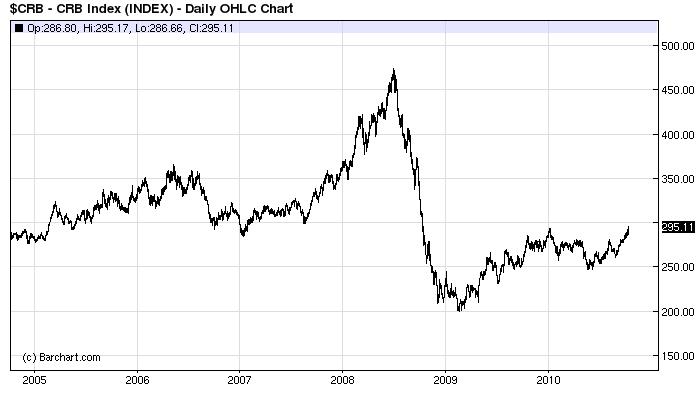
Commodity prices closed at two year highs.  Bloomberg writes,

The Reuters/Jefferies CRB Index of 19 raw materials jumped as much as 2.7 percent to 295.17, the highest level since Oct. 15, 2008. Every price advanced. Wheat, soybeans and corn led the gains, each jumping the most allowed by the Chicago Board of Trade. Copper climbed to a 27-month high, and crude oil topped $83 a barrel.

The question now is this the type of inflation the Fed desires?  We don’t think so.

In fact, all other things held constant (don’t you just love economists?),  unless nominal wages increase to offset the spike in food and fuel prices,  the net result is a reduction in real income and deflationary for other goods and services.  Consumers must reduce expenditures on other items to pay for the higher priced necessities.   Note, the Aug’07-July’08 commodity price spike was more inflationary as abundant credit allowed consumers to monetize the price increases through borrowing.  

Inflation in financial assets, i.e., stocks and bonds,  which helps pension funds meet their liabilities and make consumers feel wealthier, increasing their propensity to spend,  now,   is the Fed’s  modus operandi for jump starting the economy, in our opinion.   The dustbin of history is filled with bond market vigilantes who have fought the Fed.  Our dingy has little chance against the QE2 and we won’t fight the markets here.

Monetary policy is more an art more than a science and is tantamount to trying to thread a needle wearing boxing gloves.  What we’re witnessing in commodities is an unintended consequence of current policy and, surely, only one of many.  We are deep into this experiment and there is no turning back.  Stay tuned.

Posted in Bonds, Commodities, Credit, Currency, Monetary Policy, News, Policy, Politics | Tagged , , , | Leave a comment

Paradox of Zero Interest Rate Monetary Policy: Loose is Tight

Let us take a moment to say we’re thankful for central bankers!  They have an extremely difficult job, make monumental decisions under great pressure and uncertainty, only to be constantly second guessed by a crowd of ignoramuses, including us! Someday we’ll understand how close we came to the abyss, and if not for the decisiveness of Bernanke, Geithner, Paulson, and their respective staffs, most of the country would be eating bark and living under a freeway. They all deserve, in our book, the Presidential Medal of Freedom for their courage during the darkest days of the crisis and success in stabilizing the situation.  Structural adjustment, reconstruction, and recovery is a work in progress, however.

Now let us weigh in with our thoughts on current global monetary policy.

How ironic is it that those countries with loose monetary policy and near zero interest rates are experiencing relatively tight financial market conditions, including low volume equity markets; and those with tight monetary policy and relatively high interest rates are flooded with liquidity?  Given our experience in the emerging markets and many years of analyzing capital flows, we’re forming a new working hypothesis of monetary policy here.

Abnormally low interest rates displace capital from the domestic market to foreign markets as investors seek out higher returns.  If the net capital outflows are not offset or replaced by domestic credit creation, the financial conditions of the country actually tighten.  When the exchange rate of the receiving country is not allowed to equilibrate the flows, these capital outflows are recycled back into the originating country’s government bonds, allowing deficit expansion without upward pressure on interest rates.   This is especially true in an economy where traditional channels of credit have been impaired, such as the case of the United States and Japan.

In a CNBC interview today, Larry Fink, CEO of Blackrock, touched on this,

Maria Bartiromo:  ….Do you think the Fed should start raising rates?

Larry Fink:  I actually suggested that to the Fed some time ago, but the economy has weakened a little bit since I made that suggestion.  I believe low rates are going to be a problem in the long run.  We’re seeing more and more investors, institutional investors, individual investors, are moving more of their money to emerging markets, to overseas…  This is the money that used to invest in America, in the long-term vitality of America, they’re now investing in Indonesia, investing in other countries…  You need now to move that money overseas to get those returns… The problem, I see, with a long period of time with low rates , we are going to see a large sum of money moving out of the United States. It will continue to put pressure on our currency…..and we are going to have less available capital to invest in this country.

In addition, the negative impact of the loss of income and confidence with a zero interest rate monetary policy should not be under estimated.    Charles Schwab wrote last week in the Wall Street Journal,

The Fed’s super-loose policy has driven down the security and spending power of savers, particularly those in retirement who played by the rules during their working years and now depend on the earnings from their savings for a decent quality of life. As a result, savers and investors are being forced to take more risk with their money as they hunt for higher yields.

We had a conversation just tonight with an elderly woman, who is now drawing down her CD balances as her interest income has effectively vanished.   She has reduced her spending;  worries about how she going make her savings last; and is even considering allocating a portion of her savings to an agricultural ETF to protect against rising food prices.  We’re all speculators now.

Incumbent politicians in the U.S. are about to feel the wrath of those who feel they have played by rules and are now subsidizing those who haven’t.  We’ll continue to formulate our model.  Stay tuned.

Posted in Bonds, BRICs, Credit, Currency, Monetary Policy, News, Policy, Politics, Sovereign Risk | Tagged , , | 1 Comment

Japan’s Currency War? Nonsense!

Take a look at a 30-year chart of the Yen to see if Japan is trying to weaken its currency in a “beggar thy neighbor” policy.  The Yen has appreciated 50% against the dollar since 2007 and is at an all-time high in nominal terms and stronger in real terms.   As mentioned in our earlier post,  Japan is not engaged in a currency war, but a sandbagging mission to prevent the Tsunami of Dollars from flooding its economy,  particularly the export sector.

Posted in Commodities, Credit, Currency, Geopolitical, Gold, Monetary Policy, News, Policy, Politics | Tagged , , | Leave a comment

Fed, ECB throwing world into chaos – Stiglitz

These are the headlines from an earlier Reuters report.   Joe Stiglitz is one smart dude (OSD) and was the World Bank’s chief economist during the 1997 Asian Financial Crisis and 1998 Russian Debt Default.   He says the ultra-loose monetary policy in the U.S. and Europe is forcing Japan and Brazil to defend their exporters through extraordinary measures, including quantitative easing and implementation of capital controls.   Reuters reports,

“Ultra-loose monetary policies by the Federal Reserve and the European Central Bank are throwing the world into “chaos” rather than helping the global economic recovery, Nobel Prize-winning economist Joseph Stiglitz said on Tuesday…

“The irony is that the Fed is creating all this liquidity with the hope that it will revive the American economy,” Stiglitz said. “It’s doing nothing for the American economy, but it’s causing chaos over the rest of the world. It’s a very strange policy that they are pursuing.”

The U.S. dollar has weakened about 6.5 percent against a basket of major currencies since the beginning of September as prospects for further monetary easing by the Fed have led investors to seek higher returns elsewhere…

Recent actions by those countries to curb the strength of their currency were “necessary,” Stiglitz added.

“It’s natural in that context for them to say — we can’t just let our exchange rates appreciate and destroy our exports,” he said.

On Monday, Brazil doubled a tax on foreign investment into local government bonds, while Japan lowered the target for its benchmark interest rate to a range between zero and 0.1 percent.

The Bank of Japan also pledged to buy 5 trillion yen ($60 billion) worth of assets, in a strategy similar to the one adopted by the Fed to pump funds into the economy.

This weekend’s IMF Annual Meetings should be interesting given the global currency “chaos.”   The Guardian writes,

“Finance ministers from the G7 will hold an informal meeting in Washington this week to discuss growing concerns that the world is in the grip of an “international currency war” as government’s manipulate their currencies to bolster exports.

The meeting on Friday, on the sidelines of the annual International Monetary Fund gathering, comes amid rising tensions between the western industrialised nations and China, whose prime minister, Wen Jiabao, is on a charm offensive in Europe this week.”

We tend to agree with Stiglitz.  Outside of China, most countries, rather than fighting a “currency war”, are engaged in sandbagging missions to prevent the Tsunami of Dollars from flooding their economies.    Any agreement short of disciplined policy coordination will be ineffective, in our opinion.   And given the cyclical divergence of most emerging economies with most developed economies,  such an agreement is highly unlikely.  Stay tuned!


Posted in Black Swan Watch, Bonds, BRICs, China, Commodities, Credit, Currency, Geopolitical, Gold, Monetary Policy, News, Policy, Politics | Tagged , , , , , , | 3 Comments