The Greatest Trade Ever?

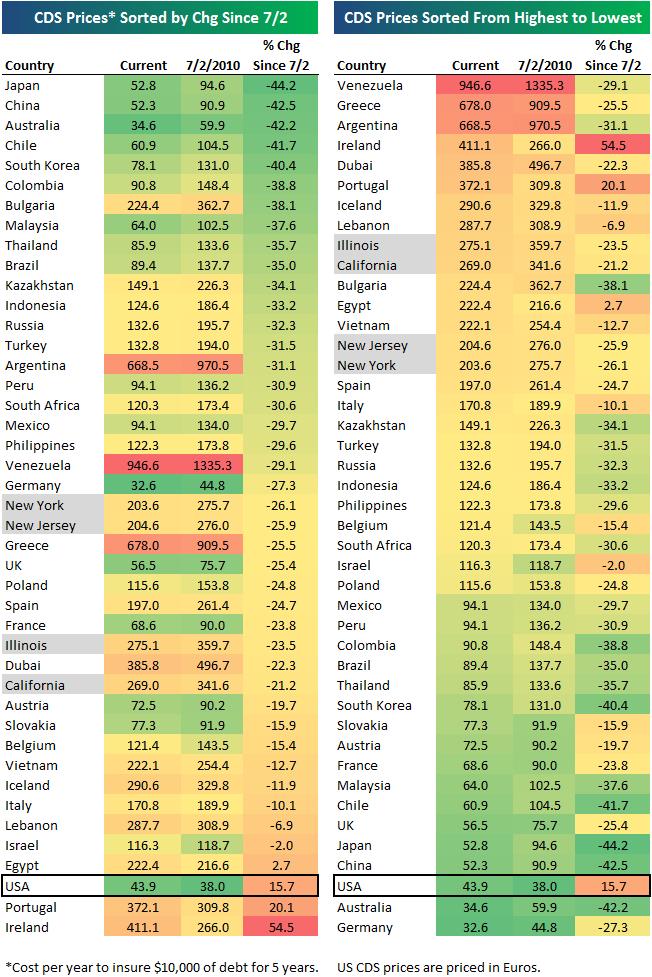
Check out Bespoke’s great table of Credit Default Swap (CDS) prices.   We don’t trade CDS, but doesn’t Long China/Short Japan,  straight up,  seem like the greatest trade ever? Or just outright short at 53 bps?   Japan’s public funding requirement is almost 60% of GDP in 2011.  Societe General’s,  Dylan Grice, illustrates in his chart the MoF’s strained cash flow. 

Could it be a massive short keeping the CDS tight?  Short Japan was the big “tail” trade at the beginning the year.  The WSJ and our good friend, Greg Zuckerman, ran this article on December 31, 2009,

Some hedge funds are starting to wager on painful times ahead for Japan, the world’s second-largest economy.

These investors, including some who made successful bets against risky mortgages and financial companies in recent years, anticipate trouble for Japan’s financial system. Their concern: Government borrowing continues to climb while demand for the nation’s debt could taper off.

Even if the Japanese government is forced to monetize debt repayment, their CDS will still  sell-off dramatically.   Stay tuned.

Posted in Black Swan Watch, Bonds, Monetary Policy, Sovereign Risk | Tagged , , , | Leave a comment

Chinese Solar Spanked on US Trade Rep Announcement

Holders of Chinese solar stocks got a little taste of what a trade war could feel like.  Trina Solar fell more than 9 percent as U.S. Trade Representative, Ron Kirk, announced his office has launched an investigation into the Chinese government’s policies affecting trade and investment in green technologies.   This, from the official press release,

The petition alleges that China employs a wide range of World Trade Organization (WTO)-inconsistent policies that protect and unfairly support its domestic producers of wind and solar energy products, advanced batteries and energy-efficient vehicles, among other products, as China seeks to become the dominant global supplier of these products. According to the petition, these policies include export restraints, prohibited subsidies, discrimination against foreign companies and imported goods, technology transfer requirements, and domestic subsidies causing serious prejudice to U.S. interests. The petition further alleges that China’s policies have caused the annual U.S. trade deficit in green-technology goods with China to increase substantially since China joined the WTO, making China the top contributor to the U.S. global trade deficit in the sector.

The announcement gives the Administration some political breathing room and was no doubt coordinated with the delayed release of the Semiannual Report on International Economic and Exchange Rate Policies, which may label China as a currency manipulator.  In today’s press release, the Treasury stated,

Secretary of the Treasury Timothy Geithner recognized China’s actions since early September to accelerate the pace of currency appreciation, while noting it is important to sustain this course.

Since June 19, 2010, when China announced it would renew the reform of its exchange rate and allow the exchange rate to move higher in response to market forces, the Chinese currency has appreciated by roughly 3 percent against the U.S. dollar. Since September 2, 2010, the pace of appreciation has accelerated to a rate of more than 1 percent per month. If sustained over time, this would help correct what the IMF has concluded is a significantly undervalued currency…

The Heads of State, finance ministers, and central bank governors of the G-20 and the Asia-Pacific region will participate in several important meetings over the coming weeks. These meetings provide an opportunity to make additional progress on the important challenge of securing stronger and more balanced growth.

The Treasury will delay the publication of the report on international economic and exchange rate policies in order to take advantage of the opportunity provided by these important meetings.

Let’s hope and pray the “currency war” doesn’t escalate into a trade war as what happened today in Chinese solar is just flea bite to what will come to the global economy and markets.    We don’t think it will, but the risk should be closely monitored.  Stay tuned!

Posted in Black Swan Watch, BRICs, China, Currency, Equities, Policy, Politics, Sovereign Risk | Tagged , , , , , | 2 Comments

Beijing’s $2.18 Big Mac and $1,400 GOLDen Arches?

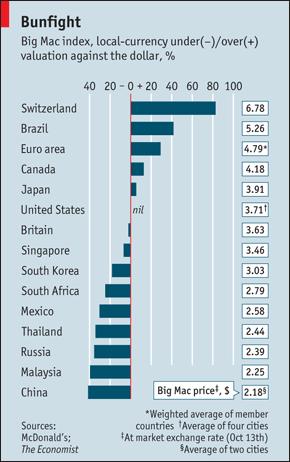
The Economist updated their Big Mac Index, which measures currency misalignments based on purchasing-power parity.  We just used the Big Mac Index this past weekend in our recent posts,  Rio’s $5.00 Big Macs and Geithner’s Naughty List.   Here is what the Economist had to say today,

A WEAK currency, despite its appeal to exporters and politicians, is no free lunch. But it can provide a cheap one. In China, for example, a McDonald’s Big Mac costs just 14.5 yuan on average in Beijing and Shenzhen, the equivalent of $2.18 at market exchange rates…In America, in contrast, the same burger averages $3.71…

The tensions caused by such misalignments prompted Brazil’s finance minister, Guido Mantega, to complain last month that his country was a potential casualty of a “currency war”. Perhaps it was something he ate. In Brazil a Big Mac costs the equivalent of $5.26, implying that the real is now overvalued by 42%. The index also suggests that the euro is overvalued by about 29%. And the Swiss, who avoid most wars, are in the thick of this one. Their franc is the most expensive currency on our list..

On Friday, the Treasury Department is due to state whether they believe China is a currency manipulator.   Treasury is required by law to issue twice-yearly reports on the currency practices of the major U.S. trading partners by Oct. 15 and April 15 each year.

The report is often delayed but U.S.-China Business Council said on Thursday the latest report would be released on Friday.   The expectation is the Administration will give China a pass.  If not, we expect some market pyrotechnics and gold at $1,400 by the close.  Stay tuned!

Posted in China, Commodities, Gold, Politics | Tagged , , , | 1 Comment

Krugman’s Dangerous Misreading of the Bond Market

During his Sunday appearance (click for interview) on This Week With Christiane Amanpour, Paul Krugman spoke the words that make us very uncomfortable.

Responding to French finance minister Christine Lagarde’s fiscal austerity and Alan Greenspan’s caution about further stimulus, Krugman spoke confidently the bond market has no problem with larger deficits,

Greenspan:   I know everyone says let’s wait for a couple years, keep the stimulus going, and then we’ll solve the problem.  I think that’s a very risky strategy. I don’t deny, if I knew you could do that, that it is obvious the best strategy.  I’m not sure the markets are going to allow them to do that.

Krugman: …And when she said people are worried about the deficit, the people who have a real stake in worrying about the deficit, are investors, bond investors,  interest rates are at near record lows….

We have written how the Treasury bond market fails to reflect fundamental value, does not price credit and inflation risk, is driven by technicals, and dominated by non-market oriented large players, i.e., central banks.  For Krugman to conclude a 2.40 percent 10-year Treasury rate reflects a lack of worry about deficits is almost equivalent to Wen Jiabao declaring his country’s currency is determined by market forces.

Paul Krugman is a brilliant economist, but we think he should be looking at more market oriented markets to gauge deficit anxiety.   Gold, commodities, and currencies would be good start.

Posted in Bonds, Commodities, Credit, Currency, Equities, Gold, Policy, Politics, Sovereign Risk | Tagged , , , | 2 Comments

“All that liquidity ends up not where it is supposed to be…”

Great CNBC interview (click for video) with British historian, Niall Ferguson.  It’s worth the 5 minutes of your time.  We’re amazed how well Ferguson understands the global economy and articulates the risks better than many trained economists.   Money quotes:

“There are more of those (sovereign debt crises) to come and, ultimately, it is going to come to Japan and the United States. And those crises of sovereign debt will be the big story…

It just depends on whether you borrow in your own currency in which case is probably going to be inflation; or someone else’s, in which case is probably a default…

All that liquidity ends up not where it is supposed to be, which is magically creating jobs for American workers in Michigan. It doesn’t do that at all. It ends up pumping up commodity prices on the other side of the world, with lots of unforeseen consequences.

“Liquidity” is an elusive concept and hard define.  Many argue that the U.S. monetary base, ante-QE2,  is not growing and money supply growth is, at best, tepid.  As a result,  the recent spike in Gold, commodities, and other financial assets is not warranted.

In a global context, however,  the displacement of capital (John Bull can stand many things, but he can’t stand two zero percent) because of G3 zero interest rate monetary policy is creating massive liquidity abroad as foreign central banks print local currency to purchase the excess supply of dollars.   QE2 will validate the recent market action, growing the monetary base and flushing capital out of long-term bonds into _____ .  Fill in the blank.  The markets will need a heavy dose of dramamine if there is any upset to QE2.   Stay tuned.

Posted in Black Swan Watch, Bonds, BRICs, China, Commodities, Credit, Currency, Monetary Policy, Policy, Sovereign Risk | Tagged , , , | Leave a comment

Apple Closes Over $300

Apple closed over $300 today and is now worth close to $275 BN.   How big is Apple?

Its market cap is larger than 150 of the 183 countries monitored by the IMF.  This is the most important company and stock in world,  and is the one to watch, in our opinion.   The “new economy,” which was only a dream during the dot.com era has arrived and Apple is the leader and its symbol.   Technology is the world’s hope and alternative to a Malthusian-like global struggle for resources.   Stay tuned.                                                       

Posted in China, Commodities, Equities | Tagged , | Leave a comment

“I’ve already considered that idea and rejected it.”

We found Ezra Klein’s take on Steven Rattner’s, Overhaul, quite amusing,

[Larry] Summers is also one of the book’s more amusing characters. His intellectual and managerial style are distinct enough that the index has six entries under “Larry Summers; style.” Here’s my favorite

Once Diana Farrell began to offer an opinion, but before she passed the mid-point of expressing her thought, Larry interrupted to say (not harshly), “I’ve already considered that idea and rejected it.” This so amused our younger colleagues that for weeks afterward they would say to one another, as they debated one proposal or another, “I’ve already considered that idea and rejected it.”

Often overlooked,  it was Larry Summers who most likely constrained the Clinton Administration from spending the windfall tax revenues of 1990’s stock market and dot.com bubble.  He is one most studied academics on bubbles and clearly recognized the unstable nature of the economy during his last days at the Clinton Treasury.  If only California had such an economist.

Posted in Credit, Equities | Tagged , , | 1 Comment

World’s Richest Women Are Chinese

The FT published an interesting piece on the world’s richest women, which came as a surprise:

The world’s three richest women are Chinese – as are 11 of the top 20 – according to the Hurun List of Self-Made Women Billionaires, published on Tuesday.

Zhang Yin, 53, the Chinese head of a recycled paper company, Nine Dragons Paper, ranks as the wealthiest self-made woman on earth with an estimated personal fortune of $5.6bn. Wu Yajun, 46, of Longfor Property, comes in second with $4.1bn and Chen Lihua, 69, of Fuhua International, a Hong Kong conglomerate, ranks third with $4bn.

The richest non-Chinese is Spaniard Rosalia Mera of Zara, the fashion house, with $3.5bn, and two others who made their fortunes in fashion: Doris Fisher for Gap is eighth and Giuliana Benetton of Benetton is 11th.

Oprah Winfrey, the US television show host, ranks ninth with $2.3bn.

Interestingly, the World Economic Forum also released it Global Gender Gap Report 2010 today, ranking China 61st out 131 countries in terms of how well they divide resources amongst male and female populations.  Guessing the “law of large numbers” explains their dominance in the rich rankings, no?

Here is Hurun’s 2010 List of the Top 10 Richest in China


Posted in China, News, Policy, Politics | Tagged , , | Leave a comment

Rising Tide (of liquidity) Lifts All Boats

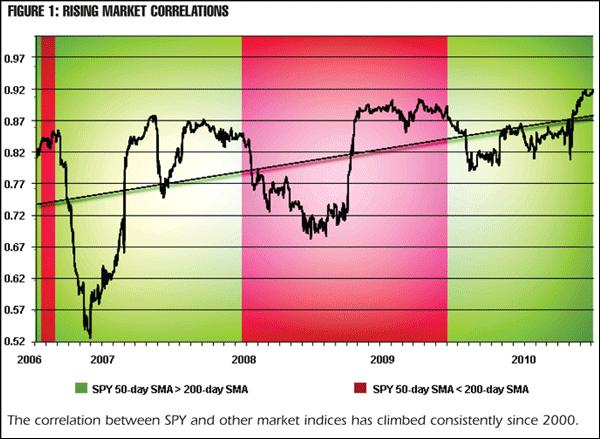
Great chart from Active Trader of the S&P5oo correlation with other markets.  Have you noticed recently that all markets are moving together?  U.S. Treasuries, domestic and foreign stocks, Greek Bonds, EM Debt, commodities, and foreign currencies all in lockstep? This is a clear sign loose monetary policy is starting to bite.  If sustained,  the animal spirits should start to spillover into the real economy.

The markets need a fundamental story — a new technology,  a “new economy,”  the “great reset” or a “new contract” — and some credit expansion to really get the liquidity driven Bubble 2.0 3.0 going.  Build your Ark and the ride the flood.   How it all ends?   Stay tuned.

Posted in Bonds, BRICs, Commodities, Credit, Currency, Equities, Gold, Monetary Policy, News, Policy, Sovereign Risk | Tagged , , , , | Leave a comment

Europe’s Ricardian Equivalence vs America’s Keynesianism

We thought this to be the most interesting chart of the recently released World Economic Outlook from the IMF.  Japan’s 2011 public sector funding requirement is a stunning 60 percent of GDP, which includes the rollover of maturing debt equivalent of 50 percent of GDP.  Note that Japan is the only country depicted on the right scale of the chart. The footnote states,  2 All left scale except Japan; Japan right scale.

The concern over public debt is a major issue dividing European and U.S. policymakers and the November election will be seen as a referendum on large budget deficits.

The Europeans are taking a Ricardian Equivalence approach, believing fiscal austerity and deficit reduction will have a far more positive economic impact than further stimulus.   In his Jackson Hole speech, ECB President, Jean-Claude Trichet confirmed this,

The concern is, however, that in the short run the deficit reductions – although unavoidable in the long run – have negative effects on aggregate demand. The economy, it is sometimes argued, is at present too fragile and thus consolidation efforts should be postponed or even new fiscal stimulus measures added.

As I pointed out recently , I am sceptical about this line of argument. Indeed, the strict Ricardian view may provide a more reasonable central estimate of the likely effects of consolidation. For a given expenditure, a shift from borrowing to taxation should have no real demand effects as it simply replaces future tax burden with current one.

There is the additional argument positing that credible fiscal deficit reductions through expenditure cuts lead the private sector to expect a lower future tax burden, especially when the nature of the cuts make future tax reductions more likely. This can generate higher consumption expenditures and more investment.

In Sunday’s  interview (click here for video) on This Week With Christitiane Amanpour, French finance minister, Christine Lagarde, spoke of the negative economic impact of further stimulus measures,

Amanpour:  …There seems to be tension between the United States and Europe over  what is the most sensible way to deal with current lack of growth.  The U.S. wants Europe to continue pushing money into the system.  Europe is talking about a lot of austerity.

Largarde:   …If we do not reduce the public deficit, it is not going to be conducive to growth.  Why is that?  Because people worry about the public deficit.  If they worry about it, they begin to save.  If they save too much, they don’t consume.   If they don’t consume, unemployment goes up and production goes down.  –  37 seconds

If the U.S. continues with fiscal stimulus and Europeans with fiscal austerity, this is about as close to a real time economic lab experiment that will ever take place — Keynesian versus Classical Economics.  Much is at stake.

It is a rare case, and we can’t recall,  when European policymakers and American conservatives were on the same side of such an important economic issue.

Our take away is the Fed senses the political winds and the “spending fatigue” of the body politic and is hoping to stimulate aggregate demand — though less direct and effective than fiscal policy — through QE2.   We will have more to say on this subject later in the week.  Stay tuned.

Posted in Bonds, BRICs, China, Commodities, Credit, Currency, Monetary Policy, Politics, Sovereign Risk | Tagged , , , , , , | 7 Comments