Rare Earth Day 3.0

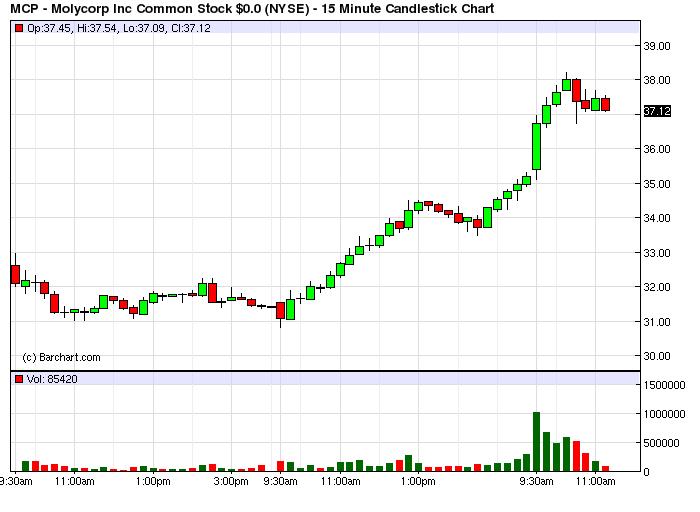
The Rare Earths continue to rock today in a down market as the story unfolds.  Germany announced yesterday the rare earth supply shortage is starting to hit their industrial base.  The Chinese canceled a three-way high level meeting with Japan and South Korea due to tensions over China’s export restrictions.  The Rare Earth stocks will trade similar to commodities until production is up and running and will continue to move on news of potential shortages and geopolitical positioning.  Their market caps are relatively small so just a small allocation to the sector could (and already has) really move the stocks.

This is going to become a major international issue, in our opinion, and could cause  great damage to China’s diplomatic relations and reputation if not managed well. Stay tuned!

Related Stories
China axes talk with Japan, S.Korea over rare earth – Agence France-Presse
Rare Earth Shortages Hit Germany – WSJ
China gets tough over rare earth minerals – ABC
Rare earth minerals shortage feared by US and EU – BBC
Germany warns of China grip on rare earths market – Bloomberg

Posted in Black Swan Watch, BRICs, China, Commodities, Geopolitical, Gold, Rare Earth Elements | Tagged , , , | Leave a comment

US Budget Deficit 9th Largest Economy in the World

After falling to a low of 2.33 percent on October 8th, the 10-day Treasury has sold-off closing today at a yield of 2.64 percent.  The recent high is around 2.83 percent, which we will be watching closely.

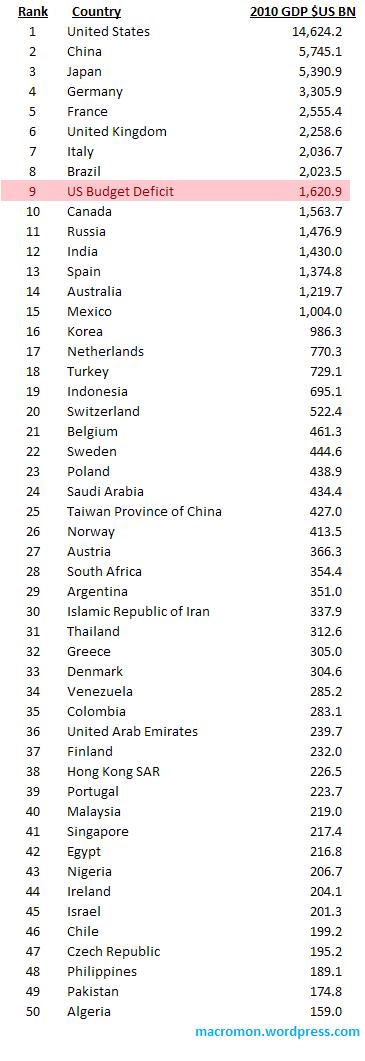
To get a sense of the magnitude of the U.S. government’s funding requirements, we’ve constructed the following table from the IMF’s World Economic Outlook (WEO) database.   If measured as a separate economy, the US budget deficit would rank as the 9th largest economy in the world.

It’ll take a boatload of quantitative easing to keep interest rates from rising if a global portfolio reallocation takes place.  This may be what the big spike in commodity prices is signaling.    Stay tuned.


Posted in Bonds, Commodities, Credit, Currency, Equities, Geopolitical, Gold, Monetary Policy, Policy | Tagged , , | 1 Comment

All Things Correlated: Stunning Aussie$/S&P 500 Relationship

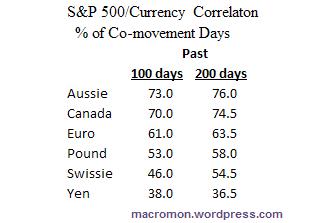
A good friend in Singapore, who is one smart dude, and former head of Goldman Sachs’ Asia asset management, pointed out the S&P500 trades almost tick for tick with the Euro and the Aussie currencies.    This is reflected in the table showing the Australian Dollar and S&P500 have moved together a stunning 73% of the past 100 days and 76% of the last 200 trading days.   The Euro is somewhat less correlated and Japanese Yen moves inversely with S&P500 65 percent of the trading days.

It is also clear from the correlation chart that a structural shift has taken place since the 2008 financial collapse.  The 30-day correlation of the S&P500 and Aussie dollar, for example,  has moved from a relatively random relationship to a consistently high positive correlation, in a range of .75-.98.

We have kicked it around with our friend for hours at a time, trying to understand why the U.S. stock market is so highly correlated with the Australian Dollar?  “Risk on/risk off” is too simplistic and general. Trying to “retrofit fundamentals” to price movement is futile, in our opinion.   Every observed price point takes a willing buyer and willing seller.  And there are no mystical forces that move markets, though, we concede, there may be mystical forces that move buyers and sellers!

Our conclusion, which, at best, is an educated guess and a work in progress, is that since the crash and abandonment of U.S. stocks by a large segment of the investment community, trading volume is increasingly dominated by high frequency algorithms and macro strategies.  There are probably sufficiently large algorithms and adequate feedback where a movement in the Aussie triggers a buy program in the S&P (or vice versa).   The movement and relationship then becomes self-reinforcing as trend following algoes kick in. We have a lot more analysis to go, but let us know if you have a better explanation.

Posted in Currency, Equities | Tagged , , , | 13 Comments

Did the Chinese Drop a Rare Earth Trade Bomb?

Call us paranoid, but what would you conclude from the following headlines:

Oct. 15:  U.S. launches trade investigation into China’s green tech sector – Xinhua
Oct 19:  China to limit exports of ‘rare earth’ minerals vital to energy tech – The Hill

Tit for tat? The beginnings of a trade war?

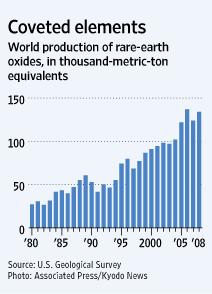
Rare earth minerals have no substitutes and are crucial for the production of high-tech products, including advanced batteries, cell phones, flat-screen televisions, hybrid vehicles and military weapons, such as radar and cruise missiles. China controls production of 97 percent of the world’s rare earths.

Recall the Chinese, though they deny it, used the suspension of rare earth exports to Japan as negotiating leverage to win the release of the fishing boat captain who had been detained in the East China Sea.   This alarmed many countries and companies, who are completely dependent on supplies from China.

Even before the current action, Paul Krugman wrote in Sunday’s NY Times,

Then came the trawler event. Chinese restrictions on rare earth exports were already in violation of agreements China made before joining the World Trade Organization. But the embargo on rare earth exports to Japan was an even more blatant violation of international trade law.

Oh, and Chinese officials have not improved matters by insulting our intelligence, claiming that there was no official embargo. All of China’s rare earth exporters, they say — some of them foreign-owned — simultaneously decided to halt shipments because of their personal feelings toward Japan. Right…

Couple the rare earth story with China’s behavior on other fronts — the state subsidies that help firms gain key contracts, the pressure on foreign companies to move production to China and, above all, that exchange-rate policy — and what you have is a portrait of a rogue economic superpower, unwilling to play by the rules. And the question is what the rest of us are going to do about it.

Steven Levine writes this afternoon on his Foreign Policy blog,

This latest move significantly escalates a steady increase in economic and trade moves by both countries. If confirmed, the Obama administration might have no choice but to reply with some similar action, particularly given the poisonous mid-term election atmosphere in the United States.

Some Chinese officials are out tonight denying the report as “groundless” and that no such measures will be implemented.   We’ll see how the rare earth stocks react to the news.

Nevertheless, the original report in the NY Times cited industry officials that the rare earth embargo is expanding beyond Japan and has prompted the U.S. Trade Representative office to investigate the allegations.   This is political dynamite in Washington,

“We strongly support USTR’s investigation into whether China is blocking exports of critical minerals to the U.S.,” said Rep. Sander Levin, D-Michigan. He is also the chairman of the House Ways and Means Committee.

“If China is found to be blocking shipments of these critical minerals in retaliation to the U.S. investigation … of Chinese practices regarding green technology, then China’s blockade would require the U.S. to immediately challenge these actions as WTO inconsistent,” he added.

Given China’s conflicting signals and their past history of denial, we don’t think this story should be so easily dismissed.  The markets surely have not priced it and one only has to look at the massive sell-off in Chinese solar stocks since last Friday’s  announcement by the U.S. Trade Rep to get a sense of how it will play out.  We have elevated a potential trade war as a major market risk.   Let’s hope China’s interest rate hike is a prelude to a similar surprise move on the exchange rate, which would relieve much of the bilateral tension.

If the rare earth story is true:  (W)hiskey (T)ango (F)oxtrot are the Chinese thinking?  Is there a power struggle taking place in Bejiing?

What will Krugman say now? 

Posted in Black Swan Watch, BRICs, China, Currency, News, Policy, Politics, Sovereign Risk | Tagged , | 1 Comment

Rare Earth Stocks Up Big on China Restrictions

China announced further limits on its Rare Earth exports today.  The country controls 97 percent of the world’s supply, which are critical for hi-tech products, including smart phones, hybrid and electric vehicles,  and cruise missiles.   Hard to read if this is retaliation for the US Trade Representative’s action last Friday.  We certainly hope not and markets are not priced for such an escalation in trade tensions.   This is a story that needs to be closely monitored.   The Rare Earth stocks, Molycorp (MCP) and Rare Earth Elements (REE),  are up big over the two days.    The Wall Street Journal reports,

Chinese officials are signaling plans to further reduce rare-earth exports next year, sustaining its controls of the metals—key ingredients in high-technology batteries and defense products—that have already severely frustrated foreign governments.

“Reducing the export quotas is under consideration, but it’s too early to talk about any reduction rate,” Lin Donglu, secretary general of the Chinese Society of Rare Earths, told Dow Jones Newswires on Tuesday. The state-run English-language China Daily on Tuesday quoted an unnamed Commerce Ministry official suggesting that cuts of as much as 30% from already-trimmed 2010 levels are possible. A Commerce Ministry official declined to confirm the report and the ministry didn’t reply to faxed questions Tuesday.

Posted in China, Commodities, Currency, Geopolitical, Politics, Rare Earth Elements, Sovereign Risk, Uncategorized | Tagged , , , , | 2 Comments

“Emerging markets at risk from a gigantic bubble” – FT

In case you missed it,  great FT piece by Peter Tasker of Argus Research about asset bubbles in Japan and China and the role of FX policy.  It’s all about Macro these days,

The message is clear. It wasn’t the rise in the yen which sunk Japan, but the response, which was an egregious policy mistake. So if you really wanted to sabotage the rise of China, the best way would be to facilitate a gigantic asset bubble.

In present circumstances, that would probably be best accomplished by leaving the renminbi where it is. This would lock high-growth China into the super-low interest rates appropriate for the weak US economy, force savers out of cash and into the housing market, and ensure credit grows much more than gross domestic product – the perfect mix for bubble trouble.

The degree of euphoria surrounding some emerging economies is already troubling. The Indian and Indonesian stock markets are trading at price earnings ratios of over 40 times, based on ten-year average earnings. You would surely need a hundred years of fortitude to buy Mexico’s recently-issued 100-year bond at a yield of 5.6 per cent. Bubble and bust in China, on which the world is now so dependent for growth and optimism, would likely tank the commodities markets, set off a second round of deflation, and end the emerging markets boom in the most spectacular way possible.

Today’s rate hike in China is crushing gold and other commodities and adding to the risk aversion, which began yesterday with the sell-off in Apple and IBM after their earnings announcements.  All other things [animals] being equal, the rate hike in China should weaken the dollar, but as Orwell once said, “some are more equal than others.”   One country’s capital account is more liberal than others.

Posted in China, Currency, Equities, Gold, Monetary Policy | Tagged , , , , | Leave a comment

Fed creating “grave distortions” – Brazil Central Bank

Brazil is considering additional measures to keep the Real from appreciating  any further.  We like the Economist’s Big Mac Index, which is based on the concept of purchasing-power parity, to get a sense of the over/undervaluation of a currency.  The cost of a Big Mac in Brazil?   A whopping $5.26 versus $3.91 in the U.S. and $2.18 in China!

To understand Brazil’s concern, simply imagine Big Macs are the world’s only export.   The Central Bank sees the country’s  competition priced at $2.18 and worries Big Macs priced in Brazil are heading to $6.00 as the tsunami of dollars flowing into the country creates excess demand for the local currency causing appreciation of the Real.  Big Macs priced in dollars thus become more expensive.

Bloomberg quotes Brazilian central bank President Henrique Meirelles,

“We now are in a phase of the process, not only of assessing what has been done, but also analyzing what could be done,” Meirelles told reporters today in Sao Paulo, when asked if the government could take additional measures, such as the adoption of higher taxes for capital inflows. “The best stance at this point is to wait, and any decision regarding this will be announced in due time if it is to be carried out”…

U.S. monetary policy is creating “grave distortions” and is causing “collateral effects” on faster-growing economies such as Brazil, Meirelles said.

“The American economy depends on stimuli, but there is a limit,” Meirelles said. “It creates grave distortions and collateral effects that are felt more in countries in which the economy is doing well, such as Brazil.”

Our friend, the great Armenio Fraga,  former head of Brazil’s Central Bank, was interviewed (click to view) by CNBC today and stated his country needs to get into a position where interest rates, which are in excess of 10 percent, can move lower.

Capital seeks out the highest returns.  And with zero interest rate monetary policy in the U.S, Europe, and Japan, “John Bull can stand many things, but he can’t stand two zero percent ” so he makes a bee line for Brazil’s 10% interest rates.   Any talk of exchange rate agreements by the IMF is just nonsense unless monetary policies become more aligned and that, our friends, “ain’t gonna happen.”  As a result, the chorus is growing louder and many countries are coming to view QE2 as the Titanic.

We think the IMF may be handing out these at the G20 to help high growth/interest rate countries defend against John Bull’s Tsunami of Dollars.   Currency speculators may want to consider a long position!  Stay tuned!

Posted in Black Swan Watch, Bonds, BRICs, China, Commodities, Currency, Geopolitical, Gold, Monetary Policy, News, Policy, Politics, Sovereign Risk | Tagged , , , , , | Leave a comment

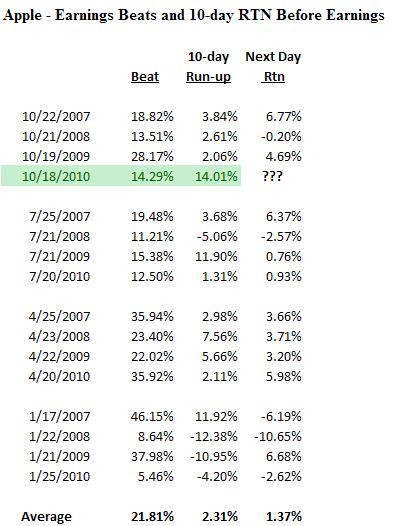
Apple Sliced 6% in After Hours Trading on 14% Earnings Beat

Wow,  a company beats earnings estimates by 14 percent and they take the stock down 6 percent.  What gives?  

Yesterday we posted, Apple Needs “Big Mama” Beat to Keep the Markets Rolling, which stated given the huge stock price run-up into earnings,  Apple needed to beat  by at least 30 percent.   Now everyone is scrambling to “retrofit fundamentals” to explain the sell-off.  Futile, in our opinion.

The stock was up 14 percent and had not had a down day in the past 10 trading days.  That is a  high hurdle even for Apple.   Let’s see how the stock settles in tomorrow.

Our sense is this is typical “sell the news” profit taking and we’ll be looking to buy when the dust clears.   We don’t think the market is finished with the Apple story just yet.   We are also watching the overall market closely and expect the reaction to Apple to trigger a correction in risk assets.  A small correction and some consolidation will make for a nice set-up for a year-end rally.

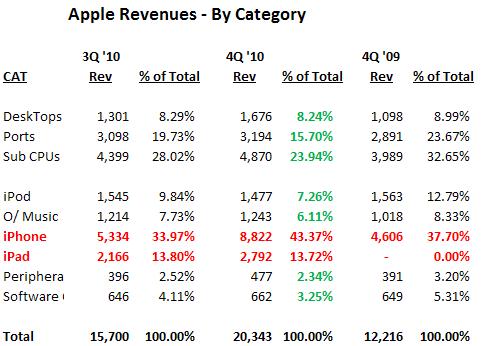
We found a couple of interesting nuggets in the earnings release.   First, the IPhone and IPad were 57% of total revenues compared to the IPhone’s 38% in 4Q2009.  Both are lower margin products, which may cause some concern.   Second, Asia Pacific is now 13.4% of revenues compared to 8.7% a year earlier.   The America’s revenue share fell to 35.3% from 42.9%.   We’ll have more to say later in the week.  Stay tuned!

Posted in Equities | Tagged , , , | Leave a comment

Rare Earth Day 2.0

Take a look at Rare Earth (not the band) today.  Lots of market buzz as Molycorp (MCP) up over 10 percent and Rare Earth Elements (REE) up over 22 percent.  Recall our take on the Rare Earth trade as “gold on steroids,”

Scarce commodities, which have no substitutes and critical for industry and national security?   Sounds like “Gold on Steroids” to us.  We wouldn’t bet the ranch, but don’t want to miss what could be a nice run as the market begins to focus.

The market is starting to focus.

Related Stories
Glencore agrees rare earth mine deal with US firm – Reuters
Rare Earths Row Continues to Build – Naked Capitalism
Rare-earth price rally to lift Asian producers – Marketwatch

Hat tips: GeZee,  Herstle, and Dougie!

Posted in Commodities, Geopolitical, Gold, Politics, Rare Earth Elements, Sovereign Risk | Tagged , , , , | 2 Comments

Apple Needs “Big Mama” Beat to Keep the Markets Rolling *

Apple reports after the bell on Monday and we think this event will determine the direction of the risk markets over the next few weeks.  Given its recent and historic run-up into earnings, the company will have to beat estimates by a very large margin for momentum in the stock and in the overall market to continue, in our opinion. 

New Economy Leader
Not only is Apple 20% of the NASDAQ, it is the leader and symbol of the New Global Economy.   Consumers all over the world seem willing to do whatever it takes to own Apple products.  The transformative potential and innovation of Apple may be Obama’s Black Swan as the Internet was for the Clinton Administration.  Imagine a medical diagnostics app for the IPad that someday replaces routine visits to the doctor office.  We have no doubt this is where we’re headed.

Apple is THE Market Leader
Apple’s stock has exhibited strong leadership since the March’09 bottom.   After constructing Chart 2, we were amazed to see how Apple and S&P500 have generally decoupled during broad market sell-offs and recouple during market rallies.  Rarely does correlation track the performance of a price series so well.  This is confirmation of Apple’s strong  leadership and relative strength.

Historic Run-up into Earnings
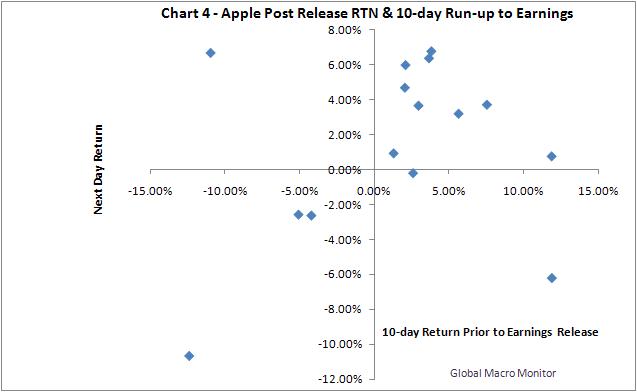
Similar to the overall market, the stock is very hot going into earnings and will need a big beat for the momentum to continue.   Apple is up 9 days in a row, which has happened only three times in the past ten years, and has rallied more than 11 percent in the past 10 days.  Chart 4 shows the post release next day return on Apple given its 10-day return prior to an earnings announcement.  The data covers 15 releases from Jan 2007- Jul 2010.

Excluding the noisy data points during the market crash,  there is a clear negative correlation of how the stock reacts to earnings and its run-up prior to the release.  Note there are only two points where Apple was up 11-12 percent into earnings – January 2007 when it sold off 6 percent after a 46.15% beat, and July 2009 when it traded up .76%. after beating estimates by 15.38%.

Seasonality
Chart 3 is interesting as it illustrates the relationship of the stock’s reaction to the earnings beat.  Not surprising, there is clear strong relationship to how the stock reacts to earnings beats.  The outliers reflect seasonality as three of the four data points with negative returns are associated with a January earnings release. 

Needs 30% Beat
Based on history and given the recent run-up of the stock,  Apple is going to have blow away the estimates and probably needs to hit a number of $5.20 or above to keep the momentum going.  We wouldn’t be surprised, but are not willing to make a big bet on it, or against it, for that matter.  We have no doubt IPad sales will blow away estimates, but we’re focused on margins.  It will be interesting to hear what management has to say about labor and materials costs on the conference call as we know their suppliers have been dealing with these issues.  In addition, during the July conference call,  management stated the IPhone4 has a higher cost structure.  

Our baseline scenario is the good news is sold, which causes a small correction in the overall market and some consolidation in risk assets.

Apple, in our opinion,  is representative of the overall market,  which has run-up in anticipation of QE2.   We love Todd Harrison’s observation,

The net takeaway is more of the same: the specter and promise of QE2. I’ll say this, given the widespread global anticipation of this program, this Wizard of Oz better be a Big Mama when the curtain is finally flung to the side. A chunk of this perceived stimuli is already baked into the tape. The question is whether the “sell the news” crowd will openly ask “what’s next?” once it’s unveiled.

We’ll have more Apple analysis on Monday. Stay tuned!

* Revised based on consistent earning series, which includes Q1 2010 accounting changes.

Posted in Equities | Tagged , , , | 12 Comments