“Bernanke… is fundamentally misguided” – Newt Gingrich

We are wondering out loud if a Tea Party/Republican rout with both houses of Congress changing hands could blindside markets with a huge short covering rally in the dollar?  QE2 needs to be large enough to offset the positive dollar story of the election results, in our opinion.  Furthermore, the policies of Bernanke & Co. are going to experience a squeeze of their own in the new Congress.  Just listen to Newt,

Gingrich is openly critical of the Fed’s anticipated move.

“Chairman Bernanke I think is fundamentally misguided in his approach. The number one job at the Federal Reserve ought to be stable money. And if it’s not producing stable money, it’s going to produce inflation” he said.

By trying to avoid the necessary shakeout, the Fed is making the recession longer and deeper and is stopping new job creation, he said.

“This entire theory that we don’t have enough cash is based on a fundamental misunderstanding of velocity – the volume of money you have is a combination of how much money there is and how fast it turns over. In a period of really deep economic recession people don’t turn it over very fast,” he said.

Just asking.

Posted in Commodities, Currency, Fiscal Policy, Gold, Monetary Policy, Politics | Tagged , , , | Leave a comment

Sovereign Debt: Not So Risk-Free

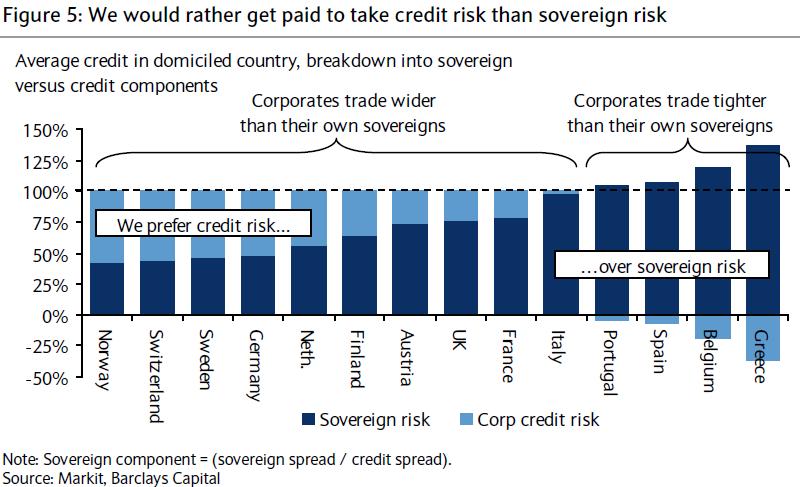
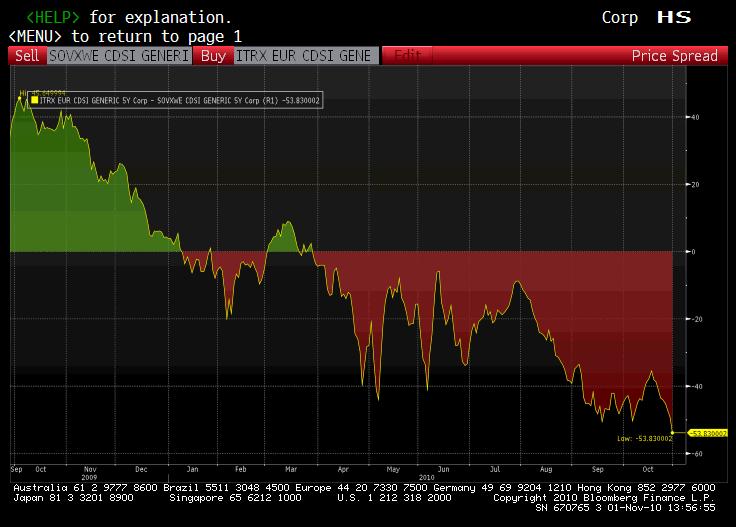
Joseph Cotterill over at FT Aphaville has a great post on how some European corporate bonds are trading through their sovereigns.   Not surprising it taking place in countries without access to a printing press to monetize deficit spending,

Markit pointed out something interesting on Monday: there’s a record spread between their iTraxx Europe and SovX Western Europe CDS indices.

SovX WE — which is filled with such wholesome sovereign goodness as Portugal and Ireland — has obviously had a few down days recently, on account of renewed troubles within its weakest members.

Not to mention possible EU treaty changes on deficit control that might favour sovereign debt restructuring in the long run. ECB board member Lorenzo Bini Smaghi seemed less than cheerful on the changes’ ability to force fiscal reform in a speech made on Monday, so there’s one to watch.

This phase of the new sovereign debt crisis is quite different than what we experienced in the 1980’s LDC Debt Crisis and 1997 Asian Financial Crisis, which were mainly the result of balance of payments problems.  That is, sovereign debtors did not have adequate access to foreign exchange to service their hard currency external debt.

During the 1980’s, the heavily indebted countries were forced to monetize their fiscal imbalances and maintain weak currencies.  This continued even after some countries declared debt moratoriums and stopped interest payments.

The PIIGS of Europe are in a much different situation after their loss of market access to financing.  The brunt of the adjustment falls on public spending reductions, which increases “adjustment fatigue” where the country grows weary of austerity.

Sovereign credit risk includes not only a government’s ability to pay, but also its willingness to pay.  There is no doubt the EU is ready to back-stop the PIIGS so ability to pay is not an issue.   The question is, and one which the markets are wrestling with, will they do so if the fiscal adjustment becomes politically unsustainable?  Stay tuned.

Posted in Black Swan Watch, Bonds, Currency, Fiscal Policy, Geopolitical, Monetary Policy, Policy | Tagged , , , | Leave a comment

Gold and the QE War?

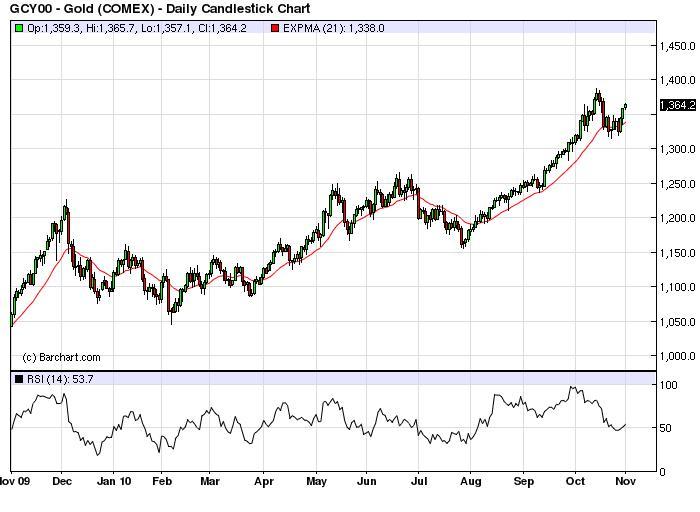
This is going to an interesting week for gold.  We expect some currency fireworks as the Bank of Japan draws a line in the sand for the Yen around the 80 level.  Will the Japanese respond to QE2 with more of their own QE?  If the Fed is aggressive and the Bank of Japan responds in kind, this could be a big week for gold.   We expect to see $1,400 this week and will change our view if gold closes below its 21-day EMA at 1338.   Stay tuned!

Posted in Currency, Gold, Monetary Policy, News, Policy | Tagged , , , | Leave a comment

Rousseff Promises Continuity of Brazil’s Economic Policy

With almost all the votes counted, Dilma Rousseff was elected Brazil’s first female president, with 56% of the votes versus 44% for her opponent, Jose Serra of the Brazilian Social Democrat Party.    The Miami Herald reports,

Dilma Rousseff, a former guerrilla turned economist and key confidant to Brazilian President Luiz Inácio Lula da Silva, was elected Sunday to succeed him in a runoff vote against Jose Serra, former governor of Sao Paulo and minister to Fernando Henrique Cardoso, Lula’s predecessor.

Rousseff’s victory was widely seen as an endorsement of Lula’s policies, enacted over eight years in office, and a desire to continue them.

Brazilian equities have been consolidating for the past month and look ready to break higher.  The Brazilian ETF (EWZ) is primed to take out the recent high of $81.30.  Many are expecting a market wide “sell the news” correction after QE2 and the U.S. election.  We’re not so sure and think the sell-off will much more shallow as there is just too much under invested capital.  We are more concerned with potential currency volatility and how the Bank of Japan may respond to QE2 with its own QE.  Stay tuned!

Posted in BRICs, Equities, News, Politics | Tagged , , , , | Leave a comment

The Yoke is Hard and the Debt Burden is Heavy

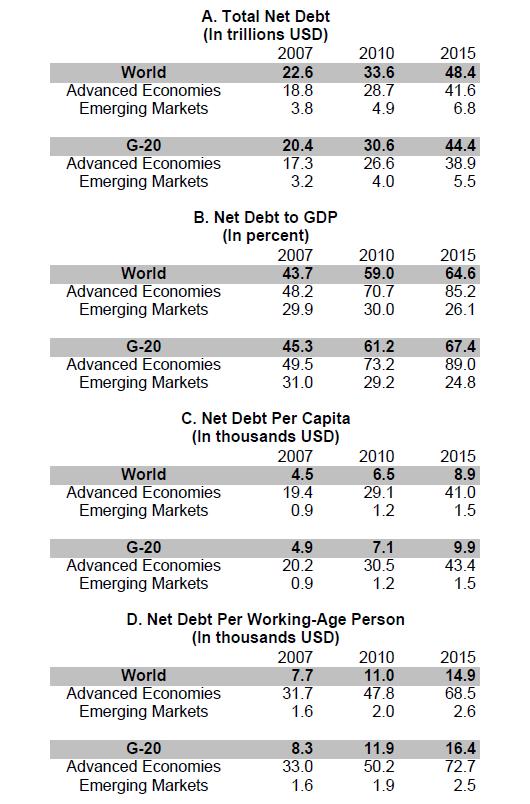
We found this table from Brookings very interesting.  The net public debt per worker of the Advanced Economies in the G20 has increased from US$33K in 2007 t0 US$50.2 in 2010, an increase of 50 percent and projected to grow another 50 percent by 2015.  Clearly, this is too heavy of a burden and is not sustainable.  The Europeans believe it is causing such distress and uncertainty that consumers and business have cut back spending and economic growth will pick-up only when fiscal sustainability is restored.  Witness European austerity.

The table also shows the huge disparity of debt burdens between the Emerging Markets and the Advanced Economies, which is magnified given that 70 percent of world’s economic growth from 2007-10 has come from the Emerging Markets.  This will create great conflict and division in the G20 and will make it difficult to agree on anything of significance, and could even fracture the international structure. 

Posted in Black Swan Watch, Bonds, BRICs, China, Fiscal Policy, News, Policy, Sovereign Risk | Tagged , | Leave a comment

Chart of the Day – Yield Seekers Go Parabolic

“John Bull can stand many things, but he can’t stand two zero percent.”

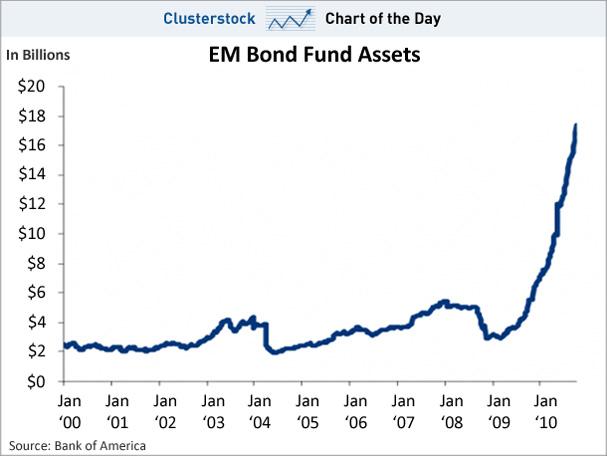
We have written about yield seeking capital flows, the currency wars, and zero interest rate, monetary policy, but nothing illustrates the issue better than this chart of Emerging Market Bond Fund Assets. 


Posted in Bonds, BRICs, Monetary Policy | Tagged , , | Leave a comment

Robert Prechter’s 100 Predictions – 7 years later

Here are 100 predictions that Elliot Wave Theorist, Robert Prechter, made in October 2003.  As my econ professor once said, “if you’re going to forecast, forecast a lot and forecast often.” No mention of the rise of Apple or the election of the first African-American President.  He is a smart guy and has been right on many things, which explains his staying power and ability to still move markets.  Grab the Ambien after the reading.

“Remember as you read the list, Prechter made these forecasts seven years ago.”

Finance
1. Stock markets around the world will continue to fall. Ultimately, the averages will drop more than 90 percent.
2. Real estate values will fall more than they did in the 1930s and 1940s.
3. Rating services will resume the trend of downgrading bond quality. Eventually, states, counties, cities, corporations and even nations will default on bonds in record amounts.
4. Debt packages made of mortgage-backed bonds, auto loans and credit card debt will become viewed as unworthy investments.
5. Many, if not most, pension plans will fall in value and be unable to provide the promised benefits. Anger over this development will result in demonstrations, violence and tardy and ineffective political reform.
6. Prices for collectibles will continue to fall. Many will become little more than curios.
7. More banks will fail than failed in the 1930s.
8. The total amount of credit outstanding worldwide will decline substantially.
9. The Federal Reserve chairman will be labeled a fool who is greatly responsible for the collapse.
The Economy
10. The trend toward economic contraction that began in 2001 will continue to develop into a depression.
11. The unemployment rate in the U.S. and in most countries around the world will rise and eventually exceed 25 percent.
12. A record number of manufacturing companies in the U.S. will fail.
Politics
13. George W. Bush, as we have said since his election and through his highest popularity ratings, will lose the 2004 election, probably in a landslide. [Editor’s note: Did not happen, mainly because the stock market held up.]
14. A Democrat will be the next president. (I think it will be Hillary Clinton, currently not a candidate.) [Editor’s note: Did not happen, but came close in 2008 as Hillary Clinton lost the Democratic primary to Barack Obama who became president.]
15. Many of the entities that were privatized or “de-regulated” during the bull market will be re-nationalized and re-regulated. (A less-likely but possible alternative is that many regulatory agencies will be abolished.)
16. Wave (a) of the bear market in social mood will bedevil more than one president.
17. The occupation of Iraq by the U.S. will progress from a quagmire to a financial, political and public relations disaster.
18. Terrorists will attack the U.S. again, more severely than on 9/11/01, probably within the next 18 months. [Editor’s note: Did not happen in this timeframe.]
19. Separatist movements will gain momentum. Many will successfully establish new geopolitical entities.
20. Fears about technology will lead to restrictions on its development.
21. Politics will become far more polarized, splintered and radical.
Other Social Trends
22. Social groups, including economic, political, religious, genders and classes, will polarize and splinter further. That is, they will polarize both internally and with respect to opposing groups.
23. The birth rate will continue to fall in the U.S. and Europe until the bear market in social mood (as indicated by the downtrend in stock prices) ends.
24. Religion will become increasingly popular. Its advocates will become increasingly passionate. Religious intolerance will increase.
25. Belief in magic will increase.
26. Science will be turned to manipulative or malevolent purposes.
27. Epidemics will increase in number and severity. Malaria will return to the U.S. Eventually, DDT will be re-legalized.
28. Films will break new ground in horror, probably with themes that include suicide and torture.
29. Environmentalists will become militant and intentionally destructive.
30. Disney’s family-fare feature cartoons will fall in popularity, and the studio will stop making them..
31. Professional baseball and basketball will suffer difficulties. New record performances by individuals will become rare. No team will have a “dynasty” during the bear market. Leagues will restructure. Attendance and viewership will fall. Salaries will decrease.
32. New brutal sports will be introduced and gain popularity..
33. Physical fitness (“working out”) will go out of style..
Finance
34. The dollar will lose its place as the world’s reserve currency. Either gold, a currency backed by gold (such as the Islamic dinar), or the Chinese yuan will take its place.
35. The Federal Reserve System will be discredited and then abolished.
36. “The rich” will be vilified, and their property will be increasingly taxed and seized.
37. Regulatory and legislative reforms will limit, curtail or ban a number of structures facilitating speculation, such as options, futures, margin lending, hedge funds, mutual funds, IRAs and 401Ks.
38. Fannie Mae and Freddie Mac will shut down.
39. Financial news networks will change formats or go off the air.
40. Despite attempted manipulation by OPEC or any other nations, the world price of oil will decline. (An exception may occur if production facilities are destroyed or shipping halted during wartime.)
41. The “debt forgiveness” movement in the third world will eventually move to developed countries and see many of its goals realized.
42. The price/earnings ratio for the S&P will hit single digits (probably falling below 6), while the annual dividend yield on the Dow and S&P will rise into double digits (probably rising above 17 percent).
The Economy
43. Countries will adopt numerous trade restrictions, import taxes and other protectionist measures.
44. Consumer confidence will fall to record low levels.
45. The number of new skyscrapers will decline dramatically.
Politics
46. Social Security in its current form will fail.
47. The U.S. will threaten and possibly attack more countries. More countries will oppose U.S. interests.
48. The Third World War, which began on 9/11/01, will escalate.
49. The U.S. will increase restrictions on immigration.
50. The U.S. will require internal travel papers.
51. Both patriotism and anti-government sentiment will grow into powerful emotional forces.
52. Openness and transparency will give way to secrecy. Spies and exclusive social organizations will have increased standing and power.
53. The U.S. will accelerate its trend toward socialism. Opposition to that trend will be vigorous.
Other Social Trends
54. The U.S. space program will be shut down.
55. Conspiracy theories will become more plentiful, and more people will believe them.
56. People will rate “the future” as increasingly less promising.
57. Race relations will become strained and violent.
58. The suicide rate will go up.
59. Mob violence will break out more often than it did from 1982 to 2000.
60. Mass demonstrations, expressing anger with some social situation, will occur.
61. Hemlines will fall, and bright colors will go out of style.
62. Music sales will slump, and popular music will become somber and/or angry.
63. Hedonism will flourish. Pornography will become more bizarre. These trends will meet with social and political backlash, as mainstream behavior will simultaneously become more conservative.
64. Popular self-help books will change focus from wealth and self-improvement to surviving hard times and beating adversaries.
65. Cults and other escapist communities will be established.
66. Food scares, probably including mad cow disease, will hit the U.S.
67. Most restaurants will decline in popularity. “Family-style” traditional fare and home cooking will become popular.
68. Interest in producing the plays of Shakespeare will wane.
69. Anti-gay, racist and xenophobic entities will organize and openly pursue their agendas.
Finance

70. Market timing will come to be viewed as the best approach to investing in stocks, although investing in stocks in the first place will be considered foolhardy. “Buy and hold” will be denounced as a flawed and foolish approach to the stock market.
71. The demographic argument for a continued boom fueled by baby boomer spending and retirement savings will be transformed (somewhere near the bottom of the decline) into an argument that the same portion of the population will be responsible for a continued bust.
72. Many of the governments and corporate entities that have been bailed out by the U.S. government and the IMF over the course of the last 34 years will fail again, along with new ones. The IMF, World Bank, the Fed and other financing entities will not bail them out.
73. The IMF, World Bank and the United Nations will be shut down.
74. Existing high-yield “junk” bonds will fall to zero, and new ones will no longer be issued.
75. After a period of exclusively derisive and negative popular allusions to the stock market, references to stocks in non-financial settings will become all but non-existent.
76. Countless difficulties attending the above events will occur.
77. Bearish speculators will make a lot of money, and safety-minded investors will see their purchasing power rise.
The Economy
78. Affordable housing will become difficult to come by. Family members will move in with each other. Homelessness will increase.
79. China will have a severe economic setback along with the rest of the world, but it will be a “wave 2,” from which the country will emerge as the economic leader of the world.
Politics

80. Suspicion or hatred of foreigners will increase around the globe.
81. Nations will tend away from liberal, representative governments and toward dictatorships.
82. The Drug War will turn more violent. Eventually, possession and sale of recreational drugs will be decriminalized.
83. Government will ration goods and services in which it is or becomes involved (such as gasoline, vaccines, medical care, electricity, water, food, etc.)
84. International travel will be restricted, whether by statute or dangerous conditions.
85. The U.S. and state governments will finish their takeover and demolition of the medical industry.
86. Third parties will gain political clout and win local elections. Libertarians, greens and others will capture many local offices and probably at least one state government.
87. At least one of the two major parties will disappear or re-form.
Other Social Trends
88. Areas of cities will become dangerous in which street gangs “rule” some neighborhoods.
89. The number of Broadway shows will fall dramatically.
90. Disney will close its NYC theater productions, and T. Square will become X-rated again.
91. Well-off people will adopt fashions that conceal rather than accentuate their wealth.
92. Gangsters, pirates and other outlaws will become popular folk heroes.
93. Entertainment media will feature fewer heroes and more anti-heroes.
94. The Olympic Games will be cancelled at least once, if not terminated altogether.
95. Organized labor will grow and become more active. The number and severity of strikes will rise.
96. Many amusement parks will close.
97. The number of coffee shops in the United States will decline substantially.
98. Per capita consumption of alcohol and other depressants will increase.
99. Public art, such as sculptures and murals, will become ponderous and ugly.
100. One or more of the sciences will go through a “paradigm shift.”

Posted in Black Swan Watch, China, Commodities, Currency, Equities, Geopolitical, Policy, Politics, Sovereign Risk, Whales | Tagged , | 10 Comments

China to Resume Shipping Rare Earth Minerals – NY Times

The NY Times is reporting China has ended its Rare Earth export embargo just shortly after Secretary of State Clinton announced she would question the policy on her upcoming visit.  Interesting, China never admitted to export restrictions.

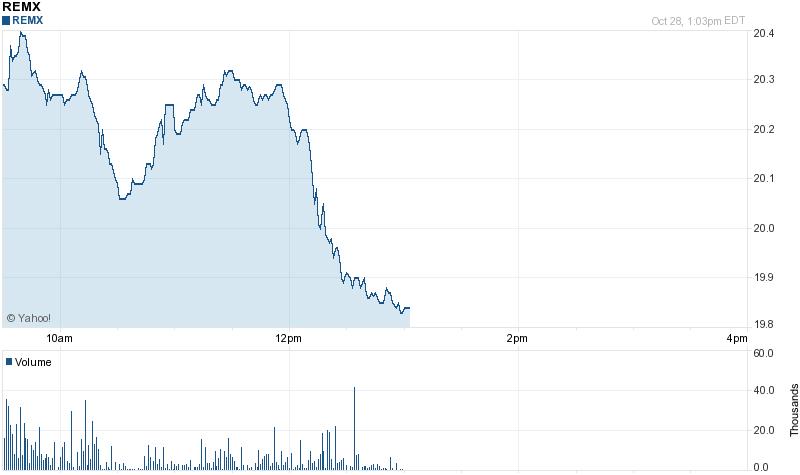
As expected the Rare Earth stocks are getting hammered with Molycorp (MCP) and Rare Earth Elements (REE) down 10 percent.  The new Rare Earth ETF (REMX), which began trading today is down about 2 percent from its opening print.  These stocks will trade from story to story with very high volatility.   The supply of the Rare Earth elements will remain extremely tight for the next few years even given the mixed signals coming out of China, in our opinion.  

Here is what the NY Times has to say,

The Chinese government abruptly ended on Thursday its unannounced embargo of exports of crucial strategic minerals to the United States, Europe and Japan, although shipments to Japan still encountered some difficulties, four rare earth industry officials said.

After blocking shipments of raw rare earth minerals to Japan since Sept. 21, and to the United States and Europe since Oct. 18, Chinese customs officials, without explanation, allowed shipments to resume to all three destinations, said industry officials who insisted on anonymity because of the diplomatic sensitivity of the issue. Resumed shipments to Japan still face additional scrutiny and some delays.

Related Stories
China Is Said to Resume Shipping Rare Earth Minerals – NY Times
China pledges not to use rare earth minerals as weapon – BBC
Clinton to Question China on Minerals – NY Times
Japan’s Nidec to make motors without rare earth metals – Reuters
Rare Earths, Rare Situation – The Cowl
US, Japan Call for New Sources of Rare Earth Minerals – VOA
Sunergy Closes Acquisition of Allied Mining and Supply, LLC’s Large Scale Rare Earth Element (REEs)  in Sierra Leone, West Africa – Marketwire

Posted in China, Equities, Geopolitical, Policy, Politics, Rare Earth Elements | Tagged , , | Leave a comment

France’s half-century spending spree is coming to an end

Run don’t walk to James Traub’s Foreign Policy’s piece, The Spectacle of the Society.  Sarkozy’s approval ratings are at 30 percent as he battles rioters.   There is a lot here, even for Americans:

The drama of rewriting the postwar social contract is taking place across Europe. Over the past generation, globalization has challenged Western economic dominance and forced wages downward throughout the industrialized world; the economic crisis that began in 2008 delivered the coup de grace. The crop of European leaders unlucky enough to hold office amid all this has been stuck with the unpopular job of offering solutions. British Prime Minister David Cameron has proposed a radical assault on the benefits of social democracy, including not just deep cuts in welfare spending, but the elimination of cherished middle-class subsidies. Cameron has also proposed raising the retirement age — to 66. Greece, where a wildly intrusive and inefficient government brought the country to within a hairsbreadth of bankruptcy, has been convulsed by popular resistance to Prime Minister George Papandreou’s proposed cuts. Germany is widely admired for having made painful changes to labor laws without endangering social peace, but the Social Democrats who drove those reforms were booted out of office in a spasm of public anger.

And a lesson for the U.S.,

Americans have no reason to feel smug on this issue. Experts in the United States have long agreed, as they have in France, that the social security system is unsustainable and will ultimately bankrupt the country. And yet both parties fall all over themselves to pander to voters on the protection of those benefits. I have recently been pelted with emails from a liberal, union-supported group called the Strengthen Social Security Campaign, which boasts that “over 135 members of Congress” have signed a letter to President Barack Obama opposing any cuts in benefits or any further increase in retirement age. Of course, all attempts to include serious cost-control measures in the health-care reform bill failed. Rewriting the social contract turns out to be very hard, no matter how obvious the need to do so.

And on the election,

You have to wonder how long this forbearance will last as countries throughout the West adjust to their diminished conditions. The one populist movement in the United States, the Tea Party, opposes the inheritance tax, the repeal of the Bush tax cuts for the rich, and most economic regulation. Its agenda can barely be distinguished from that of the American Bankers Association. What happens when finally the time comes to pay the piper — to reduce entitlement spending and increase taxes? Will the rich still enjoy their immunity? Not likely.


Posted in Geopolitical, Politics, Sovereign Risk | Tagged , , , , | Leave a comment

Rare Earth Metals ETF (REMX) Begins Trading October 28th

Don’t forget the Van Eck Rare Earth/Strategic Metals ETF (REMX) is set to begin trading tomorrow.   The ETF seeks to replicate the performance of the Market Vectors Rare Earth/Strategic Metals Index. Click here for prospectus.

Posted in Rare Earth Elements, Uncategorized | Leave a comment