QE2, Trade Deficits, and the G20

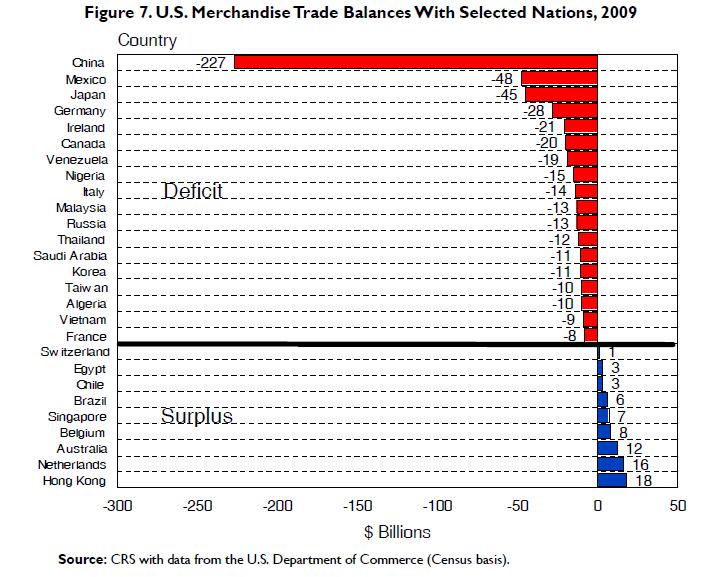
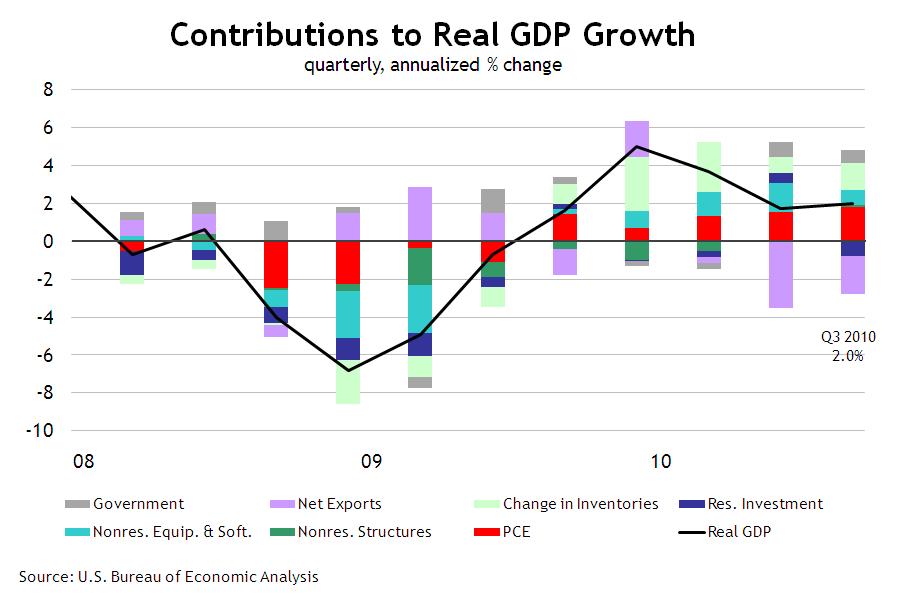
Given next week is the G20 in Seoul and the U.S. is pressing to address trade balances,  we thought the following chart from the Congressional Research Service is quite timely.  Trade deficits are big drag on GDP (see chart below)  so you can guess who the U.S. thinks the bad guys are.

The Chinese have rejected the U.S. proposal and is lining up with many countries upset over U.S. monetary policy.  The G20 risks, at best, turning into a counter-productive complaint and therapy session about QE2, which is currently not priced, in our opinion.  The FT writes,

Cui Tiankai, a deputy foreign minister and one of China’s lead negotiators at the G20, said on Friday that the US plan for limiting current account surpluses and deficits to 4 per cent of gross domestic product harked back “to the days of planned economies”.

“We believe a discussion about a current account target misses the whole point,” he added, in the first official comment by a senior Chinese official on the subject. “If you look at the global economy, there are many issues that merit more attention – for example, the question of quantitative easing.

”China’s opposition to the proposal, which had made some progress at a G20 finance ministers’ meeting last month, came amid a continuing rumble of protest from around the world at the US Federal Reserve’s plan to pump an extra $600bn into financial markets.
Related Articles
US shifts G20 currency focus to trade deficits – FT
China tees up G20 showdown with US – FT
Backlash against Fed’s $600bn easing – FT
Emerging-Market Countries Criticize Fed Decision – NY Times
Guest post: QE2 worsens China’s currency dilemma – FT
Posted in China, Currency, Monetary Policy, Politics, Sovereign Risk | Tagged , , | Leave a comment

All Things (-) Correlated: S&P500 and the Midterm Elections

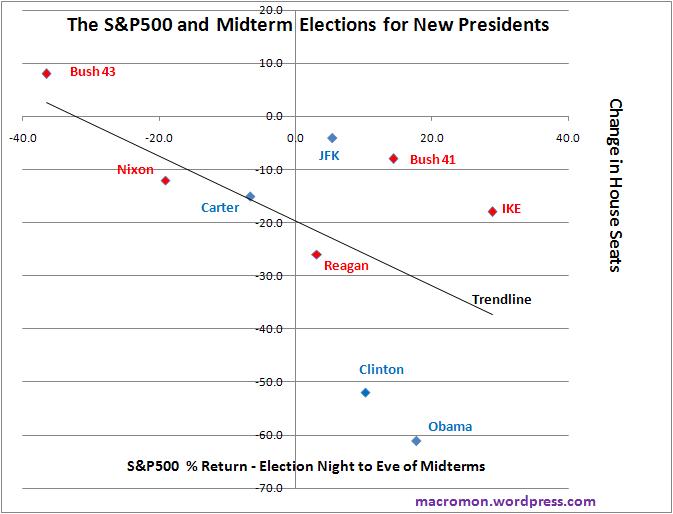
Ask almost anyone if they thought a two-year bull market in stocks would help a new President during his first midterm Congressional elections and the answer would be a resounding YES!.  That is why we were so surprised to discover such a strong negative relationship between the two-year return on S&P 500 from the day the President’s election to the eve of the midterm Congressional elections and the number of seats picked up in the House.

There have only been three post-war Presidents where the S&P5oo had a negative return.  Bush 43 was the only President to pick-up seats even though the S&P500 was down 36.6 percent as the “fear trade” dominated the election cycle after 9/11.   The other two,  Nixon and Carter suffered relatively minor losses in the midterms.

A simple regression shows that, on average, every newly elected President  since Ike loses .6 seats for every one percent increase in the S&P500 (the holding period is from the Presidential election night to the eve of the Congressional election).   The intercept of the regression in -20, which means that if the S&P500 returns zero percent, the President loses 20 seats in the House.  See the trendline in the graph.

The regression analysis is kind of a silly exercise as there many other factors that drive midterm elections, which we will look at in a later post.   Nevertheless, even if the correlation is spurious,  we find the results counterintuitive and very interesting.  The stock market just doesn’t matter!

Posted in Politics | Tagged , , | 1 Comment

Quote of the Day

I predict that the unemployed in this country who will face the inevitable inflation of this money-printing will find little joy in watching Indonesian stocks rise further.  – Howard  Simons

Posted in China, Commodities, Currency, Monetary Policy | Tagged , , | Leave a comment

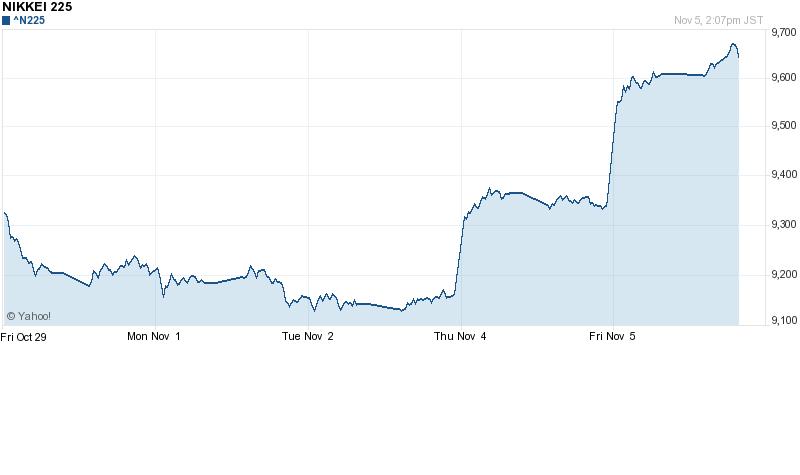
Bank of Japan Outlines Nikkei ETF Purchases

After yesterday’s FOMC action and Ben Bernanke’s Op/Ed in the Washington Post essentially stating the Fed is targeting the stock market, we now get the Bank of Japan’s outline for asset purchases. Next week the BoJ begins buying Nikkei and Topix ETFs.

We think today’s $50 gap up in the gold price will become commonplace as the lack of confidence in fiat currencies accelerates.  This is from Friday’s Bank of Japan Statement on Monetary Policy,

1. ETFs and J-REITs to Be Purchased
(1) ETFs whose prices track the Tokyo Stock Price Index (TOPIX) or the Nikkei 225 Stock Average.
(2) J-REITs that are rated AA or higher and for which there are no concerns regarding their creditworthiness.
(3) In addition, purchase and sale of J-REITs shall have been transacted on a financial instruments exchange 200 days or more per annum, with a total trading value of 20 billion yen or more per annum.

2. Method
(1) The Bank will purchase ETFs and J-REITs as trust property through a trust bank that the Bank appoints as trustee.
(2) Purchases of ETFs and J-REITs shall, taking into account the conditions in the market, be conducted by the trustee pursuant to a standard prescribed by the Bank.

Click here for the full BoJ Statement on Monetary Policy.

Posted in Black Swan Watch, Commodities, Gold, Monetary Policy, Policy | Tagged , , | 1 Comment

‘Firewall needed’ to prevent cash surge – China Daily

We have written in numerous posts about John Bull’s “Tsunami of Dollars” flooding into the emerging markets.   China Daily writes,

China should “set up a firewall” as uncontrolled dollar printing in the United States will drive more liquidity into emerging markets, a central bank adviser said on Thursday.

“The most urgent need for the emerging market economies is to curb capital inflows,” Xia Bin, an academic member of the central bank’s monetary policy committee, told a financial forum in Beijing.

Xia’s comments came as the US Federal Reserve announced a new round of quantitative easing – pledging to buy $600 billion of government bonds – to prop up the ailing economy.

Claiming the US quantitative easing was “unbridled money printing”, Xia said China should push for plans to stabilize the world’s major currencies at the upcoming G20 summit.

This sets the stage for what may be a very contentious G20 summit in Seoul next week and increases the event risk, which is currently off-radar and should be monitored closely.


Related Articles
Brazil’s Meirelles: Fed’s latest move on G20 agenda – Reuters
Emerging markets slam Fed’s QE2 stimulus – The Globe and Mail
‘Firewall needed’ to prevent cash surge – China Daily
China says inappropriate to target trade deficits at G20 – Reuters

Posted in BRICs, China, Commodities, Credit, Currency, Equities, Gold, Monetary Policy | Tagged , , , | Leave a comment

GIDDY-FRICKIN-UP!

Was it Bernanke’s piece in today’s Washinginton Post that a higher stock market is the economy’s healing balm?

This approach eased financial conditions in the past and, so far, looks to be effective again. Stock prices rose and long-term interest rates fell when investors began to anticipate the most recent action.  Easier financial conditions will promote economic growth. For example, lower mortgage rates will make housing more affordable and allow more homeowners to refinance. Lower corporate bond rates will encourage investment. And higher stock prices will boost consumer wealth and help increase confidence, which can also spur spending. Increased spending will lead to higher incomes and profits that, in a virtuous circle, will further support economic expansion.


Posted in Commodities, Currency, Equities, Monetary Policy, Policy | Tagged , , | Leave a comment

Beijing, China 2030 AD

What would Krugman think?


Posted in Black Swan Watch, China, Fiscal Policy, Geopolitical, Monetary Policy, Policy, Politics | Tagged , | Leave a comment

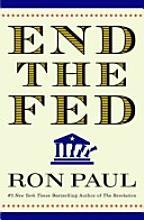
Ron Paul to Chair Monetary Policy Subcommittee

That is what Dave Weigel over at Slate is saying,

Sometimes all you need is the headline. Ron Paul is slated to run this subcommittee, giving him some actual power and a megaphone on the issue dearest to his heart.

This is a must watch interview from Fox News today if you want to understand Ron Paul’s thinking on monetary policy.  He confirms it is highly likely he will get the Chair.  He also half jokes how he and his Senator-elect son will introduce a bill to “end the Fed” on the first day of the new Congress.  Not that is will become law, but a sign of the fireworks sure to come.  Imagine the grief and abuse Bernanke will take from the new Congress if crude tops $100?  Go to 2 minutes….

Related Articles
A Monetary Policy For the Tea Party Movement – Finance Blog
Rep. McMorris Rodgers First to Oppose Fed’s New Monetary Policy – The Daily Sheeple

Posted in Currency, Monetary Policy | Tagged , , | 1 Comment

What the Fed did and why – Ben Bernanke

Ben Bernanke published an Op/Ed piece in today’s Washington Post explaining the FOMC’s action.  Here are the money quotes,

The FOMC decided this week that, with unemployment high and inflation very low, further support to the economy is needed. With short-term interest rates already about as low as they can go, the FOMC agreed to deliver that support by purchasing additional longer-term securities, as it did in 2008 and 2009. The FOMC intends to buy an additional $600 billion of longer-term Treasury securities by mid-2011 and will continue to reinvest repayments of principal on its holdings of securities, as it has been doing since August.

This approach eased financial conditions in the past and, so far, looks to be effective again. Stock prices rose and long-term interest rates fell when investors began to anticipate the most recent action.  Easier financial conditions will promote economic growth. For example, lower mortgage rates will make housing more affordable and allow more homeowners to refinance. Lower corporate bond rates will encourage investment. And higher stock prices will boost consumer wealth and help increase confidence, which can also spur spending. Increased spending will lead to higher incomes and profits that, in a virtuous circle, will further support economic expansion…

Our earlier use of this policy approach had little effect on the amount of currency in circulation or on other broad measures of the money supply, such as bank deposits. Nor did it result in higher inflation. We have made all necessary preparations, and we are confident that we have the tools to unwind these policies at the appropriate time. The Fed is committed to both parts of its dual mandate and will take all measures necessary to keep inflation low and stable.

Wow!  Unambiguous statement the Fed is targeting  equity prices.   Giddyup!

Posted in Equities, Monetary Policy, News, Policy, Politics | Tagged , , , | 2 Comments

Fed to Face Short Squeeze in New Congress

The Republican takeover of the House and some big gains in the Senate will put the heat on the Fed over its ultra-loose monetary policy.  We wrote about the hard money bias of the new Republican leaders several weeks ago.  Rand Paul’s landslide victory to replace Jim Bunning will send one of the Fed’s most outspoken critics to the Senate to compliment his father, Ron Paul, in the House.  If you think Jim Bunning’s Fed “chin music” was nasty, just wait until Rand Paul takes the mound!   This is from his website,

With so much blame going around for the current financial crisis it is surprising that so few in the mainstream press have discussed the role of the Federal Reserve System. For too long the Federal Reserve has operated behind a shroud of mystery—as Senator I would make sure that all Americans understand the dangers of unsound monetary policy and shed light on this secretive organization.

It it will interesting to see if the FOMC is influenced by today’s election results. The NY Times wrote a few days ago,

Criticism of the Fed has been more of a simmering undercurrent in this election cycle than a dominant theme, even for insurgent candidates. But Fed officials, who try to avoid public discussion of electoral politics, have become increasingly attuned to the probability that their critics will have a louder voice in the next Congress.

Clearly today’s election was a referendum on large budget deficits and should be good for bonds in the short-term.  If the Fed now senses the political winds and trims the sails of QE2,  we will see a nutcracking short squeeze in the dollar.   Stay tuned!

Related Articles
Rand Paul Victory Sends Fed Critic to Senate – WSJ
Bernanke Faces More Congressional Scrutiny After Republican Election Gains – Bloomberg
How the tea party helped GOP find a path to Election Day successes – CSM
From Tea Party Advocates, Anger at the Federal Reserve – NY Times

Posted in Fiscal Policy, Monetary Policy, Politics | Tagged , , , , | 1 Comment