The Three Legs of the Q4 Melt-up

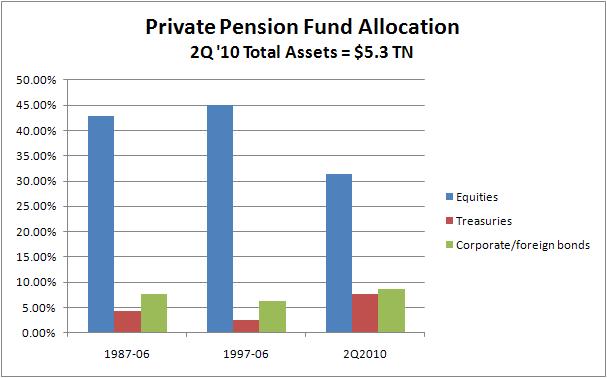
1)  Under allocated investors…

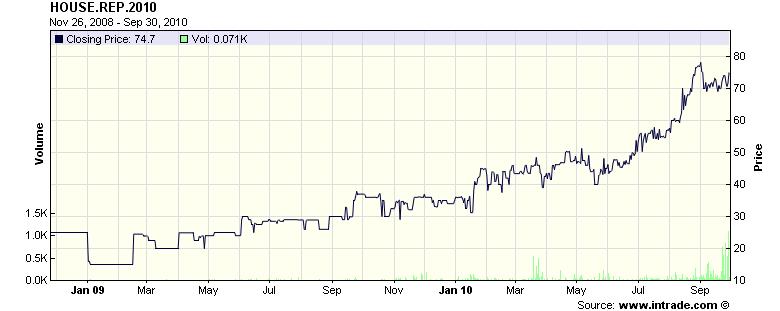
2)  Expectation of a Republican victory in the  November election…

3)  The Flood of Liquidity unleashed by ultra-loose global monetary policy…

“The Bank of Japan will encourage the uncollateralized overnight call rate to remain at around 0 to 0.1 percent…As assets to be purchased, the Bank will examine long-term government bonds, treasury discount bills, commercial paper (CP), asset-backed CP (ABCP), corporate bonds, exchange-traded funds (ETFs), and Japan real estate investment trusts (J-REITs).” –  Bank of Japan Statement on Monetary Policy

Posted in Commodities, Credit, Currency, Equities | Tagged , , , , , , | Leave a comment

Central Banks Gone Wild: Paulson Says Gold Price to $4,000

The Gold fear trade is back on.  That is, traders and investors fear they are not long enough.  The Bank of Japan really got the party started as Bloomberg reports,

“The unexpected decision by the Japanese central bank yesterday to drop its interest rate to “virtually zero” and expand its balance sheet follows the U.S. Federal Reserve’s move toward more unconventional easing. Bank of England officials will consider further stimulus tomorrow, while the central banks of Australia, Canada and New Zealand are among those now holding fire on further interest-rate increases.”

With almost all assets and commodities moving higher,  loose monetary conditions are starting to bite and we wouldn’t be surprised that credit expansion is partially behind the recent melt-up.

Note, emerging market central banks are also effectively “printing money” to purchase the excess dollars showing up in their foreign exchange markets in order to prevent rapid currency appreciation.  Sterilization,  or mopping up, the excess liquidity is not always fully effective and can lead to inflationary pressures and local asset bubbles.

There we have it.  Classic asset market monetarism — “too much money chasing too few assets/commodities.”    No wonder John Paulson is long gold,

“John Paulson, the hedge fund magnate who rose to fame for shorting securities tied to the housing market prior to the financial crisis of 2008, recently expressed his bullish outlook for the gold price…In a speech at the University Club in New York City, Paulson provided his broad outlook on several areas of the financial markets – including stocks, bonds, real estate, the Federal Reserve, and the price of gold...Given his expectation for further money printing by the Fed – and that in 1980 the gold price rose by 100% more than the correlation implied – Paulson noted that the price of gold could hit $2,400 based only on monetary expansion, and as high as $4,000 per ounce based on a projected overshoot.  Lastly, he noted that 80% of his assets are denominated in gold – a strong indication of his disdain for fiat currencies.  – Gold Alert

Posted in BRICs, Commodities, Credit, Currency, Gold, Monetary Policy | Tagged , , , | Leave a comment

Breakup of the Euro isn’t unthinkable – Peer Steinbrueck

Peer Steinbrueck, who served as finance minister under Angela Merkel from 2005 to 2009, has published, Unterm Strich (“On Balance”), his insider view of the financial crisis. It looks to be a fascinating read.  Bloomberg has a great first look:

A breakup of the European currency zone isn’t unthinkable, though it would be a catastrophe, he says. The Greek crisis exposed what he describes as “the birth deformities of European currency union” — the absence of common economic policies. The idea of creating them now is an “illusion,” he writes…

In a rare political-insider cameo, Steinbrueck recalls meeting George Papandreou in January 2009 in Berlin, when the current prime minister of Greece was still in opposition. After soliciting deficit-reduction advice, Papandreou remarked, tellingly, that “he was no longer sure he really wanted to win the election.”…

Steinbrueck describes Tuesday, Sept. 16, 2008, the day after Lehman filed for bankruptcy protection, as “one of the most dramatic days of my political life.” After speaking in parliament with “the world teetering on the edge of an abyss,” he met a former U.S. treasury secretary for a long-arranged appointment.

“Even Robert Rubin couldn’t explain the Lehman case to me…”

The major risk to the Euro’s viability is reform fatigue and the European street’s unwillingness to continue with the necessary budget austerity to realize EU fiscal convergence.   The political risks are high as slashing budgets have few supporters x/sovereign creditors.   A Euro fracture in the next few years is currently a low probability,  but not impossible.

During his European tour, China Premier Wen Jiabao told Greek lawmakers that his country applauded Greece’s handling of its debts crisis and said the country is interested in buying Greek government bonds.   China is using the leverage of its $2.4 trillion war chest of international reserves to win friends and influence in the international financial community.   Stay tuned.

Related Articles
China’s Wen offers to buy Greek debt – Reuters
Germany’s Steinbrueck Says Greece Was Just ‘a Foretaste’: Books – Bloomberg
Tougher austerity measures for Greece – BBC
Greece announces new austerity measures – BBC
Europe on strike over austerity measures – Telegraph
Europe-wide day of action fizzles – Montreal Gazette
Flames of anger: Strike fury over spending cuts sweeps Europe – Daily Mail
EMU Break-up:  Quantifying the Unthinkable – ING

Posted in Black Swan Watch, Bonds, China, Credit, Geopolitical, Monetary Policy, Policy, Sovereign Risk | Tagged , , , , | Leave a comment

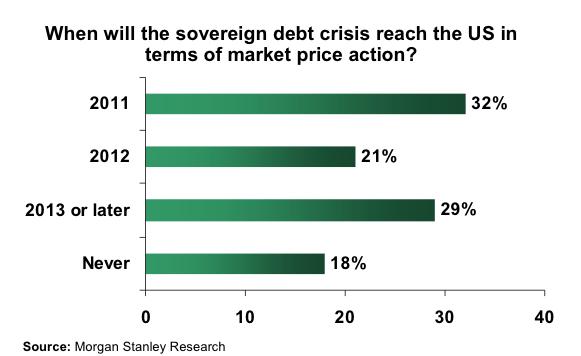
MS Poll: 53% Believe US Debt Crisis By 2012

An interesting chart from the Business Insider of the results of a Morgan Stanley survey of 150 clients at a recent investment conference.   Shockingly, more than 50% of the investors polled believe the US will experience a sovereign debt crisis by 2012.

This is the one issue that keeps us up most at night.   The yield on the 10-year Treasury closed at 2.47% today,  so clearly the market is not pricing this.   We have written that the bond yield is not a reflection of fundamental value and is distorted by various technical factors.  Policy makers must not be lulled into complacency thinking the low yields are a vote of confidence in fiscal policy.

One thing we have learned during this crisis is that markets are prone to doublethink and can live, simultaneously,  in two different realities.  Stay tuned.


Posted in Black Swan Watch, Bonds, Credit, Monetary Policy, News, Policy, Politics, Sovereign Risk | Tagged , , , | Leave a comment

Black Swan Watch: Cyberwarfare and Iran’s Revenge

Computer World reports Iran has arrested several “spies” connected to a cyber attack on its nuclear program,

“According to the Tehran-based Mehr News Agency, Heydar Moslehi, Iran’s minister of intelligence, said that “enemy spy services” were responsible for Stuxnet, the sophisticated worm that has infected at least 30,000 Windows PCs in the country, including some at the Bushehr nuclear power plant.

The DEBKAfile, an intelligence and security news service, writes that Iran is seeking revenge for the Stuxnet cyber attack,

“Tehran is bent on military action to settle scores with Israel and the United States whom it suspects of planting the malignant Stuxnet cyber worm in the computer systems of its nuclear, military and strategic infrastructure, debkafile’s military and US sources report. The timeline of this attack revolves around the state visit to Lebanon President Mahmoud Ahmadinejad has scheduled for Oct. 13-14, during which he will tour the Israeli border. Preying heavily on Iran too are the personal sanctions the United States has just imposed on its top military brass and ministers.”

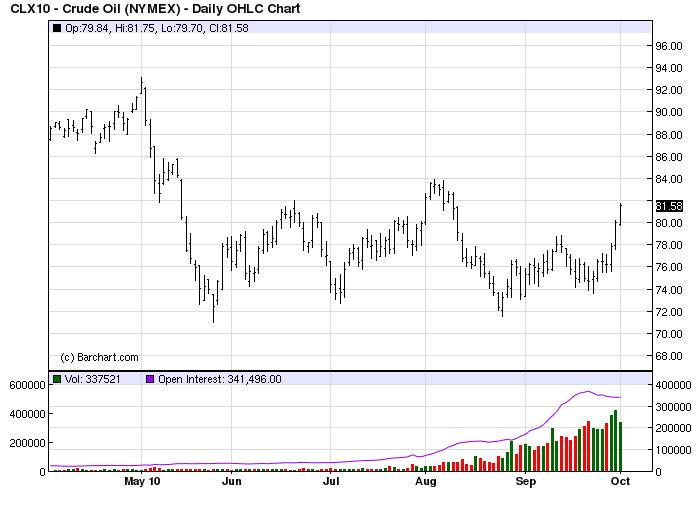
This is one issue – which could be the subject of a Tom Clancy novel – that has been flying under the market radar.   It could surface in October and may have partially influenced the 10% spike in crude prices over the past few weeks.   Our sense is the markets, and specifically crude oil, will begin to focus on a potential elevation of geopolitical risks,  especially given recent reports of imminent “Mumbai style” terror attacks in Europe.  We suggest you keep it on your radar.

Related Articles
The first full-scale cyber attack on a state – Debka
Iran confirms massive Stuxnet infection of industrial systems – Computer World
Stuxnet malware is blueprint for computer attacks on U.S. – Washington Post
Was Stuxnet Built to Attack Iran’s Nuclear Program? – PC World
Concern That Terror Teams Have Selected Targets, Ready to Strike – ABC News
US: Imminent terror attack anywhere in Europe – Debka

Posted in Commodities, Geopolitical, Gold, News, Politics | Tagged , , , , | Leave a comment

Release of New $100 Note Delayed…Printing Press Problems!

We’re not making this up!  Though the “printing press” is  more metaphor than physical reality with respect to monetary policy, this news couldn’t be more timely!  To understand how the Fed electronically “prints” money click here. Here’s the money quote:

“A central bank implements QE by first crediting its own account with money it has created ex nihilo (“out of nothing”).[1] It then purchases financial assets, including government bonds, mortgage-backed securities and corporate bonds, from banks and other financial institutions in a process referred to as open market operations. The purchases, by way of account deposits, give banks the excess reserves required for them to create new money, and thus a hopeful stimulation of the economy, by the process of deposit multiplication from increased lending in the fractional reserve banking system.”


Press Release

Federal Reserve Press Release

Release Date: October 1, 2010

For immediate release

The Federal Reserve Board on Friday announced a delay in the issue date of the redesigned $100 note.  This new design incorporates cutting edge, anti-counterfeiting technologies and the Federal Reserve imposes strict quality controls to ensure that users of U.S. currency around the world receive the highest quality notes.

The Bureau of Engraving and Printing manufactures Federal Reserve notes and has identified a problem with sporadic creasing of the paper during printing of the new $100 note, which was not apparent during extensive pre-production testing.  As a consequence, the Federal Reserve will not have sufficient inventories to begin distributing the new $100 notes as planned.

The Bureau of Engraving and Printing is working to resolve this problem, and the Federal Reserve Board will announce a new issue date for the redesigned $100 note as soon as possible. The originally scheduled issue date was February 10, 2011.

Posted in Monetary Policy, News | Leave a comment

Ryder Cup Weekend Reading

A little Ryder Cup fodder to pass the time during the rain delays.  Our faves, and your must reads,  are highlighted in green, in honor of Lula and the Brazilian elections this Sunday.  Click highlighted source to link to original articles.  Enjoy!
China

China moving heaven and Earth to bring water to Beijing
– L.A. Times
For US and China, Co-Dependency Breeds Bilateral Risk
– WSJ
Commodities

Gold is “hyper overbought”,  Dennis Gartman- Pragmatic Capitalism
Replacing Oil Addiction With Metals Dependence?
– National Geographic
U.S. aims to end China’s rare earth metals monopoly – Reuters
QE2 could boost oil price – Reuters
Currency

France and China in exchange rate talks
– FT
LatAm currencies firm on China export demand – Reuters
Why China Is Unwilling to Revalue the Yuan
– Baseline Scenario
Emerging Markets

Latin America Favored Over China in Survey of U.S. Companies, HSBC Says – Bloomberg
Lula’s legacy
– Prospect
Venezuela’s legislative election: The revolution checked
– Economist
Equities

Canadian Stocks Rise, Closing Weekly Gain, as Oil Surges – Bloomberg
European Stocks Post Biggest Weekly Decline in Three Months – Bloomberg
Emerging Stocks Rise to 27-Month High for Fifth Weekly Gain – Bloomberg
Fixed-income

Japan 10-Year Complete Three-Week Gain on Possible Monetary Easing –Bloomberg
Fed plays risky game toying with bonds
– FT
General

CFTC starts overhaul of U.S. swaps market
– Reuters
David Rubenstein: U.S. is losing its competitive edge – Fortune
Global Economy

Brazil exports, factory output dip as currency strengthens gains – Reuters
Rare Earth Minerals Stumbling Block to a Green Future – Energy Tomorrow
Global Monetary Policy

RBA Is Likely to Raise Interest Rates On Oct. 5 Meeting – Bloomberg
Fed’s Evans: More policy accommodation ‘desirable’ – Reuters
Fed’s Fisher Says Need for More Monetary Policy Easing ‘Not Crystal Clear’ – Bloomberg
ECB Orphanides: Short-Term Rates Not Good Signal Of Policy Stance – WSJ
N.Y. Fed chief Dudley: ‘Further action likely to be warranted’  – Washington Post
The Weimar Solution – WSJ Blog
Inflation/Deflation

Deflation: ‘Way Past the Point of No Return’ – Elliot Wave
Deflation, sagging exports dog Japan’s recovery – CNN
Inflation Everywhere but in the Mind of the Fed – Forbes
Indonesia Sept. Inflation Slows to 5.8%; Central Bank Seen Holding Rates – Jakarta Globe
Sovereign Risk

Greek Bonds Advance for First Time Since Debt Crisis Began: Euro Credit – Bloomberg
EU Warns of ‘Contagious’ Effects From Sovereign Debt on Banks – Bloomberg
Japan PM warns on debt, seeks multiparty tax talks – News Daily
Ratings Firms Face Fines, Tougher EU Rules on Sovereign Debt – Bloomberg
Shock, awe and the massive debt crisis – Sydney Morning Herald
Stress test shows RBS exposure to Irish debt – FT

Posted in News | Tagged | Leave a comment

The Ketchup Trade

We spoke yesterday how the “catch-up” trade, where laggards outperform,  may be the theme of the markets for the next few weeks.”  So far, so good.  They took the dawgs of Q3, the financials and the oils,  today.  Heinz (HNZ) was up $.14, or .30%.   Stay tuned!

Posted in Equities | Tagged , | Leave a comment

Bloomberg to Replace Geithner?

The Washington rumor mill is buzzing!  Larry Kudlow just said a Washington insider told him Michael Bloomberg will replace Tim Geithner as Treasury Secretary.  The NY Post reported in early September the President had spoken with Bloomberg about the Treasury job.   Doesn’t he want David Letterman’s job?

Here are some more juicy ones from Jim Puzzanghera and Tom Petruno of the L.A. Times,

The latest buzz was that Obama would tap one of two big names from mutual fund giant Pacific Investment Management Co.: widely regarded fund manager Bill Gross or Chief Executive Mohamed El-Erian.

Both deny and said they were shocked at the rumors.   Mohamed, one smart and articulate dude (OSD) sure seems to us to be vying for a policy position.   Click here for his,  Beyond brinkmanship: A better economic path for the U.S. and China, piece in today’s Washington Post.

And more,

Their names joined those of corporate chieftains and Nobel Prize-winning economists as potential replacements for Summers, whom the White House said last week would be leaving at the end of the year to return to Harvard University.

Those possible corporate candidates include former Xerox Corp. Chief Executive Anne Mulcahy, General Electric Co. Chief Executive Jeffrey Immelt and Citigroup Inc. Chairman Richard Parsons.

Economists and academics mentioned include Laura Tyson, a University of California-Berkeley economist who chaired the National Economic Council from 1995 to 1996 under President Bill Clinton; former Labor Secretary Robert Reich; and Nobel Prize-winning economists Paul Krugman and Joseph Stiglitz.

We vote for Immelt!   Stay tuned!


Posted in Policy, Politics | Tagged , , , | 2 Comments

John Bull’s Tsunami of Dollars Flood the Copacabana

We have written how “the tide of yield seeking capital flows will surge” as John Bull can stand many things, but he can’t stand two zero percent. One recipient of John Bull’s dollars (managed by PIMCO)  is the Brazilian bond market, where interest rates exceed 10 percent in one of the strongest currencies in the world.
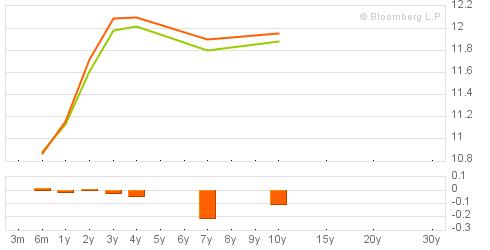
The flood of dollars is putting excess upward pressure on the Brazilian Real, forcing the central bank to intervene in the foreign exchange market,  effectively printing their own currency to buy surplus dollars.   Bloomberg reports,

“The central bank bought $9.4 billion from Sept. 1 through Sept. 24 in the foreign-exchange market, the most over such a period since the end of 2008, as part of an effort by policy makers from Japan to Colombia to slow the appreciation of their currencies...The central bank has purchased dollars every day since May 7, 2009, swelling its foreign reserves to a record $275 billion, to slow the currency’s advance.”

Brazil’s currency has appreciated 37 percent since the end of 2008 causing a loss of competitiveness and a deterioration in the country’s current account deficit.   This, coupled with the difficulty of mopping up,  or sterilizing, the excess liquidity generated through foreign exchange intervention,  is forcing Brazil’s finance minister to consider capital controls to discourage further inflow of dollars.   According to Bloomberg,

“Mantega, 61, said Sept. 27 that the government is considering implementing a tax on short-term, fixed-income investments as other countries engage in a “currency war” to weaken their exchange rates and bolster exports. Brazil implemented a 2 percent tax in October 2009 on foreign investment in the stock and bond markets.”

The announcement caused yields on Brazil’s 10-year bond to shoot up almost 40 bps this week,  inflicting pain for many foreign investors, who hold large positions in the long-end of yield curve.   According to the central bank, foreigners held around $90 BN of Brazilian local currency bonds at the end of August, equivalent to 10.1 percent of the debt, up from 0.8 percent in 2005.   Brazil’s aversion to hot money and excessive current account deficits is understandable given their painful experience in the 1980’s and early 90’s debt crisis.

So there you have it.   Go no further to understand why Gold is at $1,300 and heading north and the U.S. 10-year bond rate is at 2.5% and heading to 2.0%.  The Brazilian central bank has to put its $275 BN in reserves to work somewhere, and it is only one of many central banks in the same boat Ark.

Brazil is fighting one of the early battles of Bubble 2.0 3.0. And this, before QE2 has left port.  Imagine the flood of liquidity if only a portion of excess U.S. bank reserves are put to work and credit starts to expand!   We fully expect price bubbles to inflate in the emerging markets and the pressure for capital controls to increase.  Stay tuned!
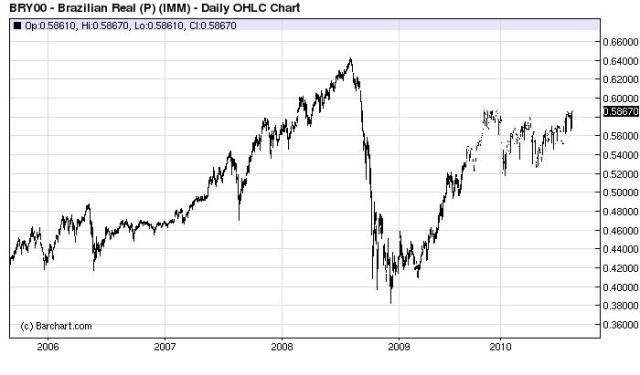
A classic “Cup and Handle” technical formation.

Posted in Bonds, BRICs, Commodities, Currency, Equities | Tagged , , , , , , | 5 Comments