Heeee’s Back…Karl, Is That You?

Gallup_1

In case you missed it, or don’t read the Drudge Report,  here is the current banner headline:

Drudge_Repor_Socialism

Should we?  Ah, uh, well…we can’t help ourselves:   YOU HEARD IT HERE FIRST!

In February 2018, we looked at the data of the political preferences of younger voters and wrote the post,

Karl, The Comeback Kid?

By the way, after that post in early 2018, everyone began to jump on the comeback Karl train.

Socialism

Socialism is a trigger word, which will be ubiquitous in the 2020 presidential campaign, is not well understood, is ambiguous, and ill-defined by most who toss it around, and ultimately means whatever you want it to mean to lend support for your politics.

Is Danish and Nordic socialism, or capitalism,  the same as Venezuelan or Cuban socialism?  What exactly does socialism with Chinese characteristics mean?

Closer To Home

Closer to home,  if you ride Amtrak and prefer the U.S. post office over FedEx or letting brown do it for you, does that make you a socialist?

Is our progressive marginal tax system socialist?

Is golf’s handicap system a form of socialism?

Are you a socialist if you believe the government should not allow markets to clear and Fed is increasingly called upon to intervene in the stock market to bail out risk-takers and traders who have racked up steep losses?  We call these the “market socialists,” by the way, and include the POTUS and Jim Cramer.  Others call it “socialism for the rich.”

Is deposit insurance (the FDIC government guarantee)  on your checking account a form of socialism?

What does it mean for the government to control the “commanding heights” of the economy?

What Is The Role Of Government

We are not confident the majority of the public has a clear understanding of the term “socialism” but very confident it won’t stop the politicos — who, most likely,  have an even more limited understanding —  from exploiting that ignorance to obtain power.

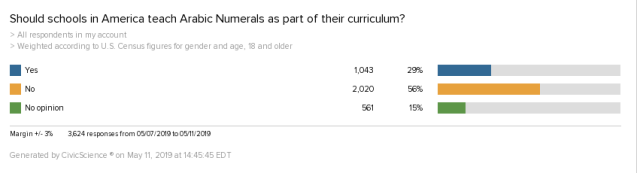
After all, a recent poll showed that 56 percent of the public does not support the use of Arabic numerals being used in public schools.   The term “Arabic” in the survey question is also a trigger word and probably confused many to the fact Arabic numerals are ubiquitous in the United States (0,1,2,3,4,5,6,7,8,9).

Poll

Let us be clear so you know where we stand.

  1. Free markets, i.e., the private sector, usually work better than the government but sometimes don’t, such as the case of public goods — clean air and waterways, roads, law enforcement, and the national military.  Markets do fail sometimes, not incorporating the cost of side effects, such as pollution,  what economists call externalities.
  2. True free markets do not exist.  As we once heard, “life is the search to find a monopoly.”    So too it is with the business sector,  they don’t like competition and will, if possible, lobby the government for protection from competition, either foreign (very relevant today) or domestic.   No judgment, it is just what they do and it needs to be regulated lest the economy becomes the economy of the few.   Only the buyer and the bought benefit when big corporate money meets politics.  But, hey, it’s freedom of speech, no?   Corporations are people too.
  3. Incentives are a good thing.  Public sector unions, especially the teachers, could do better by adopting more of them.
  4. People enter the economy with unlevel playing fields and unequal resource endowments, such as human capital, most importantly, the strength and efficacy of the family unit they’re born into.  The government does have a role pulling up the less fortunate, trying to increase their chances of being productive taxpayers, mainly through education and training.   Also providing the necessary resources to develop the human capital to succeed in the modern day labor force, including adequate nutrition for children   If you are a golfer on the first tee of a skins game, think, “what is your handicap?” The golf handicap is the biggest form of socialism in all of sport, ironically, predominantly played by some of the wealthiest self-professing capitalists.
  5. If you are reading this blog, you’re part of the  “Lucky Sperm Club” and that realization will help you better internalize the concept of “grace” and impact your values and world view.

We define socialism as government control of the means of production and main channels of commerce.

Mixed Economy

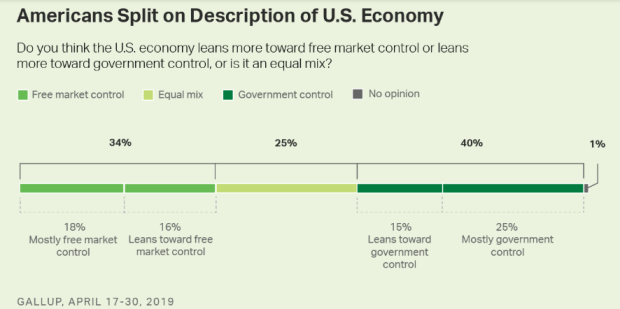
Gallup_2

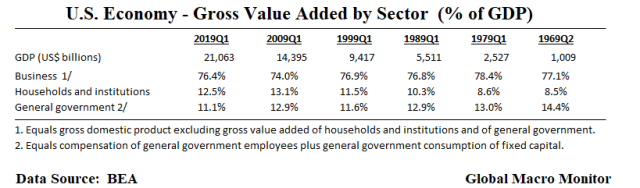
Let’s get real, folks,  the U.S. is a mixed economy.   The production of goods and services is dominated by the business sector but also has a relatively large government value added (production) as a percent of GDP.   The public sector arm also reaches much further into the economy than just producing goods & services, however, in the form of spending, taxation, redistribution, and regulation, just to name a few.

Good or bad?  You decide.

Value Added

The Clash Of Generations Is Here

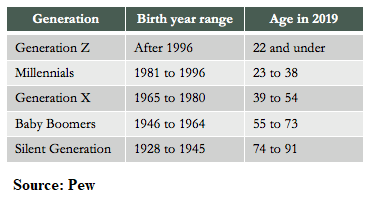
We have been writing for several years about the coming “Clash of Generations.”   See here.

Pew_Generations

It’s here folks, and we are going to see it played out in the 2020 presidential election.  The scenario may play out not like any elections we have witnessed since the passing of the political torch that torched the summer of 1968 when the parents and grandparents of those now fighting for a seat at the table of political power were doing the same.   This time, it ain’t about Vietnam, however.

Millennials cannot be blamed for concluding that the economy is rigged against them. True, in absolute terms, Americans under 40 carry less debt than middle-aged Americans. But their debt profile is toxic. Nearly half of it comes from student loans and credit cards. In contrast, 72 percent of the debt held by Americans aged 40 to 49 is mortgage debt, which comes with tax advantages and allows debtors to build home equity as they repay their loans…

Young people then struggle to stay above water financially after they graduate. The net worth of the median Millennial household has fallen nearly 40 percent since 2007. This is not because they eat too much avocado toast; it is because student loan payments consume the income that they would otherwise save. Headline unemployment figures show that the labor market is humming. It does not feel that way for Millennials, who have never experienced a “good economy.” – The Coming Generation War,  The Atlantic 

Pew_Generations_2

We hope 2020 will not be as violent and disruptive as in 1968.   Make no mistake, however,  the Summer of Discontent cometh.

Finally, we leave you with a caveat about trying to predict the future on such matters,

In 1960, Friedrich Hayek predicted in The Constitution of Liberty “that most of those who will retire at the end of the century will be dependent on the charity of the younger generation. And ultimately not morals but the fact that the young supply the police and the army will decide the issue: concentration camps for the aged unable to maintain themselves are likely to be the fate of an old generation whose income is entirely dependent on coercing the young.” It hasn’t turned out that way at all—a salutary warning that it is much easier to identify generational conflicts of interest than to anticipate correctly the political form they will take. – The Coming Generation War,  The Atlantic 

Stay tuned.

Posted in Economics, Politics, Uncategorized | Tagged , , | Leave a comment

BFTP: Rare Earth Day 5.0

BFTP:  Blast From The Past

Wow, here is a blast from the past.  Ahhhh, the daze of trading rare earfs!

Watch this one, folks.  It may play big in the trade war with China.

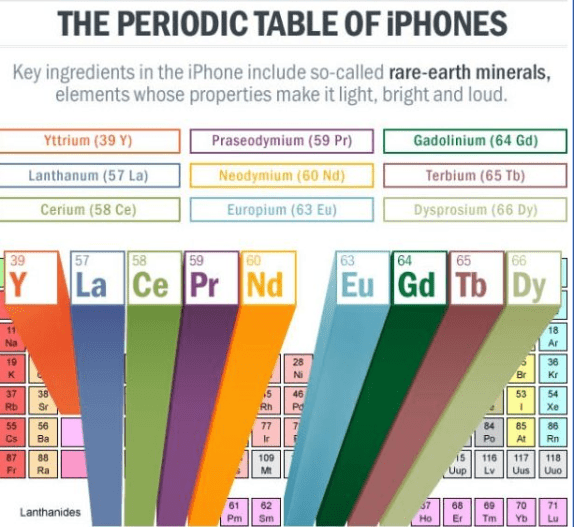
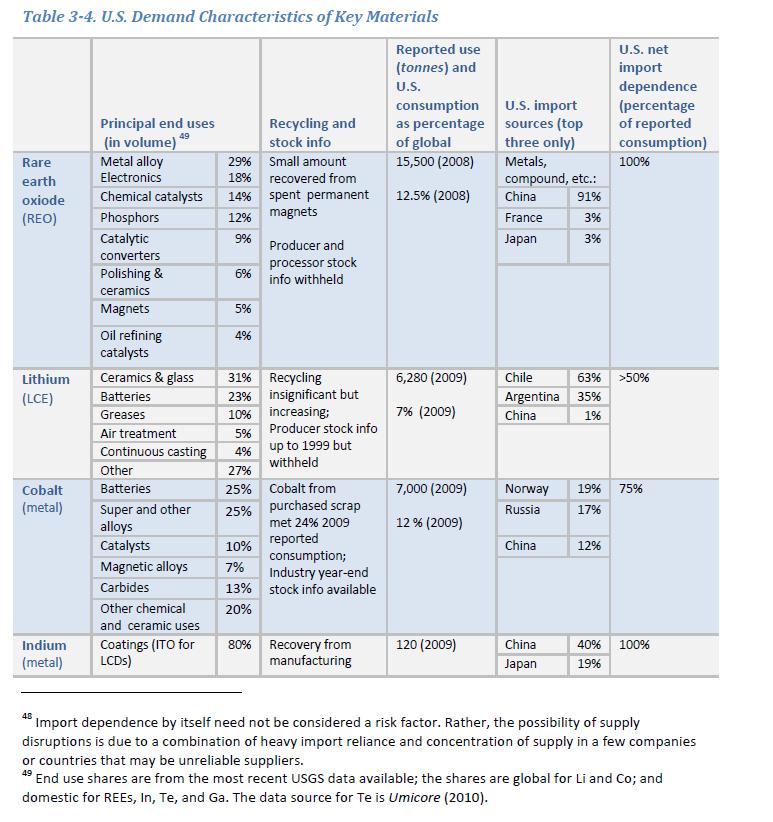
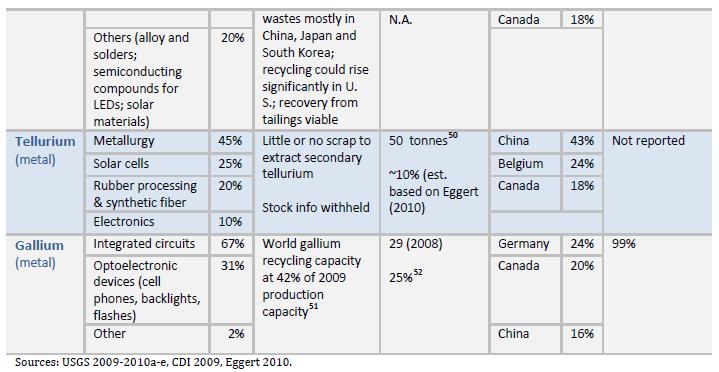
Rare earth minerals could be weaponized by China, which has essentially cornered the market — now accounts for 90 percent of world’s production — which would disrupt many firms in the U.S. tech sector, including Apple.

“There are 118 elements on the periodic table. An iPhone contains about 75 of them,”  so says Gizmodo.


Rare earth_1


Apple has announced it is moving away from rare earth minerals but we can’t yet find confirmation it has.   The stock is down over 3 percent as we write while the S&P is down about a half percent.

More on China weaponizing Rare “Earfs”,

  • President Xi Jinping’s visit to a rare earths facility fueled speculation that the strategic materials could be weaponized in China’s tit-for-tat with the U.S. on trade.
  • The Asian country raised tariffs to 25% from 10% on American imports, while the U.S. excluded rare earths from its own list of prospective tariffs on roughly $300 billion worth of Chinese goods to be targeted in the next wave of measures.
  • The U.S. relies on China, the dominant global supplier, for about 80% of its rare earths imports.
  • The visit “sends a warning signal to the U.S. that China may use rare earths as a retaliation measure as the trade war heats up,” Yang Kunhe, analyst at Pacific Securities Co., said by phone from Beijing. That could include curbs on rare earth exports to the U.S., he said.  – Bloomberg

We had a lot of fun trading these beasts after the market made them the flavor of the day just after the GFC but they fizzled out relatively fast.   Molycorp, was a fun one as the vol was nothing less than stunning.    Moly owned one big mine,  it’s Mountain Pass mine in California, which once supplied the world’s majority of rare earth minerals.

Rare earths are a series of chemical elements found in the Earth’s crust that are vital to many modern technologies, including consumer electronics, computers and networks, communications, clean energy, advanced transportation, health care, environmental mitigation, national defense, and many others.

Because of their unique magnetic, luminescent, and electrochemical properties, these elements help make many technologies perform with reduced weight, reduced emissions, and energy consumption; or give them greater efficiency, performance, miniaturization, speed, durability, and thermal stability.

Rare earth-enabled products and technologies help fuel global economic growth, maintain high standards of living, and even save lives.

There are 17 elements that are considered to be rare earth elements—15 elements in the lanthanide series and two additional elements that share similar chemical properties. – Rare Earth Technology Alliance

Molycorp eventually went bankrupt and was acquired by Oaktree.

Keep this issue on your radar.


Rare Earth Day 4.0

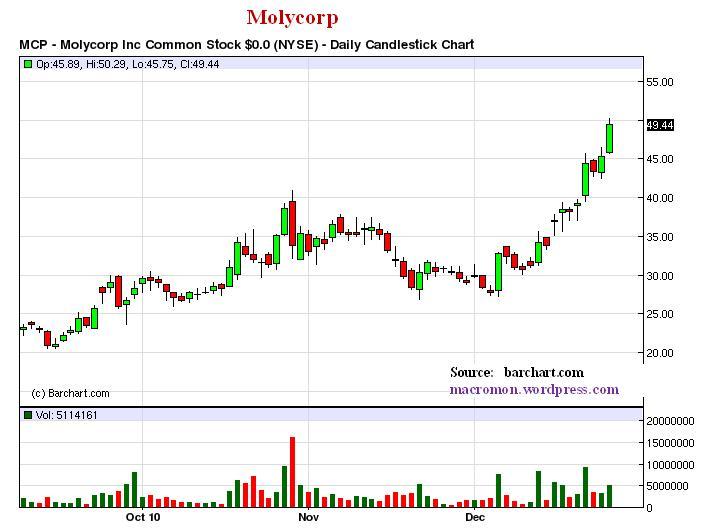
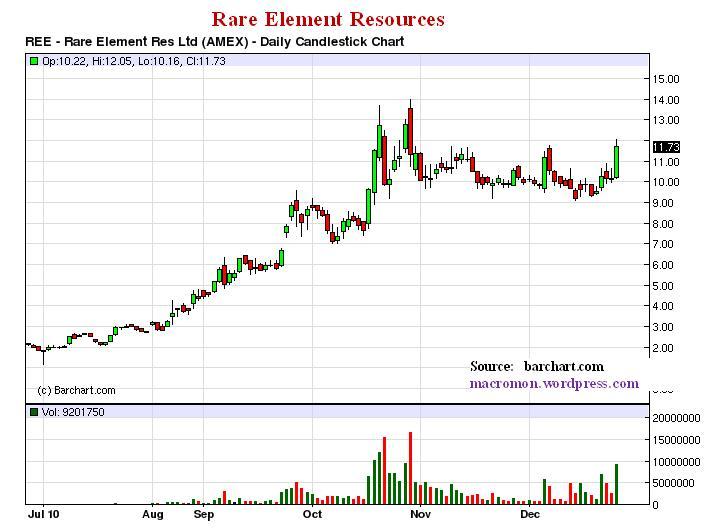
Rare earth stocks rocked today on the back of an article in PC magazinem which is really old news.   Molycorp (MCP) was up almost 10 percent,  hitting  a high of $50.29 a share, and Rare Earth Elements (REE) up almost 20 percent.   Molycorp has doubled since we first posted our views on Rare Earth Elements (REEs) in September,

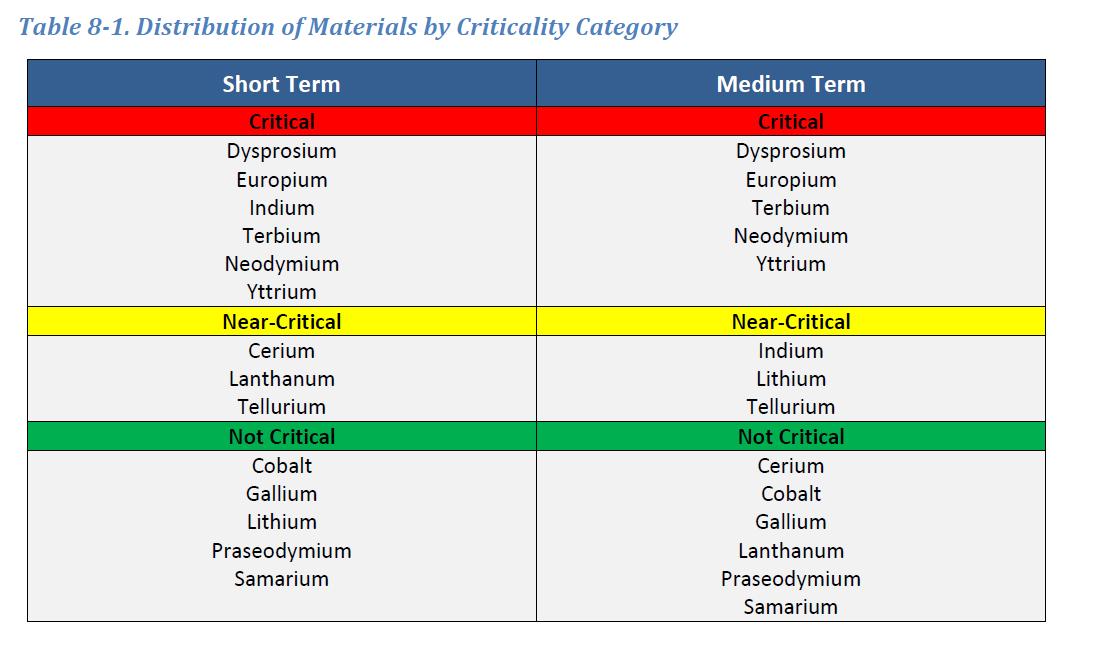
Scarce commodities, which have no substitutes and critical for industry and national security?   Sounds like “Gold on Steroids” to us.  We wouldn’t bet the ranch, but don’t want to miss what could be a nice run as the market begins to focus.  This is a long-term story and experts say that rebuilding an independent U.S. supply chain could take 15 years.   The Defense Department is about to release a study on the national security aspects of the U.S. REE dependence on China.

After China cut-off rare REE exports to Japan in a diplomatic dispute, we suspected a “Sputnik Moment” and panic among end users as China controls more 90 percent of the world’s production.   These are very volatile stocks and we have existed our position looking to reload at lower prices.   Also, check out the very informative charts below from the Department of Energy.

Related Posts
Rare Earth Day
The New Gold Rush?

What is Spec? Baby, don’t hurt me, don’t me. No more!

Rare Earth Day 2.0
Rare Earth Stocks Up Big on China Restrictions
Rare Earth Day 3.0
Did the Chinese Drop a Rare Earth Trade Bomb?
Rare Earth Metals ETF (REMX) Begins Trading October 28th
China to Resume Shipping Rare Earth Minerals – NY Times

Posted in Black Swan Watch, Commodities, Rare Earth Elements | Tagged , | Leave a comment

The Economy Heads South

Econ_Forecast_3


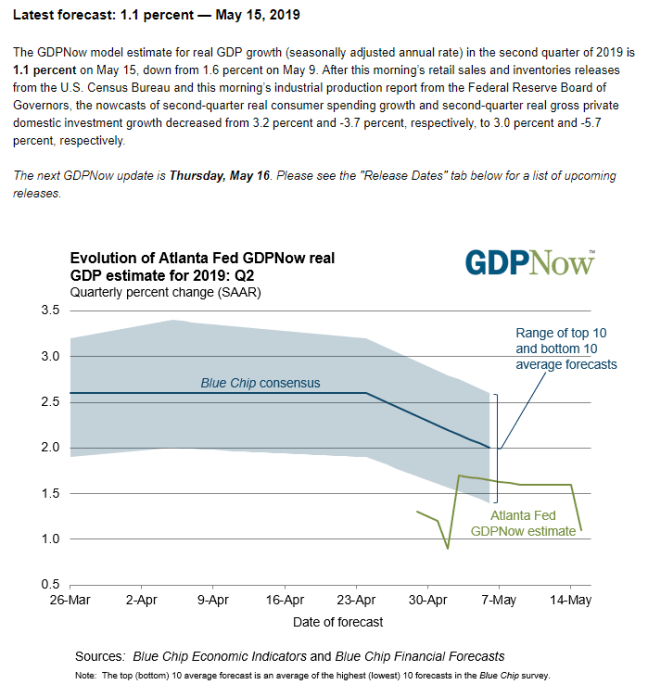
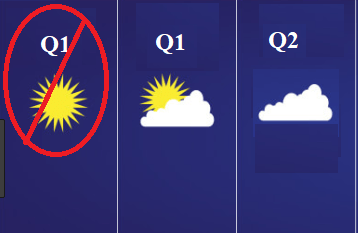
Today’s ugly retail sales and industrial production data knocked 50 bps off the Atlanta Fed’s GDP Now forecast for Q2 GDP, now down to 1.1 percent.   That’s a big decline compared to the recent Q1 3.2 percent print, which was deceptively strong as more than 65 percent of the growth was the combination of a big inventory build, an increase in government spending, and a decline in imports.

The move lower in the GDP Now Q2 forecast was exactly as we expected.  Don’t say you were not warned.

In our Monday post,  How Strong Is The U.S. Economy?,  we answered the rhetorical question with the following,

Not as strong as many, including President Trump believes.

  • GDP growth and even the jobs data, including the unemployment rate, though fairly sunny, look deceptively strong and need a deeper look, which we have provided for you over the past few weeks. 
  • We wouldn’t be surprised to see the Blue Chip consensus forecast, which is now over 2.5 percent for Q2, cut in half in the next month, and the probability of the actual number coming in less than 1 percent,  is increasing by the day.
  • Not such a strong economy, in our book.   – GMM, May 13th


Econ_Forecast_2.png

Trade and The Fed

President Trump backpedaled on his hostile trade rhetoric today as sources say that he will delay the Saturday deadline of slapping tariffs on European and Japanese auto imports by six months.   Though this won’t cause the uncertainty to go away, the stock market made a nice reversal as the news hit the tape.

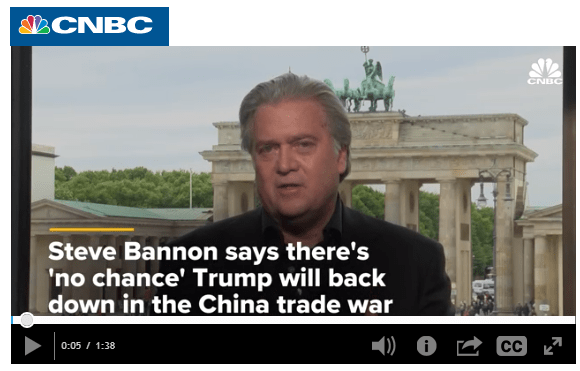
If you listened to Steve Bannon’s CNBC interview this morning, however, Trump is going full scorched earth in the China trade talks.

Bannon

 Click here for the interview

We totally disagree and Trump will eventually be forced to cave and make concessions.  Moreover,  Old Ohio and Old Pennsylvania ain’t coming back.

Steve’s a smart guy, but our advice is that he reads up on some  Graham Allison, the Harvard professor,

…as China challenges America’s predominance, misunderstandings about each other’s actions and intentions could lead them into a deadly trap first identified by the ancient Greek historian Thucydides. As he explained, “It was the rise of Athens and the fear that this instilled in Sparta that made war inevitable.” The past 500 years have seen 16 cases in which a rising power threatened to displace a ruling one. Twelve of these ended in war.  – Foreign Policy,  June 2017

America’s economic problems are much more complex and will not be solved by Bannon’s simple solution of confronting China and bringing back all those old “jobs that were stolen.”  To be fair, this is probably too simple a summation of his views.

Nevertheless,  we came across this data yesterday, which sums up almost all we believe ails our economy and society.   We will let you interpret the data for yourself.

Poll

Shame on those who exploit this type of ignorance rather than promoting policies to address it and to help those develop the necessary skills to survive and thrive in the Fourth Industrial Revolution.   You know exactly who they are.

The Fed

As economic growth forecasts approach zero, which we believe they inevitably will and are only a few more bad data prints away,  it’s only a matter of time before the recession talk grows louder and louder.

No worries, however,  the market socialists will lean heavily on the Fed again to cut interest rates and/or take more extraordinary measures to bail out and keep the stock market afloat.  Wash, rinse, repeat.

It’s getting old, isn’t it?

BTFD.

How about learning some Python and SQL so we can really compete with the Chinese and Russians,

Whoever becomes the leader in this sphere [A.I.] will become the ruler of the world – Vladimir Putin 

Posted in Economics, Uncategorized | Tagged | 1 Comment

Who Pays The Tariffs?

I had some very interesting discussions on social media last night on who is paying for the U.S.-China Trade War.   It was kind of shocking that many didn’t even understand the basic tenets of economics yet have strong convictions held strongly.   Not good in the trading business.

It reminded me of my days teaching frosh economics at the university and encountering the 18-year old ignoramuses who thought they were the second coming of Adam Smith, JMK, and Milton Friedman.  I must now confess, I had a bias to grade these geniuses on a more onerous curve.

Accounting Versus Economic Costs

One of the first principles of economics is to distinguish the difference between accounting versus economic costs.  I would challenge my students at the start of the new semester with the following three questions;  1)  how much does it cost you to go to the beach (we lived in a coastal city)? 2)  should Tiger Woods mow his own lawn? or 3) should Lebron and Kobie go to college?   Thanks to Greg Mankiw for the last two.

Few understood or could grasp the concept of opportunity costs.  Some did but I tried to make sure all did by the end of the course.

Before going any further, let’s go back to Econ 101 and brush up on the differences between the two,

Accounting costs account only for the explicit costs incurred in conducting a business and not the implicit costs. The explicit costs include the direct costs to the company, such as employee wages, utility bills (water, electricity, etc.), raw material cost, premises cost, transportation and storage costs, etc. Since these are expenses for which bills or receipts are available, such costs can be objectively verified. In fact, accountants only account for accounting costs in the financial statement of the company. Since these expenses are already incurred, accounting costs are backward looking.

Economic costs, on the other hand, account for both explicit and implicit costs. Implicit costs is the opportunity cost in terms of revenue lost by forgoing the next best alternative, say renting out premises instead of conducting the business there. Implicit costs do not appear on the financial statements and are not objectively verifiable, since there can be a number of alternative to any given course of action. Implicit costs are forward looking, since they include the what if (say, we rented out the premises for next year instead of using it to conduct the business) scenario.  – eNotes

Tariffs

There is zero debate on who initially pays the accounting costs of a newly imposed tariff.  It is the importing entity, usually a private business or contractor.    Whether the cost of the tariff is passed on to the consumer of the final product depends on how sensitive demand is to prices changes, or what economists call the price elasticity of demand.  Otherwise, businesses will have to eat the added cost of the tariff,  adversely affecting profit margins.

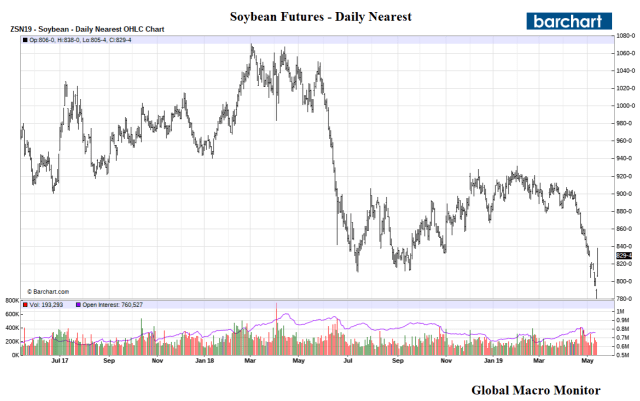
Depending on if the import that is tariffed can be easily substituted, such as a commodity as soybeans,  the importer will divert purchases to other producers.   This has clearly been the case with the soybean market.

Here is some background on the trade war and soybean market,

On March 1, 2018 the U.S. announced it would impose a 25% tariff on imported steel and 10% tariff on imported aluminum .  This tariff announcement launched a series of responses from U.S. trading partners that are still on-going.  In the three weeks following the March 1st announcement, corn and soybeans prices began to plummet. 

On March 22nd, the U.S. announced new tariffs on approximately $50 billion worth of Chinese goods in an effort to rebalance our trade relationship and address intellectual property.  The following day China outlined their plans to impose tariffs on $3 to $5 billion of U.S. products including pork, recycled aluminum, steel pipe, fruit, wine, and tree nuts.

On April 2nd, China implemented the tariffs associated with the March 23rd proposal, hitting $3 billion worth of U.S. imports with tariffs.  The following day the U.S. released list of approximately 1,300 targeted products for tariffs totaling $50 billion worth of Chinese goods, continuing to act in response to alleged intellectual property theft.

On April 4th, China published a list of 106 products which they say will receive a 25% import tariff–mainly automotive products and agriculture commodities including soybeans, corn, ethanol, sorghum, and beef, among others. – FarmDocDaily


Soybeans

The Chinese are fortunate in that much of what they import are commodities and easily substituted.  Their retaliatory tariffs are thus hitting the American producers harder than Chinese businesses and consumers in terms of economic costs.   The government has also been fairly strategic in targeting the tariffs that hit President Trump’s base and the Republican red states.

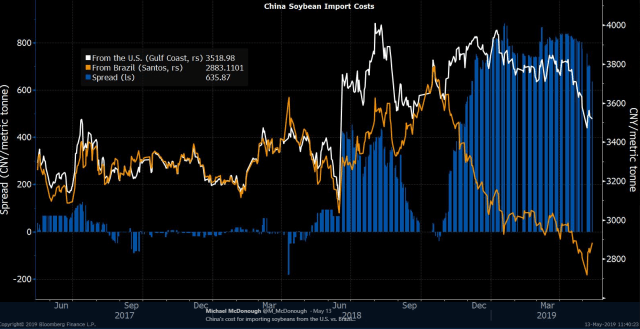
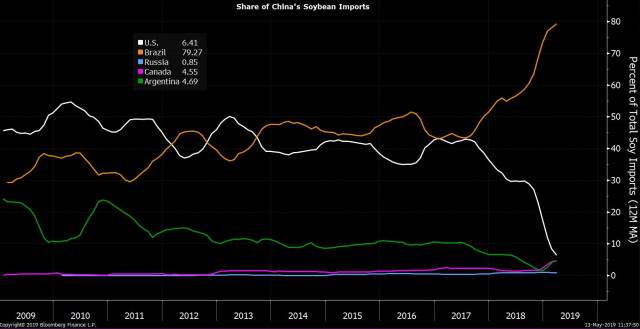
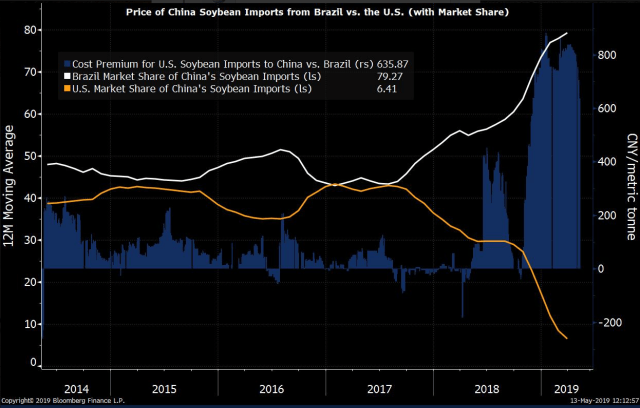
The following charts from Bloomberg, courtesy of @M_McDonough. illustrates how Chinese soybean imports have been easily substituted with Brazilian soybeans. 

We seriously doubt Chinese pigs can taste the differences between and have little preference for American beans over Brazilian beans. 

Chinese Soybean Import Costs

Soybean_1

Share of China’s Soybean Imports

Soybean_2.png

Price of China Soybean Imports: Brazil v U.S. (w/ Market Share)

Soybean_3  

Upshot

Importers pay 100 percent of the accounting costs of trade tariffs, which are, in most cases passed on to the consumer.  The economic costs of tariffs are a bit more difficult to unpack.

The exporter may eventually lower its price to offset a potential loss of market share but the fact remains the importer pays 100 percent of the tariff.  Punto!

Depending on the commoditization of the tariffed good, the importer can substitute producers easing the pain on the local domestic market, such as what is currently happening as Brazil is taking Chinese market share from U.S. soybean farmers

Even if tariffs are lifted on American soybean imports in China, the market may not, or take years, to fully recover due to a hysteresis effect,

 In economics, hysteresis refers to an event in the economy that persists into the future, even after the factors that led to that event have been removed. Unemployment rate and international trade are two areas that are mostly used to explain the hysteresis effect.  — Investopedia

We have been very critical of the administration’s trade policy as it lacks a strategy;  is steeped in economic ignorance and a dangerous nationalization;  goes it alone without our allies, who are on board with many of our beefs with China,  and is too dependent on the blunt use of tariffs, which is and going to continue to wreak havoc on American farmers, producers, and consumers, and will eventually take a major toll on the global economy.

It may or may not work out but we sense it will be an opportunity lost and end as Trump’s other trade deals have,  little gain with lots of pain.   Way too much drama for such a marginal gain.

IP Theft Is Ubiquitous In Business

Finally,  we are not excusing it, but intellectual property (IP) theft is ubiquitous in the business world.   Go no further than Steve Jobs accusing Bill Gates of stealing the MacInstosh software to produce Windows in the mid-1980s, which led to decades-long litigation; or Larry Ellison accusing Google of stealing Oracle’s code for the Android operating system.

The difference in China, it is state sponsored.

We have a great personal story, some inside baseball, on the Jobs-Gates fight, which we shall share later in the week.

Posted in Trade War, Uncategorized | Tagged , , , | 9 Comments

How Strong Is The U.S. Economy?

Not as strong as many, including President Trump believes.

Econ_Forecast


GDP growth and even the jobs data, including the unemployment rate, though fairly sunny, look deceptively strong and need a deeper look, which we have provided for you over the past few weeks.  See here.

How Will The Economy Hold Up As Trade War Escalates?

More important, is the U.S. economy so strong it can withstand an escalation in the trade war with China?

We seriously doubt it and fully expect Trump will be forced to cave on some of his completely unrealistic demands.  We have been consistent from day one: China will never give up its sovereignty by changing the structure of its economy.

Seriously, folks,  do you really think the Middle Kingdom, with all its history and past glory, after climbing back to global superpower status, is now going to cave and give up some of its sovereignty because Trump demands it?

President Xi already seems to be preparing his population for the worst case scenario, warning of “challenging times ahead” possibly in the event Trump goes ahead with the tariff hikes.  Maybe we are reading too much into it and maybe not. – GMM, Feb 12th

So much for the “Art of Deal.”   Greed kills.

Trump and his hardliners don’t seem or care to understand Chinese culture and the concept of  shi miàn zi (面子),” or losing face.   Xi can’t back down now and if Trump takes the next step in the trade war, China will be forced to match tit-for-tat, lest the country’s leadership looks weak and loses face.

We still believe there will be a “deal”, though one with little gain that has already caused lots of pain.   Potemkin and toothless, just as NAFTA 2.0 and KORUS,  but will be sold as the “greatest deal ever made.”

GDP Growth Distorted In Q1

We unpacked the 3.2 percent Q1 GDP post and found it much weaker than the headline number conveyed.

The number was much weaker than it appeared.

Private domestic demand (also known as real final sales to private domestic purchasers) –personal consumption + nonresidential and residential fixed investment – which is the traditional driver of robust and sustained economic growth contributed less than 35 percent to Friday’s headline growth number.   This was the lowest proportional level since Q4 2009.

The bulk of GDP growth came from the combination of a big inventory build, net exports, and government spending (see table below).  

…we ran the numbers and found that 5 of the 15 quarters after such similar aberrational 3 percent plus growth as was the case in Q1 2019, where private domestic demand’s contribution was so small, experienced negative growth.   Only 3 of the 15 quarters did economic growth accelerate.

The average growth deceleration of this sample was 435 bps quarter on quarter.  — GMM, April 28th

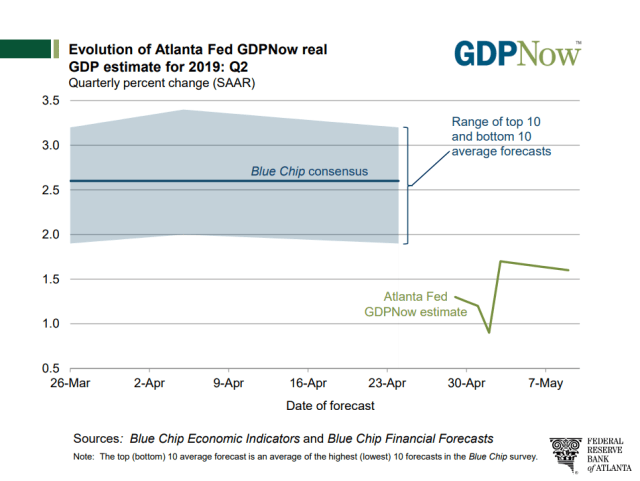
The Atlanta Fed’s Q2 GDP Now forecast, which was spot on early in Q1 that growth was much stronger than what the market socialists, who were calling for an emergency Fed rate cut to bail out the stock market, were forecasting and panicking over.

The GDP Now latest forecast has Q2 coming in around 1-1.5 percent but we believe this was posted before the latest escalation in the trade war.

GDP_Now


The increased stock market volatility, coupled with the huge spike in economic uncertainty caused by the ratcheting up of tensions, will almost certainly depress consumer and capital spending even more and likely shave several bps off Q2 growth.    We wouldn’t be surprised to see the Blue Chip consensus forecast, which is now over 2.5 percent for Q2, cut in half in the next month, and the probability of the actual number coming in less than 1 percent,  is increasing by the day.

Not such a strong economy, in our book.

Maybe the Chinese negotiators get it and the Trump team has yet to receive the memo.

Labor Market:  Employment and Unemployment Rate 

The labor or jobs market is still humming along in the nonfarm sector, almost exactly as it has been since October 2010, when the labor market fully recovered. The monthly increase in nonfarm payrolls in 2019 is averaging 205k, just a smidgen above 201k monthly average since the positive streak began in October 2010.

Strong and decent growth, neither showing a sustained acceleration or deceleration.  The strongest jobs market ever?  You decide.

Employment_NFPs

Wages

Nonfarm real average hourly earnings  have picked up in the past year, growing much faster than the monthly year-on-year average of 0.5 percent since the jobs market recovered in October 2010.   Even still, as the chart illustrates, nothing that spectacular.


Real Wages_NFPs

Trouble In the Farm Belt 

We noted in our recent post, Nonfarm Payrolls & Employment Data Diverging, the employment data, gathered by a different survey, which includes the farm sector, self employed, the informal labor market, and doesn’t double count jobs, is weakening in 2019.


Employment_3


It is not certain the if divergence is noise or reflects a significant weakening in other sectors not picked up in the payrolls survey and hitting the economy much harder than the market believes.  We encourage you to read the post.

Unemployment Rate (UR)

In the same post, we went deeper into the unemployment rate that hit a 50-year low in April.  We found that the employment-population ratio was only 60.6 percent compared to the April 2000 high of 64.7 percent when the UR was at 3.8 percent.

We tried to explain the differential through demographics but still found that the percentage of the employed working-age population is lower than it was before the last recession.  Our conclusion was the UR is distorted by the vagaries of measuring and participation in the labor force, and unemployment itself.

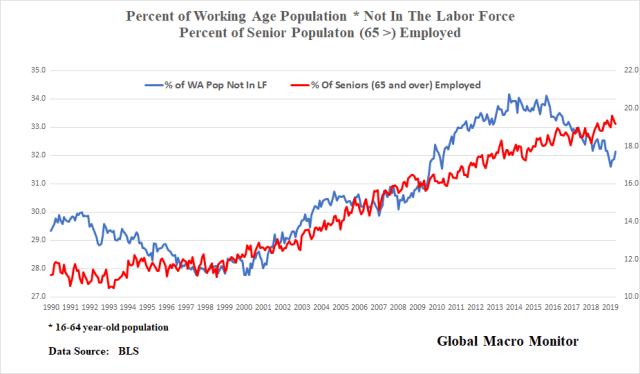
Working Age Population Not In The Labor Force

We also discovered the working-age population (16-64 years) not in the labor force remains higher than it was before the recession, making it impossible to get a true comparative measure of unemployment across time.  We suspect the UR would be several basis points (bps) higher if this measure was accounted for.   To say the “unemployment rate is at a 50-year low”  needs some qualification and normalization, to say the least.

WA POP_NILF

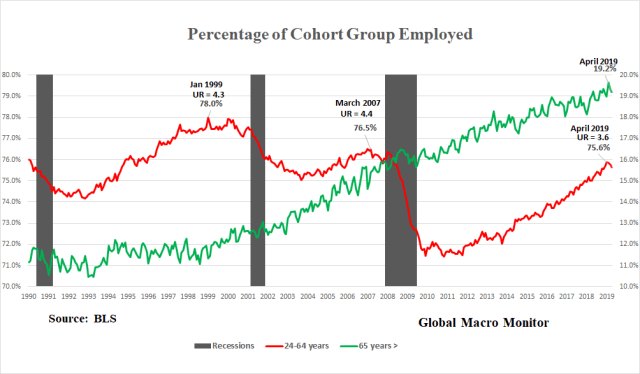
Moreover, the number of employed seniors (65 years >)  has grown by over 70 percent before the recession started with almost 20 percent of the cohort group now employed compared to just around 10 percent in the 1990s.   Some of which is due to the pure demographics of an aging population but much of which is we suspect is probably the result of a lack of adequate retirement savings by many baby boomers, which is not exactly a sign of strength, in our opinion.  It also likely distorts the unemployment rate as a comparative economic indicator over time.

Upshot 

If you have been following the GMM for any length of time, you know we love being a contrarian voice. taking on and challenging the conventional wisdom of the markets.  We only touched on a few of the headline indicators and if we had time would go deeper into debt, capital spending and many of the other macro indicators.  You don’t pay us enough, however.

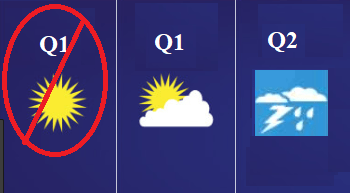
Nevertheless,  if and when the dark thunderstorm clouds arrive, you can’t say you were not warned.

Go deeper and sharpen your pencils, folks.

Stay tuned.

Posted in Economics, Uncategorized | Tagged , , , , | 11 Comments

The Case For Free Trade

The Marxists and Socialists are winning the day, folks.   Apologies for the simpleton buzzwords but they are all the rage these days.

The escalation of the trade war is bad, bad, bad news and could if we are not careful, end in a shooting war.   Many argue that one of the main factors that motivated Japan to bomb Pearl Harbor was the U.S. cutting off of trade, mainly in airplane parts and aviation fuel, with good reason, however, as imperial Japan was running rampant throughout Asia.

No, we’re not suggesting war is imminent but we admonish you to study history.

A potential  Thucydides Trap supersedes all the bluster, posturing, tweets and goes way beyond just trade.

China: Guilty On Some Charges

Yes, China has been a bad actor in many areas, including intellectual property theft, being stingy in further opening its markets, among others. They do need and should be addressed in a multilateral framework with the heft and support from our allies, who are with us on many of our disagreements with the Middle Kingdom, by the way.   In that framework, we believe this mess could have been wrapped up long ago and U.S. farmers would be in much better shape.   Nevertheless, some kudos for POTUS for finally taking these issues seriously.

However, China guilty of making quality and less expensive products that Americans prefer over domestic goods?  Using tariffs as a blunt tool to address the issues discussed above?  Totally absurd.

Make China pay for its sins by other means, not through higher prices and taxes on the American consumer and businesses or inflicting pain on the U.S. farmer.

Moreover, we totally reject the “Art of the Deal” bullshit.

There is no plan, no method in this madness.  The negotiations on the U.S. side are all impulse, based on economic ignorance and steeped in a very dangerous nationalism at the top, vacillating from tweet to tweet, and our negotiating team is conflicted with a deep seeded dialectic between the hardliners and doves.

Karl And Tariff Man

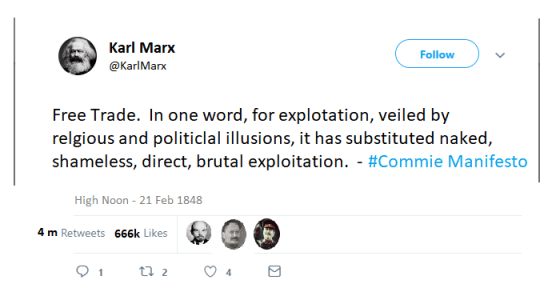
Check out the date on this thing.  What happened on February 23, 1848?

Look it up.

Karl_Marx

Hat Tip:  Deep Fake Anachronisms

A spectre is haunting the world — the spectre of protectionism.   The world is going to be much poorer.

Tariff Man has no clue and seems to share the same philosophy as Karl about free trade.

Who’s your Socialist, now?  Protectionist policies are almost always pure socialism, folks.

The Case For Free Trade

Take a hypothetical case of a pair of blue jeans that had been made in China, for example, but motivated by politics, through policies and jawboning are now manufactured in America.  The cost could increase from $10 to, say, $80 per pair (again, a hypothetical price).   Not only would inflation skyrocket, but there would also be almost no consumption and zero production of the American made blue jeans because most middle-class consumers could not afford them.  Trading and exchange in blue jeans would thus cease to exist.

At best, very few new jobs – and expensive ones, at that —  would be created and many old jobs lost, through retaliation or the reduction in demand as real incomes of consumers would decline.

Sorry, folks.  When I go to Costco or Walmart and purchase a BBQ for $200 less than the American made version in the next aisle,  I don’t consider that as “an act of war” perpetrated by China on America or our workers nor do I feel the Chinese are ripping me off.   Moreover,  my trade deficit with Costco or Walmart, and by extension with China, just went up by $500.

Do I feel unpatriotic about buying Chinese goods?  Absolutely not.

I am a proud flag-waving, card-carrying compassionate American capitalist.

In fact, the very purchase of the cheaper imported Chinese good increases my real income by $200 that I can now spend at the local restaurant, give the waitress a bigger tip and get my car that needed tune up, all, of which expand economic growth and creates additional jobs.

Trade Adjustment Assitance 

Absolutely, the U.S. manufacturer and its workers of the American made BBQ have been hurt by Chinese competition.  No question.

That $200 I saved, however, part of what economists call the “gains from trade”,  should include a small fee, tax, or whatever euphemism Grover Norquist would accept, to fund a program to help those workers hurt because of my free choice to buy the Chinese over the American product.  Remember “Free to Choose?”

We have been all over the case to expand the Trade Adjustment Assistance (TAA) program, which has an annual budget of approximately only $600 million to help those displaced by free trade.   That is an outrage as much as it is stupid, and one of the reasons why we are in such a political mess and the world teeters on the brink.

Moreover, Trump paid $12 billion to pacify U.S. farmers as China targeted soybean imports in retaliation for his trade war.   Now there are reports that POTUS is considering purchasing an additional $15 billion in farm products as China will almost surely retaliate against Friday’s new tariff hike.

That $27 billion is almost five years of the TAA program annual  budget.  Don’t you think that would have been better spent on helping the displaced workers from trade in the first place?  The U.S. and the world would be growing at a faster clip and all of its workers, including farmers, would be much better off.

Yes, the opening of China was big and very disruptive, and while many greatly benefited, U.S. policymakers were ill-prepared and ignored the costs of the new Chimerica.

But, China’s not going away, folks.  It’s impossible to Make China Small Again.

The Price of Gas And Free Trade

Why is it when the price of gasoline declines we are all happy, our real incomes increase and feel much better off yet we have no worries or consideration for the oil roughnecks in Midland, Texas or the workers in the small towns in, say,  North Dakota who are devastated by the fall in oil prices?

Could it be because there is no foreigner to blame for their pain?

We are beginning to buy into the argument we all are hardwired genetically and predisposed to fear and blame those who are “different” or foreign for many of our problems, which is the consequence and evolution of spending 95 percent of all human existence on the savannah fearing and fleeing the “different.”   Robert Sapolsky, the Stanford professor, writes,

To understand the dynamics of human group identity, including the resurgence of nationalism—that potentially most destructive form of in-group bias— requires grasping the biological and cognitive underpinnings that shape them.  Such an analysis offers little grounds for optimism.

Our brains distinguish between in-group members and outsiders in a fraction of a second, and they encourage us to be kind to the former but hostile to the latter. These biases are automatic and unconscious and emerge at astonishingly young ages. They are, of course, arbitrary and often fluid.

Humans can rein in their instincts and build societies that divert group competition to arenas less destructive than warfare, yet the psychological bases for tribalism persist, even when people understand that their loyalty to their nation, skin color, god, or sports team is as random as the toss of a coin. At the level of the human mind, little prevents new teammates from once again becoming tomorrow’s enemies.  – Robert Sapolsky

We all need to better train and strengthen our prefrontal cortex to control the impulses of our amygdala.   Try using that in a presidential campaign stump speech.

The Fork In The Road

Socialism has won the day, at least for today.   Governments are trying to control and manipulate the preferences of individual consumers in the name of…whatever.

This is really the blowback from the result of unfettered capitalism, not giving a rat’s ass about the workers hurt by free trade and underfunding programs such as  Trade Adjustment Assistance.   If this escalates the whole world is going to be much poorer and a significantly more dangerous place to live.

The complacency is stunning.  The classic boiling frog syndrome.


There you have it, folks, our rant for the weekend.   Take it or leave it but it is our firm conviction, which may or may not become a reality.  We hope it doesn’t and even if it does, many will claim an alternative reality or other excuses for the mess that has become.

Don’t say you weren’t warned.

BTFD.


Posted in China, Economics, Trade War, Uncategorized | Tagged , , , | 2 Comments

Nonfarm Payrolls & Employment Data Diverging

Summary

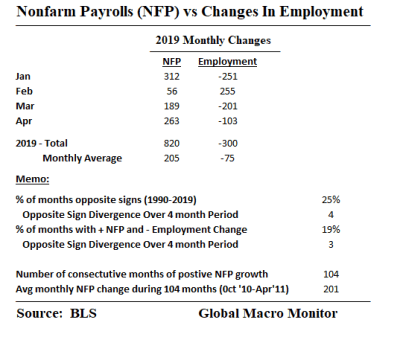
  • Last Friday’s nonfarm payrolls exceeded expectations with the first four months now averaging 205k jobs created, right on the monthly average since October 2011 
  • The employment data is moving the other way, however, falling 103 in April and has come in negative three of the first four months of the year
  • Though a monthly positive nonfarm payroll number has coincided with a negative employment number around 19 percent of the months since 1990,  three out of four consecutive months is a novelty
  • This may be the result of the fact that nonfarm payrolls are not capturing the pain in the agricultural sector and the potential shrinkage of the informal labor market due to the crackdown on immigration
  • The employment-population ratio came in at a little under 61 percent in April, still well below its April 2000 peak and the local high just before the Great Financial Crisis (GFC)
  • Demographics may explain part of the failure of the employment-population ratio to make new highs but even the percentage of employed 16-64 year-olds has yet to capture the high just before GFC
  • Seniors, the 65 years and older cohort group, are remaining in the workforce at a greater pace with more than 70 percent more seniors now employed than before the GFC. This compares to just around 5 percent for the 16-64 year-olds  
  • The percentage of the senior population now employed has increased from around 10 percent in the 1990s to close to 20 percent.  We suspect much of it has to due to the lack of adequate retirement savings
  • The unemployment rate is a very flawed statistic, especially when comparing two-time points in the economy

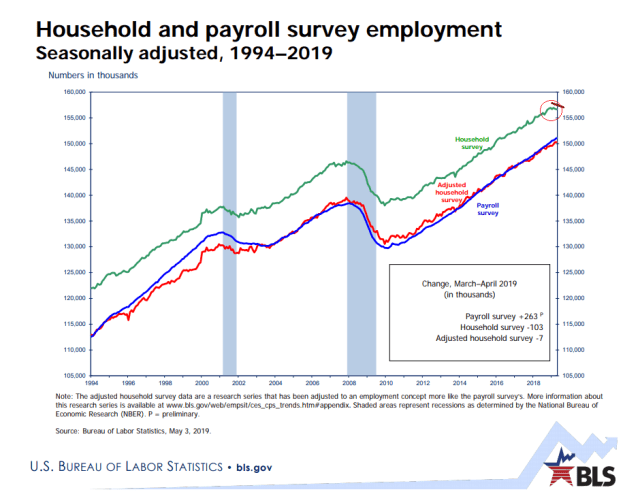
Last Friday’s payroll data blew out expectations with a monthly gain of 263 new jobs yet employment fell again by 103k, the third decline over the past four months.  This is the first time in our database, which begins in 1990, that a positive monthly payroll number had an opposite sign of the employment data in three of four consecutive months.

That should make all of us sit up and listen.
 

Employment_3

In fact, during 2019 nonfarm payrolls have increased by 820k — nothing spectacular, by the way — averaging 205k per month, which is right on the monthly average since October 2011, all while total employment has fallen by 300k.  What is impressive about the payroll growth is that most believe the pool of surplus labor is becoming increasingly shallow.

Why The Divergence? 

Our priors are that nonfarm payrolls are not capturing the extreme pain currently taking place in the farm belt.  Whereas the ag sector is included in the employment data.

“Even if the trade war ends, with this oversupply of corn and soybeans and wheat, we’re still going to have low prices,” Grassley said in an interview. Separately, the U.S. House of Representatives’ Agriculture Committee plans to hold a hearing on May 9 to review the rough Farm Belt economy.

So far this year, personal income for farmers is down 25 percent, the steepest decline since the first three months of 2016, according to an April 29 Commerce Department report. Regional banks, meanwhile, are holding their own. 

For farmers, more pain may be ahead. The Federal Reserve Bank of Kansas City last month said farmland prices may decline, and owners may receive lower returns on capital invested. That’s a change from the early stages of the downturn, when farmland values were relatively stable, and served as an attractive source of collateral for loans.  Bloomberg, May 3


Farm_Bankruptcies

Not certain if it can entirely explain such a large divergence, however.

Comparison of CES and CPS Surveys  

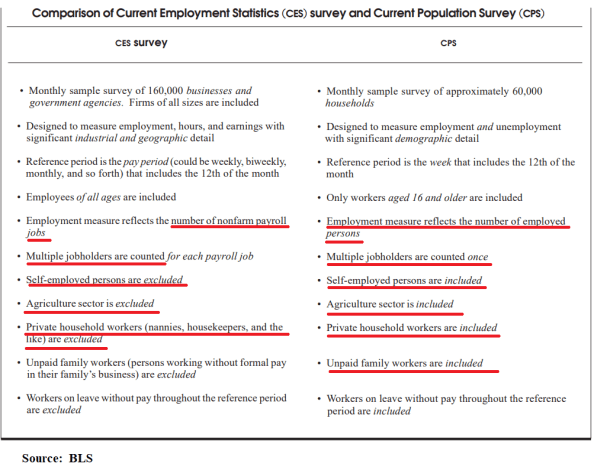
The nonfarm payroll data are collected using the Current Employment Statistics (CES) survey, commonly known as the payroll survey and do not count the farm sector.  The employment data does and is collected using the Current Population Survey (CPS) and is known as the household survey, which is also used to calculate the unemployment rate.

There are several differences in the methodology of the two surveys.  Most important, the payroll survey not only excludes the agricultural sector but also the self-employed. Moreover,  multiple jobholders are counted for each job.  That is if a person holds three jobs, all three jobs are counted in the payroll surveys whereas it would only count once in the household survey.
 

Labor_Surveys


Historically the two measures of the labor force track fairly well.
Employment


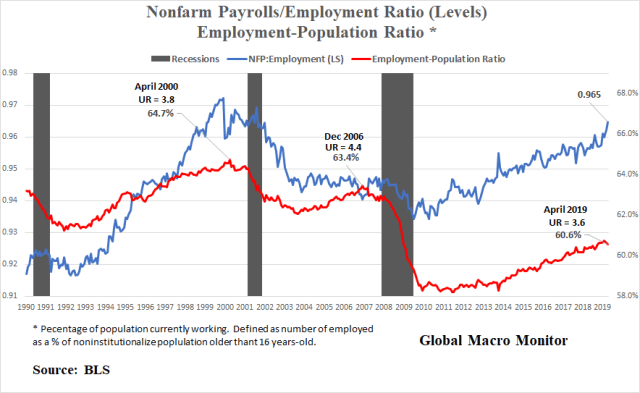
The chart below illustrates the ratio of the nonfarm payrolls to employment has remained in a range of around .92 to .97 since 1990, with the April number, .965, closing in on its high.

During two of the three expansions since the 1990-91 recession, the ratio moved higher.  We’re not certain why the ratio declined during the expansion in the first decade of the century but suspect it had something to do with the housing bubble.  Everyone and their mother turned into commission only real estate agents, jobs not counted in nonfarm payrolls.  Nor are start-ups or the informal labor market.
 

Employment_final

Employment-Population Ratio

The chart also illustrates the Employment-Population Ratio, the percentage of the working population 16-years and older that is employed.  Interestingly, the ratio peaked in April 2000 at 64.7 percent when the unemployment rate was at 3.8 percent.

The percentage came in at 60.6 percent in April, much lower than the 2000 peak and even well below of pre-GFC peak of 63.4 percent in December 2006, when the unemployment rate was 4.4 percent.

What’s up with that?  Isn’t this the greatest economy ever?

Demographics?

Some of it can be explained by simple demographics.

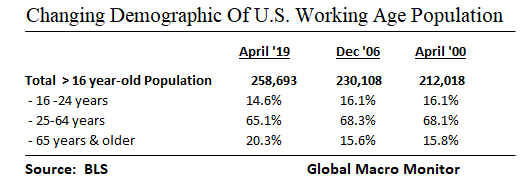
The table below illustrates how the U.S. population is aging and the proportion of the working-age population (16-64) is declining.
 

Pop_1_May6_


Even still, the percentage of the working-age population that is employed is lower than what it was before the GFC (see chart below).

We were also really surprised that the data so strongly confirmed our suspicions that seniors — the older than 65 years cohort group — have almost doubled their employment as a percentage of their rapidly growing population from around 10 percent in the 1990s to around 20 percent in the April data.

The growth of employed seniors 65-years and older since the month before GFC began is nothing less than stunning,  73.4 percent more seniors are employed versus only 5.4 percent for the 25-64-year-old cohort group.  Kind of depressing that a growing number of older folk can’t retire and go fishing.

We will be out with more in-depth analysis soon but the participation of more seniors in the labor force, many who are probably forced to work due to a lack of adequate requirement savings, has increased the size of the labor pool.

Couple this with the fact the percentage of the employed working-age population has still yet to reach the pre-GFC and all-time highs,  the surplus labor pool is probably much larger than most have estimated and explains the punk growth in wages.
Employment_May6

Unemployment Rate 

Given our analysis above, how is it that the unemployment rate is at a 50-year low? We suspect it is the quirkiness of how participation in the labor force is measured.

What are the basic concepts of employment and unemployment?

The basic concepts involved in identifying the employed and unemployed are quite simple:

  • People with jobs are employed.
  • People who are jobless, looking for a job, and available for work are unemployed.
  • The labor force is made up of the employed and the unemployed.
  • People who are neither employed nor unemployed are not in the labor force.

Who is counted as unemployed?

People are classified as unemployed if they do not have a job, have actively looked for work in the prior 4 weeks, and are currently available for work. Actively looking for work may consist of any of the following activities:

  • Contacting:
    • An employer directly or having a job interview
    • A public or private employment agency
    • Friends or relatives
    • A school or university employment center
  • Submitting resumes or filling out applications
  • Placing or answering job advertisements
  • Checking union or professional registers
  • Some other means of active job search

Who is not in the labor force?

As mentioned previously, the labor force is made up of the employed and the unemployed. The remainder—those who have no job and are not looking for one—are counted as not in the labor force. Many who are not in the labor force are going to school or are retired. Family responsibilities keep others out of the labor force. Since the mid-1990s, typically fewer than 1 in 10 people not in the labor force reported that they want a job.

A series of questions is asked each month of persons not in the labor force to obtain information about their desire for work, the reasons why they had not looked for work in the last 4 weeks, their prior job search, and their availability for work. These questions include the following (the bolded words are emphasized when read by the interviewers).

  1. Do you currently want a job, either full or part time?
  2. What is the main reason you were not looking for work during the last 4 weeks?
  3. Did you look for work at any time during the last 12 months?
  4. Last week, could you have started a job if one had been offered?

These questions form the basis for estimating the number of people who are not in the labor force but who are considered to be marginally attached to the labor force. These are individuals without jobs who are not currently looking for work (and therefore are not counted as unemployed), but who nevertheless have demonstrated some degree of labor force attachment. Specifically, to be counted as marginally attached to the labor force, they must indicate that they currently want a job, have looked for work in the last 12 months (or since they last worked if they worked within the last 12 months), and are available for work. Discouraged workers are a subset of the marginally attached. Discouraged workers report they are not currently looking for work for one of the following types of reasons:

  • They believe no job is available to them in their line of work or area.
  • They had previously been unable to find work.
  • They lack the necessary schooling, training, skills, or experience.
  • Employers think they are too young or too old, or
  • They face some other type of discrimination.- Bureau Of Labor Statistics

We also suspect the national opioid crisis is reducing, and/or participation in, the labor force thus having, at the very least, a marginal reduction in the unemployment rate.  We have yet to find a study that quantifies the effect but are still searching.  Nevertheless, the unemployment rate by definition must be lower on the margin even the working age population is affected.

Opioid addiction costs many lives, harms livelihoods, depresses labour market participation, and entails significant public healthcare spending. Death rates have surged in the past decade, particularly as (illicit) synthetic opioids have become more available around the country. The correlation with nonparticipation in areas most beset by opioid addiction suggests that addiction ultimately impairs participation.  – OECD, 2018

Measures Of The Unemployment Rate

Of course, there are different measures of the unemployment rate.

U3 is the official unemployment rate. U5 includes discouraged workers and all other marginally attached workers. U6 adds on those workers who are part-time purely for economic reasons. The current U6 unemployment rate as of April 2019 is 7.30 percent. – Macrotrends

Nevertheless, we view the U3 unemployment rate as pretty much useless as a comp indicator across time due to the vagaries in measuring the labor force though it does give a crude measure of the health of the labor market.  Comparing the unemployment rate across different years is meaningless, in our opinion.

It is like the old baseball stats that are similarly meaningless but just won’t die.

As a statistic, RBIs were not only misleading but dishonest.  They depended on managerial control, a hitter’s position in the batting order, park dimensions and the success of his teammates on getting on base ahead of him. –  Branch Rickey

The RBI stat is responsible for more bad postseason award decisions than any other single factor in baseball history…RBI just don’t tell us anything useful about a player’s individual performance in a game, a season, or a career, but they remain prevalent in the minds of writers and fans.  – Smart Baseball

The BLS and the National Income and Product Accounts could use some updating and Sabermetrics.

Upshot 

It’s always prudent to dig deeper, go beyond the headlines and look under the hood, folks.  Never so true in our post-Truth, alternative facts, and spin to win bullshitting era.

We were one of the first out with our skepticism about the 3.2 percent Q1 GDP print.

The number was much weaker than it appeared.

Private domestic demand (also known as real final sales to private domestic purchasers) –personal consumption + nonresidential and residential fixed investment – which is the traditional driver of robust and sustained economic growth contributed less than 35 percent to Friday’s headline growth number. This was the lowest proportional level since Q4 2009.

The bulk of GDP growth came from the combination of a big inventory build, net exports, and government spending (see table below). 

Empirical probabilities suggest that Q2 economic growth will be significantly lower than Q1 with the high likelihood of the final reading of growth in the quarter will be lower than the initial print.  GMM, April 28th

A few days later, a friend sent us this,

To Morgan Stanley’s economists, a lot of the boost can be explained by an unexpected surge in inventories (adding a 0.44 percentage point increase to GDP), a surge in net exports (1.2 point), and larger government spending (0.4).  They didn’t view this as sustainable and are expecting the growth pace to slow to 1.1% in the second quarter, ending June 30.    – Chief Investment Officer

The Price Of Gas  

I showed some dude in a beer pub yesterday a picture to prove a point in a discussion we were having.  He instantly retorted the picture was fake.  It was shocking as much as it was depressing.  We are losing all basis for meaningful dialogue.  Facts don’t matter as many are increasingly becoming to believe facts don’t even exist.

We are losing our culture and country.

As a consequence, the price of gaslighting has never been lower and never so effective.

Gaslighting is a form of psychological manipulation that seeks to sow seeds of doubt in a targeted individual or in members of a targeted group, making them question their own memory, perception, and sanity. Using persistent denial, misdirection, contradiction, and lying, it attempts to destabilize the victim and delegitimize the victim’s belief.  – Wikipedia 

If this is the greatest economy of all-time, why does it feel so shitty and why are so many so angry?

Furthermore, it’s only a matter of time before our national economic data is labeled fake news and the product of manipulation by the “deep state.”

Dig deeper and sharpen your pencils, folks.

Posted in Employment, Uncategorized | Tagged , , | 11 Comments

Some Background On China Trade Talks

Some perspective from a prior post on President Trump’s predisposition toward free trade.

We hope for a good trade deal and China caves on everything.  We also hope for the end of poverty, world peace, and everyone to self actualize this year but will it happen?

Come on, man, let’s be realistic.  China’s not about to give up it’s sovereignty to Trump.  See our post from yesterday.

In my experience in participating in and negotiating several multibillion sovereign debt restructurings, a good and doable deal is one where both sides win more than they give up yet at the same time both sides are not entirely jubilant with the final outcome.

…in a long-term relationship with the other party, drive for a win-win. Exercise caution driving for a win-lose. People [and Countries] have long memories, and you might encounter them again, perhaps when they are in a position of relative strength. — BizJournals

Trump is notorious for driving for a win-lose outcome.  Xi will having nothing to do with it.

No Free Trader In The White House

.

Yesterday’s NY Times guest Op/Ed confirmed our suspicions about President Trump,

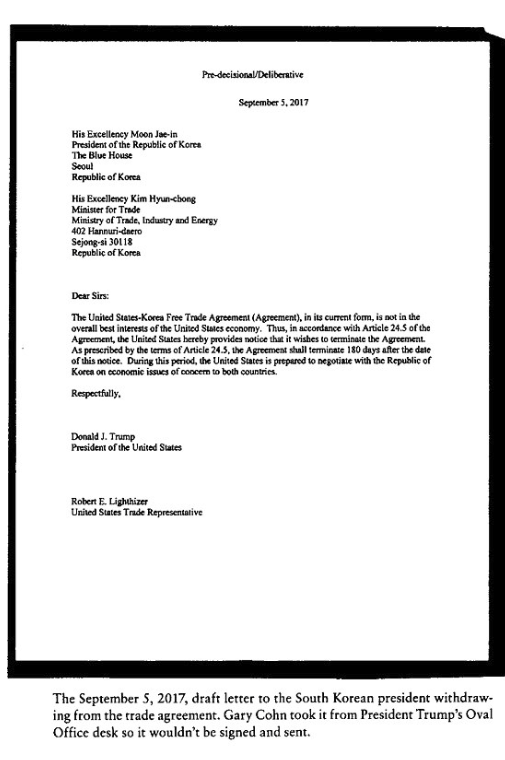
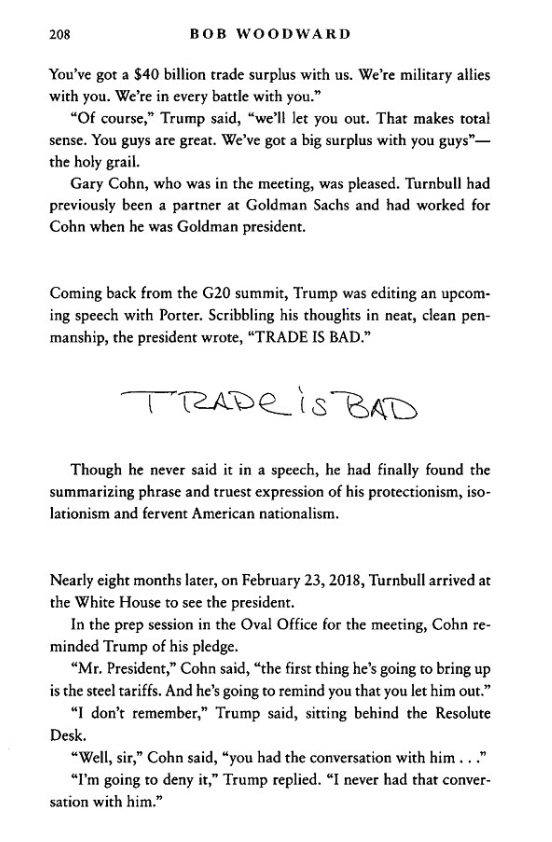
Furthermore,  we don’t believe President Trump is a free trader at heart but more of a protectionist and neo-mercantilist.  There is no “Art of the Deal” – see his waffling on immigration  – and no method to the administration ’s madness to negotiating anything, for that matter,  but only driven by impulse and myopia.  — Global Macro Monitor, June 24, 2018

Anyone who works with him knows he is not moored to any discernible first principles that guide his decision making….President Trump’s impulses are generally anti-trade and anti-democratic.  – Anonymous,  NY Times,  September 5, 2018

Today it’s solidified,

The market has been in complete denial on this issue dismissing the trade war rhetoric as “Art of the Deal” nonsense.   We suspect the market is in for a nasty reckoning when they have their epiphany.  Stay tuned.

(updated Sept. 7, 2:22 eastern)

Trump Letter


Trump Letter_2

Source:  Daily Mail

Posted in Japan, Trade War, Uncategorized | Tagged , | Leave a comment

BFTP: Don’t Say You Weren’t Warned On China Deal

BFTP = Blast From The Past

China’s Pushback In Trade Talks Over Sovereignty

Bingo!

Note our comment from an earlier post this evening,

Seriously, folks,  do you really think the Middle Kingdom, with all its history and past glory, after climbing back to global superpower status, is now going to cave and give up some of its sovereignty because Trump demands it?

President Xi already seems to be preparing his population for the worst case scenario, warning of “challenging times ahead” possibly in the event Trump goes ahead with the tariff hikes.  Maybe we are reading too much into it and maybe not. – GMM

Posted in Trade War, Uncategorized | Tagged , | 1 Comment

Baseball Giants Are Born This Day

Posted in Sports, Uncategorized | Tagged , , | Leave a comment