A life of boom and bust: Can Argentina break the cycle?

A century ago, Argentina was one of the ten richest countries in the world. But crisis after crisis has earned it the dubious distinction of being the only nation ever to regress to developing country status. With hyperinflation, devaluations and IMF bailouts now facts of life, we meet the people who have lived through a major economic crisis roughly once every decade – including a taxi driver who lost everything in the 2001 crisis and now earns more money selling antiques.

We also travel to some of the worst-hit places, where sermons from slum priest “Padre Toto” give people hope. But 2018 has once again tested Argentines’ patience. Inflation has topped 40% and the peso’s value has halved compared to the US dollar. Mauricio Macri’s government has tried to stem another crisis by signing up to the biggest bailout package in the IMF’s history. With the country’s future in limbo, the FT provides a glimpse into life in constant economic turmoil and asks: Can Argentina finally break the cycle of boom and bust?

► Subscribe to FT.com here:http://bit.ly/2GakujT

Posted in Emerging Markets, Uncategorized | Tagged , | Leave a comment

“Oh no no no I’m a tariff man”

And I think it’s gonna be a long long time
‘Till tariffs come down again
I’m not the man the market thinks I am
Oh no no no I’m a tariff man
paraphrasing Rocket Man (starts tonight)


Tariff man hit me right in the gut and wallet last night.  Then the Warriors lost the first game of the NBA finals.  A night ruined.


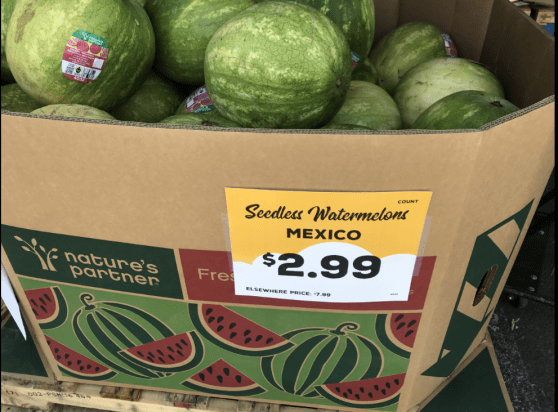
Mexico Watermelons


I snapped this picture on Wednesday in celebration and gratitude for free trade.  True story.   I paid $4.99 for my last watermelon purchase.  That’s a $2.00 increase in my real income and purchasing power just from transacting in one item, folks.  Add it all up and it’s real money to be spent and spread around to create more American jobs.

Who will pay the 5-25 percent prospective tariff on the watermelon?  It will be the American business who imports the watermelon, who will then calculate if they can pass the additional cost of the tariff on to me depending on how sensitive my demand for watermelons is to price changes and how easy it is to substitute for non-Mexican melons.  Economic geeks call this the price elasticity of demand.   Either way, Americans pay 100 percent of the tariff.

Will Mexican exporters lower the price of the watermelon to compensate for the price increase in the United States and maintain their domestic price as the peso weakens?  TBD.

But either way,  make no mistake Americans will still pay the tariff (tax) that flows into the U.S. Treasury coffers.   Trump adviser Peter Navarro is dead wrong, which is surprising given his Ph.D. in econ, or he is trying to mislead the public.  We’re not having it.

By the way,  I didn’t feel like a fool nor feel abused as POTUS seems to suggest when I purchased the Mexican watermelon on Wednesday.

Furthermore, my family has suffered from the dark side of immigration more than most.  We completely reject the hysteria and racism this administration whips up and obsesses over and won’t seem to let go.  Yes, America needs sensible and effective immigration and border policies, which strike at the root of the problem but come on, man.  

No Surprise

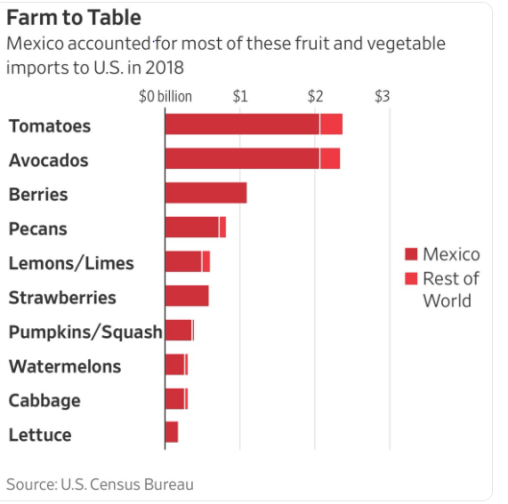
Mexico_Imports

Source:  Wall St. Journal via @scottlincicome

We were not surprised about Trump’s Mexican tariff announcement, and neither should you if you have been reading the Global Macro Monitor during the past few years.  We concluded early on in this administration, Trump is 1)  not a free trader; 2) does not understand basic trade theory, and 3) he has no strategic plan for a  trade or industrial policy.

Furthermore,  we don’t believe President Trump is a free trader at heart but more of a protectionist and neo-mercantilist.  There is no “Art of the Deal” – see his waffling on immigration  – and no method to the administration’s madness to negotiating anything, for that matter,  but only driven by impulse and myopia.  — Global Macro Monitor, June 24, 2018

Anyone who works with him knows he is not moored to any discernible first principles that guide his decision making….President Trump’s impulses are generally anti-trade and anti-democratic.  – Anonymous,  NY Times,  September 5, 2018

After all,  tariff man believes “the word TARIFF is a beautiful word indeed!”

God help us.

The Delusion Of Mr. Market

The market continues to delude itself that Trump is just using the hammer and sickle of tariffs to further crack open foreign markets to U.S. exporters.  Obviously, Mr. Market didn’t get the memo.


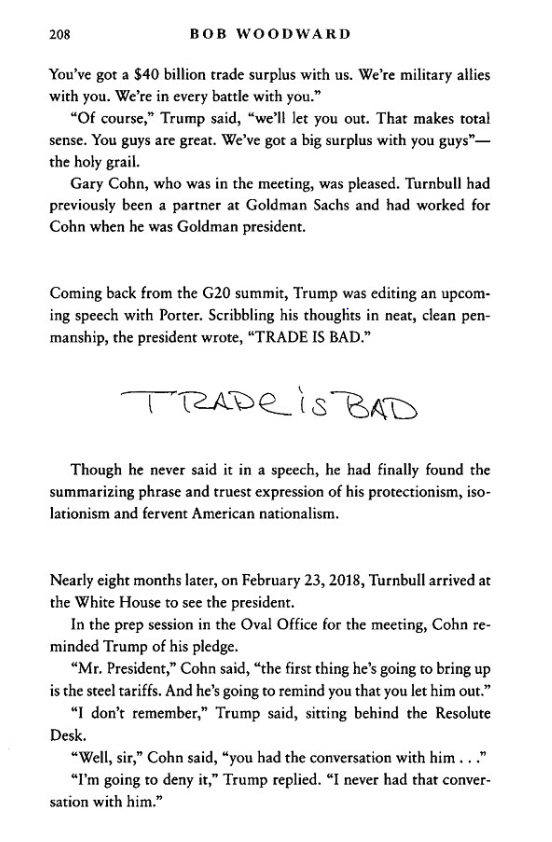
Trump Letter_2

The problem is the lack of U.S. leadership in dealing with and compensating the losers from free trade — ironically not the losers from protectionism, see the $26 billion in subsidies to farmers — and has created a vacuum that Trump can fill with his impulses, which, we believe, if not checked will set the world on fire and lead to disaster.

Is It A Bluff?

Is Trump bluffing on Mexican tariffs?   We don’t know and one would think so if he wants to run on the strong economy and be re-elected.  That’s too rational, however.

T-minus 10 days and counting before Mexico will be forced to retaliate.

Posted in Trade War, Uncategorized | Tagged , , | 4 Comments

Did Mueller Buy Or Sell President Trump?

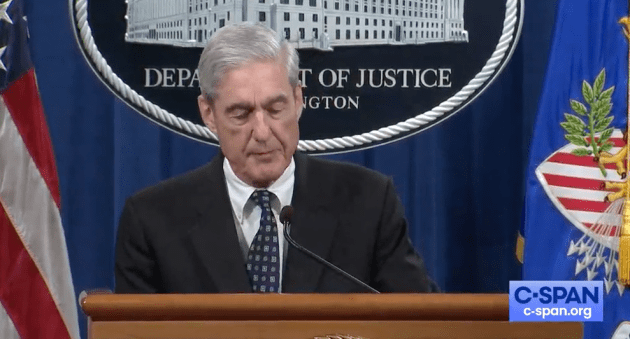
Mueller

“And as set forth in the report after that investigation, if we had had confidence that the President clearly did not commit a crime, we would have said so. 

We did not, however, make a determination as to whether the president did commit a crime… It explains that under long-standing Department policy, a President cannot be charged with a federal crime while he is in office. That is unconstitutional.” –  Robert Mueller, May 29, 2019

” Since it is the policy of Shitibank we cannot issue sell recommendations, we conclude that Bestla is not not a sell.”  – Hypothetical “Bestla” Stock Analyst (see below)

He said what?

Whatever you want him to say.  After all, we now live in a world of double negatives, alternative facts, and Orwellian doublespeak.  There is no truth, no real facts.  You make your own reality, no?

We don’t believe that stier scheisse, not for one second, and never will.

Making Money In The Political Minefields

We’re not afraid of the political minefields if our analysis is going to help us make money.  We warned way ahead of time about the risks to a China trade deal and that the U.S. negotiating team was too optimistic about what was ultimately doable. See our February post here.

We also wrote of the coming domestic political instability, warning of the Summer of Discontent in both the U.S. and the United Kingdom.

In both cases, we took incoming that we are not on the home team’s side or that our analysis was all partisan nonsense.   To that, we say nonsense to the nonsense comments. We now speak in double negatives.

What Did Mueller Say Today

So what was it that Mueller said today?

There are two major takeaway issues from today’s Mueller presser, which are very clear and unambiguous.

  1.  The Russian military launched a “concerted attack” on the 2016 presidential election “to damage a presidential candidate,”
    .
    I will close by reiterating the central allegation of our indictments — that there were multiple, systematic efforts to interference in our election. That allegation deserves the attention of every American.  – Robert Mueller, May 29, 2018
    .
  2. Mueller never believed, ex-ante or ex-post the investigation,  that he and his team could ever conclude or charge President Trump of committing a crime and were constrained by the “principles under which we [they] operated.”  He clearly stated,
    .
    And as set forth in the report after that investigation, if we had had confidence that the President clearly did not commit a crime, we would have said so.

    We did not, however, make a determination as to whether the president did commit a crime. The introduction to the volume two of our report explains that decision. It explains that under long-standing Department policy, a President cannot be charged with a federal crime while he is in office. That is unconstitutional…The special counsel’s office is part of the Department of Justice and by regulation it was bound by that Department policy. Charging the president with a crime was, therefore, not an option we could consider. – Robert Mueller,  May 29, 2019


Seeing And Hearing Mueller As A Financial Analyst 

Because we view almost everything from an economic and financial perspective let us set up how we see it.    We interpret Mueller with the following financial analogy:

For illustrious purposes, assume we are stock analysts at Shitibank and have just completed an exhaustive two-year study of Bestla, a domestic motorcycle manufacturer.  The investment community is becoming very impatient and greatly anticipates our buy or sell recommendation.

Our conclusion,

Since it is the policy of Shitibank we cannot issue sell recommendations, we conclude that Bestla is not not a sell.  

Let the tweets from Bestla CEO, Milon Eusk, begin.

Upshot

There you have it, folks, it’s up to you and Congress to interpret the special counsel’s double negative.  If you have trouble, a symbolic logic course may help.

The impeachment market continues to march higher.  Stock market volatility is picking up and the S&P is breaking down.

The Summer of Discontent is here.  You were warned.


Posted in Politics, Uncategorized | Tagged , | Leave a comment

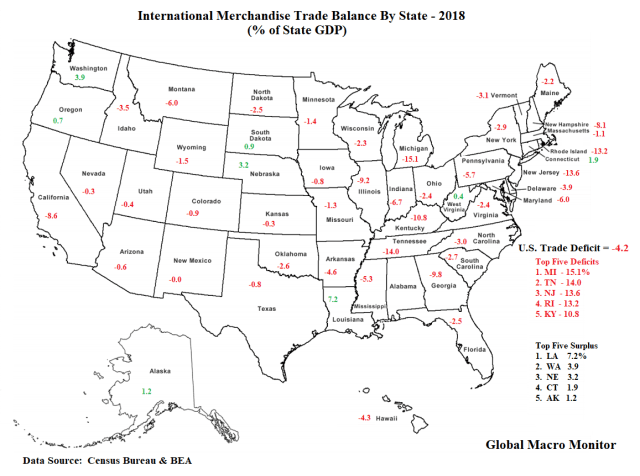
International Trade Balance As A Percent Of State GDP

Our last post,  Trade As Percent Of State GDP (2018),  which illustrated the openness of each state to international trade normalized by the state’s GDP,  provoked our curiosity about which states run the largest trade deficits with the rest of the world.

Of course, California, which is, by far, the country’s largest economy with a state GDP of over $3 trillion (14.5 percent of U.S. GDP with Texas a distant second at 8.7 percent ), ran a $260 trade deficit in 2018, or about 30 percent of the $879 billion trade deficit.  Given the size of California’s economy, the trade balance-to-state GDP came in at -8.6 percent, however.

Data Caveats

There are a ton of caveats with the data but it does give a sense of the zip codes where states live when it comes to contributing to the overall U.S. trade deficit.

Trade data is not calculated on a value-added basis as is the GDP data.  For example, we suspect much of Michigan’s imports consist of auto parts and used to produce exports in the automobile industry.

Moreover,  a couple of years ago we posted the list of foreign suppliers in the Boeing 787 Dreamliner, which is manufactured/assembled in South Carolina.

Assembly is just a small part of the Dreamliner’s  manufacturing value chain.   The International Monetary Fund (IMF) noted in a recent working paper,

More than 70 percent of the plane’s value is not generated by Boeing.  – IMF
.
The Post and Courier wrote yesterday the jetliner is…”comprised of more than 2.3 million parts made around the world.”  — GMM, Feb 2017


Thus many of South Carolina’s imports go into assembling the Boeing 787 and then exported though only the valued-added of assembly is calculated in state GDP. Consequently,  some countries have nonsensical export-to-GDP ratios which exceed 100 percent.

U.S.-China Trade Balance

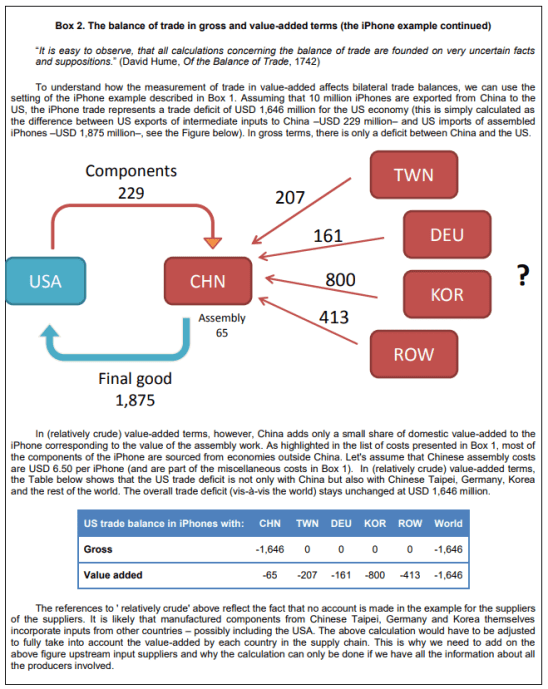
The problem with how exports and imports are calculated also distorts the U.S. trade deficit with China.  For example, the iPhone, which is assembled in China and only account for a small fraction of its value added, are counted at their final value in U.S. imports.  See here.

Mar25_iPhone Value Added


Nonetheless, the data, though imperfect, are very interesting and enlightening.


Trade_Deficit_By_State.png


State_Table


Posted in Economics, Uncategorized | Tagged , | Leave a comment

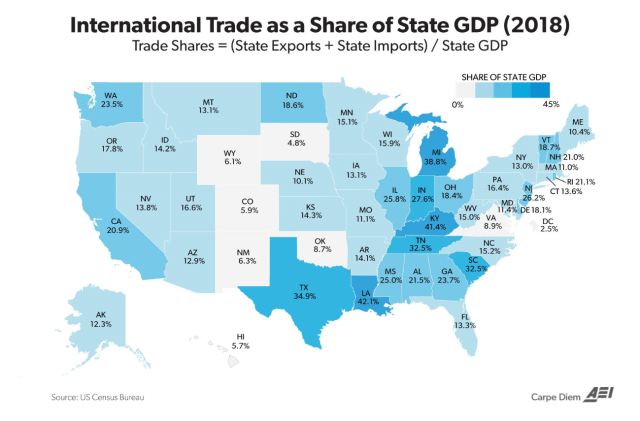
Trade As Percent Of State GDP (2018)

Who would have thunk it?

Lousiana (petrol products and soybeans), Kentucky (aircraft), Michigan (auto & parts), Texas (oil),  South Carolina (aircraft & auto),  and Tennessee (medical equipment, aircraft & auto, parts), the states most engaged in international trade (i.e., > 30 percent of state GDP).  Note, the state parentheticals reference only exports.

The Machiavelli in me thinks Trump understands, ex. Michigan, these are deep red states and will support him regardless if they get hurt in an escalation of protectionism and de-globalization.

The realist in me thinks Trump & Co. do not play the long game and think only in the now.

Upshot 

Logic almost always missing in politics.

Yes, very simplistic-off-the cuff formulation of opinion.   Show us yours?


Trade_by_State


Hat Tip:  Mark J. Perry  @Mark_J_Perry


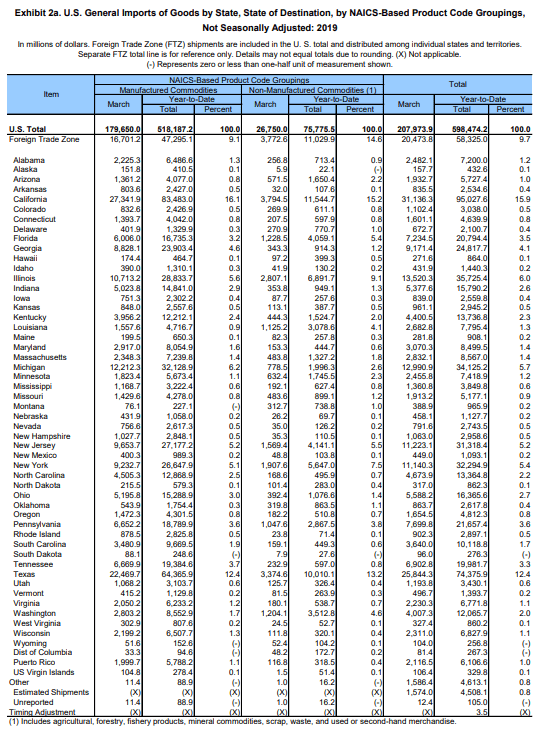
Memo Data:

Imports_by_State


Posted in Economics, Trade War | Tagged | 1 Comment

Memorial Day Tribute 2019


Posted in Video | Tagged | Leave a comment

Priceless And Timeless

https://twitter.com/bsmile/status/1131725523082797057?s=21

Posted in Uncategorized | Leave a comment

Will The S&P Hold The Line?

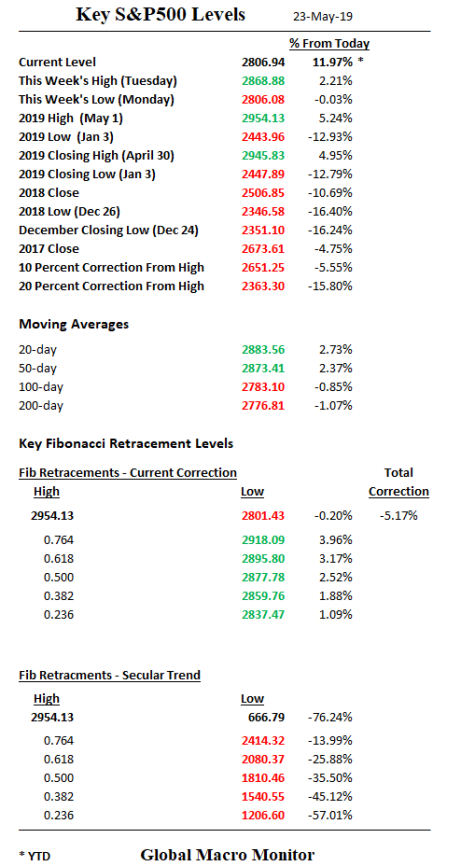
Will the S&P hold its May 13th low of this current sell-off at 2801.43?

Glad you asked.   The market is currently trading at its low of the day, 5 points above that support level.

Tuesday’s Post

The stock market took off on Mr. Toad’s Wild Road just barely after the ink was dry on our late Tuesday night post,  where we suspected stock volatility was about to increase in a big way as the market begins to internalize the seriousness of the shifting domestic and geopolitical tectonic plates.

Our economic and market analysis has focused on the major secular issues, which we believe are starting to send tremors through the markets, mainly the shifting of global geopolitical tectonic plates, which, we believe will soon usher in the Big Dipper or bear market.

If Chimerica has been a major factor driving global growth, corporate margins and profits for the past 20 years, how is its unwind going to be positive for stocks?

We suspect Mr. Toad’s Wild Ride is just beginning.  – GMM, May 22th  12:05 AM   

We are beginning to believe the increase in tariffs and the moves on Huewai are tantamount to the launch of ICBMs or an attack or attempted sinking of China’s economic flagship.   It will be very difficult to walk back with a presidential tweet or even another round of fruitless negotiations.

Almost as difficult as Admiral Yamamoto trying to walk back Japan’s flyover of Pearl Harbor in December 1941.  No comparison, folks, just a simple analogy.

It also limits President Xi’s flexibility in negotiating a deal as the Communist Party hardliners now seemed to have hijacked the trade deal.   Tough to cut a deal when hardliners on both sides are driving negotiations.

An Aside:  Memorial Day

By the way, a million hat tips and eternal gratitude to our great American brothers and sisters who paid the ultimate price fighting for our freedom and prosperity.  Ditto to all the Vets.

We civilians hope to make you just a fraction as proud as we are proud of you.  Apologies for the current state of affairs.

Let us remember and thank you every day not just on Memorial Day.

Secular Changes In Economic Environment

Global trade is tanking and unless the trend in protectionism reverses,  the new economic theme over the next decade will be one of stagflation.  Of course, markets will have difficulting finding their footing in this new environment as inertia, adaptive expectations and the ghosts of Christmas past will take some time to unwind and go away.   Deflation will be the first kneejerk response of Mr. Market.

Rational expectations?  Come on, man, where you been?

We’re talking not cyclical but secular changes, folks, economic problems that will render a 25 bps interest rate cut by the Fed irrelevant and possibly counterproductive.  Though the muscle memory of markets will love the initial honeymoon period of a new round monetary stimulus.

Domestic Politics

Getting uglier.

The Speaker of the House essentially implied in her presser today, at least our interpretation, is that a “Mad King” lives in the White House.   The third in line for the American presidency called for an intervention,

 “I pray for the president of the United States. I wish that his family or his administration or his staff would have an intervention for the good of the country.”  – ABC News

That is as fugly as it gets, yet we suspect it’s going to get much fuglier.

Key S&P Levels

The market is trading at its low of the day about 5 points above the May 13th low of this sell-off.  That needs to hold but we don’t think it will and a trip to the 200-day at 2776.81, another 1 percent lower is a high probability.

Will the S&P break 2801.43 in the last hour of today’s trading or tomorrow?   You decide.

Always tough to sell a market down 50 S&P points but we suspect the shorts are beginning to internalize all of the above analysis and are becoming bolder in holding overnight positions as the fear of presidential tweets fades.  Algos don’t think, however. Therein lies the rub.

As always, we reserve the right to be wrong, and often are.

Stay alert, stay tuned.


S&P


Posted in China, Equity, Politics, S&P500, Uncategorized | Tagged , , | 2 Comments

Stress Testing Apple

Goldman finally getting around to stress testing Apple as the trade war escalates.  They are out today warning Apple is in a world of hurt if China targets the iPhone maker in the trade war.

The U.S.-China trade war could take a big chunk out of Apple’s bottom line if China retaliates by banning its products, according to an analyst at Goldman Sachs.

Analyst Rod Hall said in a note to clients that Apple’s earnings could drop by 29% if the company’s products were banned in mainland China. The analyst cut his price target on Apple to $178 per share from $184, representing a 4.6% downside from Tuesday’s close of $186.60.  – CNBC

Folks, we warned about China’s other nuclear option in the trade war and stress tested Apple more than a year ago (see the re-post below), and, yes, we get it, timing is everything.

What more efficient way to take the U.S stock market down than to hit its largest stock by threatening market access to the Chinese consumer?   Apple’s market cap is over $800 billion, the world’s largest, and such a scenario would certainly take the overall market down.  – GMM,  March 25, 2018

We also cited the following clip from the Washington Post,

China should first take measures to deal a blow to the industries in U.S. states that helped Trump win the 2016 presidential election and those states whose political leaders are still backing him in this year’s midterm election.”

But, Mei also recommended selling U.S. Treasury bonds and undermining the U.S. stock market to make Trump “feel the pain.”  – Washington Post

Check off paragraph one.

We are hoping for a positive outcome but fully strapped in.


China’s Other Nuclear Option

Posted on 

Sorry to be such a downer, folks.

We have to stress test the macro scenarios versus current market conditions by looking at worst case events, then calculating expected values based on the most likely probabilities. Especially after such a huge run in stocks and with the “buy the dippers” still pounding the table.

Mar25_S&P500

Still Expensive

If stocks were in the tank and you could not give them away, we would be looking for green shoots to justify upping investment positions.   That is a long way off, in our opinion. Trading decisions are a different story, however.

Just take a look at the monthly S&P chart.  It looks like we are in a speed wobble in a topping and overbought market which could easily flip us over the handlebars.

China Will Target The Stock Market

In addition to the nuclear option of using its portfolio of U.S. Treasury securities to retaliate against trade tariffs, we believe the Chinese government could target the U.S. stock market.

We wrote last week how the U.S. is in a weaker negotiating position as the result of increased market volatility.

Here is the Washington Post quoting the China Daily, the government newspaper.

“China’s response should follow the principle of a precision strike,” Mei Xinyu, a researcher at a Commerce Ministry think tank wrote in an opinion piece for China Daily. “China should first take measures to deal a blow to the industries in U.S. states that helped Trump win the 2016 presidential election and those states whose political leaders are still backing him in this year’s midterm election.”

But, Mei also recommended selling U.S. Treasury bonds and undermining the U.S. stock market to make Trump “feel the pain.”  – Washington Post

Feel the pain, indeed.

Target Apple

What more efficient way to take the U.S stock market down than to hit its largest stock by threatening market access to the Chinese consumer?   Apple’s market cap is over $800 billion, the world’s largest, and such a scenario would certainly take the overall market down.

The following chart illustrates Apple derives around $50 billion of its annual revenues from greater China, which is about 20-25 percent of its total revenues.


Mar25_Apple's China Revenues

Furthermore, Apple assembles most of its iPhones and gadgets in China.  A disruption to Apple’s supply chain would further disrupt the stock.

U.S. iPhone Imports Distort Trade Imbalance With China 

We have not heard much about it during the recent uptick in trade rhetoric, but U.S. consumption of iPhones distorts the China-U.S. Trade imbalance.  China primarily assembles the iPhone, which accounts for only about 3-6 percent of its value added, yet the full value of iPhones are counted in the bilateral trade numbers.

Take a look at the iPhone X. IHS Markit estimates its components cost a total of $370.25. Of that, $110 goes to Samsung Electronics in South Korea for supplying displays. Another $44.45 goes to Japan’s Toshiba Corp and South Korea’s SK Hynix for memory chips.

Other suppliers from Taiwan, the US and Europe also take their portion, while assembly, done by contract manufacturers in China like Foxconn, represents only an estimated three to six percent of the manufacturing cost.

Current trade statistics, however, count most of the manufacturing cost in China’s export numbers, which has prompted global bodies like the World Trade Organization to consider alternative calculations that include where value is added.

…Apple shipped 61 million iPhones to the US last year, data from researchers Counterpoint and IHS Markit show, spending $258 on average to make each iPhone 7 and 7 Plus.

Using a rough calculation, that implies the iPhone 7 series added $15.7bn to the US trade deficit with China last year, about 4.4 percent of the total. That’s also about 22 percent of the $70bn in mobile phones and household goods the US imported from China.  –  Al Jazeera

Here is a good illustration and further explanation of calculating trade based on value added rather on a gross basis from the OECD,
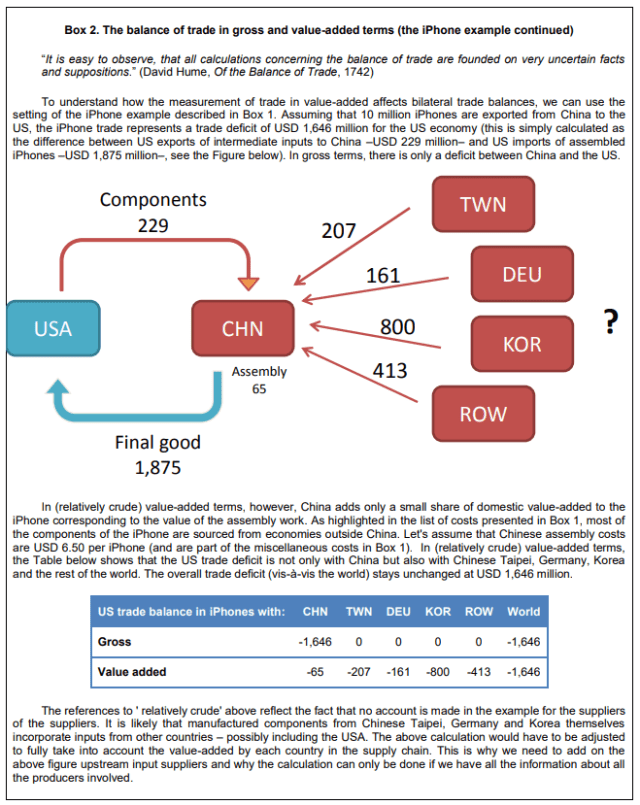
Mar25_iPhone Value Added

It is important to keep the above in perspective.  But, hey, it’s politics.  Throw out all rationality, no?

Upshot

Stocks are expensive and though cyclical factors remain relatively positive – earnings and growth — we are looking below the surface at potential structural shifts in the macro environment.    Movements of the tectonic plates, such as shifts in long-term capital flows, valuation, and sentiment;  the erosion of the  liberal world economic order; secular political trends, and the long-term trajectory of interest rates, among others.

We give our worst case scenario in the tariff dispute about a 33 percent probability and believe the market has only priced in a 5 percent probability.   There is much more going on than just the trade rift between the U.S and China, including growing tensions over Taiwan,  the East China Seas,  North Korea, and the appointment of John Bolton as the new National Security Adviser.   Any or all of these could move south and feedback into trade negotiations blowing up market volatility.

Bigger picture, and more important, is the Thucydides Trap.

Thucydides’s Trap teaches us that on the historical record, war is more likely than not. From Trump’s campaign claims that China is “ripping us off” to recent announcements about his “great chemistry” with Xi, he has accelerated the harrowing roller coaster of U.S.-China relations. If the president and his national security team hope to avoid catastrophic war with China while protecting and advancing American national interests, they must closely study the lessons of the Cold War.  – Graham Allison

Stay tuned.

Posted in Apple, China, Equities, Uncategorized | Tagged , , , , | Leave a comment

Key S&P Levels

It’s been a while since drilling down on the markets.  We have been concentrating on rebuilding our website to deal with the free riders and honing our web scraping coding skills.  Our economic and market analysis has focused on the major secular issues, which we believe are starting to send tremors through the markets, mainly the shifting of global geopolitical tectonic plates, which, we believe will soon usher in the Big Dipper or bear market.

The Coming Bear Market

Unless Trump and XI can pull a rabbit out their hats at the June 28/29th G20 in Osaka, we are starting to doubt our target of a 3025 peak on the S&P before Ursa Major comes calling.  Unfortunately, the Year of the Rabbit doesn’t come until 2023, and 2019, is, after all, the Year of the Pig.  Ouch!

We have been selling into this year’s strength.

President Xi seems to be preparing his country for the “long march” in the trade war.  Could be posturing but it’s a  danger to whip the hoi polloi into an anti-American frenzy. We suspected as much back in February but still think the two global superpowers will be able to come to some sort of cease-fire in Osaka, though of little substance.   If so, sell hard and fast.

President Xi already seems to be preparing his population for the worst case scenario, warning of “challenging times ahead” possibly in the event Trump goes ahead with the tariff hikes.  Maybe we are reading too much into it and maybe not. – GMM, February 2019

Domestic Politics  

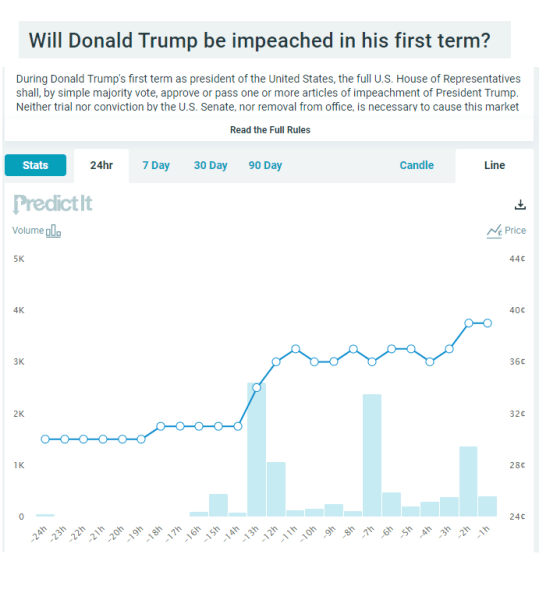
U.S. domestic politics are about to get even uglier.  The impeachment market was up 30 percent today.

Impeachment Market.png

We wrote on April 18th,

We’re not making a political statement or being partisan but just trying to give our readers a heads up on the results of our brief analysis and how we see it playing out.  The odds of impeachment have gone from around 6:1 to 4:1 in the past two weeks.

We expect the market price at PredictIt to move up another 30-50 percent in the next few weeks, or 3:1 odds for impeachment.  Don’t think your gonna make that in Amazon in two weeks, though the shares might get an impeachment bump.  – GMM, April 18th

The impeachment market is up 75-85 percent since that post.   None of the above is priced into the stock market.

S&P Levels

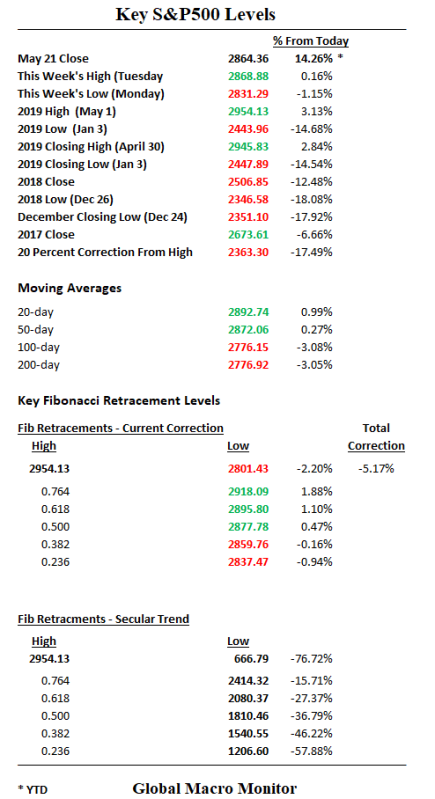
The S&P is up over 14 percent YTD, just 3.13 percent from its all-time high, and just 5.6 percent from our peak S&P target, not surprising after a down year.

Inertia and hopes of a ceasefire on China trade could get it there but we will continue to sell.

If Chimerica has been a major factor driving global growth, corporate margins and profits for the past 20 years, how is its unwind going to be positive for stocks?

Buybacks?  Where is the cash flow going to come from?

A new round of QE?  Negative interest rates?   Hope not.

The Fed will try and it may succeed in keeping asset markets afloat for a short period but that well is running dry.   We suspect it will eventually destabilize money demand and the world will be in a world of hurt.  See our friend, Sebastian Edwards latest, Modern Monetary Disasters.

Key Levels

Taking out 2877 to the upside would be huge and get the S&P back above the 50 percent Fibo retracement level and the 50-day moving average.  To the downside, this week’s low at 2831 needs to hold or the risk of a quick trip to the 200-day at 2777 increases markedly.

We suspect Mr. Toad’s Wild Ride is just beginning.

Stay alert, stay tuned.


Impeachment Market.png

Posted in S&P500, Uncategorized | Tagged | 1 Comment