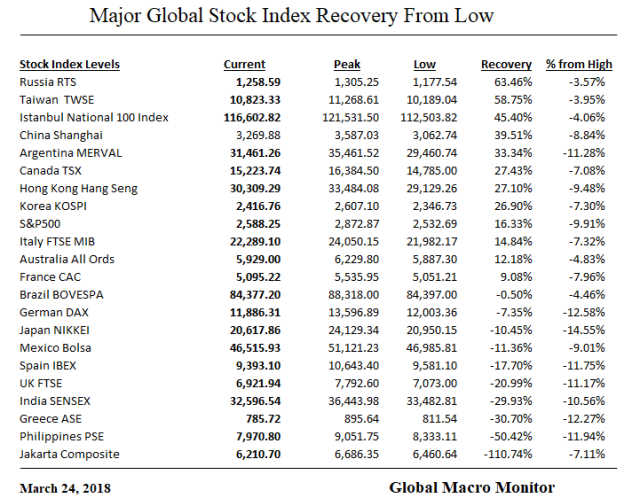
Difficult to short such beauty…
Long

Short

Difficult to short such beauty…
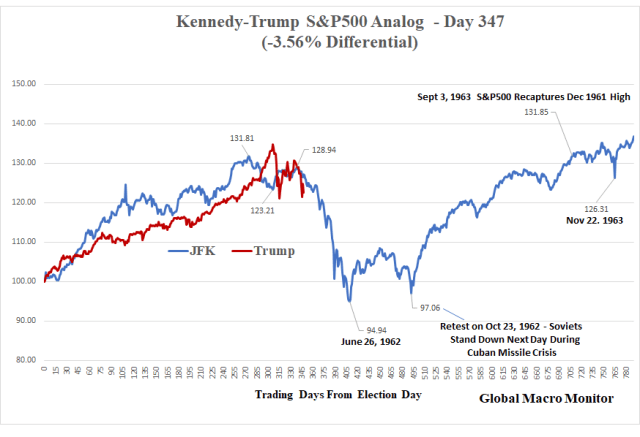
We have had lots of requests to update our JFK-Trump S&P500 analog. Here you go.
The Kennedy-Trump S&P500 analog is tracking, on a directional basis, relatively well, with the Trump S&P now 3.56 percent below the JFK S&P, 347 trading days after election day. Not a surprise with today’s lightening speed market. The Trump S&P is running about two weeks ahead of the JFK S&P.
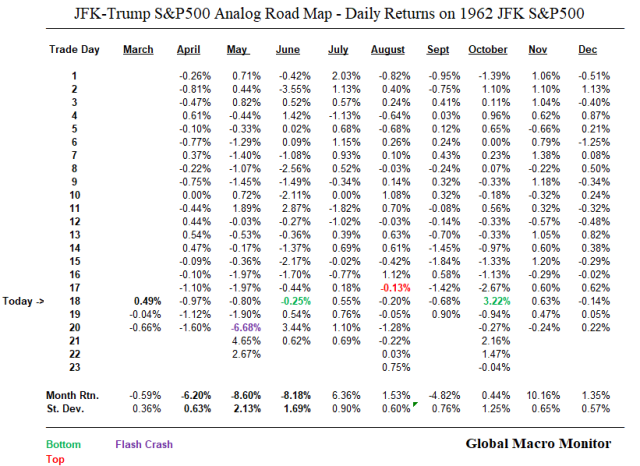
We have also included below a daily and monthly roadmap if you buy into the analog. By “buy in” we do not mean that the analog tracks on a daily basis — the main criticism of the doubters – but the direction and time-space are relatively similar. Both markets priced Goldilocks but ran into a short-term Frankenstein.
Note the downdrafts and the increase in volatility in April and May, with a bottom at the end of June, a rally into August, and the retest of the low in October, coinciding with a missile crisis.
Rare Volatility Shock In February
We discovered this analog by crunching 70 years of data looking for similar volatility shocks to the one that hit the stock market in early February. We found three:
1) 1955: Ike’s heart attack; 2) 1962: the “Kennedy slide” or JFK bear market; and 3) 1987: the “crash” bear market, which lasted only 38 days.
We threw out Ike’s heart attack as it was not a prelude to a bear market. The S&P500 recovered shortly after the sharp Monday sell-off after President Eisenhower had a heart attack on the 8th hole at Cherry Hills Country Club the prior Saturday afternoon.
Why The Analog Works
We believe this analog is working for the following reasons:
The most important, in our opinion, is #2 – the percentage move and time frame.
Bear markets always follow bull markets and the bigger the prior move in a compressed time frame, the harder the fall. Bear markets look for catalysts to sell, but the underlying vulnerability remains — valuation and longer-term overbought conditions.
Expecting A Few Flash Crashes
We are also expecting a few flash crashes during the next few months.
We came across the following piece, a real nugget, by the great Jason Zweig, who wrote in his WSJ article, Back To The Future: Lessons From The Forgotten ‘Flash Crash’ Of 1962, in 2010:
Money quotes:
…“The stock market careened downward yesterday,” reported The Wall Street Journal on May 29, 1962, “leaving traders shaken and exhausted.” The Dow Jones Industrial Average fell 5.7% that day, down 34.95, the second-largest point decline then on record.
…the “market break” of 1962 came after a run-up in the market that had led many investors into complacency. In 1961, stocks had risen 27%, with leading technology stocks like Texas Instruments and Polaroid trading at up to 115 times earnings.
Then, without warning, stocks “broke.”
…In this year’s crash, many trades, especially in exchange-traded funds, went off at prices wildly different from the orders investors had placed. Likewise, in 1962, “some orders were executed at prices substantially different from those which prevailed when the order was entered,” an investigative report by the Securities and Exchange Commission noted the following year.
Some high-frequency traders, which use powerful computers to make markets in stocks, stopped trading in this year’s flash crash at the very moments when the market needed liquidity most urgently.
In 1962, high-frequency trading didn’t exist, but “specialists” did. By law, specialists were obligated to try to maintain a fair and orderly market for each stock on the floor of the exchange. However, concluded the SEC’s report, “At no time during the day did the specialist intervene in sufficient volume to slow the rapid deterioration of the market in IBM.”
…Traumatized investors bombarded the White House with complaints and pleas for help. And they voted with their feet, in what the SEC called a “general public disenchantment with the market.” As households slashed their purchases of stocks, 8% of stockbrokers left the business throughout 1962, and “the pinch was felt” even by giant firms like Merrill Lynch, whose net earnings fell by half from the year before. – Jason Zweig, WSJ, May 29, 2010
BTFFD
During the next few months, our investment accounts will only be buying the French Dip. That is Buy The F**king French Dip (BTFFD).
Stay tuned.
“I think overall we have been pricing in for Goldilocks and we are closer to Frankenstein to be honest.” — Steen Jakobsen, Saxo Bank on CNBC, March 27
Beijing urges them to oppose U.S. tariffs targeting China’s alleged theft of intellectual property.… READ MORE : http://www.euronews.com/2018/03/26/ch…
Sorry to be such a downer, folks.
We have to stress test the macro scenarios versus current market conditions by looking at worst case events, then calculating expected values based on the most likely probabilities. Especially after such a huge run in stocks and with the “buy the dippers” still pounding the table.

Still Expensive
If stocks were in the tank and you could not give them away, we would be looking for green shoots to justify upping investment positions. That is a long way off, in our opinion. Trading decisions are a different story, however.
Just take a look at the monthly S&P chart. It looks like we are in a speed wobble in a topping and overbought market which could easily flip us over the handlebars.
China Will Target The Stock Market
In addition to the nuclear option of using its portfolio of U.S. Treasury securities to retaliate against trade tariffs, we believe the Chinese government could target the U.S. stock market.
We wrote last week how the U.S. is in a weaker negotiating position as the result of increased market volatility.
Here is the Washington Post quoting the China Daily, the government newspaper.
“China’s response should follow the principle of a precision strike,” Mei Xinyu, a researcher at a Commerce Ministry think tank wrote in an opinion piece for China Daily. “China should first take measures to deal a blow to the industries in U.S. states that helped Trump win the 2016 presidential election and those states whose political leaders are still backing him in this year’s midterm election.”
But, Mei also recommended selling U.S. Treasury bonds and undermining the U.S. stock market to make Trump “feel the pain.” – Washington Post
Feel the pain, indeed.
Target Apple
What more efficient way to take the U.S stock market down than to hit its largest stock by threatening market access to the Chinese consumer? Apple’s market cap is over $800 billion, the world’s largest, and such a scenario would certainly take the overall market down.
The following chart illustrates Apple derives around $50 billion of its annual revenues from greater China, which is about 20-25 percent of its total revenues.

Furthermore, Apple assembles most of its iPhones and gadgets in China. A disruption to Apple’s supply chain would further disrupt the stock.
U.S. iPhone Imports Distort Trade Imbalance With China
We have not heard much about it during the recent uptick in trade rhetoric, but U.S. consumption of iPhones distorts the China-U.S. Trade imbalance. China primarily assembles the iPhone, which accounts for only about 3-6 percent of its value added, yet the full value of iPhones are counted in the bilateral trade numbers.
Take a look at the iPhone X. IHS Markit estimates its components cost a total of $370.25. Of that, $110 goes to Samsung Electronics in South Korea for supplying displays. Another $44.45 goes to Japan’s Toshiba Corp and South Korea’s SK Hynix for memory chips.
Other suppliers from Taiwan, the US and Europe also take their portion, while assembly, done by contract manufacturers in China like Foxconn, represents only an estimated three to six percent of the manufacturing cost.
Current trade statistics, however, count most of the manufacturing cost in China’s export numbers, which has prompted global bodies like the World Trade Organization to consider alternative calculations that include where value is added.
…Apple shipped 61 million iPhones to the US last year, data from researchers Counterpoint and IHS Markit show, spending $258 on average to make each iPhone 7 and 7 Plus.
Using a rough calculation, that implies the iPhone 7 series added $15.7bn to the US trade deficit with China last year, about 4.4 percent of the total. That’s also about 22 percent of the $70bn in mobile phones and household goods the US imported from China. – Al Jazeera
Here is a good illustration and further explanation of calculating trade based on value added rather on a gross basis from the OECD,
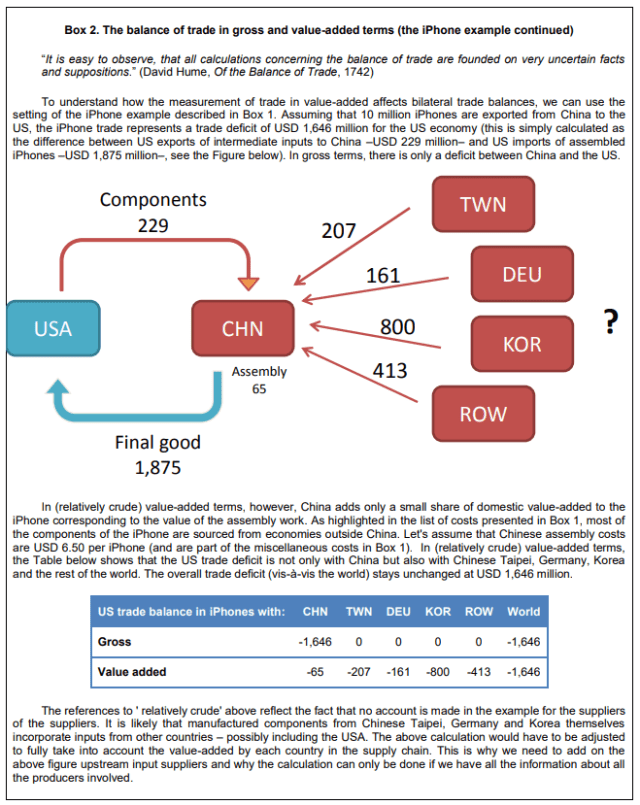
It is important to keep the above in perspective. But, hey, it’s politics. Throw out all rationality, no?
Upshot
Stocks are expensive and though cyclical factors remain relatively positive – earnings and growth — we are looking below the surface at potential structural shifts in the macro environment. Movements of the tectonic plates, such as shifts in long-term capital flows, valuation, and sentiment; the erosion of the liberal world economic order; secular political trends, and the long-term trajectory of interest rates, among others.
We give our worst case scenario in the tariff dispute about a 33 percent probability and believe the market has only priced in a 5 percent probability. There is much more going on than just the trade rift between the U.S and China, including growing tensions over Taiwan, the East China Seas, North Korea, and the appointment of John Bolton as the new National Security Adviser. Any or all of these could move south and feedback into trade negotiations blowing up market volatility.
Bigger picture, and more important, is the Thucydides Trap.
Thucydides’s Trap teaches us that on the historical record, war is more likely than not. From Trump’s campaign claims that China is “ripping us off” to recent announcements about his “great chemistry” with Xi, he has accelerated the harrowing roller coaster of U.S.-China relations. If the president and his national security team hope to avoid catastrophic war with China while protecting and advancing American national interests, they must closely study the lessons of the Cold War. – Graham Allison
Stay tuned.
Mar.23 — This robot may be the surgeon of the future. Created by Auris Health, it is designed to conduct a biopsy. This demonstration shows how the device will operate on and maneuver through a human lung. In the future, the robot could be used without a human operator. (video by Matt Goldman) – Bloomberg
Last week the S&P500 sold down 5.95 percent.
We noted in an earlier post, Why This Correction Is Different, in that the current sell-off is different from all other corrections over the past 30 years (except a special case in 1999). It is the first official correction in almost three decades that has taken place with a corresponding rise in bond yields.
No relief from the bond market last week as the 10-year bond yield closed pretty much unchanged as stocks got clobbered with the S&P down almost 6 percent.
The following chart illustrates there have been only 141 rolling 5-day equivalent sell downs since 1950, where the S&P500 sold off more than last week on a percentage basis. Such a one week big dip is rare, occurring less than 1 percent of the total trading days in the past 70 years.
Moreover, most took place in clusters at the beginning of or during a bear market. Excluding these, there have only been around twelve 5-day price moves, such as last week.
High Short Interest In Bond Futures
Remember, the current sell-off coupled with the rare rise, or unchanged bond yield, is taking place with record shorts in the futures market. If stocks really crack, bond yields will decline.
Recall during the October 19, 1987, stock market crash; the 10-year yield fell 150 bps during the next two weeks or about 15 percent. That would put the current 10-year yield at around 2.40 percent.
It’s about to get interesting. This week will see a huge supply of Treasures.
Morover, stock bulls need to step up this week and defend the 200-day moving average, right around Friday’s close, and 2,533, the recent low.
Stay tuned.

Wow! Just watched the October 16, 1987 Wall Street Week with Louis Rukeyser,which was the trading day eve (Friday night) before the Black Monday stock market crash. Marty Zweig famously nailed it.
The show ends with this eerily familiar exchange between Rukeyser and economist, Alan Sinai.
25:30
LOUIS RUKEYSER: Is the answer to get tough with our trading partners as people suggest?
ALAN SINAI: Oh, I think some of that will be tried.
LOUIS RUKEYSER: Will it be successful?
ALAN SINAI: Part of our problem today is a crisis in confidence because in Washington we are having trouble, and we’re having trouble dealing with our trading partners.
Gulp! Remember to panic before everyone else.
Third Test Of Lows Comng
The Dow and S&P500 are on their way to a third test of Feb. 9th lows. The S&P bounced slightly off the 200-day into the close on Friday. Maybe a little more to the bounce on Monday morning as traders place their bets, but we doubt it will hold as long-term buyers now seem to be on strike. The intraday low at 2,532 will also most likely fail, in our opinion. Stress, opinion.
Something big does feel afoot. Tectonic plates are shifting. The end of easy money and a shift away from the “financial engineering mirage.”
Is this the end of the liberal world order?
After a run of nearly one thousand years quipped the French philosopher and writer Voltaire, the fading Holy Roman Empire was neither holy nor Roman nor an empire. Today, some two and a half centuries later, the problem, to paraphrase Voltaire, is that the fading liberal world order is neither liberal nor worldwide nor orderly. – Richard Haass, CFR, March 21
<Seat Belts>.
Random thought: We hear much about how the corporate tax cut has changed the game for profits. Isn’t this just the government jumping into the financial engineering game? Did the underlying economics of Apple really change?
That is will it increase a companies revenues? Generate new products? Will economic profits change, not just accounting profits?
Apple needs more than just a tax cut and financial engineering. Maybe a new product, or two?