Week In Review – January 26

Summary

The wealth effect – boosting consumption out of what is perceived as permanent wealth -seems to be kicking in.   Consumers are feeling flush with the humungo gains in stocks and housing over the past few years.  It also appears consumers are not cashing in on their theoretical wealth but rather reducing savings and taking on debt to finance the increase in consumption.   Or, it could be, those who do not own assets are reducing savings and taking on debt to finance their consumption.

Savings Rate_Jan29

David Rosenberg,  Chief Economist & Strategist, Gluskin Sheff,  dishes on the latest GDP release

We’ve seen this picture before.  Wealth is not always so permanent and therein lies the new “boom-bust cycle” of the new millennium.   “It’s the economy stock market, stupid.”

The global economy and stock markets are now in a positive feedback loop.

Fixed-income

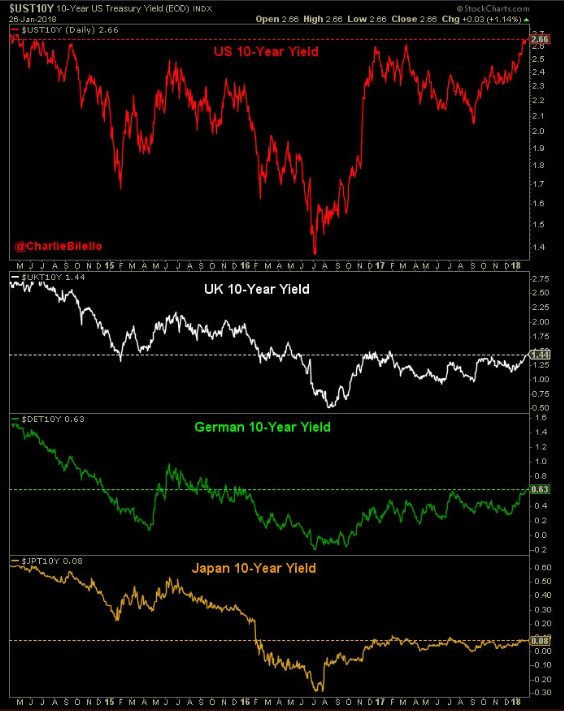
– Global 10-year yields breaking higher across the G3 economies;
– U.S. 10-year at highest since April 2014;
– Germany highest since December 2015;
– Japan highest since July 2017;
– China down 10 bps after making a new multi-year high in past few weeks;
– Euro yields in Convergence 2.0 as the eMac Euro vision takes hold;
– Credit behaving bigly as the stock gains feedback into the bond markets.

.
Weekly_Chart2

Source:  @charliebilello

Currencies

– Dollar flop continues after Secretary Mnuchin’s Davos faux pas.
– Traders sell the Trump walk back.

Stocks

– Ditto last week: global stocks keep ripping, especially emerging markets;
– Brazil, baby, on Não Lula!  Country’s ETF now up 17 percent in dollars for the month.

Week_2017_ETFsOther Risk Indicators

– Biotech and retail having a gangbuster January;
– Euro banks confirming breakout;
– Russell 2000 lagging, even though up almost 5 percent for the month. Stunning;
– Bad week for Trannies. Watch this space.

Commodities

– Nattie with another yuuuge week on the nation’s cold snap. Look to fade;
— Crude up on massive net positioning by specs.  Look to fade.

Weekly_Chart4

Source: Quandl


Week_2017


Posted in Uncategorized, Week in Review | Tagged , , , , , , | Leave a comment

Big Brother Alive And Well And Living In China (Must View)

This clip from the BBC is incredible and very disconcerting.

We suspect this technology, and the use thereof, is not just limited to China but ubiquitous throughout Western countries.   Double yikes!

China has been building what it calls “the world’s biggest camera surveillance network”. Across the country, 170 million CCTV cameras are already in place and an estimated 400 million new ones will be installed in the next three years.

Many of the cameras are fitted with artificial intelligence, including facial recognition technology. The BBC’s John Sudworth has been given rare access to one of the new hi-tech police control rooms.

Producer: Joyce Liu. Camera: Wang Xiqing.

Please subscribe HERE http://bit.ly/1rbfUog

.

Hat Tip:  Larry Wagner


Posted in Algos, Automation, China, Technology, Uncategorized, Video | Tagged , , , , | Leave a comment

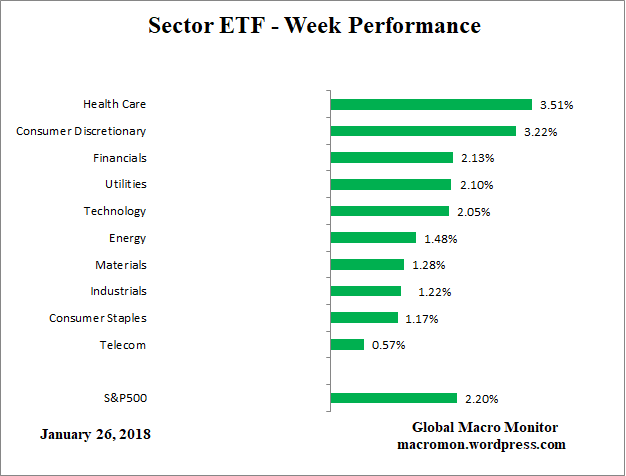
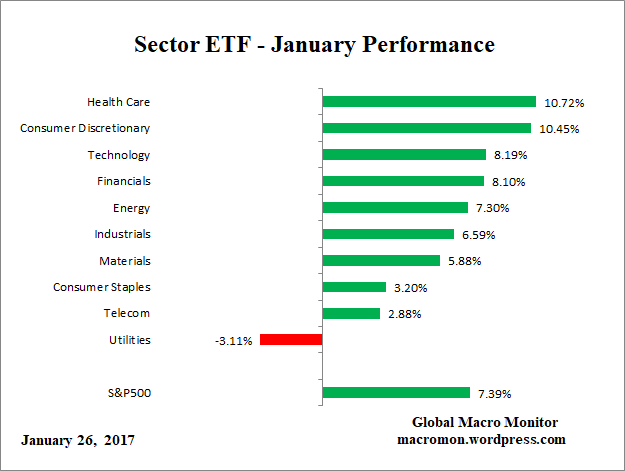
Sector ETF Performance – January 26

ETF_D

ETF_W

ETF_M

Posted in Sector ETF Peformance, Uncategorized | Tagged , | Leave a comment

Global Risk Monitor – January 26

RiskMon_1

RiskMon_2

Posted in Daily Risk Monitor, Uncategorized | Tagged , , , , , | Leave a comment

Top 10 Most Expensive and Cheapest Stock Markets


… look at the table ranking the top and bottom 10 countries by PE10 valuation. The bottom features a couple of usual suspects (Russia and Greece), although in the case of Greece you might argue that earnings are now structurally lower so the PE10 is less useful for that particular market. At the top end, it’s likewise many usual suspects: America and a selection of high growth Asian countries (and Japan). While there are some similarities between those at the top and bottom it’s hard to make a broad sweeping statement which generalizes the two groups  – TOPDOWN Charts

.

Expensive and Cheap Global Stock Markets

Hat Tip:  Derek Pietro


Posted in Equities, Uncategorized | Tagged , | Leave a comment

Why the dollar is weak – FT

Authers dishes on the weak dollar.

You know our suspicions (and just that – suspicions – as nobody really knows with certainty), which should negate some of this morning’s reversal on the president’s comments that sent shorts scrambling. Unless that is, we see a dramatic turnaround in how the world perceives the Trump administration.

Maybe in for a short-term bounce as the flamethrower seems to have been shelved in  Davos, for now, but longer-term doubtful.

Almost hit the 87 measured move we targeted last week.

John Authers explains why the US dollar is so weak, and how it distorts perceptions of other markets

► Subscribe to FT.com here: http://bit.ly/2GakujT

.

Dollar_Jan25


Posted in Dollar, Uncategorized | Tagged , , | Leave a comment

Rosie The Riveter Tweets A Red Flag

Note the date of James Baker’s comment.

Posted in Dollar, Equities, Uncategorized | Tagged , , , | Leave a comment

Dangerous Gambit Out Of Davos

We woke to a comment out of Davos that surprised both us and the market.

Dollar_Jan24

The U.S. Treasury Secretary, Steven Mnuchin, broke from tradition and welcomed a weaker dollar.

“Obviously a weaker dollar is good for us as it relates to trade and opportunities,” Mnuchin told reporters in Davos. Mnuchin said recent declines in the value of the dollar against other currencies were “not a concern of ours at all.” – Steven Mnuchin

We question the Secretary’s  wisdom and timing of such an announcement. The White House tried to walk some of it back, but, it appeared, only half-heartedly.

Foreigners Are America’s Largest Creditor

First, foreigners own more than 50 percent of marketable Treasury securities and now finance most of the U.S. budget deficit.  It comes at a time when the Fed, who has monetized almost all the U.S. budget deficits since the great financial crisis (GFC), has stopped QE and has even begun to run off their Treasury holdings.

Treasury_Holdings_ Jan24

All other things being equal (which they are not), interest rates will have to rise to compensate foreign holders of U.S. bonds for the weaker currency.

How do you think the People’s Bank of China (PBOC) and Bank of Japan (BoJ) are feeling today with their country’s  $2 trillion-plus holdings of Treasury securities?

Pissed off, we suspect.

We have voiced our concern as we have noticed over the past few weeks the dollar weakening as interest rates are rising. A red flag.

Bad Timing 

Second, is the timing.

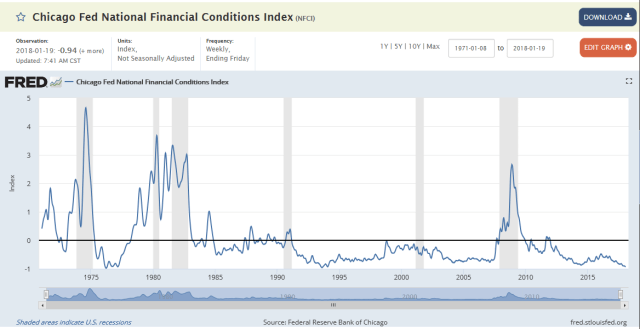
The U.S. economy is humming at full capacity with inflation already on the cusp of moving higher. A weaker dollar is, effectively, a monetary easing and makes the Fed’s job that much harder at a time when financial conditions are incredibly loose.

.

Financial Conditios_Jan24

.

The Administration also just announced the implementation of tariffs on solar panels and washing machines. LG Electronics has already announced they plan to raise prices on some of its models.  Retaliation by our trading partners seems likely.  Ergo inflationary pressures increase on the margin.

Tax Repatriation To Strengthen The Dollar?

Finally, we hear from market pundits the dollar is going to strengthen because, say, Apple, is about to repatriate all its foreign holdings of $200 billion-plus cash back to the United States.

Doesn’t Apple already hold almost, if not, all of its cash in dollar-denominated securities? The only difference is that most is domiciled in Ireland. Thus no need for currency conversion, right?  Just askin’.

We suspect that the same holds for most U.S. multinationals.  Please correct us if we are wrong.

Geopolitics and the global political economy are about to get even more interesting.

Amateur hour in Davos.

SM_Jan24

Posted in Bonds, Dollar, Uncategorized | Tagged , , , , , | 14 Comments

Short Sellers In A Bull Market

Ouch! I remember days like this guy is having.

Shorting a market that is melting up and having the bulls gore you where the sun don’t shine is no fun!

.Short_taking it_Jan23


Shorting stocks willy-nilly is a surefire beeline to blowing up your account. Are there any shorts still breathing, by the way?

Though we think the global markets are growing extremely bubblicious by the day, we have learned to go with trends and never step in front of a freight train as powerful as this one.

Guessing a market turn, trading by “gut feeling” or based on valuation in a liquidity induced bull market is a sure loser. We learned this lesson a way back, the hard way, unfortunately.

Good Story, Extreme Valuations

We would feel much better and confident about this market if asset values were not so darn expensive. My first boss on Wall Street, Michael Lewis’ “human piranha,” taught me that buying and holding assets that were expensive unless supported by rapidly improving and sustainable fundamentals risked having the bottom fall out on you.

The 1987 crash was a classic example. Though valuations were cheaper than today, interest rates were higher and already had a big move up throughout the year.

Similarly, however, the market was in a massive bull run, fueled by the Tax Reform Act of 1986. The S&P500 was up 38 percent for the year before peaking in mid-August and almost 60 percent since the beginning of 1986. The market had already begun to wobble in August with S&P500 selling off 15 percent before crashing 20 percent on Black Monday.

We are in a yield starved momentum-driven market fueled by excess liquidity (and, to some extent, but not an entirely unambiguously effective, fiscal stimulus) and a dominant theme – synchronized improving global growth – which is getting better, but these hardly justify the markets’ extreme valuations, in our opinion.

In other words, good neighborhood, good story, bad prices.

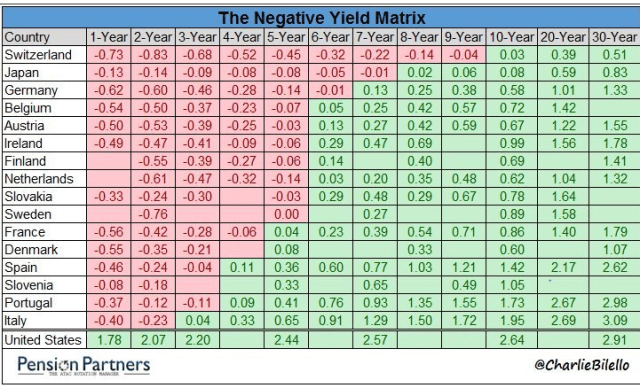
In addition, if the world economy is getting better,  the below matrix has got to get a lot greener.   We are not so sure, however, markets are prepared.

Negative Rates_Jan23

“Something Is Rotten [Not Just] In the State of Denmark”

It is hard enough to make a living on the short or, should we say, dark side. The natural trajectory for markets is to move higher.

Moreover, now that machines dominate the markets, they can squeeze you 23/5 and pick you off  especially in the darkness illiquidiity of the middle of the night.

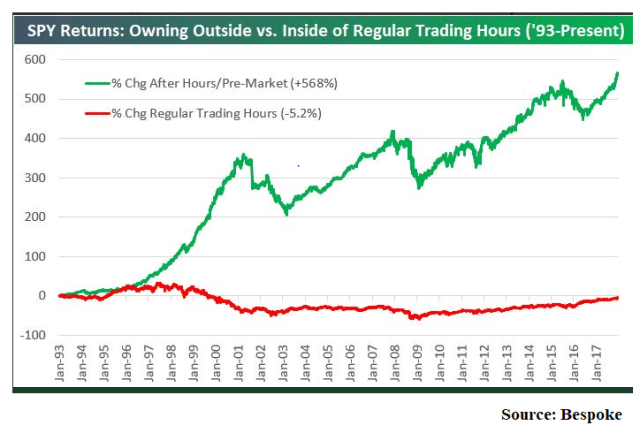
Take a look at this remarkable chart from Bespoke, for example.

Bespoke_Jan23

Since, 1993, buying the S&P500 ETF at the open of trading and selling at the close each day – i.e., on real volume – would have yielded a -5.2 percent return.  Conversely holding only overnight positions, buying at the close and selling at the open, returned 568 percent.

Come on, folks, “ something is rotten [not just] in the state of Denmark.”  Is it no wonder passive investing is taking over?

How High Can We Go?

We do not know how high the market goes or when it peaks but feel confident the shorts will have their day unless “this time is different,” which it never is, by the way.

Bull markets often have their strongest leg as their last leg, the proverbial “blow-off top.” The last twelve months of the 1990’s NASDAQ run, from March 1999 to March 2000, for example, had the index move up over 110 percent.

We also believe investors will have better entry points than they do today.

Political Event Risk

Finally, you also see the investing public openly mocking the bears during the later stages of a bull market. We see a lot of that these days. Just check your twitter feed.

As democracy around the world seems to be sliding into a secular bear market (absolutely not priced, in our opinion), short sellers, as the above picture analogously illustrates, have become the new circus, the modern day gladiators being ripped apart by the bulls in the trading arena.  And the new Rome roars!


Posted in Equities, Global Stock Performance, Uncategorized | Tagged , , , | 9 Comments

Angela Lives!

At least to fight another day and the final round of negotiations to form a collation government with the Social Democrats (SPD).   Not a done deal just yet.

.
The euro/$ is quite muted and coming off tonight’s opening high. Let’s see what happens tomorrow.

If there is no follow through-buying, decent dollar short covering could ensue.

Conversely, if euro buyers come in, the Dixie could push through last Thursday’s intraday low of 90.113, and we may see an 80 handle for the first time since December 2014 – on the way to the 87 measured move we posted last week. 

Rising interest rates and a weaker dollar is a red flag in our book.  That is an early signal of potential capital flight.   Keep it on your radar

Euro_Jan21

Posted in Euro, Germany, Politics, Uncategorized | Tagged , , , | Leave a comment