China and Brazil Equity Markets Rolling Over

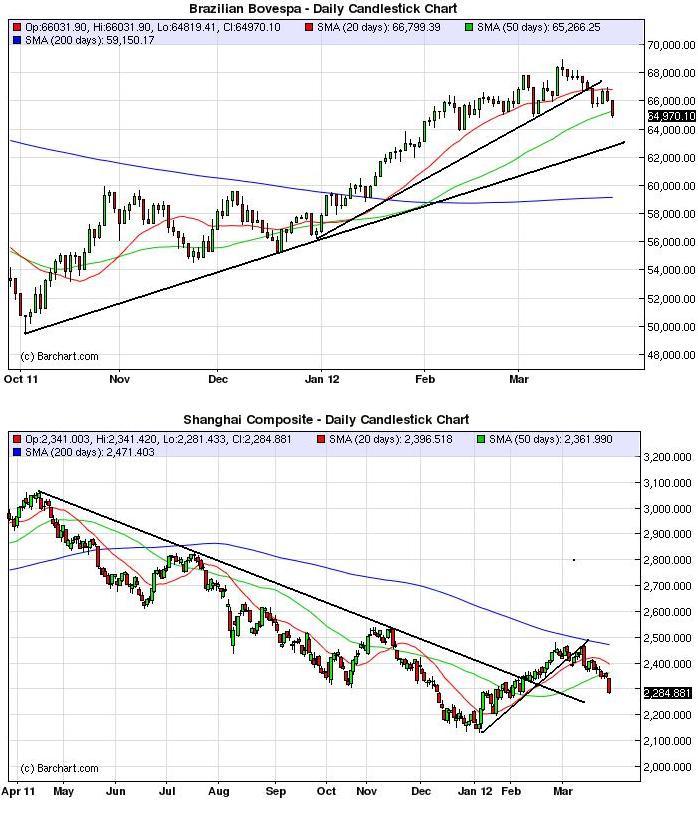
The Brazilian Bovespa, which has been one the best performing global equity indices in 2012,  looks like it’s rolling over.   It was down 1.62 percent today and closed below its 50-day moving average for the first time this year.   Brazil’s commodity led economy is closely linked to China, which is slowing and reflected in the down move in the Shanghai Composite.

These may be just healthy corrections and let’s see if the Bovespa can bounce off the 50-day here.  Keep them on your radar.

(click here if charts are not observable)

Posted in Black Swan Watch, BRICs, China | Tagged , , , | Leave a comment

Where Now, Dr. Copper?

In prior posts we’ve noted copper is key to divine where the Chinese and global economy are headed.  It was down almost 2 percent today and at key short-term support and its 200-day moving average.  It’s tracing out a descending triangle chart pattern, which usually resolves in a bearish move.   If 3.70 on the nearest contract breaks,  one more reason to play better defense.

(click here if chart is not observable)

Posted in Commodities, Economics | Tagged , , | 1 Comment

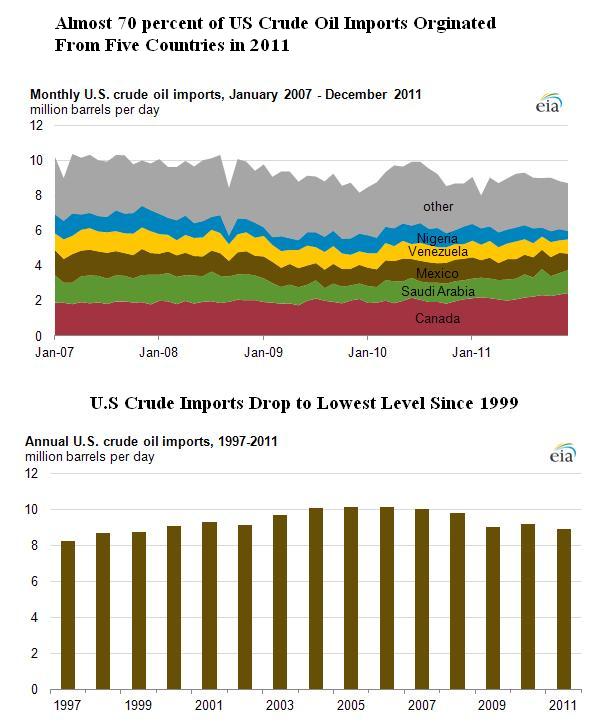
US Imports Crude Oil Likes It’s 1999

(click here if charts are not observable)

Posted in Crude Oil | Tagged , , , , , | Leave a comment

PBS Newshour: Structural Unemployment in the U.S.

Here’s a good piece on what we’ve been talking about. The days of simple unskilled manufacturing are long past. A problem that won’t be solved by zero interest rates and cyclical policies, by the way.

(click here if video is not observable)

Vodpod videos no longer available.

Posted in Employment | Tagged , , , | Leave a comment

Real Chance of Japan-like Housing Slump – Robert Shiller

Robert Shiller, who coined the term “irrational exuberance,” is one of our favorite economists.   He really nails it here on the structural shifts taking place in housing.   We agree there is a generational change going on in the sector where the younger “connected” cohort groups are shunning McMansions in the ‘burbs.

Also, the risks of a Japan-like multi-decade slump in housing is much higher than the markets perceive.    Is Mr. Bernanke listening?

Many young people are choosing to live at home for a longer period of time instead of buying. Moreover, would-be homebuyers are settling into modern apartments and condominiums, further hindering a housing rally. Shiller says the shift toward renting and city living could mean “that we will never in our lifetime see a rebound in these prices in the suburbs.”

A perpetually sluggish housing market, which Shiller believes has become “more and more political,” might push the country in a “Japan-like slump that will go on for years and years.”

(Click here if video is not observable)

Vodpod videos no longer available.

Posted in Black Swan Watch, Housing, Uncategorized | Tagged , , , | 3 Comments

Nonlinear Thinking: Robotic Surgeons & Central Bankers

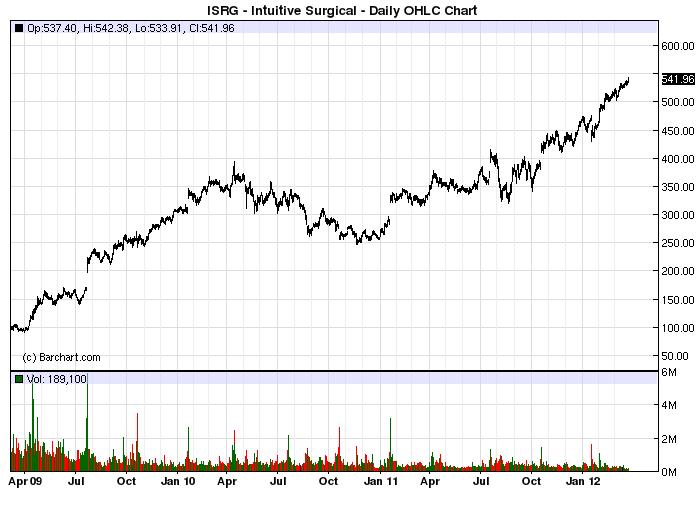
Here’s a piece we’ve been wanting to post for a long time.  Intuitive Surgical (ISRG) is a leader in the development and commercialization of medical robotic technology.  As the chart shows this is not just a concept but a very profitable reality.

The transformative tech theme, which we have been preaching, has really taken hold in the market and is reflected in this year’s impressive 20 percent rise in the Nasdaq.  It’s only March 26th, folks!

Think about these types of transformative technologies being introduced and taking hold across all industries throughout the  economy.   We suspect most business CapEx are  in these types of labor displacing technologies, though this particular example is not so clear in its labor replacing ability.

Nevertheless, this is why we believe Mr. Bernanke was so wrong in his speech today that cyclical forces, i.e, insufficient aggregate demand, is the predominate force behind the country’s long-term unemployment.   Zero interest rate policy (ZIRP)  will not train the new workforce for the new economy that is evolving out of  financial and economic crisis.

ZIRP may put a few more real estate and mortgage brokers back to work and increase some fake wealth that can be levered and consumed, but we have serious doubts that the incremental aggregate demand created by the reconstruction of, say,  the Housing ATM or a new dot.com-like bubble will ever return to the levels it once was.

We’ll try and surf the direction where the markets lead,  but ZIRP it’s misguided and bad, bad policy, in our opinion.  Mr. Bernanke, of all people, surely knows the first principle of economics is that “there is no free lunch.”   How, when, and how much will the total bill be for the free lunch is anybody’s guess.  But we will pay.

Maybe it’s time for some robotic central bankers, who follow rules and algorithms and reward savers rather than reacting to every 20 point move down in the S&P500.  You think?

(click here if chart and video are not observable)

Posted in Nonlinear Thinking, Policy | Tagged , , , , , , | Leave a comment

TR50: The 50 Most Innovative Companies (11-15)

Here are 11-15 of MIT’s Technology Review’s 50 Most Innovative Companies in 2011.  We’re posting in increments of five every few days as not to overwhelm you with info and required reading.

Click here for 1-5 of TR’s most innovative companies of 2011.
Click here for 6-10 of TR’s most innovative companies of 2011.

Technology Review uses the following criteria to choose the most innovative companies,

What is a TR50 company?   It is a business whose innovations force other businesses to alter their strategic course. TR50 members are nominated by Technology Review’s editors, who look for companies that over the last year have demonstrated original and valuable technology, are bringing that technology to market at a significant scale, and are clearly influencing their competitors.

11)  Complete Genomics
Why: 
New sequencing projects that the company announced in 2011 include one aimed at predicting preterm births and another that will sequence cancer genomes.
Key innovation: 
A computational platform allows it to assemble DNA sequences into genomes more accurately.

12)  Dreamworks Animation
Why:
Speeding up production of digitally animated movies will also benefit gaming and augmented reality.
Key innovation:
Software that can take maximum advantage of a multi­core processor allows animators to create scenes in minutes instead of hours.

13)  Dropbox
Why:
Its technology makes it easier for users to sync and share files on smart phones, laptops, and desktops.
Key innovation:
Cloud-based systems are the basis for a consumer-focused service that works across multiple platforms.

14)  EADS
Why:
Using lightweight parts will decrease the fuel consumption of the company’s aircraft and make its satellites cheaper to launch.
Key innovation:
Redesigning select parts to take advantage of the capabilities of 3-D printers has cut their weight in half.

15)  Facebook
Why:
The social network has become the means by which many online users communicate, get news, and find entertainment.
Key innovation:
New features automatically integrate casual online activity, such as listening to music or reading newspaper articles, into the social sphere.

TR – (1-5)
TR – (6-10)

Posted in Innovation, Technical Analysis | Tagged , , , , , , , , | Leave a comment

Bid!

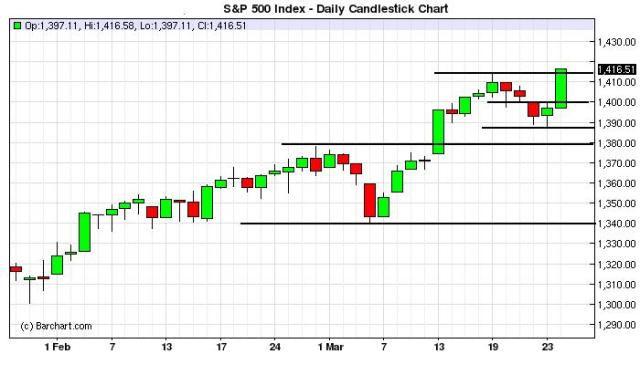
The S&P5oo made a new post crash high, closing above 1414.  We’d like to make a small correction to our post this weekend on the S&P’s key levels,

1399.68– Thursday’s high.  Only a couple points higher, but a close move above this level will pave the way to test the 1414 recent high;

The S&P500 rallied big today on the back of Tiger Woods’  comeback victory at Bay Hill.  Or was it sovereign spread tightening in Europe?  Or the German business confidence number?

Didn’t the  Fed Chairman Bernanke make a statement today?

Is the current high level of long-term unemployment primarily the result of cyclical factors, such as insufficient aggregate demand, or of structural changes, such as a worsening mismatch between workers’ skills and employers’ requirements?  If cyclical factors predominate, then policies that support a broader economic recovery should be effective in addressing long-term unemployment as well; if the causes are structural, then other policy tools will be needed.  I will argue today that, while both cyclical and structural forces have doubtless contributed to the increase in long-term unemployment, the continued weakness in aggregate demand is likely the predominant factor.  Consequently, the Federal Reserve’s accommodative monetary policies, by providing support for demand and for the recovery, should help, over time, to reduce long-term unemployment as well.

We believe Mr. Bernanke is more wrong now than he was  about the housing bubble, by the way, and using cyclical policies to address structural problems will end in tears.  This isn’t the issue here, however, as we’re just trying to divine the market direction to put bread on the table.

Whatever the case,  this market didn’t need much of catalyst as it is clearly technically short, under owned, and lacks real sellers.    The Bernanke speech with a different technical backdrop could  have been a catalyst for a sell-off as the market may have perceived the Fed as being overly bearish on the economic outlook.

Nevertheless, we have noticed an interesting characteristic about this market since volatility collapsed after the ECB LTRO2 operation.   The S&P500’s ability to close above its open on a consistent basis has been impressive and is sign, at least to us, of a market that it technically short/under owned.

Take a look at the chart below, for example.   Over the past 60 trading days, the S&P5oo has closed higher than its open 40 days, or 67 percent of the time.   Rarely does any market give traders such an opportunity for abnormal profits — that is,  in this case, to buy the open and sell the close for a profit.

Since the early 1960’s,  the market has experienced such 40/60 streaks only 3.08 percent of the time.   What’s even more impressive about today’s market is the 40/60 run of higher closes than opens has continued for 21 of the past 23 days.  Stunning!

This seems to us there is much more firepower out there than most believe to drive U.S. equities higher.     We could be wrong and equities will remain bid until they aren’t,  but this is our observation.   Add it to your arsenal.  Hope it helps.

(click here if charts are not observable)

Posted in Equities | Tagged , , | 3 Comments

Spain’s People Party Takes Hit Before Austerity Budget

From Euronews,

Spain’s ruling centre-right People’s Party has been dealt a blow ahead of launching a new austerity budget on Friday. Despite being tipped to win, it has failed to secure an outright majority in the Andalucian regional election.

The Socialists have been in power in the region for three decades, but the result suggests the electorate is tired of corruption scandals and high unemployment.

The PP won 50 of the 109 seats in Andalucia, still the most it has ever won. However, the combined totals of the Socialists, with 47, and the United Left on 12 open the possibility of a leftist ruling coalition.

Now it is down to the region’s United Left candidate to play kingmaker to the Socialists, a role Diego Valederas says he is going to relish.

Victory in Andalucia was seen as key as it also has the country’s highest level of unemployment. Spain’s plans to deepen cutbacks in public spending will be felt particularly hard here as it tries to pull itself out of the eurozone debt crisis.

A solid win would have put the PP in control of 12 of Spain’s 17 autonomous regions and also strengthened Prime Minister Mariano Rajoy’s hand before a general strike on Thursday

(click here if video is not observable)

Posted in PIIGS, Politics, Sovereign Debt, Sovereign Risk | Tagged , , , , | Leave a comment

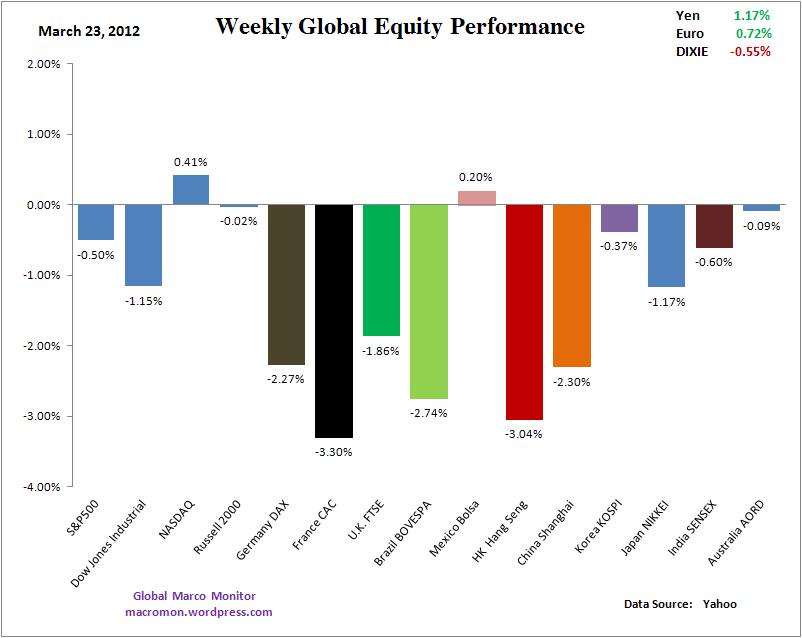
Week in Review: Global Equities Starting To Rollover?

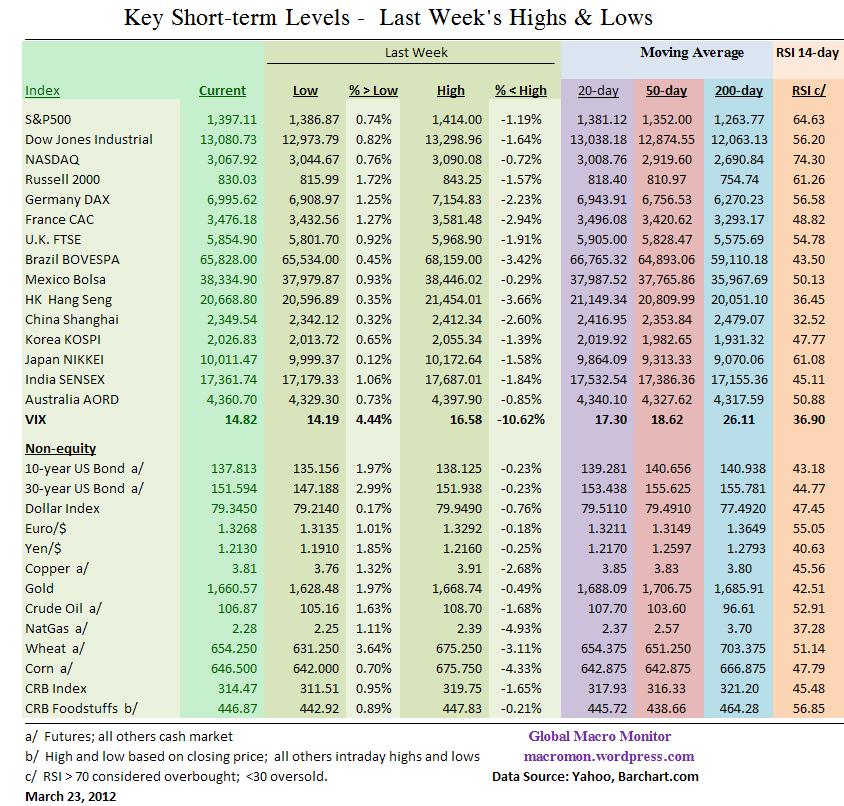
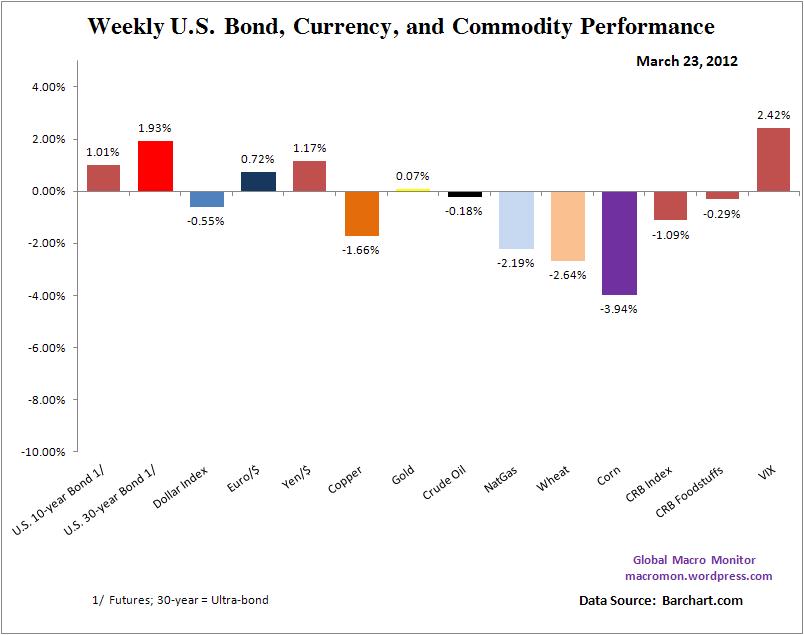
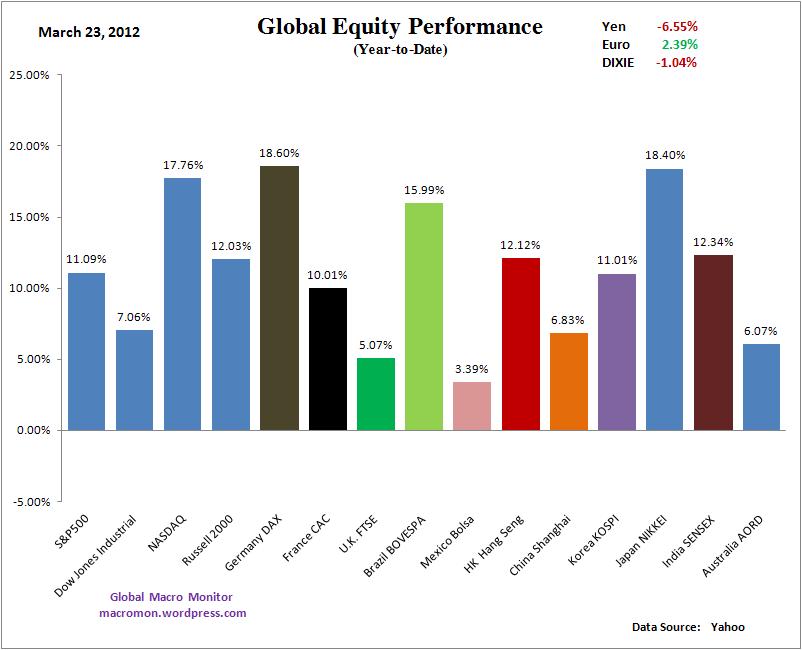
We are the first to confess we have no idea which direction equities are headed next week.  As you can see some of the stronger markets had a rough week verus  a relatively strong performance in the U.S. indices.

Watch the key levels on the S&P500 closely this week as a clue for where equities are headed.   Keep on your radar European sovereign spreads, which rallied off their lows into Friday’s close, and the Hang Seng and Shanghai composite — both, of which,  broke through their 50-day moving averages last week —  as leading indicators of risk aversion.   Traders would do well to also moinitor how Dr. Copper trades.

After such a stellar run with the S&P500 up close to 30 percent since its October low, we’re trying to be patient and  looking hoping for a pullback in the S&P500 to the 50-day moving average at around 1250.  Good luck next week!

(click here if charts are not observable)
Posted in Week in Review | Tagged , , , , , , , | Leave a comment