Dangerous Merkel-Sarkozy Spin

Interesting read by some traders on the Merkel/Sarkozy nonevent.   Their take away is both leaders sent a message to the PIIGS to either get on board with fiscal adjustment or leave the Euro.

Hmmmm.    Now what would that do to each country’s stock of debt denominated in Euros?   Would their bank and bond creditors take Greek drachmas and Irish punts as payment?    If some of these countries left the Euro and went back to home currencies their debt to GDP ratios would freaking skyrocket!

Dangerous stuff being kicked around at a dangerous time.   Our sense is both leaders were relieved by the success of ECB intervention to bring down Spanish and Italian bond spreads and they will continue to rely on Trichet’s monetary bazooka to fend off the wolves.  Bonne Chance!

Posted in Black Swan Watch, Monetary Policy, PIIGS | Tagged , , , , | Leave a comment

Macro Notes from the WalMart Conference Call

A pretty good insight into the lower end consumer.  See here for the full transcript.

Key Metrics

EPS from continuing operations of $1.09, up 12.4 percent over the $0.97 per share from continuing operations last year.

EPS guidance range of $0.95 to $1.00 and raised full year EPS guidance range to $4.41 to $4.51.

Net sales for the second quarter were $108.6 billion, an increase of 5.5 percent from last year, with contributions from all segments.

Total U.S. comps, without fuel, for the 13-week period ending July 29 were flat. Sam’s Club comparable sales, without fuel, increased 5.0 percent for the same period, at the top of guidance. Walmart U.S. comparable store sales were -0.9 percent, within guidance for the period.

Walmart International increased net sales 16.2 percent to $30.1 billion for the quarter. This included a currency exchange translation benefit of $2.3 billion.

During the second quarter, the company returned $2.7 billion to shareholders through dividends and share repurchases.

Struggling U.S. Consumer

…recently observed several consumer focus groups, and it’s clear that many consumers are still struggling. They’re trading down to stretch their budgets, buying a lower-priced brand of detergent, moving from branded canned goods to private label and purchasing half gallons of milk instead of gallons.

…The economy remains challenging for our core customers. Customers are still consolidating trips due to higher year-over-year gas prices. The swings in sales due to paycheck cycles remain pronounced, and our stores must staff and stock for the volatility both up-and-down. We also have seen an increase in the number of customers relying on government assistance for food and necessities for their family. Our grocery business continued its positive trend and again delivered low-single digit positive comps for the period. Food remains a key traffic driver to our stores. The strong performance during the July 4 weekend offset softness in the Memorial Day weekend.

…Sales across dry grocery continue to accelerate

…Food inflation has replaced gasoline price as the most important household expense concern. In addition, more than 15% of Walmart moms in our monthly survey have experienced the loss of a household wage earner’s job in the last year. Almost 40% of these Walmart moms indicate they’re holding off or eliminating items they would normally buy, reinforcing the need for us to drive Every Day Low Price. Moms of all income levels showed a drop in confidence over the last year, with middle-income moms showing the greatest drop.

New Technology and e-commerce

…our global e-commerce team stepped-up its work on delivering a continuous shopping experience to customers from the store to the Web to their mobile devices. In mature markets, we’re investing in multi-channel initiatives by integrating our stores with online services. We completed the rollout of Pick Up Today in all Walmart U.S. stores and within the last month, we announced that VUDU, our movie streaming technology, is now available on Walmart.com, as well as through any iPad browser.

..In June, we established Walmart’s China e-commerce headquarters in Shanghai, and we put in place the leadership team to quickly build this business. We are investing in the right talent and technology to pursue the growth in e-commerce. I believe that Walmart is the best positioned retailer to serve the needs of the next-generation customers who are striving to join the emerging global middle class. They’re connected to the world through smartphones and social media. They have higher expectations of value, quality and a better life. We will continue to advocate for policies that make sense for our customers and our business.

Corporate Taxes

We’ve also called for modernizing our nation’s corporate tax code. Last month, I [Mike Duke] testified before the U.S. Senate Finance Committee on reforming the tax code to drive job growth here at home and encourage America’s competitiveness abroad. To achieve comprehensive reform, we’ve called for putting everything on the table including the existing incentives that benefit us. There are 3 key points that I emphasized to the committee: one, lower their corporate tax rate; two, get rid of existing incentives that benefit some industries over others; and three, level the international playing field with a territorial system.

Global Sales: 53 New Stores in China

Walmart International reported second quarter net sales of $30.1 billion, an increase of 16.2% over last year. Changes in currency rates increased our net sales by $2.3 billion. As a reminder, our markets benefited this fiscal quarter from Easter sales and in the United Kingdom, the royal wedding.

…On a constant-currency basis, net sales were $27.8 billion, an increase of 7.1% over last year’s second quarter. All of our markets had constant currency sales growth, except in Japan, where sales were affected by the March 2011 natural disasters. Mexico, the U.K., Canada, Brazil and China provided the strongest net sales growth in the second quarter.

…While Walmart China sales continue to grow in the second quarter, the sales growth was not enough to offset the increase in expenses. As a result, China had a small loss from operations. Net sales for the second quarter grew 9.7% over last year and comparable store growth was 1.8%. Average ticket grew 10% in China, but traffic declined 8.2%.

…In the past 12 months, we opened 53 new stores including 48 supercenters and that brings our China store count to 344 stores.


 

Posted in Earnings | Tagged , | Leave a comment

Apple Ups iPhone Orders; SAC & Greenlight Buy More Shares

Digitimes reports,

Apple has upward adjusted the total order volume for iPhones, consisting of iPhone 3GS, iPhone 4, iPhone 4 CDMA and iPhone 5, for the second half of 2011 by 12-13%, from 50 million units originally estimated at the end of the second quarter of 2011 to more than 56 million units. iPhone 5 will account for 25.5-26 million units, according to Taiwan-based supply chain makers.

iPhone 5 orders for the third quarter of 2011 have been lowered from seven million units to 5.5-6 million units, while fourth-quarter orders have been raised from 14 million units to more than 20 million units, the sources pointed out. Total orders for iPhone 3GS, iPhone 4 and iPhone 4 CDMA for the third quarter exceed 20 million units, and fourth-quarter orders have been reduced to eight million units, the sources indicated.

Total shipments iPhones in 2011 will reach 95 million units, the sources noted.

While Taiwan-based supply chain makers will benefit from increased component orders, they are expected to see pressure for price cuts from Apple, especially touch panel makers which account for the largest proportion of total production costs, the sources said.

Apple closed at $383.41 or 5 percent off its July 27 all-time closing high of $403.41.  After the bell,   Steve Cohen of SAC Capital Advisors  announced that he had  more than doubled his  stock holdings in Apple Inc. during Q2 to 598,000 shares.   David Einhorn of Greenlight Capital also reported increasing his stake in Apple to 1.1 million shares as of June 30,  up from  837,500 shares at the end of the prior period.


Posted in Apple | Tagged , , , , , | Leave a comment

The Brazilian Blowout

Today’s rally in front of the Merkel/Sarkozy cup of tea surprised many, including us.  We’re not expecting much from the meeting, but you never know, and the market may have set itself up for disappointment.   Looking at the action in the dollar and commodities, including gold, it feels the market is expecting a monetary blast from Fed Chairman Ben Bernanke’s August 26th speech at the Jackson Hole conference.    The S&P was bid today and with sellers scarce you know exactly what the shorts were reaching for.

We’re watching an interesting development in Brazilian equities.  Over the past five trading sessions the BOVESPA has doubled the performance of the S&P500, up 12 percent vs 6 percent.   The Brazilian index is the worst year-to-date performer of the global indices we monitor so this may just be a “first of the worst” rally, where those down the most rally the most.  In fact, Bespoke put out some interesting research today showing that the best performing individual stocks in the rally that began on August 8th  are those that were hit the hardest during the downdraft.

(click here if chart is not observable)

Posted in BRICs, Commodities, Currency, Dollar, Global Stock Performance | Tagged , , , , , | 2 Comments

Is It Déjà Vu All Over Again?

Great ‘toon on the 1932 banking crisis, dated May 24, 1932,  posted over at the Worthwhile Canadian Initiative blog.  See our post, Credit-Anstalt 2.0?.

The caption reads: “Phew! That’s A Nasty Leak.  Thank Goodness It’s Not At Our End of the Boat.”  Now how is this translated in Chinese?

(click here if cartoon is not observable)

Posted in Black Swan Watch, Cartoon of the Day, Euro, Sovereign Debt, Sovereign Risk | Tagged , | Leave a comment

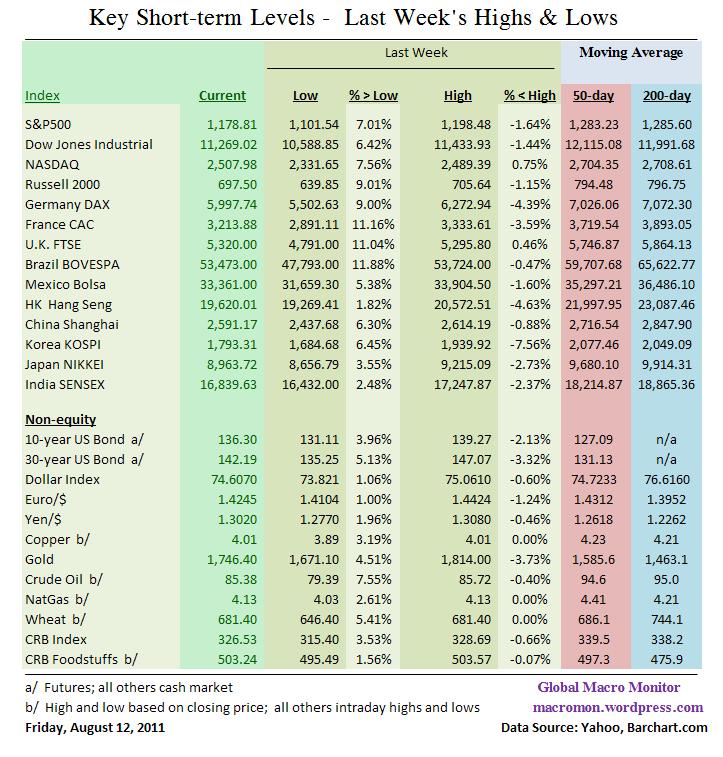
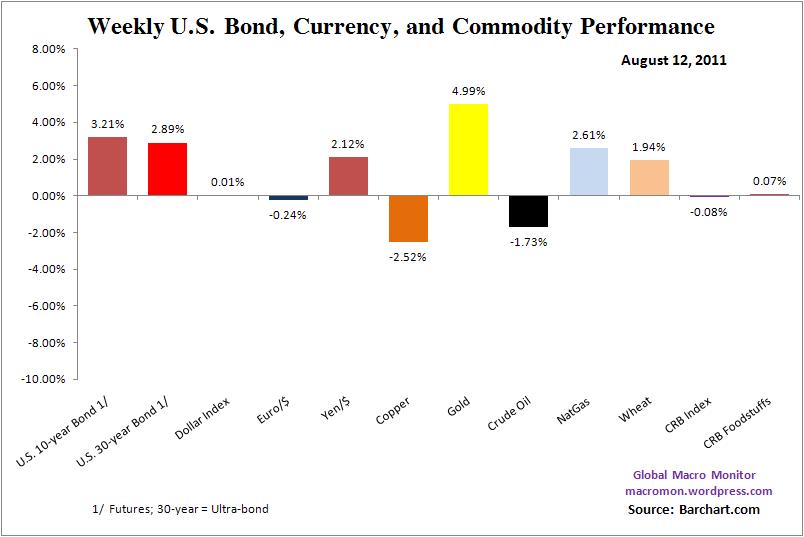
Week in Review: Can the European Center Hold?

What a week.  What a year.  Who would have predicted that U.S. bonds, even in foreign currencies and a sovereign downgrade, would be outperforming the BRIC equity indices and copper by several hundred basis points in mid-August?   Stunning and a lesson from W.B. Yeats:  “The best lack all conviction, while the worst are full of passionate intensity.”   Longevity in markets demands that discipline trumps conviction.

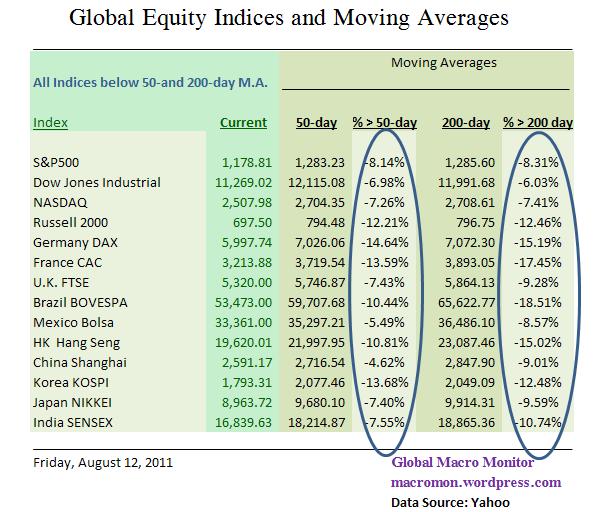
We have no idea where this is all headed as we are like the falcon that cannot hear the falconer but our sense is the markets will continue to turn and turn into widening gyre until it is clear the center of Europe can hold.  Furthermore, Toto has pulled back the curtain on the Wizard of Oz and the loss of confidence in American and European leadership is another led shoe that will continue to weigh on markets.  All this, combined with uncertainty and worries over global growth makes it’s difficult to argue for a sustained equity rally anytime soon, or, let us say, we lack all conviction for a sustained rally.

Nevertheless,  which ever way the market leans in the short-term, many with little tolerance for pain will be caught off guard and sent scrambling to cover or dump positions keeping volatility relatively high, in our opinion.   And don’t forget the Battle of the ‘Bots.   Last week’s performance shows what happens when capital stampedes like buffalo with absolutely no idea where to go.   On a positive note,  Apple remains very well bid and bounced nicely off its 50-day moving average.

One last point, if everyone is piling into the Swiss Franc due to worries over a European banking crisis, have they not looked at that country’s bank asset to GDP ratio?  Just askin’.

(click here if charts are not observable)

Posted in Uncategorized, Week in Review | Tagged , , , , , , , | 3 Comments

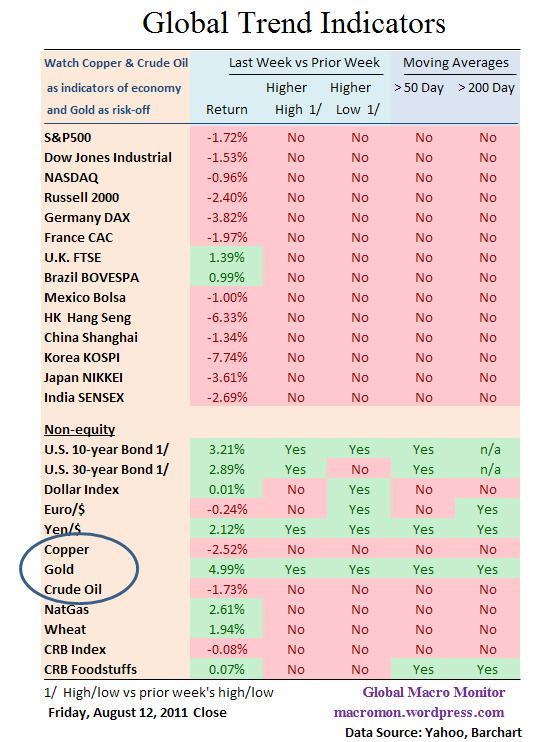
Global Trend Indicators

(click here if tables are not observable)

Posted in Global Trend Indicators | Tagged , , , , , , | Leave a comment

Credit-Anstalt 2.0?

If there is any doubt what is spooking the global markets look to the IFR piece, Credit taps run dry for European lenders, setting scene for liquidity crisis.   This is a must read over the weekend.

Remember,  Chairman Bernanke, the number one student of the Great Depression, believes it was the bank failures that took place in 1931 Europe that “made the Great Depression great.”  In a 2009 conversation with the Council of Foreign Relations the Chairman stated,

I think perhaps the most critical, in May of 1931, the Creditanstalt, which was one of the largest banks in Europe, failed, which generated a wave of financial crisis around the world.  Up till early 1931, arguably the 1929 downturn was just a ordinary — severe but ordinary downturn.  It was the financial crises and the collapse of banks and other institutions in late 1930 and early 1931 that made the Great Depression great. 

The IFR reports,

Options are rapidly running out for Europe’s ailing mid-tier banks as nervous creditors pull the plug on once vital sources of funding in response to growing sovereign contagion worries, sowing the seeds of an imminent liquidity crisis at the heart of the eurozone.

With bond markets shut and investors unwilling to buy asset-backed securities, the repo market – for some banks the sole remaining source of private funding – has become the most recent tap to run dry, with some investment banks pulling credit lines worth tens of billions of euros in recent weeks.

Another reason that Bernanke gives for the great in the Great Depression was the Fed was constrained by the gold standard and couldn’t provide liquidity to even healthy banks.  People lost their savings, the money supply experienced a massive contraction, and the rest is history.

The eurozone countries and banks are on a quasi-gold standard with the Euro and the institutional constraints on the European Central Bank.   This better change quickly or we’re gonna have a big problem.   Stayin’ in the bunker for now.

Posted in Black Swan Watch, Currency, Euro, PIIGS, Policy, Sovereign Debt | Tagged , , , , , | 2 Comments

64% of Americans Can’t Handle a $1,000 Emergency Expense

This is a stunning stat and shows how out of touch Washington and Wall Street are with Main Street.  Imagine if gas prices spike $2.00 per gallon.    CNN writes,

A majority, or 64%, of Americans don’t have enough cash on hand to handle a $1,000 emergency expense, according to a survey by the National Foundation for Credit Counseling, or NFCC, released on Wednesday.

Only 36% said they would tap their rainy day funds for an emergency. The rest of the 2,700 people polled said that they would have to go to other extremes to cover an unexpected expense, such as borrowing money or taking out a cash advance on a credit card.

Back in the 1990’s we used to discuss and joke with our European friends, who have relatively strong safety nets,  as to why Americans worked so hard and mutually concluded it was because they knew they were two paychecks from the street.   No joke anymore.

Posted in Demographics, Employment, Policy, Politics | Tagged , | Leave a comment

What the Germans Are Reading

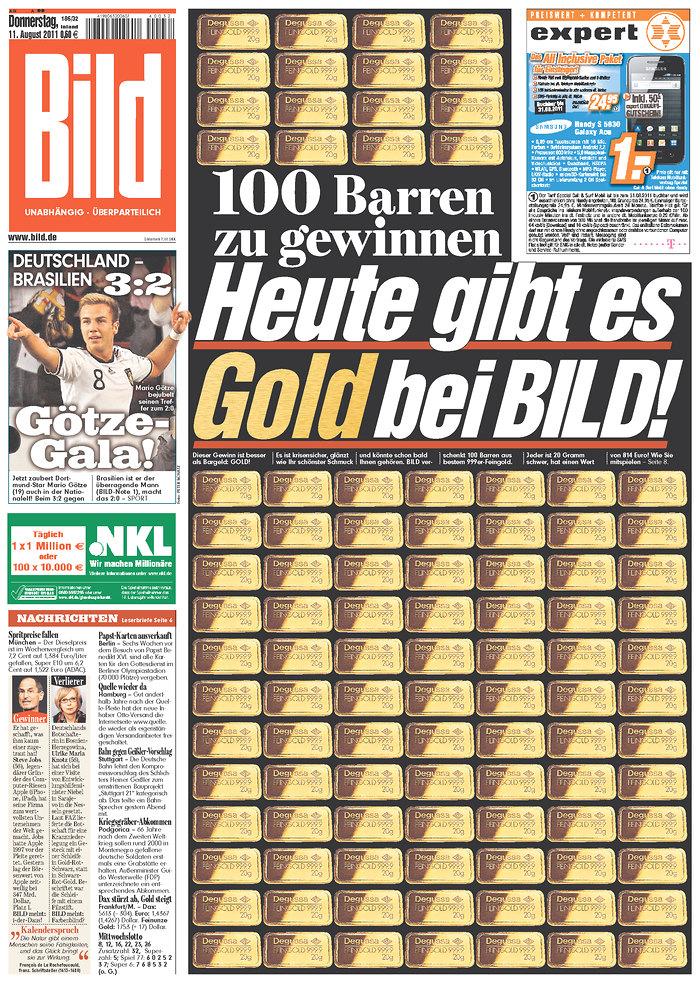
When real interest rates are negative resources are  misallocated and we pay dearly in the future.   This was the case during the housing bubble when Playboy bunnies were forsaking their careers to pursue the real estate gold rush (see here).   Now, according to Agora Financial,  the front page of Germany’s top selling newspaper, Bild,   “has forsaken its usual topless model in favor of gold bars… which the paper is giving away all day.”   This kind of makes you wanna sell.   Naw….we’ll let the market tell us when its time not the magazine cover indicator. 

The headline reads,   “100 Ingots to Win: Today You Can Get Gold With Bild”

(click here if cover is not observable)

Posted in Gold | Tagged , , | 1 Comment