Week in Review

We’re not going to say much as the nation (and Globex) celebrates the end of Bin Laden.  We were in Lafayette Park on September 10, 2001 and now watch thousands gather there and across the country to celebrate his demise.  Bravo and thank you to the men and women who serve and have sacrificed so much for this day.

We have no idea how long and how far the Bin Laden rally will last, but it will be widespread and should also buoy the dollar and hit precious metals.     Could it be a turning point and bottom for the dollar?   That is the question the shorts are going to have to think long and hard about.

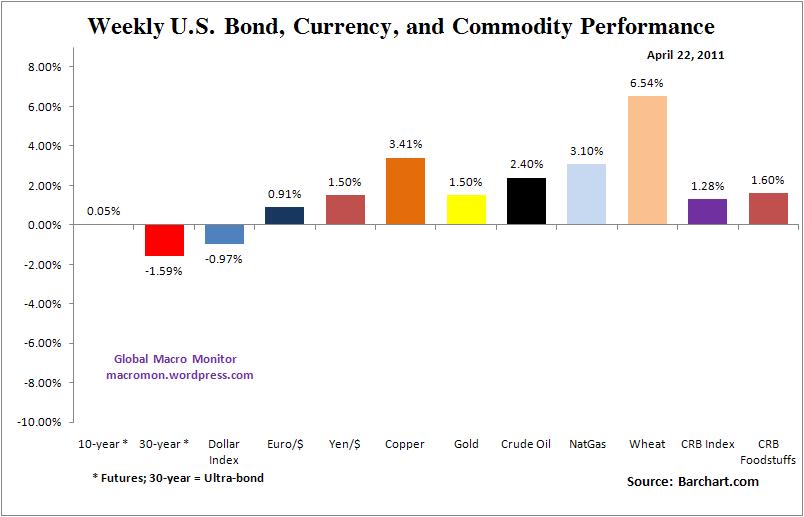
We do point out last week’s weakness in China and copper.   Keep it on your radar.

Posted in Week in Review | Tagged , , , , , | Leave a comment

The Weekend Read: Gold Fever!

In my theory of reflexivity I assert that the thinking of economic agents serves two functions. On the one hand, they try to understand reality; that is the cognitive function. On the other, they try to make an impact on the situation. That is the participating, or manipulative, function.

The two functions connect reality and the participants’ perception of reality in opposite directions. As long as the two functions work independently of each other they produce determinate results. When they operate simultaneously they interfere with each other. That is the case not only in the financial markets but also in many other social situations.               –  George Soros

China
4 Reasons To Cheer When China Overtakes America – US News
Chinese Manufacturing Withstands Wen’s Campaign to Rein in Surging Prices – Bloomberg

Commodities
Bernie Sanders Demands Action From Obama On Wall Street Oil ‘Gambling’ – Huff Post
Coffee producers chase the high – FT
Gold-Buying Central Bankers May Extend Record Rally – Bloomberg
Gold surges to all-time price record – FT
Investors stampede into a modern-day silver rush – LA Times
When the apocalypse comes, we’ll have all the gold – Market Watch
Why the Silver Market Has Gone Nuts – Smart Money

Currency
Cheap dollar fuels one-way bets in everything else – Reuters

Economics
Caterpillar bullish on global economy – FT
What’s wrong with America’s economy? – Economist
Why I agree with (some of) Friedrich Hayek – George Soros

Emerging Markets
Brazil’s boom masks growing vulnerabilities – FT
Poland:  A place at the top table – Economist

Europe
Earth to Greece: It’s Over – Forbes

Geopolitical
The battle for Libya:  Pressure points – Economist
The revolt in Syria:  Not so easy – Economist

Japan
If Bill Gross Sees U.S. as Shaky, Check Japan: William Pesek – Bloomberg

Markets
Apple juggernaut sends ripples through tech world – AP|
Brussels opens CDS antitrust probes – FT
Where’s the wall of worry? – Market Watch

Monetary & Fiscal Policy
As Inflation Surges, Central Banks Run Amok – Andy Xie
EM central banks are doing Fed’s dirty work – FT
For the Fed, a Narrowing of Options – NY Times
What Ben Bernanke should’ve said – Washington Post
Why the power of the mighty Federal Reserve is finally on the wane  – Telegraph

Posted in Gold, The Weekend Read | Tagged , , , , | 5 Comments

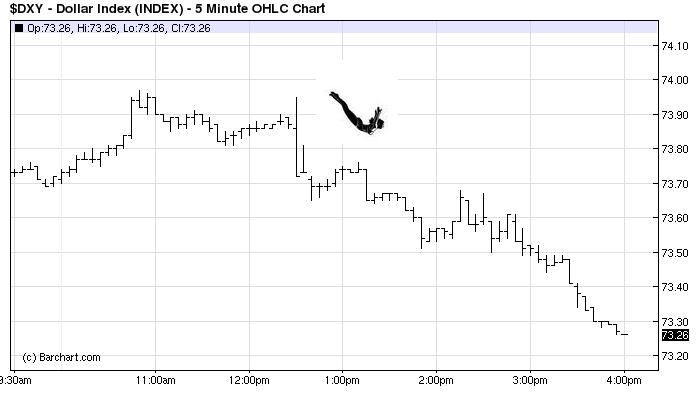
Chart of the Day: Dixie Swan Dive

Don’t know about you, but we’re feeling a little poorer after the FOMC statement and Chairman Ben’s historic press conference.    One spark away from a full blown dollar panic, in our opinion.  (click here if chart is not observable)

Posted in Black Swan Watch, Dollar, Gold | Tagged , , | Leave a comment

10 Questions for Chairman Bernanke

If we were attending the Fed’s historic press conference tomorrow,  here are the ten questions we would ask Chairman Bernanke:

1)  Do you think the new monetary policy tool of the Federal Reserve of paying interest on reserves (IOR) is contradictory?  That is, increasing the IOR rate is equivalent to a liquidity injection as the Federal Reserve makes more interest payments to banks.   Will the markets think it credible that printing money (or turning over less surplus funds to the Treasury) to make these interest payments is really a tightening of monetary policy?

2)  How much of the current oil price do you think is real and how much is speculation?    And do you think the Fed’s zero interest rate policy (ZIRP) is having any impact on the price of commodities, especially food and oil?  

3)  You missed the housing bubble and misread systemic leverage so what do you fear today that you may be missing and getting wrong?  

4)  Was the recent tax cut extension, effectively financed by QE2 , equivalent to what you stated in your famous 2002 speech –“ A money-financed tax cut is essentially equivalent to Milton Friedman’s famous “helicopter drop” of money.”

5)  Do you think Fed policy could be having a perverse impact on the economy as the dollar weakens, food and energy prices increase, causing real wages and consumption to fall leading to weaker economic growth and deflation in other goods and services? 

6)  Who do you think will step up and be the main buyer of Treasuries once QE2 ends?

7)  Since the start of the millennium, why have real short-term interest rates been negative the majority of the time?  Is there some fundamental flaw in the U.S. economy that necessitates this?    

8)  When will the Fed start rewarding savers rather than debtors and speculators?

9)  Were you scared during the financial crisis, as Henry Paulson has admitted, and how close did the global economy come to the abyss?   Please define abyss. 

10) What do you think would have happened if the Fed had not taken the extraordinary steps it did during the financial crisis?     

Posted in Budget Deficit, Commodities, Credit, Crude Oil, Currency, Food Prices, Gold, Monetary Policy, Policy | Tagged , , , | 3 Comments

A Credible & Comprehensive Plan for Europe’s Debt Crisis

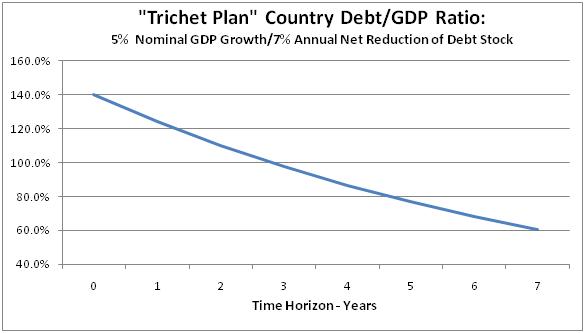
The following is the Executive Summary of a longer article that offers up a credible and comprehensive plan for the European Debt Crisis, which deals with the periphery debt overhang  and weak balance sheets of Europe’s commercial banks.  It has some great ideas and well worth your time.

A Credible Solution to Europe’s Debt Crisis: A “Trichet” Plan for the Eurozone

Executive Summary

In April 1989, Mexico’s external debt negotiator, Angel Gurria, asked his country’s commercial bank creditors for a 55 percent haircut.  This was the opening pitch of the newly created Brady Plan, which finally addressed both the debt overhang of developing countries and the weak balance sheets of their commercial bank creditors, ultimately resolving the LDC Debt Crisis.

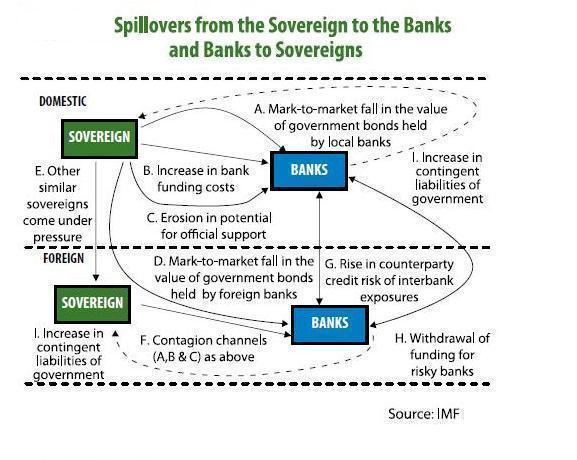
More than twenty years later, Europe is in the midst of a similar sovereign debt and banking crisis.  The EU is in a destabilizing feedback loop that it cannot control.  Sovereign credit is deteriorating and this is reducing confidence in national banking systems, causing or increasing the likelihood that sovereigns will have to assume bank liabilities.  This further impairs the sovereign credit and increases the lack of confidence in the banks.

We review the basic tenets of the Brady Plan in the context of our personal experience working on many of these sovereign restructurings and how they could apply in a comprehensive solution for the European debt crisis.   The markets and the Eurozone desperately need a positive confidence shock in the form a comprehensive plan that simultaneously addresses the sovereign debt overhang and the balance sheets of European commercial banks.    (click here for full article)

Posted in Black Swan Watch, Bonds, Currency, Euro, Geopolitical, PIIGS, Sovereign Debt, Sovereign Risk | Tagged , , , , | 1 Comment

Week in Review

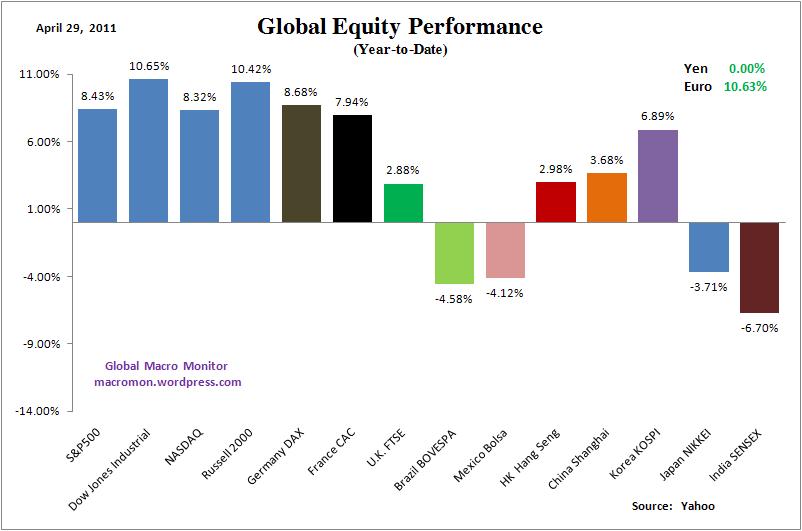
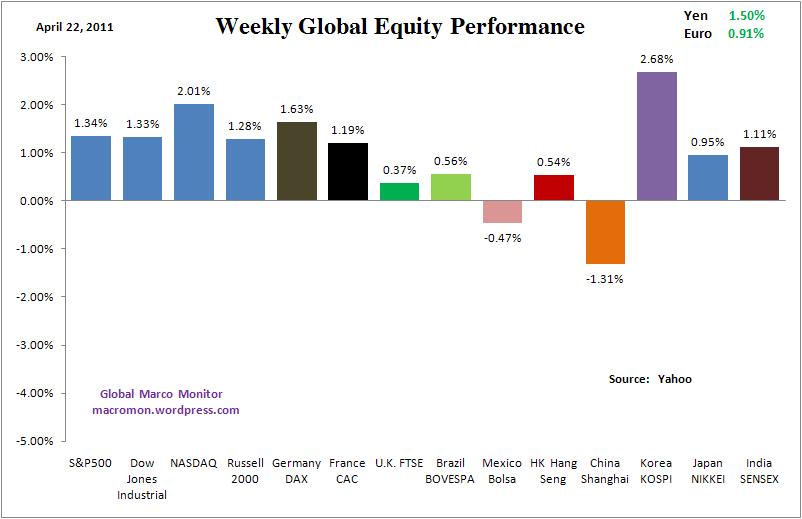
The weekly oscillation in global stock markets continued last week with stocks reversing the prior week’s losses and finishing up strong.   Korea continued its strong rally up almost 2.70 percent.   In the U.S.,  the Nasdaq lead the way up 2.01 percent with a big short killing reversal in Apple, up over 7 percent,  and strength from the semiconductors, up 4.10%.

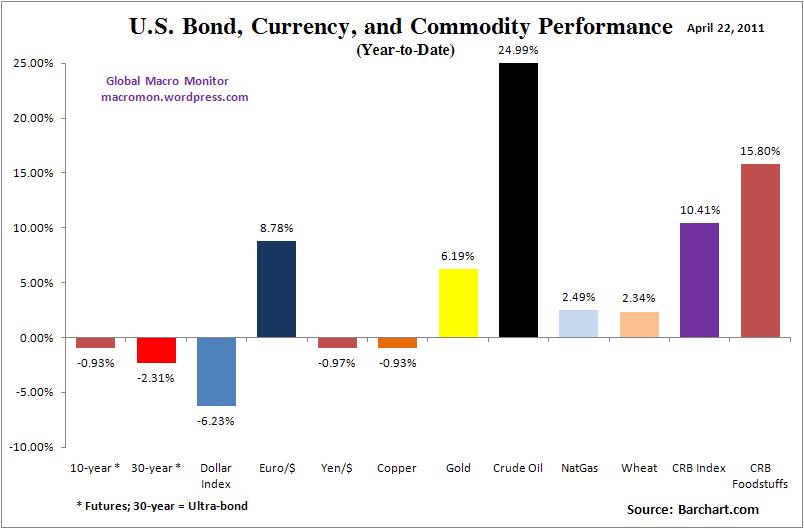
The markets were bolstered by the continuing decline in the dollar, which is now down over 6 percent for the year.    Earnings and the Fed with Chairman Bernanke’s first post meeting press conference will be the dominate drivers of the U.S. markets this week.  We expect  the noise from the regulators pounding on speculators to heat up.

We’re keeping it lite and going with the flow as the market is right at resistance.  Taking down some cheap vol and waiting for a close above 1345-1350 on the S&P 500 as a signal of the next leg up.  You know our schtick: staying on the island of game changing tech, while dodging and monitoring the flock of macro swans.   Good luck out there!

(click here if charts are not observable)

Posted in Week in Review | Tagged , , , | 1 Comment

Apple: Break Out the Pom Poms

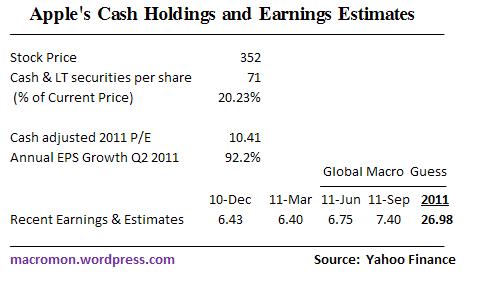
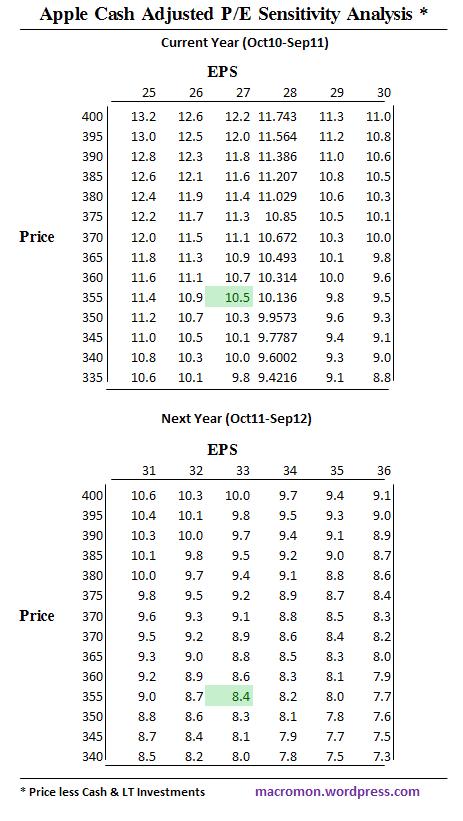
We’re gonna put on the pom poms for Apple again here.   Last night the company reported $65.6 in cash and marketable securities, which equates to around $71 per share.    Adjusting for the cash and assuming a conservative $27 in earnings for fiscal 2011,  the stock is now trading at a cash adjusted P/E of of 10.4  and it grew earnings at 92 percent y/y!  Stunning!!

Getting shorty this stock for less than a short-term trade is death and only going to pay when Apple trips up on execution and innovation.  That doesn’t look like it’s in the cards anytime soon, however.    Below is a P/E sensitivity analysis based on various earnings and prices.   (click here if charts are not observable)

Posted in Apple, Earnings | Tagged , , | 1 Comment

Apple Juices the Shorts

The past week we have been blasted with e-mails and comments about Apple’s head & shoulders pattern, how it’s going to $280, blah, blah.   This stock is a fave of the MoMo boyz and the leveraged set, which is a reason for the volatility,  and why, if your treader,  you can’t bet the ranch and need to protect your capital when it behaves poorly.    A big run-up into earnings usually sets up almost a sure bet of a sell the news correction.   Not this time.

Shorting into earnings is death.  Apple is the best company in the world, in the best space in the universe, and the leader of the new global economy.   iPhones with creative apps can be turned into an EKG monitor.    Innovation is our only hope.

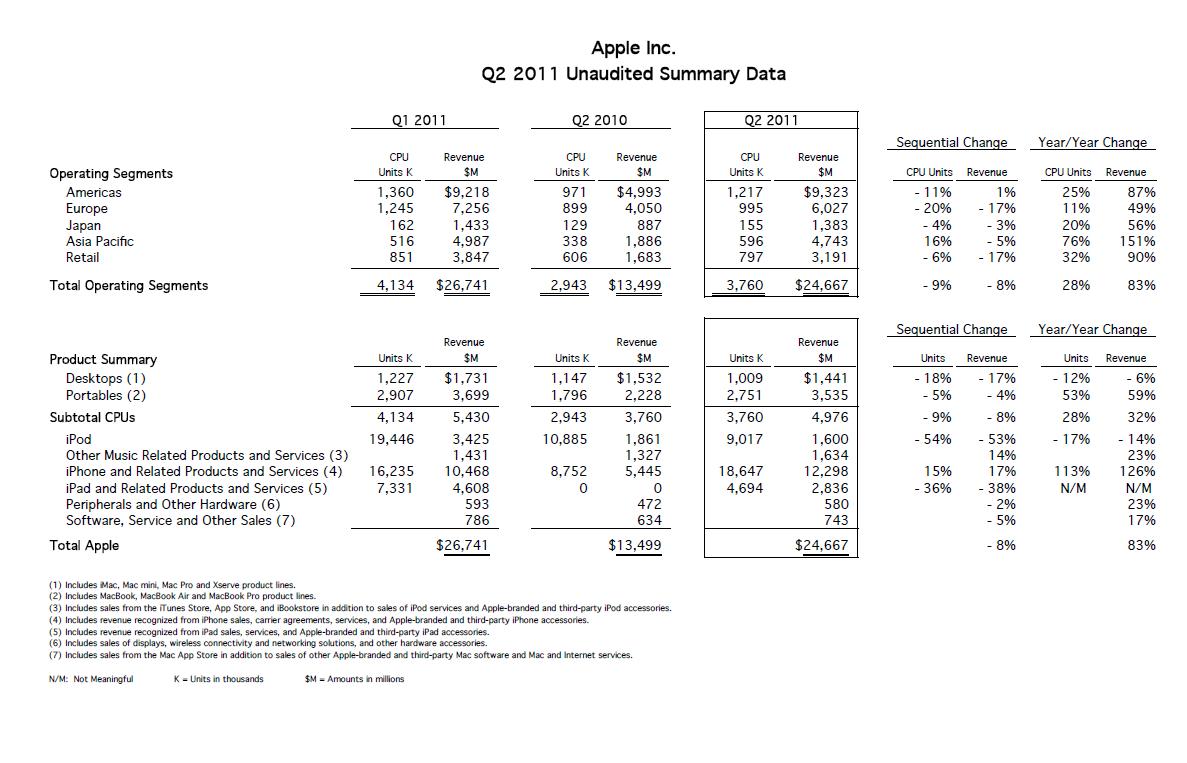
A close today above 351.54 would be above the lower closing high and negate one big technical negative and probably take the stock up to test its all-time high of around 365.  We’re in an ugly macro/great micro market.   Stay tuned.   (click table for  better resolution and here if table and chart are not observable)

Posted in Apple, Earnings | Tagged , | Leave a comment

Euro Fracture: Angry Greeks

The following article was posted today on SpiegelOnline and reflects the toxic and fractious politics in the Eurozone.   Whether it is the historic turnout for the True Finns on Sunday or the Angry Greeks suing German newspapers,  Europe is, at least, in our opinion, fracturing.

Politics, rather than cash flows, is the biggest short term risk of default in the periphery.  But, hey, don’t you remember the fighting between Texas (Enron) and California (energy crisis)  in the summer of 2001.   Nothing compared to what’s to come in Europe.

          “Swindlers in the euro family:” A cheeky cover has come back to haunt Germany’s Focus magazine.

Bird Trouble

Angry Greeks to Sue German Magazine for Defamation

A German magazine cover showing the goddess Aphrodite flipping off the rest of the euro zone annoyed the Greeks when it was published back in February 2010. Now a group of Greeks are suing the journalists involved for defamation.

It was supposed to be a provocative piece of journalism and a tongue-in-cheek comment on German concerns about a European Union bailout for debt-ridden Greece. But the Feb. 22, 2010 cover of the weekly German newsmagazine Focus — which showed the goddess Aphrodite making an obscene gesture — caused outrage in Greece. At the time, the president of the Greek parliament even summoned the German ambassador to complain about German media coverage of his country.

Now six Greek citizens who felt particularly offended are taking legal action against the journalists involved, including Helmut Markwort, the magazine’s founder who was also editor in chief of Focusat the time of publication.

According to reports in the Wednesday editions of the German newspapers Handelsblatt and Tagesspiegel, Markwort and nine other Focus employees are due to appear in an Athens court on June 29. The newspapers reported that public prosecutor Ourania Stathea is looking into accusations of defamation, libel and the denigration of Greek national symbols.

‘I’m Not on the Run’
The Focus cover featured a photograph of the famously armless statue Venus de Milo, which depicts the Greek goddess Aphrodite, that had been doctored so that the deity was showing her middle finger to the viewer. The story, titled “Swindlers in the Euro Family,” included a detailed description of what the authors claimed was “2000 years of decline” in Greece, including reports of tax fraud and failed construction projects. The six Greeks who are now suing the journalists maintain that the article included false claims and was also insulting to the Greek people.

Markwort, who could face up to two years in prison, appears unperturbed by the accusations, however. He told the Tagesspiegel that he had a “clean conscience” and had only been performing his “journalistic duty.” He said he would only get the magazine’s lawyers involved once he had received an official court summons.

Markwort also asserted that he was a great fan of Greece. “I’m not on the run, and I’m also not afraid that I will have to go to prison,” he said.

(click here if cover is not observable)

Posted in Black Swan Watch, Currency, Euro, Sovereign Debt, Sovereign Risk | Tagged , , , , | 1 Comment

Macro Notes from the Intel Conference Call

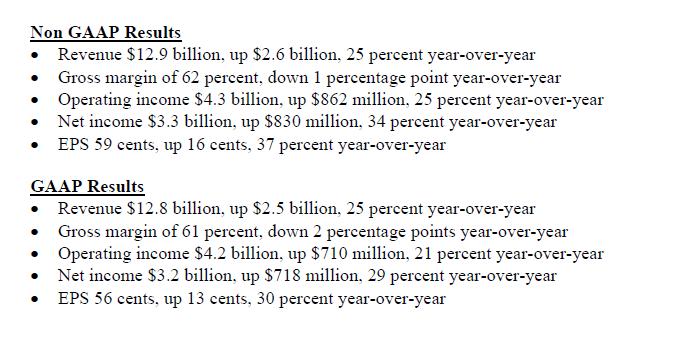
Intel put up some surprisingly strong numbers as reflected below.  The stock traded up as much as 7 percent in after hours.  Holding gains after earnings has proven elusive in the past.  It will be interesting to see if “this time is different.”   (click here if chart is not observable)
Japan
As for our business, I want to note that we did not see any unusual changes or fluctuations to our backlog after the earthquake, nor do we anticipate any major disruptions to our supply lines moving forward.

PC Supply Chain and Business
Aggregate inventory levels of the PC supply chain remained healthy and well within normal operating ranges as we enter Q2. In Q1, our customers replenished approximately half of the inventory that was depleted in Q4 primarily with new Sandy Bridge-based products. Compared to the first quarter of last year, which was a very good quarter for us, we achieved double-digit growth across every major product segment, and across every region in the world.

Our PC Client business remains strong and grew 17% from last year. What we are witnessing is an explosion of computing devices that connect to the Internet, and Intel is a big part of this trend. We not only participate through selling our products into these device categories, but we also profit from the wide array of products that we sell in the build out of the data center capacity required to serve all of these devices…

Let me make 2 final comments about demand and CapEx. Like many of you, I noted that some of the third-party research firms issued reduced forecasts for PCs in 2011. I want to be clear that our views differ from some of theirs. The PC business has evolved into a global industry that is approaching 400 million units this year.

While some channels like PCs sold through consumer retail outlets and mature markets have deep visibility, other channels, especially in emerging markets, are not well reflected in the forecast of third-party firms until shipments from Intel and its competitors have been reconciled.

Over the last 5 years, we have put considerable effort into improving our visibility with systems like just-in-time inventory hubs for our major customers, as well as realtime metrics to monitor sales through all of our worldwide channels. As a result, we were able to call the inflection in our business in Q1 of ’09, as well as predicting 2010 growth to within 1 point of accuracy.

Our projections for PC segment growth in 2011 remain in the low double-digit range based on early sell-through strength we are seeing as we begin 2011 and the great reception to Sandy Bridge in both Consumer and Enterprise segments. And while it’s too early to call 2012 with an improving global economy, we see no reason for growth to be materially different from what we see in 2011.

Secondly, we are increasing our forecast for CapEx spending this year. This reflects the widening of our process technology lead and the incremental opportunity that advantage will provide our business. The increased CapEx is focused on both 22- and 14-nanometer capabilities

Emerging Markets
The emerging markets now are well over 50% of our total business level. And I think the dynamic that’s going on there is really one of economics. The desirability of technology is high and the affordability of technology is now coming into the range where when we look across markets like China, Latin America, Eastern Europe, you’ve got a couple of billion consumers that now the price point of a PC is within 1 to 2 months of income and it’s really driving our growth, and penetration rates are still pretty low. So we think this is something that has legs and will drive our growth into the future…

Most — something like 1/3 of all the PCs sold in emerging markets are not branded machines, their white boxes built by the channel through our distribution network worldwide. We saw strength on Sandy Bridge and even strengthened the Desktop business, which we haven’t seen for some time based upon that product in those markets. And of course, those markets are still surging in terms of purchasing notebooks. It’s not a low-end mix, I’d also add. It’s a pretty average mix of products on a worldwide basis.

Tablets
…you’ll see quite a bit of tablet demonstration to Computex. If you notice what we did at IDF in Beijing last week, that was — there were a lot of tablet-centric announcements there around MeeGo and Windows and Android. And so we’re heads down on a number of designs on tablets on all 3 of those operating systems where we see the Android code, Honeycomb version of Android source code from Google, and we’re actively doing the port on that and expect to be able to ramp those machines over the course of this year for a number of customers. In terms of phones, obviously, we lost Nokia, which took a lot of wind out of the sales for phones this year. We’ve redirected those resources onto a number of other major accounts, focusing on carriers who want their own devices and also on handset manufacturers. They’re all based on Medfield, which is, I think, still the first 32-nanometer phone apps processor in the industry. And quite frankly, the limit in terms of them getting to market is going to be the interoperability testing of the networks at this point in time. So I think I would be very disappointed if you didn’t see Intel-based phones for sale 12 months from now

Supply Shortages
Could we run into some shortages? We’re running I’d call it in the healthy range of utilization. So as we said before, not too hot, not too cold. Certainly on the chipset side of the business as we had responded to the Cougar Point issue, we ramped very quickly there. But I’d say in general, we’re not anticipating shortages. And I think we have the ability to respond. If demand ends up being hotter, we can put the capacity in place. And frankly, if we end up in a situation where demand ends up being less, I think you saw in 2009, we now have the tools to respond very quickly to that kind of environment. So I think we can respond to both sides of that equation as we get into the second half and into 2012.

Corporate Spending
I assume you mean corporate PCs, Srini. We’re seeing — obviously on the corporate side, we’re seeing good growth in the data center. Yes, on the — we saw, I think I said that sort of mid-last year, we started seeing the enterprise market start to recover from the recession timeframe. And the most recent data we have is that something like 75% of enterprise PCs are still running Win XP. And so if you think about a 3 to 4 year refresh cycle, we’re probably not even halfway through that cycle yet. And I think that the adoption of Win7 seems to be pretty strong and the combination of the Win7 SKUs with Sandy Bridge as we look forward into Q2 and Q3 look really good from our customers’ perspective.

Consumer Weakness in U.S. and Europe
I think it’s a little bit of everything, plus you mentioned Win7 saturation for consumers, the tablet things and macroeconomics. I think it’s a little bit of each of those, John. But I’ll add 1 more, which I think is a big one. Remember in 2009 in the first half of ’10, during the depths of the recession, the consumer notebook market worldwide, particularly in the U.S. and Western Europe, was very strong and it was strong contrary to GDP at the time. Remember GDP was going south and consumer sales were going north. And I think what happened is that people bought a lot of machines in that timeframe and we’re still just early in the cycle. So those machines are 1.5 years old or less. And so seeing a consumer refresh right now probably isn’t, on average, what you’re going to see in mature markets. Because this is not like emerging markets where people are buying their first machine. This is a mature environment where people are buying a new machine when they decide that they need to upgrade or whatever. Now clearly some tablet cannibalization is impacting that, but I think the bigger 1 is that macroeconomics and the prior cycle.

Point of Enterprise Cycle
Top of the fourth, 3 on, no outs…. We’re less than halfway through.

Posted in Earnings | Tagged , | 1 Comment