Week in Review

We wrote a few weeks ago about the global markets weekly oscillations.  Not just markets, but fundamental outlooks on inflation and deflation.  When markets are driven and highly dependent on liquidity and the direction of monetary policy, the underlying fundamentals are inherently unstable.  Witness the talk of dollar collapse and hyperinflation one week and deflation the next.

Many commodities, especially silver and gold, are journeys and not destinations.  That is, we’re not obsessed with prices targets and levels as much of the potential changes in monetary policies of the major central banks.    This is an important week and with some important levels.  Our sense is we chop around and digest last week’s commodity collapse.  Good luck!  (click here if charts are not observable)

Posted in Week in Review | Tagged , , , , | Leave a comment

The Weekend Read: Commodity Flop

On How Academic Economists Missed the Crisis

I was shocked by how large a panic was produced by what seemed to me – and still does – relatively small losses (in terms of the size of the global economy) in subprime mortgages; by the weakness of risk controls at the major highly-leveraged banks; by how deep the decline in demand was; by how ineffective the market’s equilibrium-restoring forces have been at rebalancing labor-market supply and demand; and by how much core-country governments have been able to borrow to support demand without triggering any run-up in interest rates.

It is the scale of the catastrophe that astonishes me. But what astonishes me even more is the apparent failure of academic economics to take steps to prepare itself for the future. “We need to change our hiring patterns,” I expected to hear economics departments around the world say in the wake of the crisis.

The fact is that we need fewer efficient-markets theorists and more people who work on microstructure, limits to arbitrage, and cognitive biases. We need fewer equilibrium business-cycle theorists and more old-fashioned Keynesians and monetarists. We need more monetary historians and historians of economic thought and fewer model-builders. We need more Eichengreens, Shillers, Akerlofs, Reinharts, and Rogoffs – not to mention a Kindleberger, Minsky, or Bagehot.   – Brad DeLong

(click here if chart is not observable)

China
China’s energy bosses taking political wheel – Asia Times
China population turning-point to spur inflation: state economist – Reuters
Power bubbles are Hu’s big challenge – Asia Times
The end of cheap: China’s tipping point – beyondbrics

Commodities
Lessons for exchanges in oil’s ‘flash crash’ – FT
Ring of Fire for Corn Futures – FuturesFile
Speculators seen leading commodities crash – MarketWatch

Currency
Dollar diplomacy: Public policy calls for ‘strong’ currency, but strategy may not – WaPost

Economics
Chile: Lessons from Land of 15% Growth – IBD
U.S. Job gains largest in 11 months – Reuters
Ten reasons for thinking the world economy is turning soft – Telegraph

Europe
Europe is running a giant Ponzi scheme – FT
Greece Considers Exit from Euro Zone – Der Spiegel
Greek restructuring needn’t mean big fat haircuts – FT
Inevitability of a Default in Greece – NY Times
Ireland likely to pay more for its bailout than Greece or Portugal – Irish Independent
Sovereign Debt and the Seven-Year Ditch – Project Syndicate

Fiscal Policy
National Debt: Fix It or Face National Decline – Mort Zuckerman

General
Economics in Crisis – Brad DeLong

Geopolitical
Bin Laden raid reveals US rail terror plot – FT
The Road to Arab Democracy – Project Syndicate
What to Read on Bin Laden and Al Qaeda – Foreign Affairs
Why Obama chose SEALs, not drones – FP

Monetary Policy
ECB holds fire on interest rates – FT
Fed ready to fight inflation, but not yet time – Reuters
India central bank toughens stance, lifts rates by 50 bps – Reuters
Interest rates will have to rise, warns Reserve Bank of Australia – Dow Jones
The Conflicted Bank of England – Project Syndicate

Markets
Equity and bond bulls prepare for life after QE2 – FT
Have Bond Vigilantes Become Dollar Vigilantes? – WSJ
Canary in the Coal Mine: More on the Bond/Stock Disconnect – WSJ
The Double Dip’s Official: Home Prices Fall to New Low – The Atlantic

Technology
Facebook Could Be Planning a Visual Dashboard of Your Life – Technology Review
The rise of tablet computers – LA Times

Posted in The Weekend Read | Tagged , , , , , , | Leave a comment

Did Trichet Hear the PIGs Squealing?

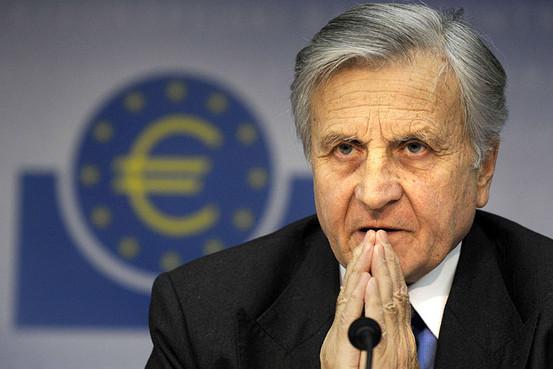
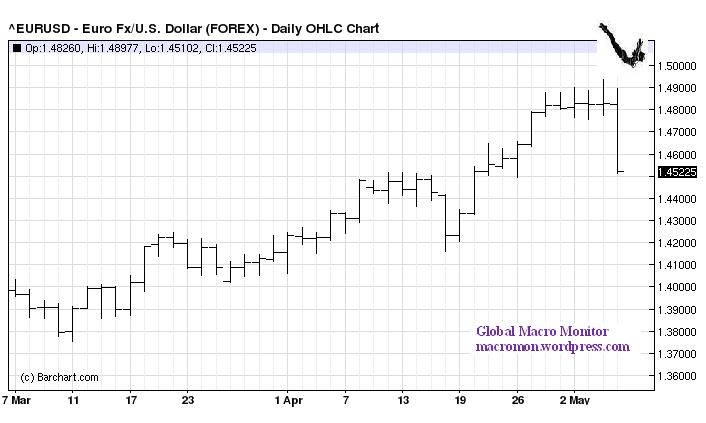
Wow, what a swan dive!  The Euro fell a rare five handles and 3 percent against the dollar in just twenty-four hours as ECB President,  Jean-Claude Trichet, seemed to back away from his previous hawkish rhetoric at the Bank’s press conference this morning.   The big move in the dollar contributed to today’s commodity blood bath, which was probably part of his plan.  This guy is one hell of a trader and knows when and where to tap to generate the maximum market reflex.

We’re also thinking Mr. Trichet may be hearing the rivets starting to pop in the highly indebted periphery — Greece,  Ireland, and Portugal — who are getting hammered by the 16 percent appreciation of the Euro since mid-January.   These countries already have plenty of deflationary pressures to deal with without a rapidly appreciating currency.    CNBC reports a “liquidity crisis” may also be starting to brew in Europe,

“Last week, 241 banks bid for money at the ECB repo window. Why are so many banks retracting from the business of lending unsecured funds to each other at 40 percent of the banks in the euro zone need to come to the ECB repo window?” asked Carl Weinberg, the chief economist at High Frequency Economics in a research note on Wednesday. These funds are not attractively priced. We can only assume that banks with excess reserves see an increasing number of counterparty institutions as too risky in the face of an exploding sovereign debt crisis,” Weinberg added. The problem is that Europe’s banks hold an awful lot of Greek government debt, and the debt of others like Ireland and Portugal, on their books.

Pigs do squeal when squeezed and we’re wondering if Mr. Trichet is starting to sweat as more European banks tap the ECB teat.     Add this one to your McSwan watch list.   (click here if chart is not observable)


Posted in Black Swan Watch, Bonds, Charts, Commodities, Crude Oil, Currency, Sovereign Debt, Sovereign Risk | Tagged , , , , , , , | 2 Comments

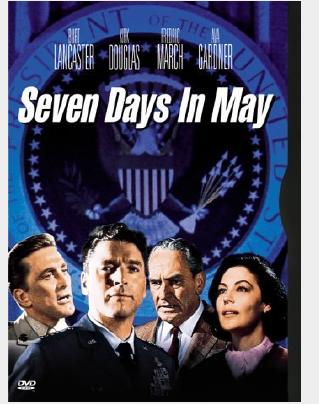
Seven Days in May?

We noted last night only four other times in the past fifty years has the S&P500 opened May with three consecutive down days.   We find this type analysis great cocktail chat, at best interesting, but not very actionable.  Nevertheless, today’s S&P decline narrows the field to only one other time since 1950 (the beginning of our times series) has the S&P500 traded down in the first four days of the month of May.   The chart below shows that in 1966 the S&P declined in the first six days of May.   Seven Days in May?

The ball is now in Asia’s court and we are watching China and the Hang Seng, which needs to hold 22,600 for the violence in the commodity markets not to spill into equities.  We’re not making a bet it will but definitely staying on McSwan watch.  (click here if chart is not observable)

Posted in Black Swan Watch, Charts, Equities | Tagged , , , | 1 Comment

Chart of the Day: Dr. Copper Falls Through the Ice

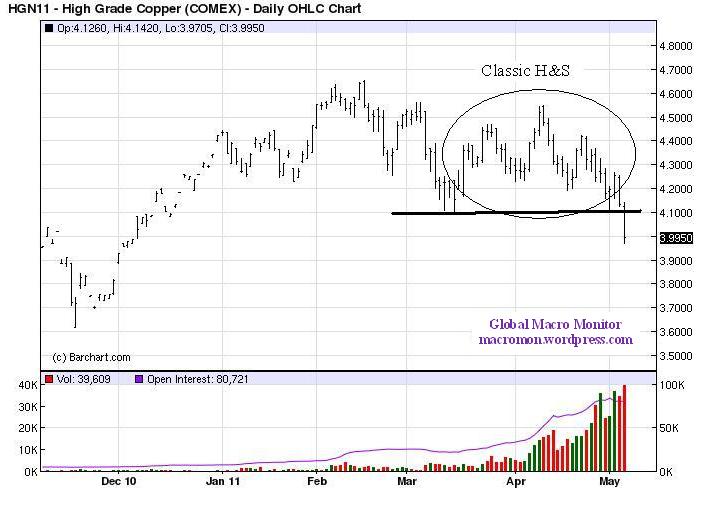
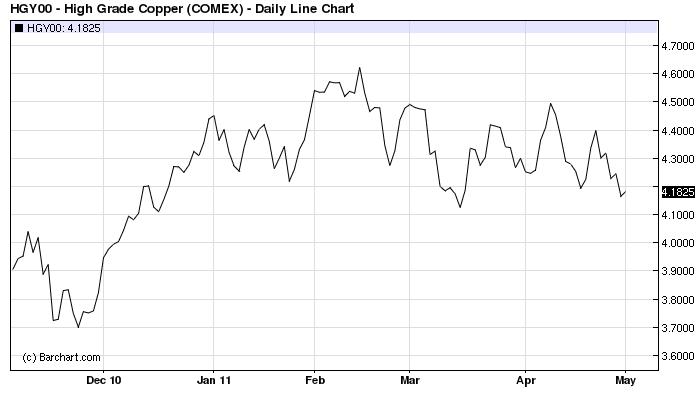
Dr. Copper broke through its support at 4.10 and is below 4.00 for the first time since early December.   Lots of flakes in this chart as head and shoulder patterns are ubiquitous.   Copper is a very crowded trade and some big players have bet the ranch.  Unless we get an intraday reversal in the Doctor, it looks like the next stop is 3.60.  Maybe it’s time to start channeling our inner Jim Chanos or rather our margin clerk?   (click here if chart is not observable)

Posted in Black Swan Watch, China, Commodities, Credit, Currency, Dollar, Monetary Policy | Tagged , , | 3 Comments

Quote of the Day: Siemens’ McSwan Watch

Siemens AG (SIE), Europe’s largest engineering company, reported decent numbers this morning, including strong growth from the emerging markets.   But listen to CEO,  Peter Loescher,  on the conference call this morning.   He is vigilantly monitoring the many macro swans,  including the U.S. budget deficit.

“Germany’s exports trends delivered a strong growth contribution to our businesses. And the main growth engines though are the emerging markets, such as China or India among others. We closely watch the potential impact from uncertainties about the political development in North Africa and the Middle East rising prices for commodities, suffering debt worries in some European countries and increasingly credit a view on the U.S. budget deficit to react flexible, if required and possible.”   – Peter Loescher,  May 4, 2011

Posted in Black Swan Watch, Budget Deficit, Geopolitical, Quote of the Day, Sovereign Debt, Sovereign Risk | Tagged , , , | Leave a comment

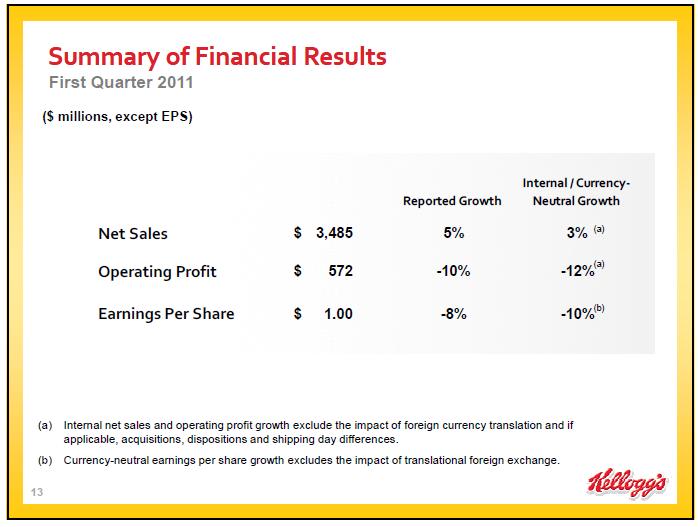
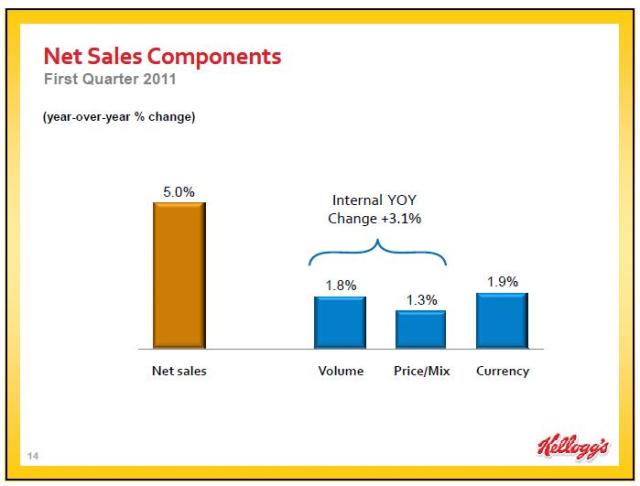
Macro Notes from the Kellogg’s Conference Call

We find it fascinating how companies are engaging the consumer.  Check out how Kellogg’s is doing it with digital media.   The following are direct quotes from company executives from today’s earnings conference call.

Digital Media Advertising – “Engaging the Consumer”

We continue to invest heavily in brand building, as demonstrated by our 10% spending increase during the first quarter…As we have discussed, digital media is an important tool for increasing the effectiveness and efficiency of our ad spend. With an ever increasing number of ways to target our consumers through new media platforms, we can often spend less to reach the same and potentially larger audience. Our goal is to engage our consumers, forging stronger relationships with our brands whether through traditional television, print media or online programs such as Special K Resolution.

Let me give you three examples of how we engage consumers and bring our programs to life. An example of a recent integrated promotion is our Share Your Breakfast program, part of our ongoing effort to drive category growth. We are asking consumers to take a picture of their breakfast and post it on shareyourbreakfast.com. For every breakfast shared, we will donate one to a child in need, giving away 1 million breakfasts. We also celebrated National Breakfast Day on March 8 and served cereal to thousands of New Yorkers in Grand Central Station. During this week, we had the highest cereal consumption of the year.

Cheez-It is another great brand that benefits from strong consumer engagement programs. In February, we launched a campaign inviting consumers to help choose the next flavor of Cheez-It. Consumers purchased samples and then went online to vote for their favorite flavor. We had 29 million votes and nearly 1 million views on Facebook. Not only did we engage with the consumer during the voting process, we are now able to build brand loyalty through a digital connection going forward. We believe that we’re off to a solid start in 2011 and are well positioned to continue to build momentum throughout the remainder of the year.

Commodities and Margins

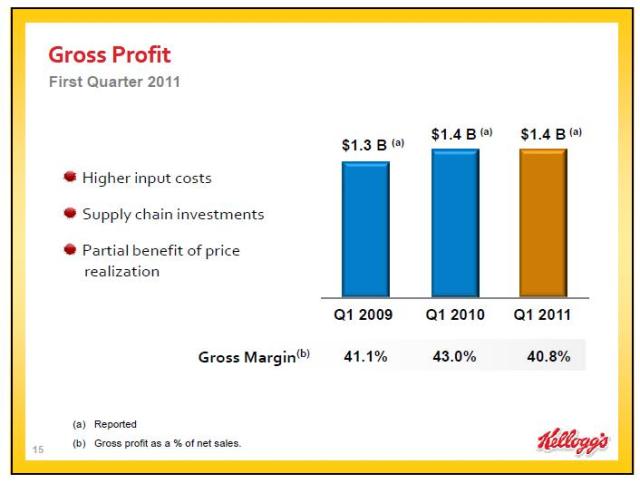
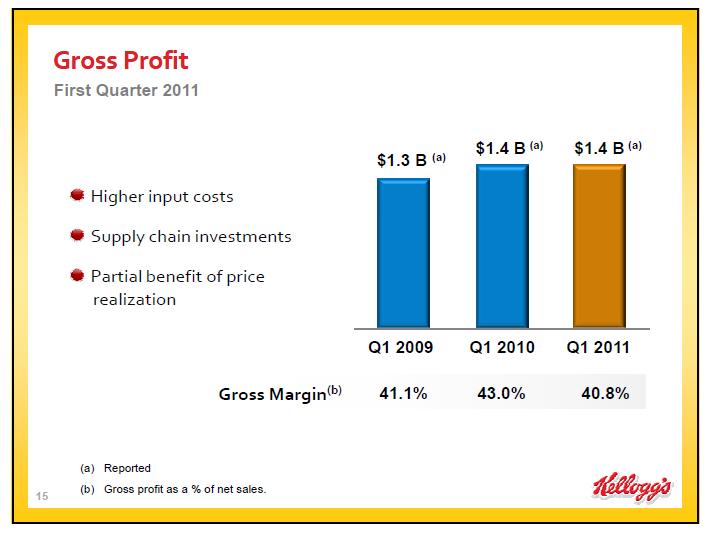
First of all, the first quarter performance, we did expect our gross margin to decline in the first quarter. Our cost pressures in the first quarter were very consistent with what we expect for the full year. So they were in the 7% to 8% range and that’s what we expect for the full year as well. So we don’t necessarily see a significant ramping up. The issue for us in the first quarter, obviously, was in our pricing was settling into the marketplace, and as a result, our gross margin, our performance was down…The supply of grains has been relatively limited, but the market grain is increasing, whether it be ethanol production or whether it be emerging market assumptions of grains or meat-based products. And the result of that is you’re going to see increased prices of grains over time. And so we would look at 2012 and say, yes, it’s probably going to be inflationary. How inflationary, we have to wait and see where all the supply demand shakes out when the prices shakeout.

Pricing Power and Elasticity

I think it’s very difficult to get what the real elasticity number is going to be. We have obviously a series of very complicated models to help us model out the elasticity, and we tend to give quite frankly a haircut of what those models tell us. If you try and get how much elasticity is out there, we’re not seeing very much to date. So the first quarter, we do have some price mix, we had, within U.S. Cereal our promoted price points were up 6% in the first quarter, and yet we continue to get good merchandising support and the business continued to do well. If you look, say, at another proxy around sensitivity to price, is private label doing well, were private labels down in share U.S. Cereal. It’s down on all the international markets. It’s moving up or down by 10, 20 basis points in some of the snack categories. So as we look at the consumer elasticity with certain expectation out there for the past 3 quarters of the year that as we sit coming through the first quarter, we’re not really seeing a whole lot of elasticity yet.

Emerging Markets

It’s always difficult to get into emerging markets and how much of the portfolio is there. So we look at Latin America and say obviously, all of that region for us is emerging markets. You take Asia Pacific and just take Australia out of that, and the rest of Asia Pacific would be an emerging market. It would come across to Europe and you come out the U.K. For us, Continental Europe is an emerging cereal category. It’s relatively for consumptions and has potential for long-term growth. So we don’t have a metric as such for emerging markets, but you can see 10% growth in sales and internal basis in Latin America in the first quarter. So signs of growth returning on Continental Europe. Double-digit growth in Russia. And if you took Australia out of Asia Pacific, it would’ve been a very good growth performance as well, with double-digit growth in India and South Africa, China in the quarter.  (click here if charts are not observable)

Posted in Charts, Commodities, Earnings | Tagged , , , , , | Leave a comment

First Three Days in May

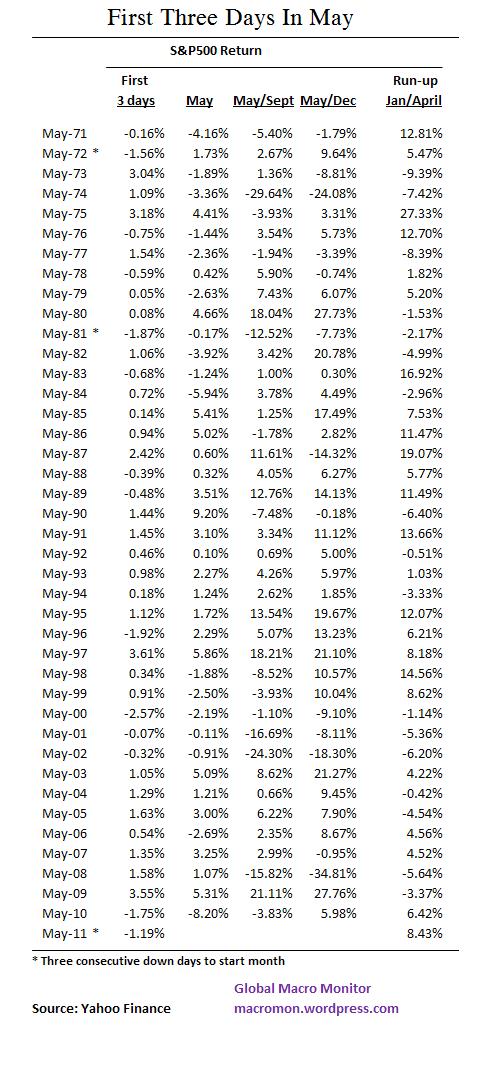
The equity market has made a little bit history in the first three days in May.  Only four other times in the last fifty years has the S&p500 opened May with three consecutive down days.

Bespoke did some great work yesterday analyzing the first two consecutive down days in the new month and we thought we’d add our two cents.

This year the S&P500 has experienced its 12th best run-up into May in the past forty years, up 8.43 percent from the beginning of the year to the end of April.   The 1.19 percent loss in the first three days is the 6th worst start of the past forty-one Mays.    In only two of these five years (not counting current year) has the S&P500 had a negative return from May to December.  That was the case only in 2000 and 1981 when the run-up into May was negative and thus a continuation of a negative trend.

Bottom line?  History doesn’t seem tell us much about the future after such a poor start in the month of May.  We are more focused, however, on how poor China/Hang Seng and Brazil are behaving and monitoring commodities and bonds as a signal of any down shifting in the global economy.   Recall last May’s nasty 8.20 percent growth scare correction, which,  in fact,  was the S&P500 worst May performance in forty years.   Stay tuned!    (click here if tables are not observable)

Posted in Bonds, China, Equities | Tagged , , , | 3 Comments

Charts of the Day: Asian Credit Bubble?

Great chart from Deustche Bank of Asian home prices indexed to Jan’07.   It’s becoming increasingly clear, at least to us, that a big part of Asia is in massive credit/asset bubble and as monetary tightening plays out their day of reckoning nears.  When we see a day like today in commodities we wonder if it that day is closer at hand.   Indian and Brazilian stocks were hit hard on tightening and fear thereof.   Even the U.S. 10-year treasury yield is behaving contrary to what the end of QE2 should dictate.   What up?   We’re not certain, but certainly reducing risk.  (click here if charts are not observable)
Posted in Black Swan Watch, Bonds, China, Commodities, Credit, Crude Oil, Currency | Tagged , | Leave a comment

Fight of the Century: Keynes vs. Hayek Round Two

Great rap video explaining the political economy for the Facebook generation.

Posted in Video | Tagged , , | Leave a comment