China Rate Hike: Four Markets to Watch

Fearsome Foursome

We’re watching the reaction in four markets to gauge how the Christmas gift from the Kings of the East will affect global risk appetite.   The People’s Bank of China increased both the benchmark lending rate by 25 basis points to 5.81 percent and the benchmark deposit rate by 25 basis points to 2.75 percent.

The rate hike is the second in the tightening cycle, which began on October 19 and compliments other monetary moves, such as increases in bank reserve requirements.   The markets viewed the first rate hike in October as a positive event.    Though most analysts were expecting several interest rate increases by the PBOC, the timing may catch some markets off guard.  The recent upgrade of the U.S. economy may have bolstered the confidence of Chinese policymakers to be more aggressive in their fight on inflation.

Nevertheless, nobody knows for sure how markets will react and, most important, how the Chinese economy will respond to tighter financial conditions.   Some smart people are betting China is “Dubai times a thousand” and even though they have been wrong thus far, their warnings do loom, at least, in our trading psyche as they’re just too smart to ignore entirely.

So here is what we’re watching:

Shanghai Composite:    The main Chinese stock index is down 13.5 percent for the year and currently sits at 2,835.  It has been hovering around and been supported by its 200-day moving average at 2,785. A major break would suppress risk appetite.

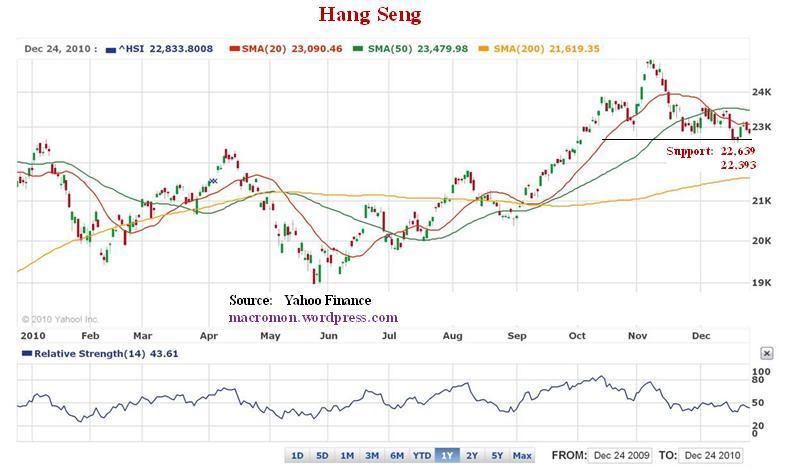
Hang Seng:   The Hong Kong index is one of our main indicator species for global risk appetite.  The Hang Seng is currently up 4.4 percent for the year and since rallying 20 percent off the May low, the index has been carving out a head and shoulders pattern starting in early October.  For the past few weeks, it has been threatening to break the neckline of the pattern right around the current level.  The Hang Seng divergence with other risk markets makes us the most nervous.   The market is closed on Monday.

Crude Oil: After floundering for the first three quarters of the year, crude oil was the “catch-up” trade for Q4, rising over 15 percent since October 1 and is now up 16.2 percent year-to-date.    There’s much chatter the market has internalized “peak oil” and crude is now driven mainly by these structural issues and less by cyclical forces.   If the China demand story goes away for a few quarters as the tightening begins to slow the economy,  and oil remains around the 90ish level, we’ll be converted.   Otherwise, we’ll continue to channel our inner Jim Chanos and expect crude to take a hit here, which, by the way, we think will be spun as positive for U.S. markets.

Copper: The industrial metal has had a massive 225% move off its crash low, is up 50 percent from the 2010 mid-year correction, and up 28 percent year-to-date.    Though copper has been driven by supply concerns, including a recent accident at a key Chilean copper export port, this is the one commodity that appears most over extended to us.

One unidentified company reportedly “has the potential to own at least 90 percent of the copper in warehouses monitored by the London Metal Exchange, the largest such position in two years.”

If this company is not fronting for an end user and is holding the position on spec, we’re wondering if they’re feeling a bit like Wiley E. Coyote as China turns the screws on its liquidity driven construction sector.   We have no idea of the details behind this trade, but we know one thing for certain – traders love the smell of blood.

A continued move higher in copper as China moves deeper into the tightening cycle, however, would confirm Jeremy Grantham’s, “we’re running out of everything” thesis and may even set off some panic buying and a real blow-off.

Other markets:  We’re also monitoring the Australia, Japan, Brazil and Korean equity markets as these economies are now more dependent on the China market for their exports than the U.S. market.

Our baseline scenario is for a knee-jerk sell-off in the markets, which is bought as the spin will be, as it was in October, that China is getting ahead of the inflation curve.  This should also bolster the case the U.S. as the place to be invested in 2011.

Like everyone, our best guess how the markets play out here is an imperfection construction made by analyzing and internalizing data and interpreting it through a reflection in a clouded mirror or seeing it “through a glass darkly.”  This is why we believe it is important to be  in constant search of new dynamic leading market indicators that, though imperfect, act as the “shadows on the wall of cave” to help us figure out and  confirm what really drives markets.    Stay tuned.


Posted in Black Swan Watch, BRICs, Commodities, Crude Oil, Equities, Monetary Policy | Tagged , , , , , , , , , , | Leave a comment

George Will on Coming War Over Public Pensions

Be sure to catch George Will’s Washington Post piece on the coming battle in the new Congress over state and local public pensions.   In early December, we posted the report by James Pethokoukis of a secret Republican plan to push states into bankruptcy as a way to force them to address their underfunded pension liabilities.    Will writes,

Principal author of the Public Employee Pension Transparency Act is Rep. Devin Nunes, a Republican from California, where about 80 cents of every government dollar goes for government employees’ pay and benefits. His bill would define the scale of the problem of underfunded state and local government pensions and would notify states not to approach Congress like Oliver Twists, holding out porridge bowls and asking for more…

There are legal provisions for municipalities to declare bankruptcy. Some have done so. As many as 200 are expected to default on debt next year. There are, however, no bankruptcy provisions for states. Some who favor providing such provisions say states are “too big to fail,” and under bankruptcy, judges could rewrite union contracts or give states powers to do so, thereby reducing existing pension obligations. Unfortunately, government-administered bankruptcy of governments might be even more unseemly than Washington’s political twisting of the bankruptcy process on behalf of General Motors and Chrysler, including the use of TARP funds supposedly restricted for “financial institutions.”…People seeking backdoor bailouts hope that the fourth branch of government, a.k.a. Ben Bernanke, will declare an emergency power for the Federal Reserve to buy municipal bonds to lower localities’ borrowing costs. This political act might mitigate one crisis by creating a larger one – the Fed’s forfeiture of its independence.

This is going to be big next year.  Keep it on your radar.

Posted in Black Swan Watch, Bonds, Budget Deficit, Fiscal Policy, Muni Bonds, Muni Market, Policy, Politics | Tagged , , | 1 Comment

Three Christmas Carols…


Posted in Video | Tagged , , , , | Leave a comment

THICK AS A BRIC – U.S. Stocks Outperform Star E.M.s

To the surprise of many, the U.S. stock indices are set to outperform those of the beloved BRICs in 2010.   As of December 23rd, China and Brazil are down for the year with the Russian RTS the top performer, up 22 percent.   India’s SENSEX is up 14.4 percent.  The BRICs are struggling with inflationary issues, some, of which, are caused by massive capital inflows in search of higher yields.

We find it ironic, given all the sound and fury of currency wars during the year, the Yuan, Real, and Rupee have only appreciated 2.5 percent against the Dollar this year, while the Ruble has slightly depreciated.   It almost appears Brazil and India have pegged their currency to the Yuan with almost no change in their cross-rates.   China may find it easier to fight inflation by allowing a faster appreciation of their currency next year.   That is how we’re leaning and it will be initially viewed as positive, though we won’t like paying the higher prices at Costco and Walmart.

The Russell 2000 has returned 26 percent, the Nasdaq, 17.5 percent, and the S&P500 up almost 13 percent.   The performance of the U.S. indices is a testimony to the high quality and adaptability of a well managed corporate sector and, yes, even to the aggressiveness of policymakers in addressing the virulent issues that have infected the economy.   It’s way too early to even think about taking a victory lap, however.   Let’s hope and pray the politicos begin to work on the structural problems plaguing the economy and to tackle the deficit and debt overhang before it tackles the markets and tanks the global economy.

All in all, not an easy year.  Those who lived the words of Jethro Tull, Really don’t mind if you sit this one out, missed quite a ride and are now scrambling to catch up.

Merry Christmas, Happy Holidays, and a Healthy and Prosperous 2011 to all our friends (and enemies) around the world!

Posted in BRICs, Charts, China, Currency, Equities, Uncategorized | Tagged , , , , | Leave a comment

S&P500 Rarity – Up 14 of 16 Days

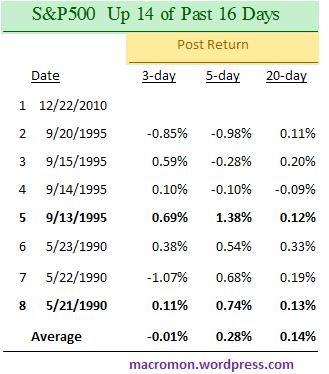
The S&P500 has traded up 14 of the past 16 days, which has happened only seven times in the past twenty-five years.  Dismissing the streaks,  it has only happened twice.   Bespoke, who does great work and to whom we subscribe, beat us to the punch.

Nevertheless,  don’t look for the market to rollover just yet.  History is not on your side.  In fact,  the 5-day post streak return was .74% in “sell in May” 1990 and 1.38% in September 1995,  both poor seasonal months.   We’re overbought, but Santa Claus is coming to town.

Posted in Equities | Tagged , , , | Leave a comment

A spectre is haunting Europe

This is what’s  going to blow up the Europe.   All the cash and backstopping in the world is not going to solve the political problem.   Jim Corr, a member of one of our favorite Irish bands, The Corrs,  nails it at about 2:45 minutes into the interview with Russia TV (RT),

Ultimately, the solution is, the root cause of the problem is we’re not printing our own debt free money. That is what we need to do.   Like Abraham Lincoln’s greenback , we need to get back to printing our own debt free money.   We need to get out of the EU and back into European economic area where we can set our own monetary policy and not be dictated by Brussels in terms of monetary policy that is set up [by] Germany and France to the detriment of other countries in the EU…The Euro should be confined to the dustbin of history, and soon.

Bid adieu to the Euro.   Man, we love The Corrs! Talk about Breathless.

Related Articles
IMF concerned about aid plan if Irish ruling party loses election – Washington Post
Political risks to watch in Western Europe in 2011 – NewsCenter


Posted in Black Swan Watch, Bonds, Budget Deficit, Euro, PIIGS, Sovereign Debt, Sovereign Risk, Video | Tagged , , , , , | Leave a comment

Lumber Rising…….Jobs to Follow?

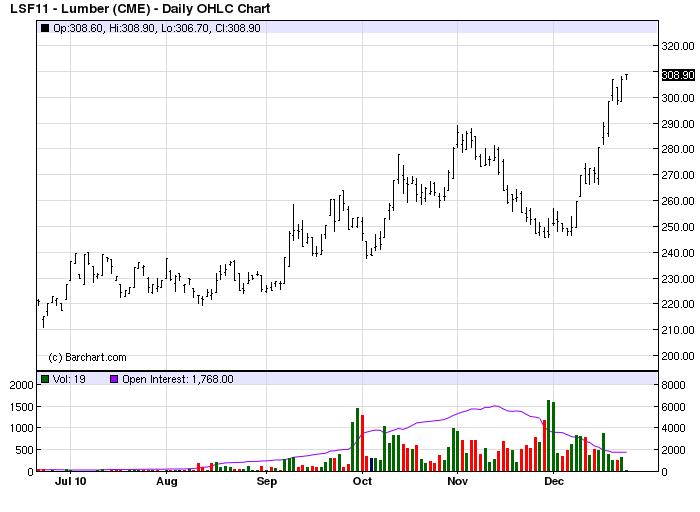
We wrote yesterday of the almost 50 percent increase in lumber prices since mid-June and how it bodes well for the U.S. labor market.  We’ve constructed a cleaner chart to show how nonfarm employment moves with lumber.

Though prices are not driven solely by macro factors, which is illustrated by the noise and volatility of the price series,  they do peak and trough with employment during periods of depressed economic activity.   While the employment data is only observed with a long lag, lumber prices are viewed in real time and can be used as a signal of future trends.    As a leading indicator for housing as well as the economy,  the sharp rebound in lumber prices from the June lows is another hopeful sign the employment situation may be about to improve.  Stay tuned!


Posted in Commodities, Economics | Tagged , , | Leave a comment

Why OPEC should fear $100 plus Crude

This is very cool and the future, in our opinion.   We’re at the elbow of the technological exponential curve and just one key breakthrough in, say, battery technology and it’s off to the races.   What’s coming will be mind blowing.

Almost 75 percent of U.S. crude oil consumption goes for  transportation.   Clinton’s Black Swan was the internet, which saved his Presidency and maybe this will be Obama’s.  Ironically, higher oil prices just may be the catalyst.


Posted in Black Swan Watch, Clean Tech, Video | Tagged , , | 2 Comments

Japan Opposition Plans for “X-day” Bond Crash

Japan’s opposition Liberal Democratic Party (LDP)  says the government’s spending plans increase the risk of a collapse in the country’s bond market.   Bloomberg reports,

“We’re approaching a danger zone where bond prices could plunge,” Yoshimasa Hayashi, the Liberal Democratic Party’s shadow finance minister said in a Dec. 20 interview at his office in Tokyo. “It’s very important to be implementing a fiscal rehabilitation plan by 2012,” when baby boomers born after the war will start receiving state pensions, he said…

The opposition is working on what it calls the “X-Day” project, to fend off a potential bond market rout, said Hayashi, 49, a former Economy Minister…

Bank of Japan Governor Masaaki Shirakawa yesterday warned about risks to the economy from rising bond yield. Benchmark 10- year yields rose more than 40 basis points in the past two months to as high as 1.279 percent. The 10-year, 1.2 percent Japanese government bond was recently trading at 1.145.

Japan finances more than 90 percent of its deficits with domestic savings, the highest of any OECD country.  The problem, however, is Japan’s aging population is beginning consume its stock of savings and will eventually reduce the pool of savings for the bond market, including their appetite for U.S. Treasuries.  In addition,  social expenditures on an aging population are going to increase.

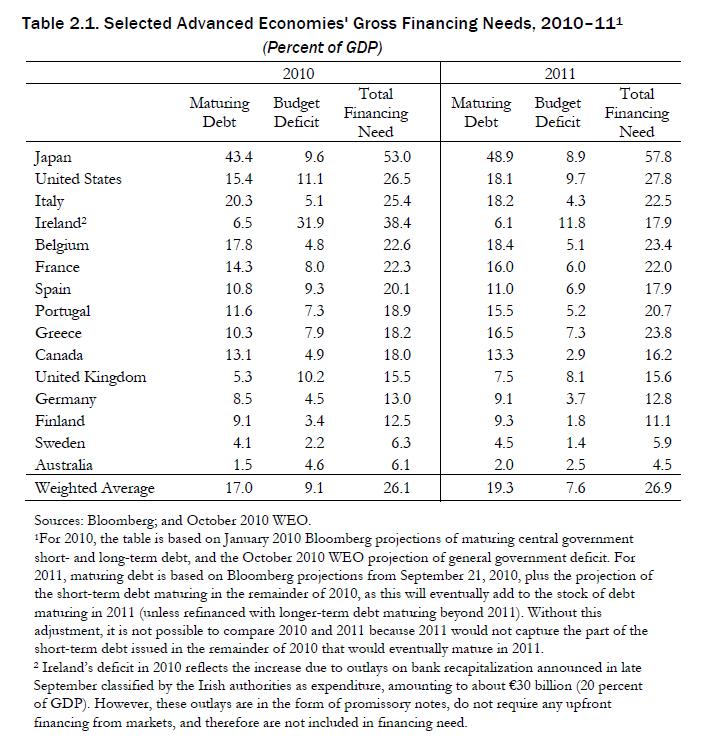
Japan’s 2011 financing needs are almost 60 percent of GDP and we believe the central bank will be forced to monetize a portion of these obligations.   Being long the dollar against the yen is one of our favorite trades for 2011. The risk to the trade is Japan’s strong net international investment position, which could provide a source of funding and as the assets are brought home, the yen would strengthen.

Posted in Black Swan Watch, Bonds, Sovereign Debt, Sovereign Risk | Tagged , , , | 5 Comments

IMF Concludes 403.3 Tonne Gold Sale

The International Monetary Fund announced today they have concluded their sale of 403.3 metric tonnes of gold, which was approved by the Executive Board in September 2009.   From the press release,

These sales are a central element of the new income model for the IMF that was endorsed by the Executive Board in April 2008. They will also increase the Fund’s capacity to support low-income countries under a strategy endorsed by the Board in July 2009 (Press Releases No. 08/74 and No. 09/268). The gold sales were conducted under modalities to safeguard against disruption of the gold market. All gold sales were at market prices, including direct sales to official holders.

The market, including central banks, had no problem hoovering the 400 tonnes, which is about 1/3rd of the gold held by GLD, the Gold EFT holds.  Gold is up almost 50 percent since the sale was announced in September 2009.

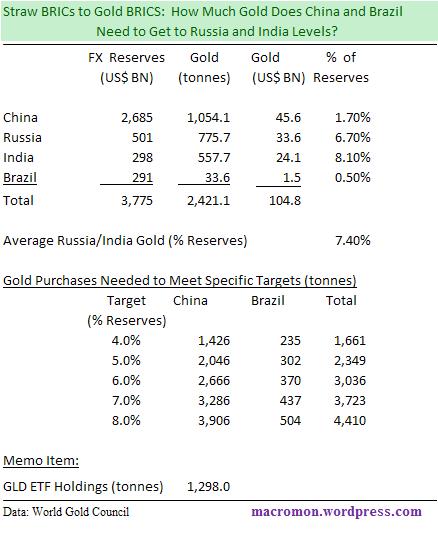
You know our theme for gold is  “Straw BRICS to Gold BRICS,”  where central banks are forced to diversify and reallocate a portion of their massive foreign exchange reserves to gold and not silver! The average official foreign exchange portfolio is allocated 90 percent to the dollar and euro, both, of which, have serious store of value issues.

The following table shows China’s  reserves, and especially Brazil, are significantly under allocated to gold relative to their fellow “Gold” BRICs,”  Russia and India.  The table shows that for China and Brazil to match the Gold BRICs average allocation of 7.4 percent of reserves,  they would have to buy a combined 3.5-4K  tonnes, which is more than 3x the stock of gold  held by the GLD trust.

This is the fundamental reason why gold is so bid, our friends.  No doubt the price will remain volatile,  but the journey north will continue until the U.S. raises interest rates, global capital flows reverse,  and the U.S. current account deficit makes a sustainable improvement.


Posted in BRICs, Gold | Tagged , , , | 3 Comments