Send In The Neocons

Not a surprise, but still troubling.  Totally inconsistent with President Trump’s view on the Iraq War.

Posted in Geopolitical, Politics, Uncategorized | Tagged , , , | Leave a comment

Mr. Market Weakens U.S. Negotiating Position With China

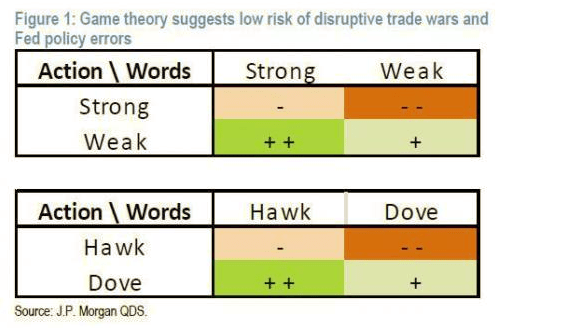
Last week we were thinking about pulling together a post using game theory to predict the outcome of the Trump administration’s tariff announcement.   JP Morgan beat us to it, however.

More interesting is the JPM quant’s assertion that Trump will – or should – avoid launching a trade war at all costs, not least of all because he wants to avoid impeachment, which would be far more likely if Trump “destabilizes global markets” impairing the administration’s ‘market scorecard’ and likely leading to an election loss. And, as Marko adds, “lost elections open a path to impeachment, and other complications.”  – JP Morgan, via Zero Hedge


GameTheory_Mar22

China’s Strategy

There is no doubt, in our opinion,  the Chinese government understands this.  That they have Mr. Market on their side, which will punish President Trump with a bear market if the U.S. takes a hard line and chooses a trade war.   President Trump has tied his success to a soaring stock market.

Today’s 700 plus decline in the Dow is a case in point.  Market volatility dilutes U.S. bargaining power and may make the path to an outcome much more unstable.  Thus more volatility.  A classic feedback loop.     

President Xi may calculate another 3,000 points shaved off the Dow, and the U.S. will capitulate.

We are not so sure this White House,  Mr. Navarro, in particular,  is as rational as JP Morgan believes.  Nor is it so easy to control the genie once she is out of the bottle.

S&P500 Tips Over

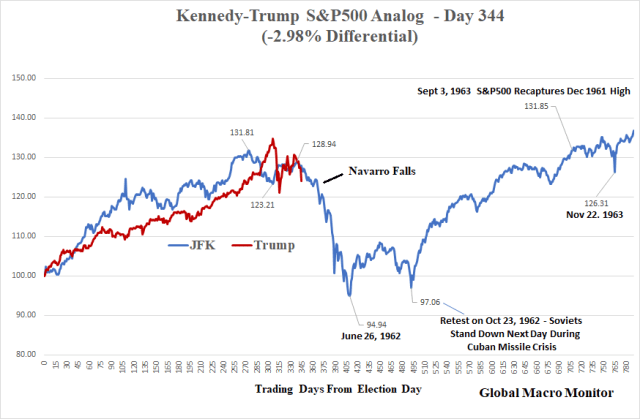
As we suspected, and as our analog instructed,  the S&P500 tipped over the “Navarro Falls” on Monday, and the sell-off got some real legs today.    The JFK-Trump S&P analog continues to track on a directional basis like clockwork with the Trump S&P now almost 3 percent below the JFK S&P 344 trading days after election day.


JFK_Trump_Mar22


The Trade War Nobody Wants

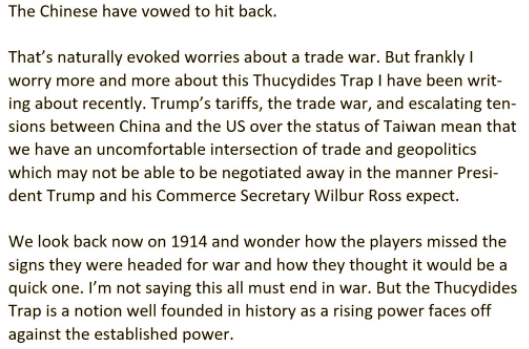
The conventional wisdom of the market pundits is the tariffs are just an opening position, it is all noise, and will be over quickly.  Upon hearing all this we immediately thought it was the same thinking at the beginning of World War I,  the war nobody wanted.

We prepared to write something up, but our good friend, Greg McKenna, down in Australia beat us to the punch.  Here is his profound thinking in the Friday morning commentary.

McKenna_Mar22

Source:  Greg McKenna @gregorymckenna 

That is big thinking, folks.  Greg is one smart dude.

Deep State

We suspect it will not be long before we hear an official pronouncement the “deep state” is behind this sell-off.  In fact, there are already whispers of such in the market.   Just sayin’.


Bears_Mar22


Dollar_Mar22

Posted in China, Equities, Uncategorized | Tagged , , | 21 Comments

The Biggest Risk At The Fed

It is FOMC day, and the committee just raised the Fed Funds rate another 25 bps.

Well, actually, they increased the interest rate on excess reserves (IOER) by 25 bps to target a higher Fed Funds rate.   That is an additional $5.25 billion plus annual interest payment the Fed pays to the banks.

Strange days for monetary policy as the traditional approach to raising interest rates was to drain bank reserves through open market operations, making system liquidity tighter on the margin thus pushing up the Fed Funds rate.  Now they pay banks, add liquidity, to lock up their excess reserves at the Fed.  It is not a certainty banks will follow so the Fed augments the IOER tool with the overnight reverse repurchase agreement (ON RRP).

Orwellian, indeed.  “Tightening Is Easing.”

Policy Mistake Not Our Biggest Concern

Yes, the Fed, like all of us, can’t predict the future, often has the wrong model of the economy, and tends to miss inflection points.  Welcome to the world of forecasting.

Ben S. Bernanke does not think the national housing boom is a bubble that is about to burst, he indicated to Congress last week, just a few days before President Bush nominated him to become the next chairman of the Federal Reserve.

U.S. house prices have risen by nearly 25 percent over the past two years, noted Bernanke, currently chairman of the president’s Council of Economic Advisers, in testimony to Congress’s Joint Economic Committee. But, these increases, he said, “largely reflect strong economic fundamentals,” such as strong growth in jobs, incomes and the number of new households.  –  Washington Post,  October 27, 2005

But this doesn’t concern us as much as the Fed’s independence.

“Just let it rip”

That is we are worried more about the freedom from White House pressure and interference in conducting monetary policy than getting a few bps wrong on the Fed Funds rate.   This is especially true and relevant given the strongman tendencies and  lack of respect for institutional norms of the current president.

Here is Larry Kudlow, the president’s new chief economic adviser:

“Just let it rip, for heaven’s sake,” Kudlow said of economic growth in the U.S., during a more than hour-long interview Wednesday on CNBC. “The market’s going to take care of itself. The whole story’s going to take care of itself. The Fed’s going to do what it has to do, but I hope they don’t overdo it.”  – CNN

We concede that Kudlow may have made this statement before he was seated as N.E.C. chair.

We have not heard this kind of jawboning directed at the Fed from the White House for many years.  Even then, it was only after the president had left office.

WASHINGTON — Former President Bush said in a television interview that he blames Federal Reserve Chairman Alan Greenspan for his 1992 defeat.

“I think that if the interest rates had been lowered more dramatically that I would have been re-elected president because the [economic] recovery that we were in would have been more visible,” Mr. Bush told interviewer David Frost. “I reappointed him, and he disappointed me.”

Mr. Bush’s economic advisers, particularly Treasury Secretary Nicholas Brady, were critical of the Greenspan Fed’s reluctance to cut interest rates more rapidly during the recession of 1990-91 and the sluggish recovery that followed.  – WSJ, August 25, 1998

Political Pressures Will Build

Furthermore,  the administration is going to feel more political pressure from higher interest rates.    Let’s see how it behaves as the Fed continues to ratchet up rates and drains the lifeblood from the stock market.   The Dow Jones has no doubt become the voting machine for the Trump administration

Open Seats On The Federal Reserve

There are also three open seats on the Federal Reserve board, including the vice-chair, assuming Marvin Goodfriend is approved by the Sentate, but we do hear rumblings his confirmation may be in trouble.   Thus, five seats on the FOMC, including the NY Fed President,  are in play for some potential monetary mischief by the administration.

The question now is will Larry Kudlow use a “let it rip” litmus test in nominating future Fed governors?

If Trump wants to get reelected, he should rethink his Federal Reserve picks

If the Senate approves Goodfriend, there will be three more slots to fill on the Fed’s board of governors. Trump should avoid the usual Republican suspects and pick economists who are inclined to vote against rate increases. He can do this in the name of improving his reelection prospects. The rest of us will be happy to see workers get jobs and decent wages.  – Dean Baker,  LA Times,  March 15

Stacking The Deck

That is the larger risk.  The administration attempts to stack the deck  with “let it rip” doves.  Maybe it makes for a short-term sugar high for markets but we suspect the long-term damage of such a move will start to be discounted – an air pocket in the dollar – causing a reduction in the Fed’s credibility and doing structural damage to the U.S. economy.

We have heard nobody, absolutely no one,  bring up this as a potential risk, though concerns have been raised about how slow the administration is moving  in replacing Federal Reserve board seats and the overall inexperience of the new Fed and staff.

But the future of Fed personnel is now uncertain. Trump still has four open board governor seats he could nominate, although he has been especially slow about filling the ranks of presidential appointees. At the same time, the influential New York Fed president post is up for grabs after William Dudley announced his early resignation, and the presidency of the Richmond Fed is also open after the prior president resigned in April due to a leak scandal.  – Business Insider,  November 26

Foreign Worries

We have no doubt foreign holders of U.S. assets, especially fixed-income, are concerned, however.   Foreigners, mainly central banks,  hold over $6 trillion of U.S. Treasury securities.  It could be another reason why the dollar is so weak when it should be strengthening.

Look at today’s price action after the FOMC announcement, where growth was upgraded but not inflation risks.    Maybe they are betting robots will fill the shortage of workers in the construction industry.

Dollar_Mar20

Interesting to hear the spin today:  “It was a dovish hike.”   The conclusion of many only after watching the price action.  This is what we call “retrofitting fundamentals to the price action.”

We have some good friends that deal with foreign investment in U.S. real estate.  They constantly pound us about how their Chinese investors believe the U.S. has a big debt problem, including underfunded pensions, that is going to be monetized and inflated away.   That is why they are buying up U.S. real assets.  Interesting,  and we always keep it on the back of our radar.

When Monetary Hawks Convert To Full Blown Doves

An overly dovish Fed seems to contradict everything that the traditional “hard money” Republican Party,  including “King Dollar” Larry Kudlow and  Under Secretary of the Treasury for International Affairs, David Malpass,  has stood for.

We believe political expediency will trump ideology in this administration, however.

If stocks do enter bear market territory, watch the decibel level  When [the] Doves Cry in the administration.  Will they lean hard on the Fed to ease up?

Then watch how the dollar behaves.  That will provide a signal of Fed credibility and a road map to the future.

Confidence is a very fragile thing as the greatest quarterback in NFL history often says.  The Fed has had the credibility and confidence of markets for almost three decades now, warranted, or not.   Can it endure this administration?

Stay tuned.


Posted in Fed, Monetary Policy, Uncategorized | Tagged , , , | 10 Comments

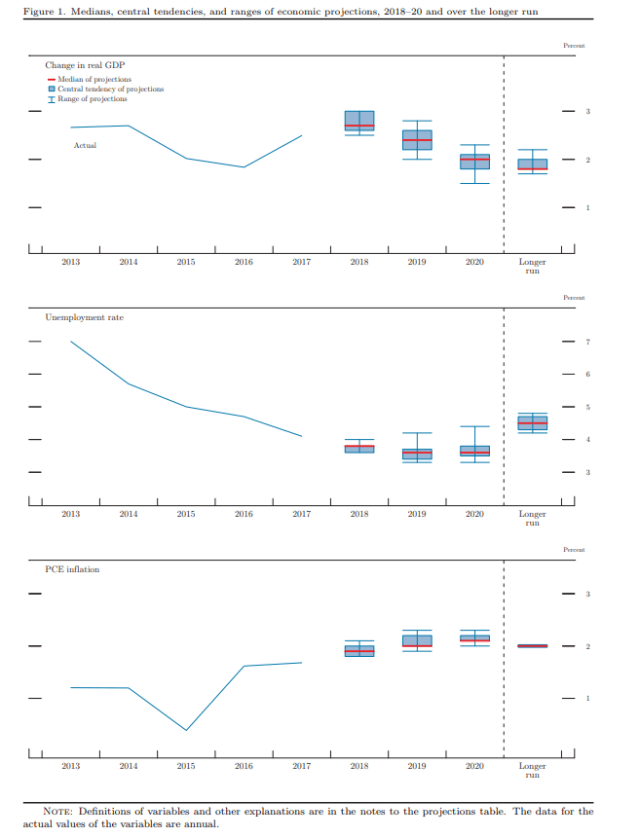
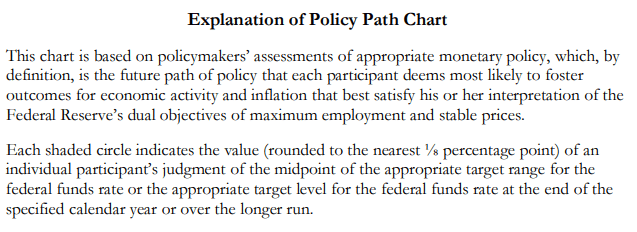
FOMC Dot Plot & Other Data – March 21

FOMC_3_Mar20

FOMC_1_Mar20

FOMC_2_Mar20

FOMC_4_Mar20FOMC_5_Mar20

Posted in Fed, Monetary Policy, Uncategorized | Tagged , , , , | Leave a comment

Federal Reserve issues FOMC statement – March 21

March 21, 2018

Federal Reserve issues FOMC statement

For release at 2:00 p.m. EDT

Information received since the Federal Open Market Committee met in January indicates that the labor market has continued to strengthen and that economic activity has been rising at a moderate rate. Job gains have been strong in recent months, and the unemployment rate has stayed low. Recent data suggest that growth rates of household spending and business fixed investment have moderated from their strong fourth-quarter readings. On a 12-month basis, both overall inflation and inflation for items other than food and energy have continued to run below 2 percent. Market-based measures of inflation compensation have increased in recent months but remain low; survey-based measures of longer-term inflation expectations are little changed, on balance.

Consistent with its statutory mandate, the Committee seeks to foster maximum employment and price stability. The economic outlook has strengthened in recent months. The Committee expects that, with further gradual adjustments in the stance of monetary policy, economic activity will expand at a moderate pace in the medium term and labor market conditions will remain strong. Inflation on a 12-month basis is expected to move up in coming months and to stabilize around the Committee’s 2 percent objective over the medium term. Near-term risks to the economic outlook appear roughly balanced, but the Committee is monitoring inflation developments closely.

In view of realized and expected labor market conditions and inflation, the Committee decided to raise the target range for the federal funds rate to 1-1/2 to 1-3/4 percent. The stance of monetary policy remains accommodative, thereby supporting strong labor market conditions and a sustained return to 2 percent inflation.

In determining the timing and size of future adjustments to the target range for the federal funds rate, the Committee will assess realized and expected economic conditions relative to its objectives of maximum employment and 2 percent inflation. This assessment will take into account a wide range of information, including measures of labor market conditions, indicators of inflation pressures and inflation expectations, and readings on financial and international developments. The Committee will carefully monitor actual and expected inflation developments relative to its symmetric inflation goal. The Committee expects that economic conditions will evolve in a manner that will warrant further gradual increases in the federal funds rate; the federal funds rate is likely to remain, for some time, below levels that are expected to prevail in the longer run. However, the actual path of the federal funds rate will depend on the economic outlook as informed by incoming data.

Voting for the FOMC monetary policy action were Jerome H. Powell, Chairman; William C. Dudley, Vice Chairman; Thomas I. Barkin; Raphael W. Bostic; Lael Brainard; Loretta J. Mester; Randal K. Quarles; and John C. Williams.

Implementation Note issued March 21, 2018

Last Update: March 21, 2018
Posted in Fed, Monetary Policy, Uncategorized | Tagged , , , | Leave a comment

Jack Ma: KFC Reject to Asia’s Richest Man – Bloomberg

Great story.

Jack Ma wasn’t born rich but now he is the richest man in Asia. This Bloomberg profile tells the story of how Ma started as a poor kid in China’s countryside, learned English, got rejected from a job at KFC but then went on to found Alibaba, the massive e-commerce site.

Video by Vicky Feng, Lulu Chen


Posted in China, Uncategorized | Tagged , | Leave a comment

Market Digits You Need To Know…

Running out to passport office and we will be out a few days.  Here are the market data you need to know:

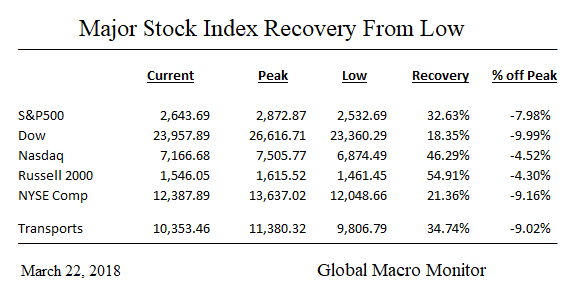
Recovery faltering...

Mar19_recovery

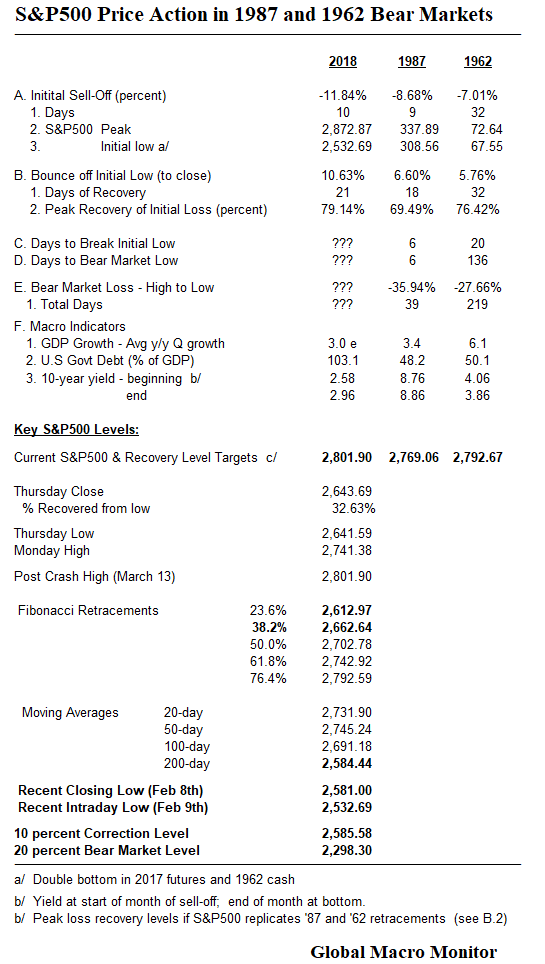
S&P held 100-day moving average and closed above 50% key fibo today.  Put down today’s low and the 100-day as your key marker…


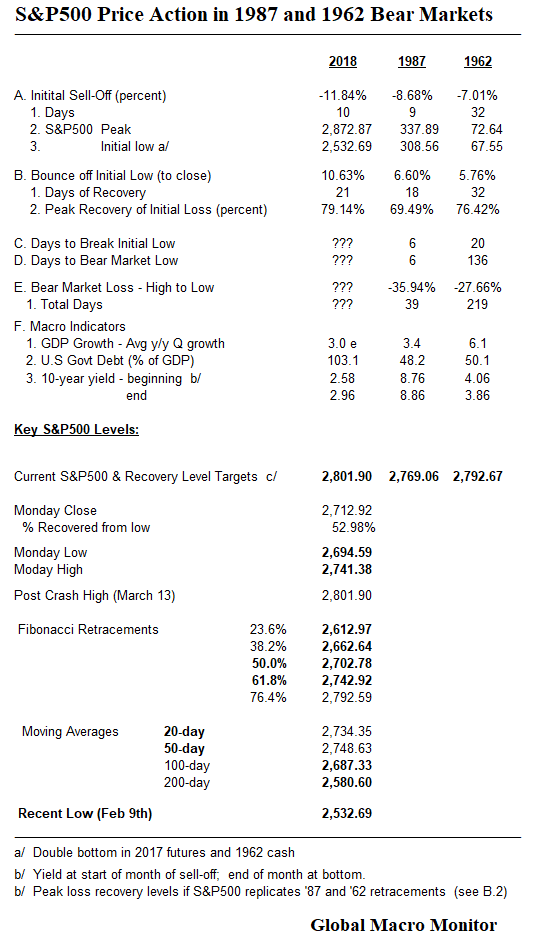
Mar19_bears

Like clockwork,  the S&P500 rolls over just as the analog instructs it should.  Trump S&P now trails JFK S&P by 73 bps, 341 trading days after election day…

S&P500 Analog

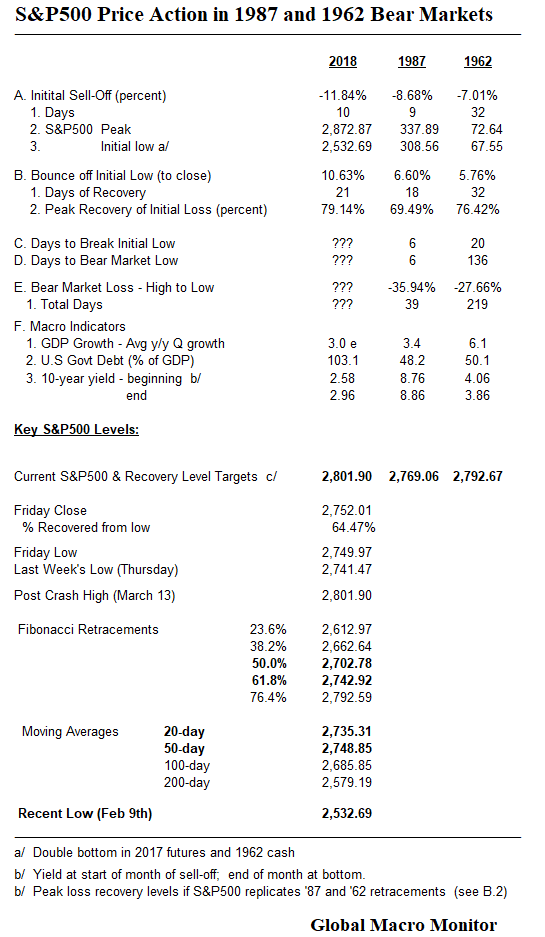
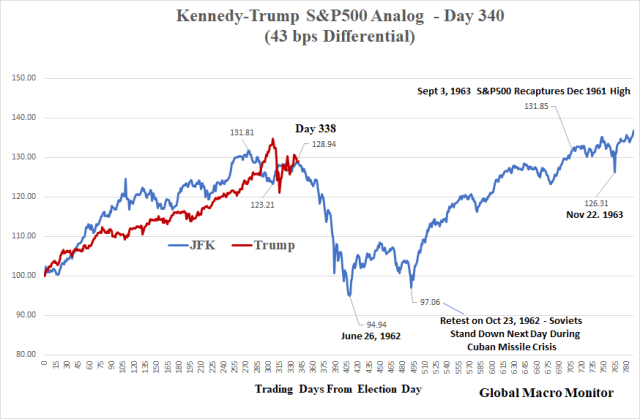
Our JFK-Trump S&P500 continues to track.  We have had some big push back on this analysis, such as:   useless analysis; meaningless correlation;  throw two charts on top of one another, you will always get a good analog.

Let us now push back.   We didn’t invent the analog.  We discovered it through comparing the recent volatility shock to past data.  We found only three comparable periods:  1) 1955:  Eisenhower heart attack, which did not lead to bear market;  2) 1962:  the “Kennedy Slide” or bear market, and 3) 1987:  the October stock market crash.

What caught our eye was the similar big advance in the S&P500 after the JFK and Trump election, which were very close in percentage terms.   They both peaked at a relatively close number of trading days after the election, and the subsequent correction and attempt to get back to new highs have exhibited similar  price patterns.  Of course, the analog does not have daily correlation of 1,  but they do tend to move closely (within a week or two) together on a directional basis, however. 

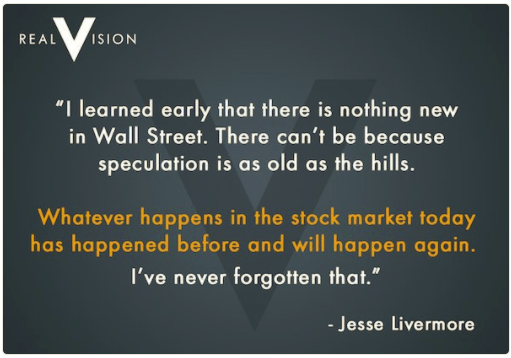
Speculative price action is timeless and should always be studied by any serious market historians, watchers, and analysts.   – GMM, March 18


LivermoreSpecQuote_Mar18


Mar19_analog


Posted in Equities, Uncategorized | Tagged , , | 1 Comment

Why This Correction Is Different

Those dreaded words you never want to hear as an investor, “this time is different.”

Stock and Bond Correlation

It does apply to the latest stock market correction, however.

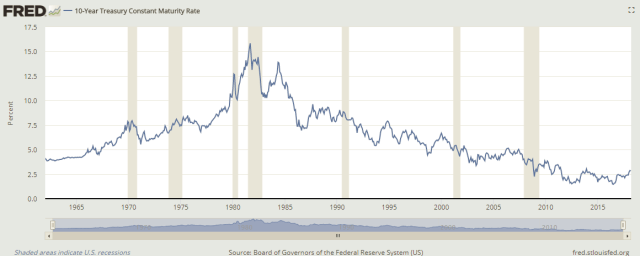
The sell-off that began on January 29th spanned ten trading days and took the S&P500 down 10.2 percent (11.8 percent from intraday high to low), and was the first correction this century that corresponded with a rise in the 10-year Treasury yield.   That is a positive correlation between stocks and bonds to the downside during an official correction.

Moreover, the table below shows there has been only one other correction or bear market in almost 30 years that has seen the 10-year Treasury yield rise.  The correction in 1999 and 41 bps move higher in bond yields was the result of the Fed and market yields rebounding from the sharp drop and overshoot in interest rates during the Russian debt default and LTCM crisis in 1998.

Excluding 1999, a special case, in our opinion, the recent correction was the first that has experienced a simultaneous rise in bond yields since 1990.  Before February for almost 30 years,  bonds have rallied during every stock market correction as a “flight-to-quality” trade.

Debt_BearMakets_Table_Mar18

High Debt Stocks And Rising Rates

What is also remarkable about the rise in rates during the volatility spike is that it coincided with record shorts in bond and note futures.   If past is prologue,  any trader would think the fast money would run to cover their short positions as stock market volatility experienced its largest one-day spike in history.   Rates hardly budged and have traded in 15 bps range since the first day of the sell-off.

The bulls will argue the rise in rates is a positive signal.  That they reflect an economy which is picking up momentum and positive for future earnings.   We do not disagree,  but our bullishness is tempered by the large increase in the stock of debt over the past 20 years.   We believe this is the essence of what is bothering the risk markets.

After all it was not long ago that former Fed Chair, Paul Volcker,  stated that interest rates are not rising because they cannot rise.

Our current debt may be manageable at a time of unprecedentedly low interest rates. But if we let our debt grow, and interest rates normalize, the interest burden alone would choke our budget and squeeze out other essential spending.  – Paul Volcker and Pete Peterson,  Oct 2016

The following table and chart illustrate the change in debt by sector, normalized by GDP,  over the past several years.  The total debt-to-GDP ratio, as measured by the Federal Reserve Flow of Funds data  (Table D.3) currently stands at or near a record high,  2.53 times GDP, up almost 40 percent relative to GDP since the beginning of the century.

The ratio would be much higher if not for the standstill in mortgage debt by households since 2007, as household mortgage debt outstanding  on an absolute basis is below 2007 levels.   Note the massive build in mortgage debt relative to GDP from 2000-07, which was the main culprit of the credit and financial crisis.

Debt to GDP_Sector_Table_Mar18

Crowding Out

The chart illustrates that a debt-to-GDP ratio of 2.5 seems to be some sort of a ceiling.   It could be markets will not allow it to go much higher.   Therefore as the U.S. government further increases its total debt outstanding,  crowding out may ensue restricting further increases in other types of debt.   That appears to be case with mortgage debt.

Debt to GDP_Sector_Mar18

Trump Administration Not Heeding The Warning

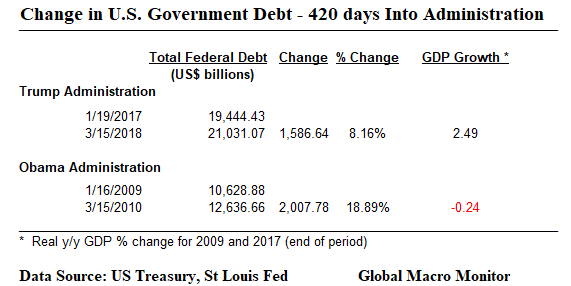
Furthermore,  we just put the following table together, and to our surprise total U.S. public sector (central government) debt stock has increased over $1.5 trillion since the Trump administration took office even as the economy is experiencing some of its highest growth in a decade.

This is only $500 billion lower than the first 400 days of the Obama administration’s increase in the public debt, which took place during a deep recession borderline depression.

If debt expansion cannot be arrested during periods of increased growth, when will it? This, even before considering phase 2 of the tax cuts and the infrastructure deal.

Again, this is the major underlying worry that is nagging global markets as interest rates creep higher, in our opinion.
 

Debt_Ch_Administration_Table_Mar18


Technical Position Of Treasury Market

The current overall technical position of the stock of Treasury securities remains favorable, as the Fed and foreign central banks still control more than half of outstanding marketable notes and bond.    The flow is deteriorating rapidly, however.

The U.S. government financing needs are increasing rapidly, which will result in greater supply in the form of new issuance.   On the demand side,  the Fed is a now a net seller and its supply will also have to absorbed by the price sensitive market.

In addition,  foreign central banks have also been net sellers over the past few months though it appears they did show up at the auctions last week.  This in the context the Fed and foreign central banks have indirectly been the largest financiers of  the U.S. budget deficit over the past ten years.
Debt_Ch_Yield_Mar18

Structural Headwinds

The equity market should continue to struggle to make new highs during this period of monetary contraction.  The funding of the U.S. budget deficits is now more dependent on market forces and is more price sensitive as opposed to the rate insensitive policy dependence, the dynamics which drove the funding of the government over the past ten years.

Granted,  the BoJ and ECB are still injecting liquidity into the global markets,  the hawks will soon be coming from Germany to the ECB, however, and the markets should begin to discount this later in the year.

Who knows what the BoJ will do, but if any country on earth can’t afford higher interest rates, it is Japan.  There is no way out and room for rising rates in the land of the rising sun.   Unless, of course,  they move into full monetization or a BoJ debt jubilee.

Orwellian Monetary Policy –  “Tightening Is Easing”

Thank goodness the U.S. is in a period of Orwellian Monetary Policy,  where monetary tightening is,  in reality,  an easing as the Fed injects liquidity into the system in the form of paying higher interest rates on excess reserves.   Otherwise, liquidity conditions would be growing much tighter.

Interest On Excess Reserves (IOER)
Because of the extremely large amount of excess reserves in the banking system – the liability side of balance sheet expansion —  the Fed no longer uses traditional monetary policy.  The long-standing monetary policy tool prior to the crisis was draining and adding bank reserves through open market operations to control liquidity, the Fed Funds interest rate, and bank credit.

Now, the Fed uses a new tool — interest on excess reserves (IOER) — to tighten monetary policy and raise interest rates.  That is rather than draining it adds liquidity to the financial system in the form of interest payments to the banking system.  – Global Macro Monitor,  May 2017

When Excess Debt Becomes Your Governor

The large stock of global debt in a rising interest rate environment is going to act as governor on both the equity markets and global economic growth.   That was the signal and how we are reading February’s simultaneous rise in bond yields and massive volatility shock.

The U.S. government’s huge and growing budget deficits have become gargantuan enough to threaten the great American growth machine. And Trump’s policies to date—a combination of deep tax cuts and sharp spending increases—are shortening the fuse on that fiscal time bomb, by dramatically widening the already unsustainable gap between revenues and outlays. On our current course, we’re headed for a morass of punitive taxes, puny growth, and stagnant incomes for workers—a future that’s the precise opposite of what Trump champions…

[The Doom Loop]

…as the debt load grows, efforts by the Federal Reserve to stimulate the economy with lower rates would be more likely to feed runaway inflation. “Then, investors will dump Treasuries,” says John Cochrane, an economist at the Hoover Institution. “That will drive rates far higher, and make the budget picture even worse.”  – Fortune, March 15

Time to temper thy short and medium-term bullishness, and be patient for lower prices.


Posted in Bonds, Equities, Fed, Uncategorized | 30 Comments

Week In Review – March 16

Equity markets are still struggling to get back to all-time highs as geopolitical and U.S. domestic political risk is on the rise and growth projections ratchet lower.

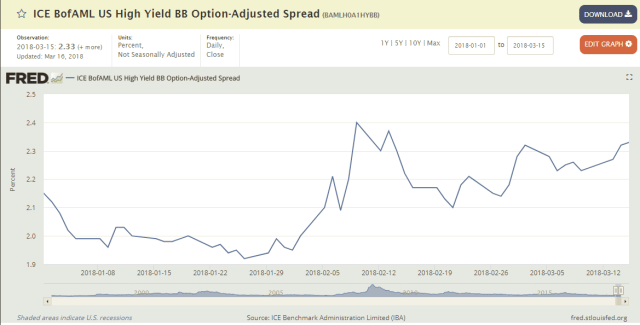
Corporate spreads are blowing out again.

The U.S. 10-year yield is very sticky, in a range of 2.80-2.95 percent.  Surprising given the risk aversion and big shorts in the futures market.  Not surprising given that the Fed has reversed from big buyer to big seller, foreign central banks have been selling, and new supply has increased.

We suspect this coming week will be a critical battle between the bulls and bears as the Fed meets and raises rates by another 25 bps.  The key will be in their forward guidance.

S&P500 Analog

Our JFK-Trump S&P500 continues to track.  We have had some big push back on this analysis, such as:   useless analysis; meaningless correlation;  throw two charts on top of one another, you will always get a good analog.

Let us now push back.   We didn’t invent the analog.  We discovered it through comparing the recent volatility shock to past data.  We found only three comparable periods:  1) 1955:  Eisenhower heart attack, which did not lead to bear market;  2) 1962:  the “Kennedy Slide” or bear market, and 3) 1987:  the October stock market crash.

What caught our eye was the similar big advance in the S&P500 after the JFK and Trump election, which were very close in percentage terms.   They both peaked at a relatively close number of trading days, and the subsequent correction and attempt to get back to new highs have been similar (see table).

Speculative price action is timeless and should always be studied by any serious market watcher or analyst.

LivermoreSpecQuote_Mar18


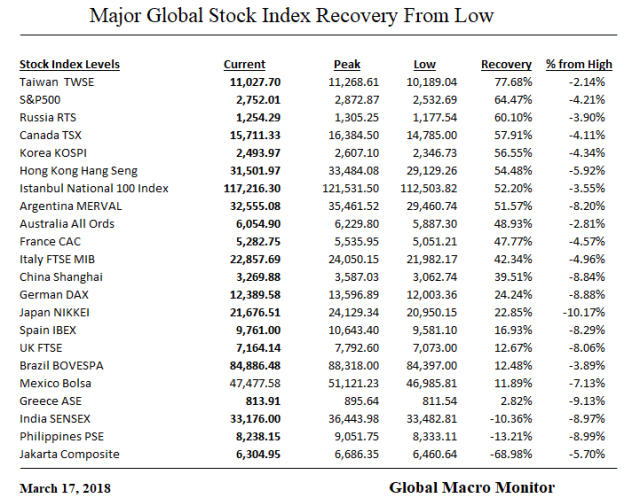
Weekly_Chart_1_Mar18


Weekly_Chart1


Weekly_Chart2


BB_Spread_Mar18


JFK-Trump_Mar18


Week_2018_ETFs


Weekly_Table

Posted in Uncategorized, Week in Review | Tagged , , , , , | 2 Comments

Sector ETF Performance – March 16

ETF_D

ETF_W

ETF_M

ETF_YTD

Posted in Sector ETF Peformance, Uncategorized | Tagged , | Leave a comment