I remember buying a computer for my loft apartment at the Archive in Greenwich Village just to watch the 1997 Mars rover, Sojourner, land, and cruise around the Red Planet. The brand new days of the internet and analog dial-up.
We know one of the NASA engineers who was tasked with building and now monitoring the mechanical arm that will grab rocks from Mars and bring them back on board the Perseverance, which launched last Thursday and is scheduled to land on Mars, February 18, 2021.
The high-tech Mars 2020 rover is about to launch into space (complete with its own helicopter). But how does this one-tonne beast compare to the original, pint-sized rover we sent to Mars in 1997?
Compassionate capitalism is our mantra around but the pandemic has really complicated things, especially when it comes to private property rights. As the pandemic drags on, who is right? Renters or landlords?
Chapter 19 Of U.S. Bankruptcy Code?
We suspect there is going to have to be new and special legislation, maybe adding a Chapter 19 to the U.S. bankruptcy code, to clear the arrears built with rental forbearance. We have friends on both sides, landlords who are not getting paid and renters who cannot afford to pay.
It’s complicated but someone will eventually have to take the hit — that is, the loss of rental income, both from residential and commercial properties.
Our priors are that a big chunk of the stock of rental arrears will find its way back to the banks and the Fed will take it off their balance sheets with the miracle of the digital printing press. Gold, baby!
The real estate lobby is very powerful.
Land Of Make Believe
Stunning, but not surprising, how all these issues have been ignored and swept under the rug. The debts that are accruing and not yet reported are in extend and pretend mode. How the PPP loans are just a hidden form of unemployment insurance and distorting the unemployment rate — keeping the reported data lower than the actual number of unemployed.
We are truly living in the land of “suspended animation.” And, we get it, the policymakers are just plugging holes trying to keep the boat afloat but they do need a long-term comprehensive and bold plan, which addresses both the health and economic crisis.
We suspect one is coming at 12:01 pm Eastern on January 20, 2021.
Left Is Rising
It doesn’t take a genius to figure out which direction the political winds are blowing after viewing the following photo.
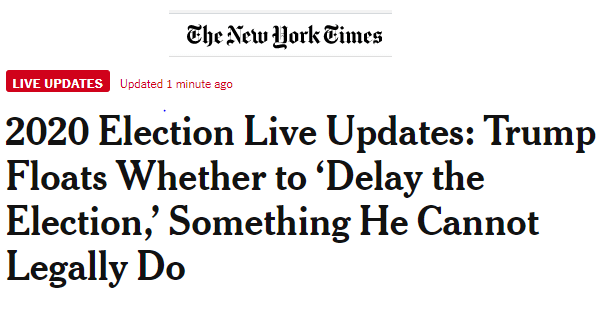
With Universal Mail-In Voting (not Absentee Voting, which is good), 2020 will be the most INACCURATE & FRAUDULENT Election in history. It will be a great embarrassment to the USA. Delay the Election until people can properly, securely and safely vote???
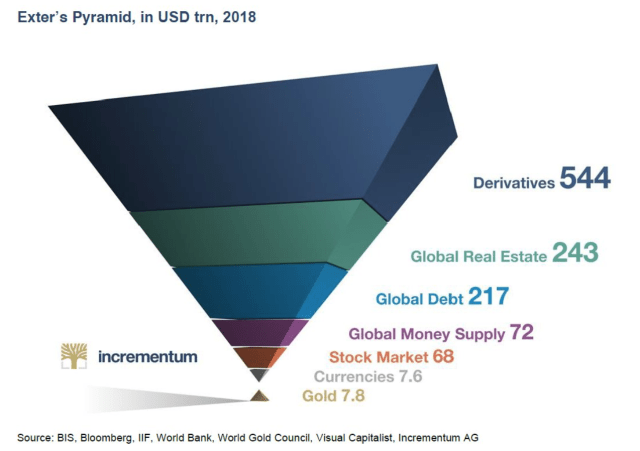
They can be rare—gold bars, diamonds, houses on Victoria Peak, bottles of 1982 Pétrus, Van Gogh paintings, or
They can generate cash flows over time
We have been writing for years how the supply-side (relative shortages) has been increasingly driving financial asset values.
Also, run, don’t walk to our donut shop analogy,
The Local Donut Shop And Financial Asset Inflation
…The Fed, the Brinks Truck, has created a demand and supply shock for chocolate donuts or financial assets. A positive demand shock by handing out cash and injecting more liquidity through its purchases. A negative supply shock by removing chocolate donuts or financial assets from the donut shop and those of the customers in line.
All good until the price of maple donuts begins to rise, especially if some are imported from Canada with a now weaker currency, as the mandate of Brinks company is to maintain a stable price and production of maple donuts. — GMM, July 1st
Check out the following chart. Is it any wonder why gold, now backed by an almost bulletproof story and negative real interest rates, is on a one-way rocket ship ride?
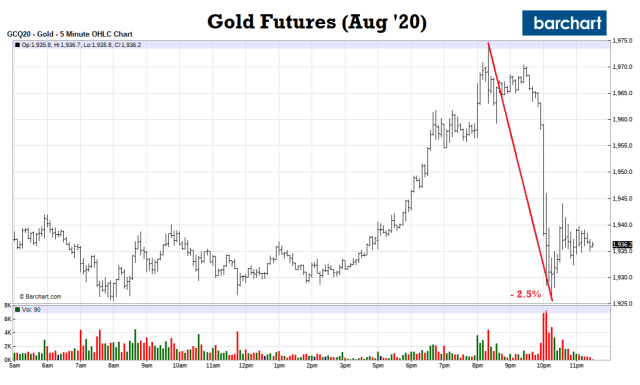
I was just explaining to a close friend earlier today how gold can sometimes be a “Tower of Terror” trade where the bottom falls out of the price for no apparent reason. In addition, the metal is mainly driven by sentiment around a central bank’s long-term resolve and ability to maintain the currency’s purchasing power, which makes gold just a “date” and never a “long-term marriage.”
Gold Is Going Much Higher
Though we do expect this move to be a relatively long and thrilling date, with a not zero probability of morphing into a marriage.
"We find that the Fed will need to provide significant accommodation — roughly equal to a fed funds rate of -5% — and that [quantitative easing] and forward guidance could be insufficient." https://t.co/cm6hCcr7Ah
Before leaving for a walk tonight I see gold futures in Asian trading up to 2 percent after the New York close and fast approaching $2k. I come back and the price had fallen almost $50 from its high trade of $1975, or almost 2 1/2 percent in a little less than two hours.
The yellow metal is pretty overbought here and needs some consolidation before making its next move to $3000.
No Inflation?
Not so fast. There is no credit crunch and it feels, at least to us, there is inflation in the economy. Continued accommodation will result in more inflation and central banks really can’t do a damn thing about it.
This inflationary spike is unprecedented across all comparison years and constitutes more inflation than normally occurs in a year. We show that the increase in prices mainly happened in the first week of the UK’s lockdown (which began on 23 March 2020), and that a key driver was a reduction in the fraction of promotional transactions as retailers cut back on both price promotions and quantity discounts. This fall in promotions contrasts with the Great Recession, during which consumers purchased more on sale (see Griffith et al. 2016 for evidence in the UK, and Nevo and Wong 2019 for the US).
Second, we show that declining product variety strengthens inflation. Typically, inflation between two successive periods is computed by comparing the prices of products available during both periods. However, consumers’ effective cost-of-living is also impacted by the removal or entry of new products; all else equal, if less products are available consumers will be worse off. In Figure 2 we show the evolution in the number of unique products purchased per week in 2020 and in preceding years. Prior to the start of lockdown, and similar to previous years, the number of products sold in each week is stable. However, from the beginning of lockdown, there is a fall of around 8% in the number of products we observe purchased. This points towards a reduction in product variety, which erodes consumers’ effective purchasing power
…What lessons about the dynamics of inflation can be drawn from these findings? Lockdown coincided with unusually high inflation, which was experienced by almost all households and in almost all product categories. This finding is noteworthy given financial markets expect the COVID-19 pandemic to be a disinflationary shock (Broeders et al. 2020). The pervasive nature of the inflation, along with the fact that it is observed even in product categories with declines in output, point toward a risk of stagflation.
It is naturally too early to say for sure whether persistent stagflation will materialise. While the higher price level has persisted for several weeks, the inflation spike coincided with a one-time event, the beginning of lockdown; in addition, we do not observe the entirety of households’ consumption baskets (e.g. rents and services are not included). Nonetheless, it is crucial for central banks, fiscal authorities, and statistical agencies to closely monitor inflation risks going forward. Our work highlights the advantages of real-time scanner data for this purpose. One can track changes in spending patterns for disaggregate products in real-time and observe changes in promotion activity and product variety, all of which are important drivers of inflation and are typically overlooked by statistical agencies. – Voxeu
Yes, the study was done in the UK but the laws of economics know no borders and the thesis rings true in America too.
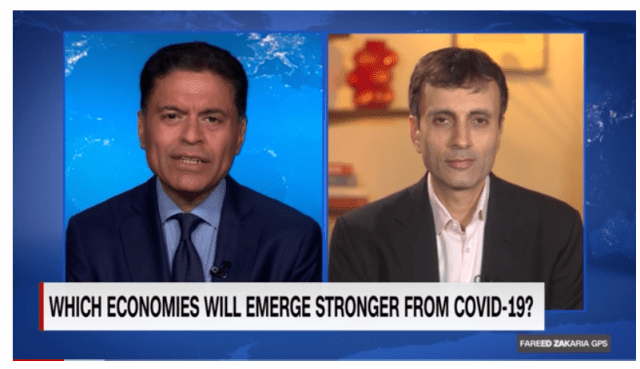
Morgan Stanley’s Ruchir Sharma joins Fareed to grade countries around the world on their responses to Covid-19 and their economic resiliency to the crisis.
Wintley Phipps performs an emotional rendition of Amazing Grace at a ceremony honoring the life and legacy of civil rights icon and Congressman John Lewis in the U.S. Capitol Rotunda. pic.twitter.com/NXELdGSANs
…the whirring of the printing presses. In America, Britain, the euro zone and Japan central banks have created new reserves of money worth some $3.7trn in 2020. Much of this has been used to buy government debt, meaning that central banks are tacitly financing the stimulus. – Economist
Buyers Of Last Resort
Now central banks increasingly have to get their hands dirty on Wall Street and elsewhere by acting as mammoth “market makers of last resort”. – Economist



 The Tower of Terror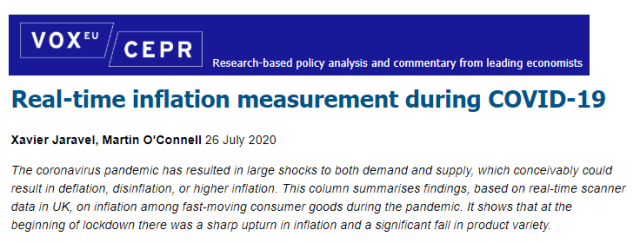



 Global Macro Monitor