
QOTD: Quote of the Day
The truth is incontrovertible. Panic may resent it, ignorance may deride it, malice may distort it, but there it is. — Winston Churchill, HOUSE OF COMMONS, May 17th 1916
QOTD: Quote of the Day
The truth is incontrovertible. Panic may resent it, ignorance may deride it, malice may distort it, but there it is. — Winston Churchill, HOUSE OF COMMONS, May 17th 1916
The ultimate goal of hyperautomation is to automate anything that can be automated, everything from single tasks to entire business operations… Among all trends that we have uncovered over the course of the year, I believe that hyperautomation and autonomous things are the two most crucial trends that businesses shouldn’t ignore… By taking hold of related technologies, businesses can transform and satisfy key performance indicators..It might be hard for us to visualize, but autonomous devices will be much more perceptive and will be able to interact with other devices. — Michael Kung, Tapei Times
Gartner research director of personal technologies Lu Chun-kuan also predicted that AI-related research conducted by businesses would increase 10-fold over the next five years, from an average of three to 30. See full articel at Tapei Times here.
COTD: Chart of the Day
Maybe a bit dated but you get the picture, no surprise, China dominates the supply chain, which also includes fabs. Apple is very exposed to a protracted or forever trade war and deterioration of the global trading system, which of course makes the stock market much more vulnerable to the spectre of anti-globalization haunting the world.

The just-released phone logs in the House Intel report would be a nuclear bombshell and could potentially take down a government. Unless, of course, Rudy is working on a balanced budget amendment with the OMB.

Democracy cannot survive if facts don’t matter. The pols may start repeating propaganda and conspiracies propagated by America’s foreign adversaries. Wait….


…As partisans have drifted apart geographically and ideologically, they’ve become more hostile toward each other. In 1960, less than 5 percent of Democrats and Republicans said they’d be unhappy if their children married someone from the other party; today, 35 percent of Republicans and 45 percent of Democrats would be, according to a recent Public Religion Research Institute/Atlantic poll—far higher than the percentages that object to marriages crossing the boundaries of race and religion. As hostility rises, Americans’ trust in political institutions, and in one another, is declining. A study released by the Pew Research Center in July found that only about half of respondents believed their fellow citizens would accept election results no matter who won. At the fringes, distrust has become centrifugal: Right-wing activists in Texas and left-wing activists in California have revived talk of secession…
What has caused such rancor?
But the biggest driver might be demographic change. The United States is undergoing a transition perhaps no rich and stable democracy has ever experienced: Its historically dominant group is on its way to becoming a political minority—and its minority groups are asserting their co-equal rights and interests. If there are precedents for such a transition, they lie here in the United States, where white Englishmen initially predominated, and the boundaries of the dominant group have been under negotiation ever since. Yet those precedents are hardly comforting. Many of these renegotiations sparked political conflict or open violence, and few were as profound as the one now under way. — The Atlantic
The above is a must-read, folks (click on the link to the Atlantic).
Rather than just momentum and central bank haruspicy — the reading of the Fed’s entrails, for example – there are much bigger forces at work which will determine the future path of asset prices in the long-term. Politics and demographics are a couple of the biggies.
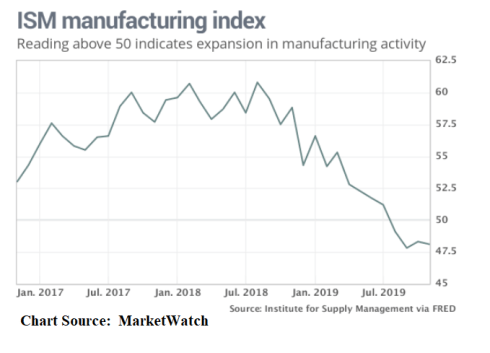
Of the 18 manufacturing industries, five reported growth in November: Apparel, Leather & Allied Products; Food, Beverage & Tobacco Products; Paper Products; Miscellaneous Manufacturing; and Computer & Electronic Products.
(Tempe, Arizona) — Economic activity in the manufacturing sector contracted in November, and the overall economy grew for the 127th consecutive month, say the nation’s supply executives in the latest Manufacturing ISM® Report On Business®.
The report was issued today by Timothy R. Fiore, CPSM, C.P.M., Chair of the Institute for Supply Management® (ISM®) Manufacturing Business Survey Committee: “The November PMI® registered 48.1 percent, a decrease of 0.2 percentage point from the October reading of 48.3 percent. The New Orders Index registered 47.2 percent, a decrease of 1.9 percentage points from the October reading of 49.1 percent. The Production Index registered 49.1 percent, up 2.9 percentage points compared to the October reading of 46.2 percent. The Backlog of Orders Index registered 43 percent, down 1.1 percentage points compared to the October reading of 44.1 percent. The Employment Index registered 46.6 percent, a 1.1-percentage point decrease from the October reading of 47.7 percent. The Supplier Deliveries Index registered 52 percent, a 2.5-percentage point increase from the October reading of 49.5 percent. The Inventories Index registered 45.5 percent, a decrease of 3.4 percentage points from the October reading of 48.9 percent. The Prices Index registered 46.7 percent, a 1.2-percentage point increase from the October reading of 45.5 percent. The New Export Orders Index registered 47.9 percent, a 2.5-percentage point decrease from the October reading of 50.4 percent. The Imports Index registered 48.3 percent, a 3-percentage point increase from the October reading of 45.3 percent. –Institute of Supply Management


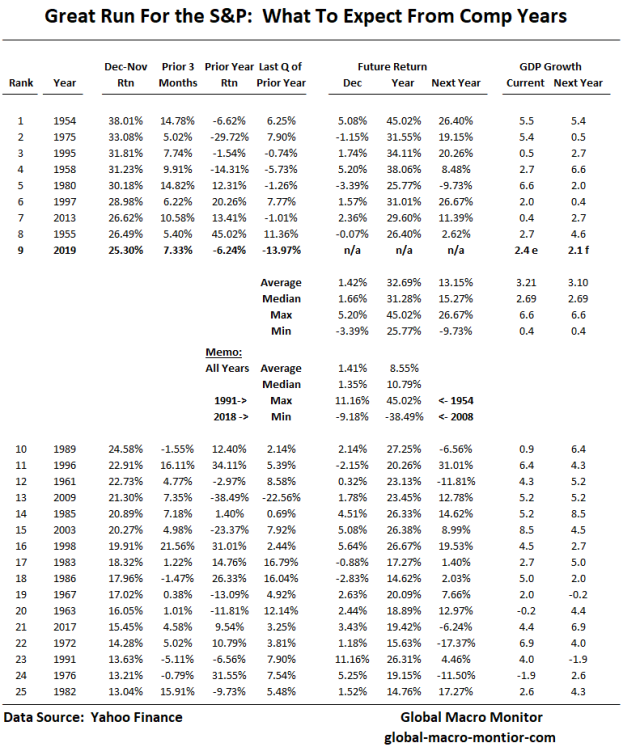
The S&P500 price index is up 25.30 percent going into December, the 9th best performance for the index from January to November since 1950. What makes this year’s rally unique to the prior big years is that it launched from the nastiest Q4 and December, in particular, in the preceding year. So in some sense, much of the rally has been a reflexive bounce back from the crash in Q4 2018 and has also been goosed by the Fed reversal to easing and big repo operations in the money markets.
What to expect in December and next year after such a great run?
We don’t know but do look too similar markets from the past for some guidance. We crunched the data and though past is not always prologue, we do know that the algos look to history for patterns in their predictive analytics and to set trading and market perimeters.
The data show that the S&P return for December in the years with such momentum in the first eleven months average a 1.42 percent, which is almost exactly what the average return is for all the Decembers in the data set (1950-2018).
Next year? The average return for S&P for the proceeding year in the eight years of 26 percent-plus returns from January to November is 13.15 percent, which is about 500 bps above the average return for the S&P for all years.
Valuations
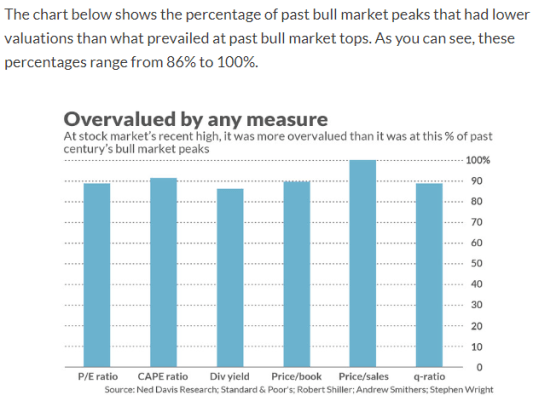
Given that valuations are at, or close to record highs, we suspect the prospective returns that history suggests are a bit too bullish.
Source: Mark Hulbert, MarketWatch
Maybe the inertia and the increasingly positive narrative that “things are turning up” pushes the S&P a bit higher into the New Year, which of course will also be determined by I f the Chinese get their rollback on some tariffs and President Trump does not impose the new round of tariffs scheduled for December 15th.
We are waiting for a better set up to sell this market after getting stopped out at 3125.
Very good discussion on the inequality landscape in the AEs. We know it ain’t no Tik-Tok video but it’s a good investment of your time to learn something more about what is important and going to drive the political economy in the next several years.
(Full session) Lucas Chancel, codirector of the World Inequality Lab and of the World Inequality Database (WID) at the Paris School of Economics, explains that economic inequality is on the rise after a historic decline. Inequality, he says, is now greater within advanced economies than between the world’s rich and poor countries. In a presentation at the conference on “Combating Inequality” at the Peterson Institute for International Economics on Oct. 17-18, 2019, Chancel outlined why racial and gender inequality remains high, how trade and technological advances cannot totally be blamed, and why progressive taxation offers a solution to curbing extreme inequality. He is joined by discussant Peter Diamond (MIT Department of Economics) and chair Adam Posen.
For more details on the event, visit https://www.piie.com/events/combating….


 Global Macro Monitor